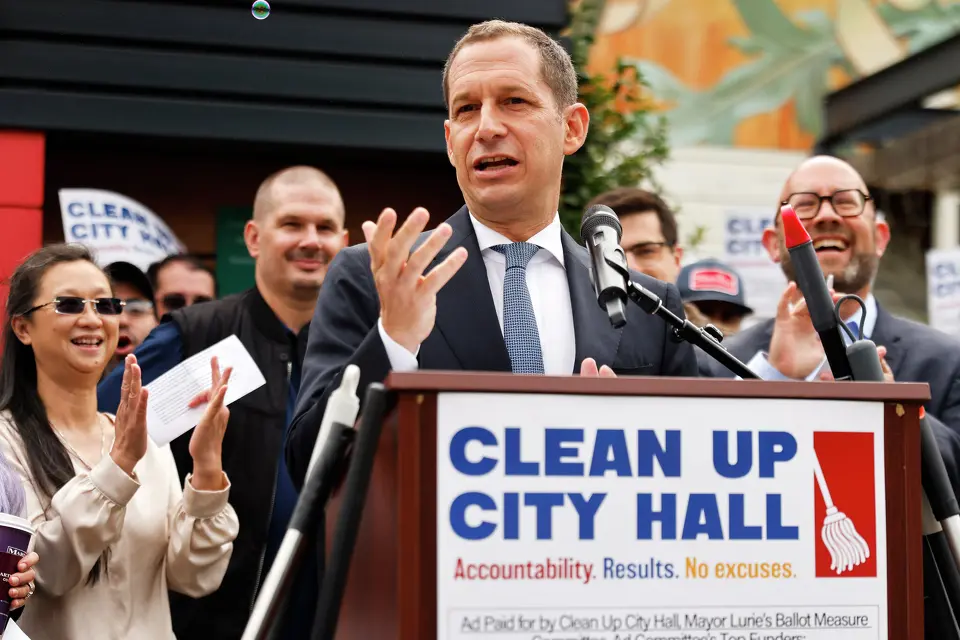

Last week, Mayor Daniel Lurie — who saw fit to tell voters that there was corruption afoot in the City Hall he’s led for nearly two years and a slush fund being run out of his office — held a press conference. Its purpose was to announce his first inchoate steps after voters resoundingly affirmed his Measures D, E and F to address those alleged problems by further centralizing city power.
Prop. E, which empowers City Administrator Carmen Chu’s office, passed with 64% of the vote. Insofar as voters thought about it beyond the mayor’s reductive “Clean up City Hall” messaging, few could argue that the present diffuse contracting and procurement systems are a Swiss watch. The highest high-information voters — current and former City Hall big shots tied to big-money departments that procure cars and trucks and things that go — told me they were comfortable ceding some power to a central authority.
So long as that central authority was Carmen Chu, one of City Hall’s most competent and well-regarded denizens.
And yet it was strange watching Lurie and Chu address the public last week. Because, truth be told, it felt like we were watching two press conferences announcing two different things.
When Chu spoke, she touched on tangible, achievable measures, like “clear rules” and “practical guidance” for the city workers tasked with ensuring San Francisco gets the most bang for its buck. She’s going to write those clear rules. She’s going to provide that practical guidance.
The mayor, however, stuck to his broad preelection mantra about corruption and “insiders” and overpriced toilets and lawbreaking department heads — even though Chu’s forthcoming reforms would not have prevented this city’s $1.7 million Noe Valley commode debacle. Nor would they have reined in an unambiguous criminal like Mohammed Nuru, whose stint in federal prison was not due to a dearth of clear rules or practical guidance.
The mayor’s post-campaign rhetoric is identical to his campaign rhetoric. The mayor, it seems, is never done campaigning.
It was the mayor who chose to hold a campaign rally in front of a toilet. Not Carmen Chu. And it was the mayor who, still, presents the city administrator’s forthcoming legislation as some manner of anti-corruption cudgel.
It really isn’t. While Chu is going to do good and necessary work, Lurie is doing his ablest City Hall colleague no favors by tethering that work to his simplistic and dodgy campaign slogans.

Chu’s initial steps with her newly delivered authority are both more and less than you might have guessed.
No, she is not (yet) wresting away contracting authority from the city’s quasi-independent, big-money “enterprise departments,” which generate their own income by charging for services — outfits like the Public Utilities Commission, Port, Airport and Municipal Transportation Agency. She will not be telling the PUC which type of piping it should buy nor deciding what manner of light-rail vehicles are best for the SFMTA.
Rather, Chu’s next task is to write overarching ethics rules that even these quasi-autonomous, revenue-generating enterprise departments must adhere to. This, by the way, is one of the reasons voters needed to weigh in on Prop. E: The city charter had to be altered to allow Chu’s department to be the One Ring with supreme authority over contracting requirements, imbued with near-unilateral authority to introduce contracting legislation. The charter also needed to be amended to expand the city administrator’s term from five years to 10.
With diffuse contracting authority came diffuse definitions on what you could and could not do. Imagine if drivers had to follow different rules when motoring through various parts of the city. That wouldn’t make much sense. It also doesn’t make much sense that different departments have different definitions of what, exactly, constitutes an improperly split contract to elude competitive bidding rules, or how much information a city official is allowed to share with a prospective vendor vying for a contract. But that’s the way it is.
Chu will address this. We will have one, overarching set of ethics rules regarding contracting instead of what we have now — a patchwork of separate fiefdoms resembling pre-unification Italy. At least when it comes to contracting rules, Chu can be this city’s Garibaldi. And this is just the beginning: Chu will, in time, work to rationalize her sphere of influence in San Francisco.
But not overnight. And let’s be clear about what these first new rules won’t do — namely clean up City Hall.
They will not deter willfully dishonest people. City officials who dish to prospective bidders are likely not doing so out of the goodness of their hearts. It remains to be seen whether the forthcoming new rules deter people who are being dishonest for ostensibly good reasons. City workers have been known to split invoices to avoid reporting thresholds, not only to steal money or pass contracts to their in-laws. Rather, they are trying to avoid paperwork and speed up a cumbersome process (yes, this may be achieved by avoiding competitive bidding, which is problematic). Everybody knows there are rules against this. It still happens.
Perhaps if Chu is successful, the rules will be easy enough to follow that nobody will be tempted to break them for expediency’s sake. If you will it, it is no dream.
The new rules will not deter hardened criminals. Nuru was a five-tool player when it came to municipal corruption. And while he certainly handed out his fair share of rotten no-bid contracts, he also brandished the Hollywood-trope-worthy envelope full of cash and was bribed with the very un-Hollywood-trope-worthy John Deere tractor (it was worth $40,000 and Nuru acknowledged it was “very nice, you know. A modern tractor for sure.”).
Once again, it was not a dearth of clear rules or practical guidance that led Nuru to believe he could disseminate largess in return for agricultural machinery.

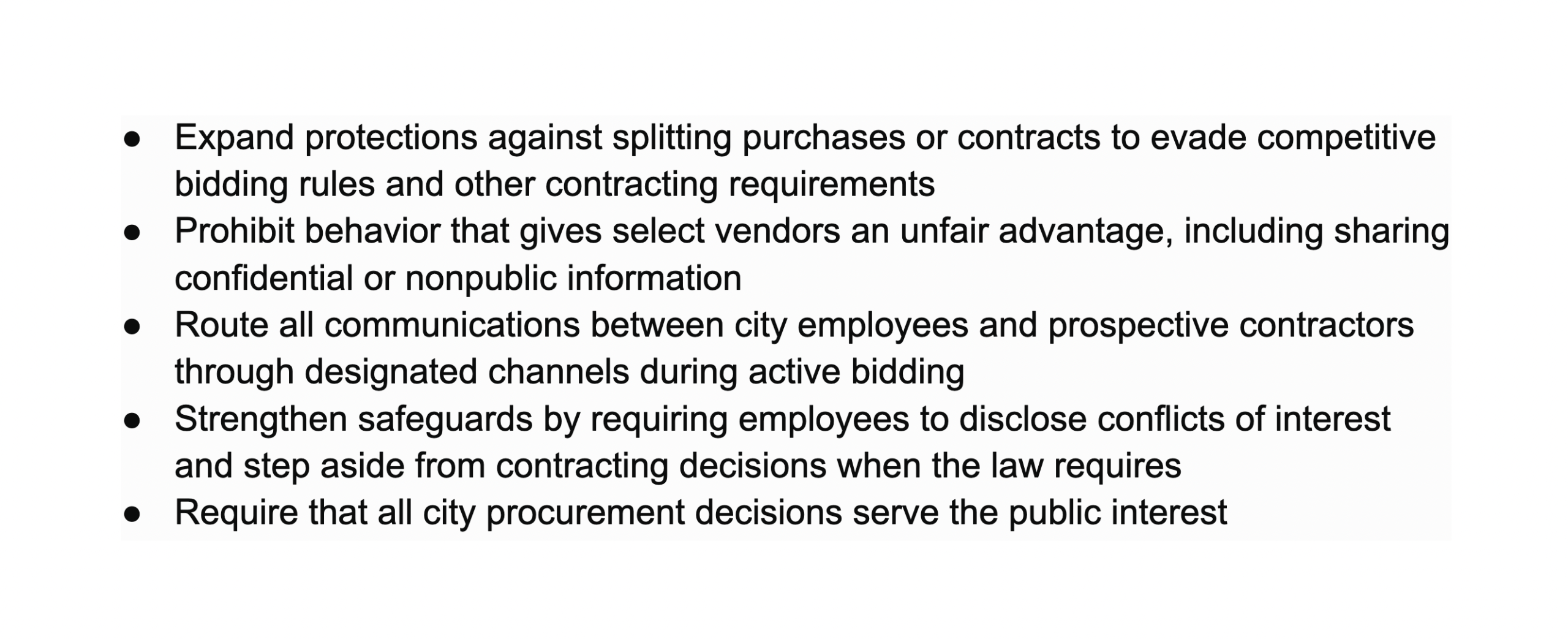
Glancing over the list of goals set out for the forthcoming contracting reform, we’re left scratching our heads a bit. One of those goals is, no joke, “require that all city procurement decisions serve the public interest.” This is a bit like announcing that you intend to outlaw crime.
If a city worker was popped for making procurement decisions that didn’t serve the public interest, do you think they’d say, “Was that wrong? Should I not have done that? I tell ya, I gotta plead ignorance on this thing because if anyone had said anything to me at all when I first started here that that sort of thing was frowned upon … you know, cause I’ve worked in a lot of offices and, I tell ya, people do that all the time.”
Well … you never know. Former controller and PUC general manager Ed Harrington remembers a long-ago situation in which a PUC worker was set to be fired for allegedly stealing copper wire from a wastewater treatment plant. He says she was even caught on video putting it into her car’s trunk. Her response: Was that wrong? Should I not have done that?
Harrington recalls the woman saying she thought it was scrap wire. But there was a training session not long before in which workers were told nobody could take home scrap wire. The worker purportedly said she didn’t attend. But she’d signed in. Very well, she countered, but she was in the back and she didn’t hear anyone say that.
This worker, Harrington recalls, kept her job.
So that’s what this appears to be about. San Francisco’s contracting regulations are onerous and confusing and Chu will simplify them for all the good-faith contracting employees who want to follow the rules — and there are far more good-faith employees than bad-faith ones. But, for the baddies, the rules will now be clear enough that nobody caught breaking them can sidestep accountability with the Was that wrong? defense. That’s what this is about.
It’s not about somehow, via contracting, confronting the fact that 57% of the Noe Valley restroom’s budget — triple the high end of the industry standard — was tied up in interdepartmental soft costs like management and design. That’s a featherbedding issue, not a contracting one.
It’s not about nailing federal criminals like Nuru, who were arrested, prosecuted and incarcerated because what they were doing was already unambiguously illegal.
It’s not even about ensuring future mayor’s offices don’t unilaterally award permitting software contracts without the benefit of a full bidding process to companies whose products perform with the grace and efficiency of a Ford Edsel.
It is an interesting look for this mayor’s office to tub-thump contracting reform. When asked about it, a mayoral spokesperson stated that the city’s budget and legislative analyst found the mayor’s office broke no rules in its unilateral award of a lucrative contract to OpenGov. And this is true. But the move was also found not to “conform to typical City practice or best practice.”
Incidentally, no rules are broken in wearing a loincloth on the 14-Mission or gallivanting barefoot through the Tenderloin. But it does not conform to typical City practice or best practice.
Alas, this, too, will not come under the purview of Chu’s pending legislation. But, you know — perhaps it should.