

A long time ago, in a school not so far, far away, your humble narrator had a job feeding Scantron multiple-choice tests through the grading machine.
The device emitted a telltale click every time it marked a wrong answer. When you ran an ace student’s test through the machine, it would make a pop or two. But, for a particular class clown, God help me, that machine sounded like being strafed by an AK-47 — the audible signifier of a barrage of uninterrupted nonsense.
Sometimes, all these years later, I still hear that staccato burst in my head, unbidden, when reading or hearing the words of certain politicians.
It is surprising — and disappointing — that the most recent politician to induce this unwelcome nostalgia is Mayor Daniel Lurie.
In a joint press release with the police and firefighter unions issued last week, Lurie took aim at Proposition I, an affordable-housing measure.
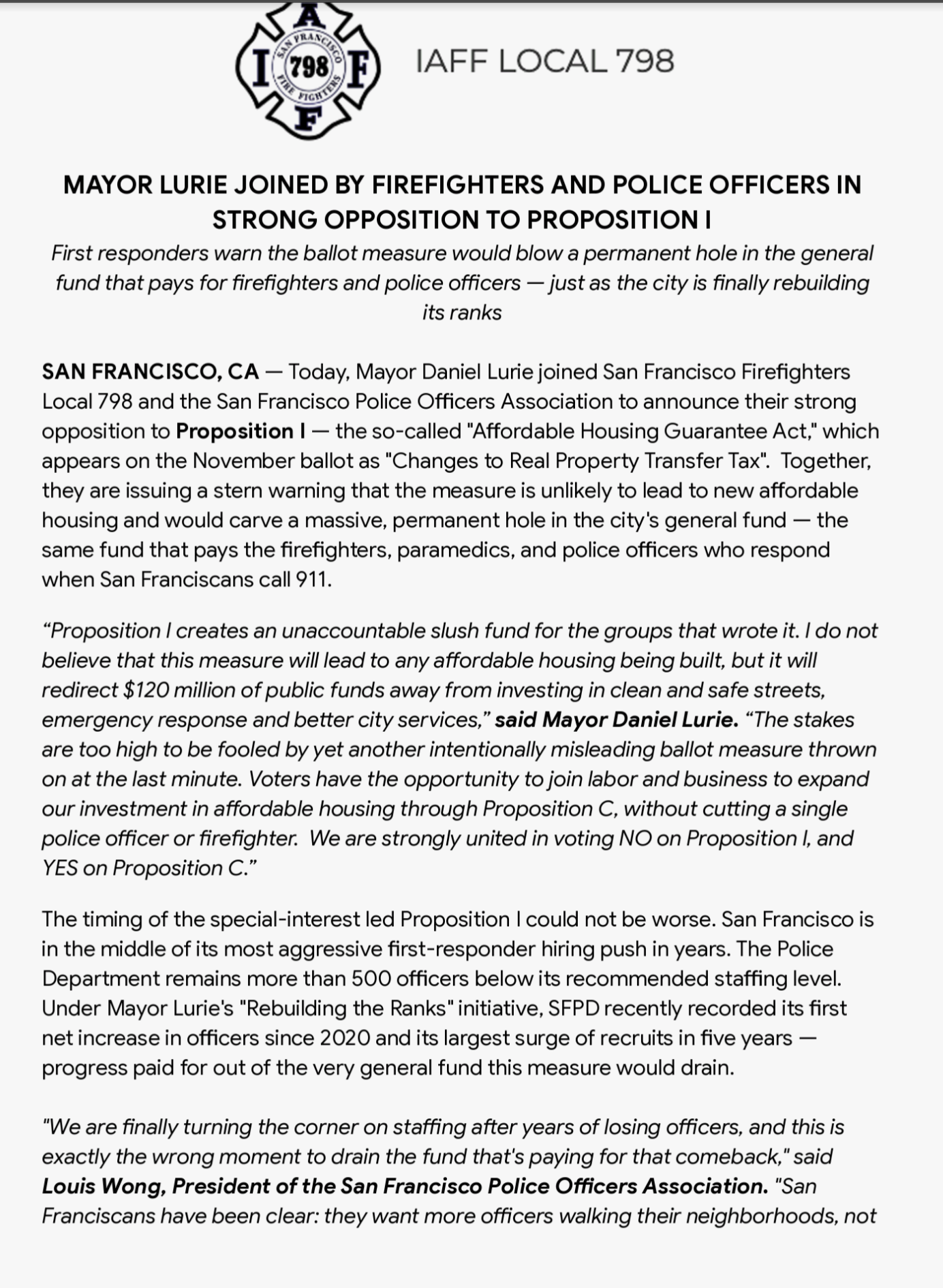
Fair enough: There’s nothing wrong with the mayor opposing this measure, which was signature-gathered onto the ballot largely by the Democratic Socialists of America.
That’s especially the case when his office, labor, the Board of Supervisors, affordable housing developers and others have already created Prop. C, their own deeply negotiated, consensus affordable-housing measure, to bolster the Housing Trust Fund.
Affordable-housing groups wrote the future Prop. I, but dropped it as part of the grand bargain that led to Prop. C. But that deal evidently didn’t apply to every last vestige of the city’s left: Those meddling kids at the DSA picked it up and signature-gathered it onto the ballot, so here we are. Some degree of irritation is understandable.
The issue, however, isn’t with the mayor’s sentiment but his salesmanship. To wit: Lurie described Prop. I as an “unaccountable slush fund.”
Well, that’s odd: The entity responsible for administering the funds amassed by Prop. I would be none other than the Mayor’s Office of Housing and Community Development. Yes, the Mayor’s Office of Housing and Community Development.
Machine-gun noise.
In the press release, Lurie further warned that, if passed, Prop. I would siphon money out of the general fund — money that could, instead, go to recruit and retain police and firefighters.
Again, fair enough, but every voter-approved set-aside — be it for libraries, trees, early childhood education or, in fact, the bolstering of the Housing Trust Fund — reduces the size of the general fund.
But it took particular chutzpah for Lurie to lament the loss of these specific dollars. Because, in February, he also proposed doing away with them.
Rather than sucking them out of the general fund to ostensibly fund affordable housing, he proposed to simply eliminate them altogether as a tax break for sellers of property valued at $10 million or more. This is a group we could, by way of shorthand, refer to as the wealthy.
Machine gun noise.

It’s not problematic for Lurie, or anyone, to object to Prop. I. But it is deeply problematic — and irresponsible — for anyone, let alone the mayor, to claim that an “unaccountable slush fund” is being run out of the mayor’s office.
The Mayor’s Office of Housing and Community Development has a longstanding reputation for monomaniacal scrutiny over its monetary distributions. Its present director, Dan Adams, is a highly regarded public servant.
“Anyone who thinks money controlled by MOHCD is a slush fund never tried to get blood out of a stone or a dollar out of MOHCD,” summed up a longtime affordable housing developer. “The level of scrutiny and oversight and second-guessing of developers is epic before they release any funds.”
Adds another, “They run a tight ship, they are good at what they do, and they do the mayor’s bidding.”
“There are all kinds of good or bad reasons you might be for or against” Prop. I, notes former longtime city controller Ed Harrington. “But it’s not a slush fund.”
Slush funds, he continues, require some degree of clandestine secrecy, like the one former Public Works director Mohammed Nuru gleaned from Recology, parked in the Parks Alliance, and tapped to underwrite lavish, liquor-fueled parties.
A ballot measure voted on by the people, administered by the mayor’s office — and subject to mandatory yearly audits — is not quite the same.
With so much of San Francisco government being both practiced and received at a superficial level, it is deeply unfortunate that the mayor is telling voters there’s a slush fund being run out of his office.
Lurie has a small army of smart political people working for him 24/7/365, but this doesn’t seem like a great way to convince voters to give money to ailing transit agencies — or, for that matter, pass a separate affordable housing measure (which aims to do some of the very same things, is pushed by some of the very same people and would also be administered by the Mayor’s Office of Housing and Community Development).
Team Lurie is confident that the mayor is so popular and voters are so enthused with the city’s trajectory that they will dutifully enact his specific desires on the forthcoming ballot. Lurie’s strategists have been right before, and they will probably be right again. Regardless, sowing voter nihilism via ludicrous statements only makes the general public dumber and more cynical.
Why is this happening? In a word: Money. In another word: Control.

Giving the backstory for how things in San Francisco got to be the way they are always feels a bit like the scene in “Henry V” laying out the king’s convoluted and tenuous claim to the French throne. It’s difficult, even tedious, but know this: It reliably culminates in bloody constraint.
Once more unto the breach, dear friends: In 2020, voters passed Supervisor Dean Preston’s measure, which was, cosmically, also called Prop. I. It doubled the “transfer tax” imposed upon sellers of properties valued at $10 million or more, with the windfall intended to go to affordable housing.
But, due to the prevailing legal opinion at the time, the money was not mandated to go to affordable housing, and Mayor London Breed subsequently directed the funds as she saw fit.
In March 2024, voters approved a measure meant to ease the conversion of offices to housing, an intuitive thing to do in San Francisco’s hollowed-out downtown. Within that measure, however, was a clause allowing the Board of Supervisors to adjust the transfer tax rate, not the voters.
And that’s key. Prop. I raised hundreds of millions of dollars for San Francisco, but the city’s unionized building trades have always loathed it, accusing Prop. I of “freezing the pipeline” and depriving its workforce of the jobs they would’ve had on big buildings after they’d changed hands.
Earlier this year, Lurie and Supervisor Bilal Mahmood rolled out a proposal to undo Preston’s 2020 measure and roll back the city’s high transfer tax rate, a gift for wealthy real-estate interests, but also a move intended to spur building sales and property tax reassessments, and goose construction work and development.
Lurie and Mahmood shelved their proposal in June: They didn’t have the votes on the board to pass it. But if Lurie’s desired supervisors win in November, those votes could materialize, and the transfer tax could be reduced. But, here’s the thing: not if Prop. I wins. Prop. I would put the transfer tax rate back under the purview of voters.
So, in large part, that’s what this is about. Lurie wants the flexibility to lower the city’s highest-in-the-realm transfer tax rate without going to voters. And the proponents of the original Prop. I of 2020 want voters to lock this high tax rate in — and, this time, officially direct the funds into producing, preserving and protecting affordable housing.
This is why everybody is kung-fu fighting.
In light of the above, what Prop. I would actually do feels a bit like an afterthought. But the mayor’s people are rankled about that, too.
During the ballot simplification committee process, the mayor’s office unsuccessfully tried to strip the term “affordable housing” off Prop. I (it polls well) and replace it with “alternative housing” or “social housing” (people don’t know what the hell that means).
Mayoral allies complain that Prop. I isn’t really an affordable-housing measure and is, rather, a Trojan Horse for social housing. But this is a semantic failure. Social housing — not-for-profit residences owned by the government or another organization, permanently off the speculative market and rented or sold to low- or middle-income people — is a form of affordable housing.
The city’s fervent pro-housing activists, incidentally, are not reflexively turned off by funding social housing: “Social housing is cool,” said Laura Foote, the executive director of YIMBY Action.
“Don’t threaten me with a good time,” added Jane Natoli, the organization’s former Bay Area director.
But the mayor’s complaint that Prop. I is unwieldy and highly proscriptive is not unwarranted.
Some 30 percent of its funds — likely scores of millions of dollars yearly — are mandated to be directed not just to social housing but social housing in which “residents shall have the right to participate directly and meaningfully in decision-making concerning the operation and management of the project.”
This is a model that housing professionals warn is extremely difficult to pull off, especially via top-down government initiative. It has been problematic in the past, as low-income tenants, intuitively, are loath to vote against their own economic self-interest to raise rents and take on deferred maintenance and other eventualities; even rich people don’t want to do that.
The Mayor’s Office of Housing and Community Development would be pressed to foster a type of housing that has often proved infeasible. But, because MOHCD isn’t a slush fund and because the mayor’s office unilaterally controls disbursements — Prop. I, praise the Lord, does not call for a committee — what might happen instead?
That’s difficult to foresee, but, if Prop. I passes, a good deal of money may end up directed to keeping low-income people in their homes and improving the woeful conditions at city co-ops. It’s hard to say either of these things are bad per se, but they aren’t necessarily affordable housing production.
We’ll write more about this as November approaches. Until then, we’re sure that the political discourse will be nuanced, truthful and respectful.
Machine gun noise.
I assumed Prop I was a response to the contention surrounding the use of Prop C funds in recent years. But in any case, as you note, Prop I is bad policy and the slush fund message is just a political shorthand to convey that it’s being championed by people who want guaranteed access to those moneys – which is absolutely the case. The fact of the matter is that irrespective of how MOHCD sits within the administrative structure of City Hall, that money is not within the mayor’s control when it’s locked up behind statutory set asides. Every budget cycle we lament the dearth of discretionary money in the general fund. How does Propel’s measure improve that situation? But I need to look into it further.
Lurie is lowkey a Republican
Lurie funnels money to the rapist-protecting cops in the SFPD union. Lurie wants your tax dollars to give cops raises as they fail to investigate rape.
Don’t trust Lurie, or anyone else who protects rapists.
“In 2020, voters passed Supervisor Dean Preston’s measure, which was, cosmically, also called Prop. I. It doubled the “transfer tax” imposed upon sellers of properties valued at $10 million or more, with the windfall intended to go to affordable housing.
But, due to the prevailing legal opinion at the time, the money was not mandated to go to affordable housing — and Mayor London Breed subsequently directed the funds as she saw fit.”
Preston tried to have his cake and eat it too. He wanted the threshold for Prop I to win to be only 50% plus 1. The problem with that is that it means the money can only go to the General Fund. It cannot be earmarked for a specific use.
If instead Preston had wanted those funds dedicated only to affordable housing, then he should have phrased the proposition such that it needed two thirds to pass.
So Breed and Lurie were perfectly entitled to spend the revenues on whatever they wanted. If Preston or the voters thought that money was “intended” or “mandated” for affordable housing, then they were just plain misguided and wrong.
This is a common misconception. The legal opinion at the time was that you couldn’t mandate it go to affordable housing with *any* percentage. The two-thirds requirement was a different thing that was overturned by a 2018 court case.
In any event, it’s water under the bridge now because by voting Yes on 2026 Prop I we can deliver on that intent and guarantee the funds for affordable housing! It also waives the tax for first sale of new multifamily construction to make sure it doesn’t impact growth.
Except that the new Prop I is probably going to lose.
I have no problem with the Mayor using his judgement and expertise to determine how much money is allocated to subsidized housing. Prioritization of funding is a key responsibility of his office.
“His judgement and expertise” doing what? Running a big money non-profit with little in the way of actual deliverables with regard to expanding housing?
More like having seen how MEDA shat the bed with maintenance on small sites, requiring a $80m+ bail out, I’d imagine they’re pumping the breaks on affordable housing strategies that can’t scale.
I find it pretty ironic that you note most voters don’t know what social housing means when it’s featured very heavily in the prop I messaging. Seems like a failure by the props backers to properly educate the electorate on what their policies are.
Affordable housing polls well bc it doesn’t really mean anything. Like Trump saying he’ll make America great. We’ll make housing that’s affordable. End of the day someone’s gotta make payroll to construct and maintain the buildings.
Prop I will deliver affordable housing without raising taxes, I’m all in. Vote Yes on Prop I! Also seeing a lot of confusion and some blatant misinformation in this thread, encourage yall to check out https://yesonisf.com for the info from advocates involved with the measure.
Bruce Lee I’ll kick my own ass
The big mistake of Prop I is taxing unsubsidized rental apartments to pay for subsidized rental apartments, boosting rents for all but the few who win one of the application lotteries.
If that’s your concern with 2020 Prop I, I have great news about 2026 Prop I! It waives the tax for the first sale of newly built apartments to ensure that there is no disincentive to construction. According to the Controller’s estimate, more than 99% of the revenue from this tax currently comes from sales of properties that are not new housing, like skyscrapers, mega mansions, and offices. Keeping that part of the tax in place is a win-win that guarantees funding for desperately needed affordable housing without impacting new unsubsidized housing.
MOHCD does good work and I want affordable housing funded. I can’t believe the mayor would attack his own city workers like that. No wonder SEIU 1021 endorsed Prop I.
for you yimby folks: Let’s say ABC, Inc buys a property. The seller pays the existing transfer tax, not ABC. They then construct a new building on that property. When completed, they sell it whole or in units within 5 years. Those sales are *currently* subject to a transfer tax paid by ABC, Inc. **THAT** is a substantial cost for new development and taken into consideration when calculating the potential net proift of their investment. Prop I absolves them of **ALL THAT** and makes their transfer tax liability ZERO. On the other hand, it doubles the cost paid by the initial seller. So if you OWN an old property worth 10M you pay twice as much transfer tax when you sell. But they can EASILY build that into a sales contract, meaning ABC can literally pay the original transfer tax, calculated at the base value of the dirt, for their ENTIRE construction project. (I’ve bought and sold prop in SF. Trust me, there are tons of crazy deals made to cover costs. This will be on the table immediately)
Just so you’re clear, being against Prop I means that you choose to cut the profit margin of companies building new buildings. Being in support of it means you’re willing to trade a massive amount of tax revenue for new housing (of any sort, whether luxury condos or affordable rental buildings)
So the Council of Community Housing Organizations uses public tax dollars to propagandize in support of ballot measures to raise the transfer tax to direct more public money to them and the mayor refused to do this.
Then the CCHO runs another ballot measure to make that tax a special tax that can only be used for projects like CCHO member nonprofits build.
CCHO did not include commission oversight over affordable housing expenditures to ensure sunshine over grant making. I wonder why “progressives” would want affordable housing multimillion dollar grant making to happen in secret?
Are we expected to ignore the massive ethical conflicts of interest here and presume that all is well and that this is not a slush fund because “Affordable Housing (TM)?”
CCHO has adroitly exploited the desire of voters for housing affordability, broadly construed in a bait and switch move that construes that as demanding Affordable Housing (TM), the widgets that CCHO builds.
Contrast these means tested drops in the bucket with Mamdani’s universal affordability agenda that wins elections.
Their greed to service their addiction to tax dollars, exemplified by skyrocketing nonprofit developer ED salaries, has pulled a scorching backlash to shut down signature petition ballot measures moving forward.
This is nothing new. Over the past 20 yr, housing and homeless nonprofits have centered their funding at the expense of the rest of the progressive agenda which had been summarily jettisoned. This anorexic politics does not represent public priorities and is not viewed by today’s SF voters as being politically responsive.
Their addiction to public dollars warps their perspective so much that they think that forcing a strong mayor with unitary budgetary authority to spend tax dollars with their agencies is a good idea.
Antagonizing a strong mayor like this from a position of weakness will only pour even more fuel on the backlash.
San Francisco would do well to dispense with CCHO, SFIC and their member nonprofit developers, and just contract with private developers to build publicly financed housing.
I’ve no love lost with market rate developers, but all things said and done, they are on average less corrupt than the CCHO grift machine that will never, ever scale to make a dent in housing affordability.
Hey Marc, Prop I has a wide range of supporters including labor, small business, and neighborhood and community groups listed on https://yesonisf.com/endorsements. It’s wonderful that CCHO recently chose to join the endorsers, as announced last week, but they did not write the measure nor are running the campaign. The Mayor’s Office of Housing is required to spend the money on affordable housing in general, and no specific nonprofit or set of nonprofits is privileged in any way. There is no conspiracy here — just neighbors working to hold City Hall accountable on building affordable housing to keep our city inclusive and thriving.
Ten years after we co-founded the SFCLT, you became a YIMBY.
Now, you expect to lead on what you think is progressive housing policy.
You really need to take a seat.
Wait! Are you defending King Charles VI? Despite what Shakespeare has to say about it, Henry’s arguments were as straight forward and forceful as his military campaign. The Brits won. Move on.
The absolutely most expensive housing to produce is (so-called) “Affordable Housing”.
Currently, at well over $1 million per average unit, the system we have in place is a massive grift with all manner of players with their fingers in the till.
The ill-conceived Prop C (the so-called “mansion tax” — which actually thwarts the creation of apartment buildings!) — and now Prop I aid and abet this massively inefficient, corrupt and wasteful system — so, most certainly, the latter creates a dedicated “slush fund” to continue with this unsustainable idiocy.
Affordable housing at $1m/unit is not the most expensive housing to produce.
The cost per unit to build Millennium tower was $835,000 in 2013. Adjusted for inflation into 2026 USD, the cost per unit was $1,210,793.51.
The average unit size in the Millennium Tower is ≈1450 sf.
The average unit size in the 730 Stanyan project is ≈675 sf.
Per your own (inflation-adjusted) analysis, the average production cost per unit in the Millennium Tower was ≈$1.22 Million — resulting in cost per square foot of ≈$841.
Per the developers CTCAC filing, the average production cost per unit in the 730 Stanyan project was ≈1.02 Million — resulting in a cost per square foot of ≈$1,511.
Accordingly, on a per square foot basis, it cost a whopping ≈79% more to create the “affordable” 730 Stanyan project than to create the “luxury” Millennium Tower project.
Note: Both projects were built with union labor.
The usual YIMBY changing of the goalposts.
You know that the cost differential on Affordable Housing (TM) is that they have to build it out to incorporate wrap around services which the nonprofits can monetize over time.
Above and beyond self serving nonprofit corruption, smaller units increases the count per lot area which means more unit infrastructure like fixtures which increases cost per square foot. More kitchens and bathrooms increases costs PSF.