

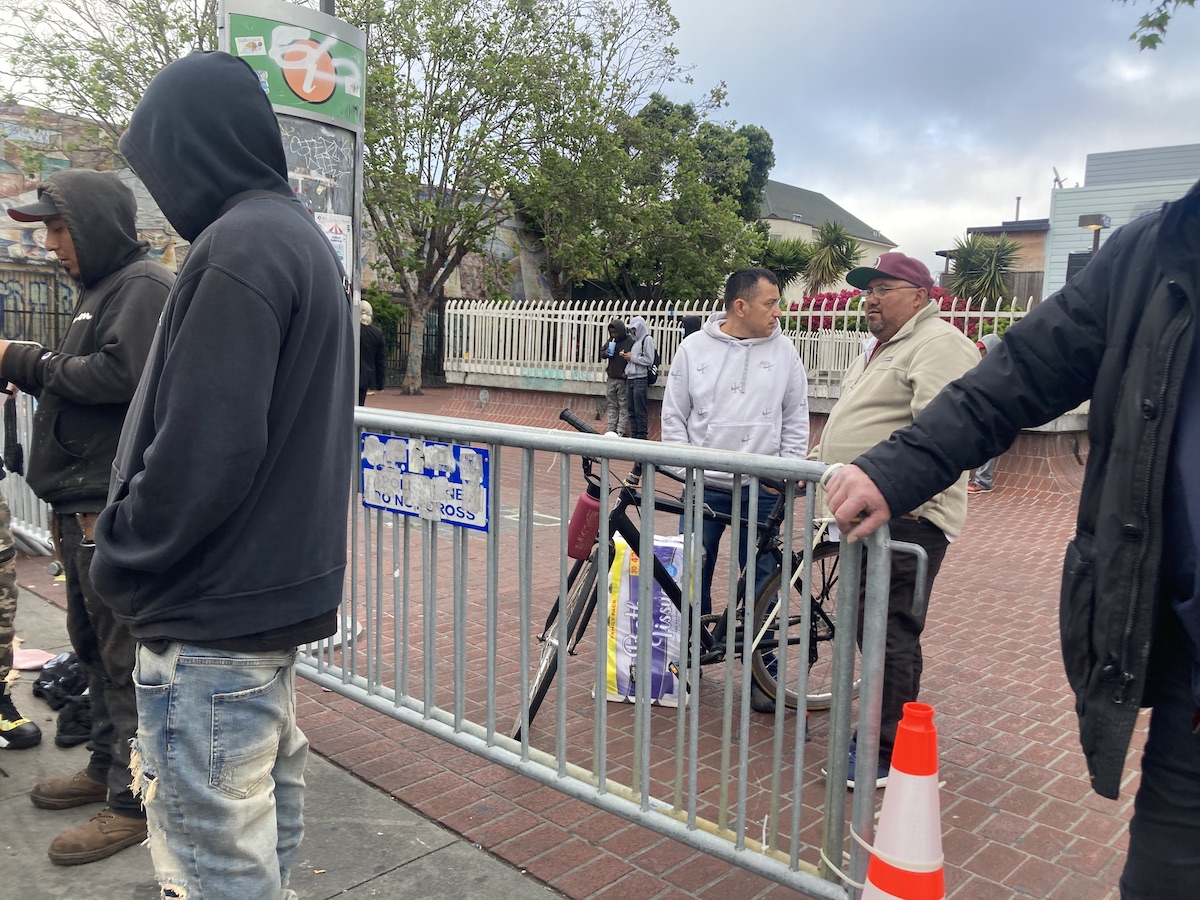

It’s one of those San Francisco days where the sun shines invitingly, the wind periodically bites, and the northeast corner of 24th and Mission streets is brimming with activity.
The BART plaza itself is surprisingly spotless on a recent Wednesday in mid-June, with just a few people relaxing, smoking cigarettes or chatting with friends. But on the sidewalk, separated from the plaza by several yards of metal grates running along the Mission Street side, the sidewalk is ever-crowded with vendors who have put out their wares, and dozens of people buy and sell merchandise.
Although it was only the second day they were up, the fences seemed to be doing something: The often debris-filled plaza on this Wednesday afternoon was strikingly clean and remained that way nearly two hours after orange-vested community ambassadors left the area to make their rounds up Mission Street.
The sidewalk, on the other hand, was packed, and most of the dozen or so vendors along Mission Street appeared to be operating without a permit.
So, in some sense, despite permitted vending that launched in September 2022, patrolling by Public Works and police and now, the addition of a new community ambassador team that is at the plaza daily, the sidewalk adjacent to the plaza borders on chaotic. Unpermitted vendors abound, drug use remains and many who want to use the plaza still say they do not feel safe.
“We’re not all the same,” says Nardo, 32, in Spanish. He is selling electric razors and two baseball caps just north of the plaza near El Farolito, where many sellers without permits congregate to avoid the various city officials who patrol the area these days. “Some of us are respectful, some others aren’t.”
Eking out a living
Nardo, who hails from Nicaragua, works as a cleaner at a hotel, but when he can’t get shifts, he comes to the plaza to buy and resell whatever people bring in that day.
“I know why this is illegal,” he says. He doesn’t ask questions about where the products he resells come from. “But we want to make a little more money for our rent, for our food.”
Aside from the few established vendors with permits, tables and umbrellas, many vendors at 24th and Mission don’t seem to care much about what they’re selling.
Nearby, a man sells nuts, coffee, cigarettes and lighters on a piece of tarp, sitting on a bench next to the bus stop. At the other end of the bench, a man is curled up and passed out on the ground.
A few feet from Nardo, a woman leaning against a stroller sells two boxes of Glad bags and two large packs of Peanut M&Ms and other miscellaneous items on a piece of cardboard while she scrolls on her phone. When asked to talk about what she does here, she turns from friendly to hostile.
“People don’t have trust; they think that it might be for something bad,” Nardo says. And, he adds, “some among [them] are more aggressive, more violent.”
Oftentimes, the intersection is a bustling hub of activity: People pass through, gather with friends, or browse the merchandise that can widely vary from day to day. The narrow sidewalk, choked by vendors and others milling about, presents obstacles for wheelchair users, seniors, and others with mobility issues.

On Wednesday, a curious woman with a newborn baby in her arms passes through and shops. She’d never been to this BART plaza before, but accompanied her brother, who came to the Mission to return something at a store.
Narcan, stolen goods, confiscations
For many, though, the influx of people at 24th and Mission in the past year or two is untenable.
Permitted vendors say they can’t possibly compete with the prices of unpermitted vendors, a number of whom are apparently selling stolen goods. Other vendors worry about the potential for violence, or the theft of their merchandise.
Then there’s the drug use. “They’re dropping dead like flies,” says Roscoe Campos, who said he passes through the plaza after work. “You become numb to it.”
Across the street from the plaza, just past the city-installed gates in front of McDonalds, a man dozed off sitting on a suitcase next to a spread of clothes on a tarp. Two Latinas loudly and repeatedly called “excuse me” before he eventually came to and made the sale.
Police, who are frequently stationed in the plaza in recent months, can’t — or don’t — do much, those at the plaza said. “They’ll be standing 20 feet away from somebody smoking fentanyl … and just worried about who’s selling it to them,” Campos says.
That Friday, vendors were observed ignoring the fences and selling their wares. They dispersed once two officers pulled up in a patrol cruiser and began strolling through the plaza.
And on Wednesday, June 21, vendors returned to both the sidewalk and the plaza.

Jessica Haner, who for about 10 years has been working a booth at the plaza, giving out free cell phones and tablets with the California LifeLine Program, said her husband administers Narcan, an overdose reversal drug, two or three times a week at or near the plaza.
And, while she believes the situation has gotten chaotic and out of control, Haner said she’s witnessed city workers at times making things worse for those just trying to make a living.
“They literally just will walk up and grab your stuff and throw it in a bag … My jaw dropped,” Haner said. “I mean, a lot of it is stolen, but not all of it is!”
Department of Public Works spokesperson Rachel Gordon said workers “go through a deliberative process before [goods are] impounded.” Vendors are first informed about the permit process, how to come into compliance, then receive warnings for future infractions. “If still out of compliance … the goods they’re vending may be impounded.”
Enrique Arreola, who sells everything from household cleaners to toiletries on a large white table, said in Spanish that he’s also “used to being on the defensive” — he’s been robbed, and the police don’t help him when the value of the stolen items is so low. He knows the risks of street vending, but he prefers to make an independent living.
While Nardo believes the new gates keeping the plaza clear are helping keep the area cleaner than usual, Arreola, who is fenced into the crowded sidewalk at his designated vendor location, said he fears being trapped in an emergency.
Already, his wife had not come to work with him that week, worried for her safety after particularly violent recent events.
City presence temporary
Javier Chavez, 52, who has been coming by the plaza for the past month after work to relax and people-watch, said he likes the new fences. He thinks they give a semblance of control.
But it’s unclear whether that’s actually the case. As evening approaches and the community ambassadors, the BART crisis intervention specialists and police have all disappeared, the plaza quickly fills back up: Young people hanging out, people selling three bottles of wine here, five canisters of deodorant spray there.
It is generally calm and respectful, but things can take a turn in an instant.
While I speak with Nardo, a fight nearly breaks out in front of us when a man refuses to keep to his right when passing another man rolling a bicycle and trailer. He shouts and shoves the man with the bike. The two men posture for a fight, and others nearby begin shouting. I scan my surroundings and wonder which direction to leave, in case I need to.
The confrontation died down, but they don’t always.
“They are constant: Up to six, eight, 10 fights a day, I think. It is at all times, at any time,” Arreola said. “Sometimes they come to blows, other times they bring out weapons.”
A few feet away, a man leans against a bus stop and his scooter, carefully sharpening a large knife.
The only thing Arreola can think of that might help is more constant surveillance, something he knows is impossible to sustain.
Amin, the manager of Mi Pueblito Market grocery store a few yards away, has someone watching the produce on display at all times. Even so, he estimates they lose on average $20 to $30 of produce each day.
He points to a man nearby with a half eaten apple in his hand, next to the store’s display of fruit. “He didn’t pay for it,” Amin said. “And I’m not gonna go tell him, ‘Hey, you didn’t pay for the apples.’”
Amin said he’s not sure what the solution is, because he sees that the moment city workers leave, people flood the vacated area.
“They have to do something better,” he says.
This story was updated with a statement from the Department of Public Works
It makes me sad for the neighborhood, and it’s also frustrating when you’re trying to make your way through the sidewalks. I’ve lived here around Capp and 25th since the late 90’s and I’ve never seen it like this. I avoid the BART plazas strip now when I can. Quite depressing, suspect and unusable. It resembles a human dumping ground.
The only way to clean up the area is build affordable housing over the plaza. The area cannot be kept as open space.
You can arrest people. That always works. Fact
and whatever you do, do not vote for Lerma.
The solution would be to enforce existing laws. It isn’t that complicated.
16 paragraphs before you mention that they’re selling stolen goods. That’s some great reporting.
Sir or madam —
You seem to have missed some pretty damn clear inferences far higher than that. Apparently you were too busy trying to impress us by proving you could count to 16.
Well, ta-da.
JE
Yeah, like this little gem about “the dozen or so vendors along Mission Street appeared to be operating without a permit.” The idea that you can spot a vendor operating without a permit by looking at them is classist at best and potentially far worse.
It’s nice to see a more active police presence in the area. Sometime during the pandemic they stopped enforcing laws and started “quiet quitting.” That’s when the stolen goods flea market took up residence, the drug zombies arrived, and things really started declining into dystopian chaos.