


Like you, I was surprised when a political advertisement depicting nine berobed, hairy people (and a cat) was crammed through my mail slot. “No one knows better than SF,” the mailer read, “Communes just don’t work.” It then exhorted us to vote “Yes” on Prop. C and “No” on Prop I in the November election.
Sorry, what? If this is a Jonestown reference, the “commune” part of that arrangement was the least of everyone’s worries. What does a group of people who look like the second-run traveling cast of “Jesus Christ Superstar” have to do with the midterm elections? The Prince of Peace, after all, could spring for 12 apostles, not eight.

Who are these hippies? And how dare the Yes on C, No on I people make us think about “Let the Sun Shine In” and get it stuck in our heads.
As it turns out, these shaggy people chosen to illustrate the perils of collectivism to San Francisco’s voters in 2026 are, in fact, “the Source Family,” a Los Angeles health food cult and acid-rock band, as photographed in 1976.

This sect, led by charismatic guru Father Yod — who was purportedly both a former World War II flying ace and a bank robber — operated a wildly successful restaurant at 8301 Sunset Blvd. before relocating to Hawaii and dissipating after Father Yod perished in a hang-gliding mishap.
Yes, this really happened.
So that’s the who. As for the why — why has someone put this image on a mailer and sent it to your San Francisco home? — the answer is: They must think you’re not very bright.
There are plenty of arguments to be made against Prop. I that don’t evoke the specter of Jesus sandals. The proposition, which would direct taxes on big-money real estate transactions toward affordable housing, is both overly complicated and overly prescriptive, housing professionals tell us. They warn that it’s exceedingly difficult for the government to, top-down, create setups where “residents shall have the right to participate directly and meaningfully in decision-making concerning the operation and management …” Thirty percent of the Prop. I money is earmarked for this.
That “right to participate directly and meaningfully,” it seems, is the “commune” the flyer is warning of — though it also sounds kind of like a suburban HOA or the board elections for your average condo complex. By this measure, the Freedom West co-op, whose redevelopment plan was last week lauded by Prop. I foe Mayor Daniel Lurie, is also a “commune,” albeit one primarily inhabited by African American seniors and families, not weird hippies with a salad empire.
There’s a lot about how the government works in San Francisco that could be better. There are deep and nuanced conversations that need to be had about how best to open up this city’s hood and remake its mechanics. But we’re not having them, and flyers like this — produced with the backing of civic leaders who claim to be on the side of reasonable, level-headed governance — suggest they think that voters don’t deserve to have them.
The writing on this flyer should be taken as seriously as the photos: Prop. I doesn’t “fund housing communes.” The claim that the money raised by Prop. I “won’t build new housing” is only true if the Mayor’s Office of Housing and Community Development opts to not spend it. The claim that this money is a “nonprofit slush fund” would require a slush fund to be administered out of the mayor’s office.
Mayor Daniel Lurie’s drive to remake City Hall has reaped unprecedented amounts of political money and minted an entirely new San Francisco donor class.
Our mayor remains earnest, energetic, positive and likable. Which is why it’s distressing to see his line of argumentation against Prop. I and for his Measures D, E and F range from inadequate to Orwellian.

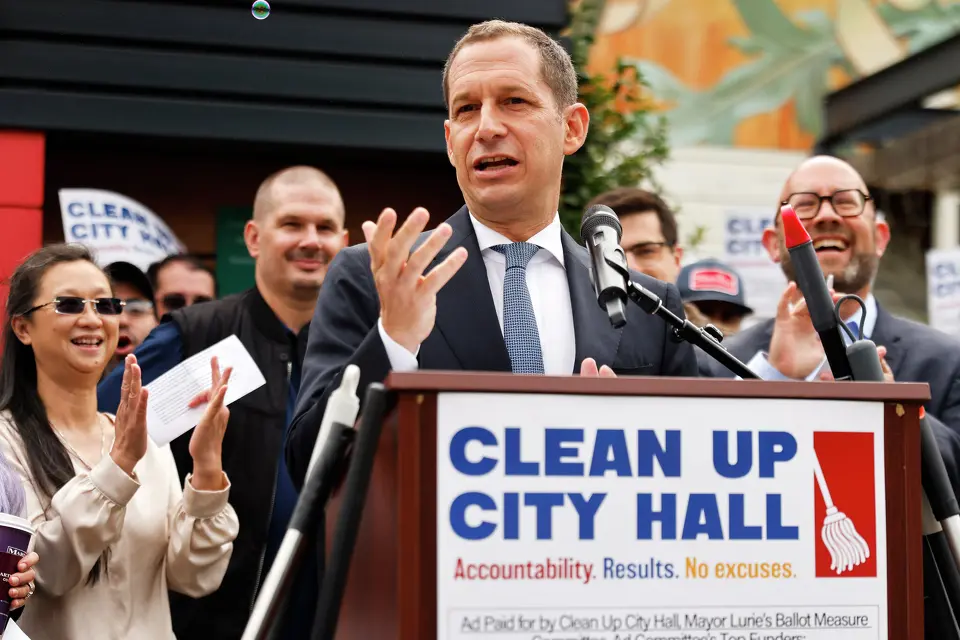
Mayor Lurie appeared on KQED’s “Forum” program last week, to talk about the suite of ballot measures — D, E and F — that Lurie claims will “clean up City Hall.” In this interview, Lurie — the chief executive of a city with a strong-mayor system and a pliant Board of Supervisors to boot — described his place of business as “run by insiders … gamed by special interests, and frankly, it is corrupt, it’s bloated, and it needs reforming.”
Good Lord! Somebody should tell the mayor!
More to the point: Does Daniel Lurie know he’s the mayor? That he’s been the mayor since January 2025? That, as mayor, he could take sweeping action without legislation, let alone going to the voters? What “corruption” is there that is preventing the mayor from doing his job?
At this, radio host Alexis Madrigal pushed back. The drive to enact these charter reforms, Madrigal noted, is backed by “Mayor Lurie’s yes on D, E, & F Committee.” It is funded to the tune of (at most recent count) more than $13 million, much of it coming from three wealthy allies of Lurie’s goals — Michael Moritz, Chris Larsen, and John Pritzker. “Who is plausibly more an insider,” Madrigal asked, “than three people who could give $1 million and the mayor?”
Good question! Lurie did not answer it. Instead, he complained that it was too easy for some people to get measures on the ballot in citywide elections. He was hoping, he said, that San Francisco’s voters would agree that collecting a shade over 10,000 signatures from fellow residents was too light a burden. His measure would quadruple the number of signatures required to qualify a ballot measure, from 2 percent to 8 percent of the electorate. This, he told listeners, would still keep San Francisco at a lower signature threshold than “our friends down in Los Angeles.”
Friends in Los Angeles? You mean like the Source Family? Alas, like Father Yod’s hang-gliding prowess, Lurie’s answers here were lacking.
If you want to gather signatures and get a measure on the ballot in the city of Los Angeles, you need 15 percent of the total number of votes cast in the last mayoral election. We did the math (and called the registrar to get the overall tally of city of Los Angeles registered voters). If you divide the votes cast by the total registration, it comes out to 6.3 percent of the electorate.
In order to signature-gather a measure onto the ballot in Los Angeles County, you need 10 percent of all the votes cast countywide in the last gubernatorial election (when Gavin Newsom beat Brian Dahle in 2022). Doing the math, this comes out to 4 percent.
Lurie also stated that, in 2024, Oakland had three ballot measures and San Jose one, to San Francisco’s 15, as an example of San Francisco’s intemperance when it comes to direct democracy. It’s true! What he failed to mention is that, in staid San Jose, signature-gatherers only need 5 percent of the electorate to qualify a ballot measure.
Also, a close look at San Francisco’s 2024 ballot reveals that, even with the limitations that Prop. D would place on both elected officials and signature-gatherers to qualify measures, we would’ve still had 11 or 12 propositions to vote on.

You knew we’d be talking about toilets at some point. The mayor sure wants to: On “Forum,” he brought up how his procurement reform measure would eliminate fiascos like the infamous $1.7 million Noe Valley water closet. He’s held campaign events in front of this toilet, which seems like an allegory of sorts.
A lot of reporters did good work writing about this commode cataclysm. But only in Mission Local did you get the headline “Class for your Ass.” And only here did you get the absolutely vital detail that 57 percent of its swollen budget was soft costs — think management and design — a figure three times or more the industry standard. And that’s not a procurement issue.
A mayor who wants to do something about substantial toilet overruns needs no ballot measure to plunge this city’s crappy system. They merely need to use their powers as chief executive to plug the leaks. Once more, with feeling: You cannot legislate a solution to a problem that is fundamentally a management problem. It requires good management.
San Francisco is not a well-oiled machine. There is, undoubtedly, decent stuff in the mayor’s charter measures. The problem is: There’s other stuff, too, that’s weird and less decent. If San Franciscans think it’s worth it, they should vote for the mayor’s measures. But they have to accept the less decent with the decent — there are no substitutions on this menu.
In the past, major charter reform was openly and methodically legislated and contentious issues would be discussed on the front end. Not this time: These reforms were sprung, fully formed, in front of the very voters that their backers attempted to terrify with photos of health food cultists. Mayor Lurie talks up the value of legislating rather than throwing ballot measures before the voters — but he’s chosen to do the latter rather than the former.
His reform measures’ backers argue that the legislative process would have watered down the changes they see as necessary — so that’s why this was signature-gathered onto the ballot. Fine, but, we can’t say it enough: The mayor’s team signature-gathered a measure onto the ballot to make it harder for you to signature-gather a measure onto the ballot.
Unless, of course, you have the wealth at your disposal to spend $4.5 million on signature-gathering alone, license photos of the Source Family, print up heaps of flyers and send them forth to line every recycling bin in San Francisco.
Meanwhile, as the mayor negs on direct democracy, some of his most popular moves to date were enabled by the signature-gathered ballot measures of yore. Expanding subsidized childcare was made possible by a signature-gathered ballot measure — “Baby Prop. C” of 2018. As was the drone policy that Daniel Lurie’s San Francisco is now so pleased with — Prop. E of 2024. We could go on, but we’ll leave it at this: Prop. M of 2024, which rationalized San Francisco’s business tax structure with near-universal support, was signature-gathered onto the ballot.
Gov. Gavin Newsom last week endorsed Mayor Lurie’s charter reform measures. For what it’s worth, Newsom’s epochal ballot measure, the “Care Not Cash” Prop. N of 2002, was signature-gathered onto the ballot.

The mayor’s backers have, to date, unleashed more than $13 million to promote “Yes on D, E, & F.” Additional millions have gone from the coffers of big-time land-use players like Kilroy Realty to persuade voters to spurn Prop. I (which would, notably, lock in the current high transfer tax rates on the sale of properties for more than $10 million, dinging those big-time land-use players).
The mayor already made one attempt to cut this tax and, if Prop. I fails, a subsequent attempt is likely coming. Regardless of whether you think a high transfer tax is a good thing or a bad thing, this weakens the mayor’s argument that Prop. I would blow a hole in the budget.
Mayor Lurie remains exceedingly popular and his measures are facing only token opposition. It feels likely that November’s voters will give him all he asked for, just as they did in June.
But it is a dangerous game to trash-talk the government you lead as inept and corrupt — as previous mayors have learned the hard way. When you tell workaday people that their ballot access should be curtailed, they might wonder why this doesn’t really apply to you and your wealthy pals.
When you tell people that the government they years ago elected you to lead is running a slush fund that you can’t be trusted to manage, you sour voters on the very concept of functional government.
That much may become clear eventually, if not in November. Let the sun shine in, indeed.