

In June, we noted that Mayor Daniel Lurie’s Brunello Cucinelli outerwear did not come equipped with much in the way of coattails. The question on the eve of June’s primary election was: What about his metaphorical coattails?
It turns out he had them: Voters gave Lurie everything he could’ve asked for, by gaudy margins to boot. If the mayor chooses to match his literal coattails to his metaphorical ones, he’d film his next Instagram video decked out like Arturo Toscanini.
(Of note: Lurie’s actual jacket of choice at Outside Lands would appear to be this “sherpa-lined” overshirt from Yves Saint Laurent; what goes with Charli XCX better than YSL?).
San Franciscans began reporting happy thoughts on the trajectory of the city to pollsters nanoseconds after Lurie sent London Breed into private life, and continue to do so. San Francisco remains a place with problems to solve, but the right-track wrong-track numbers are the best city politicos have ever seen.
Lurie’s appeal is not hard to fathom: He’s an earnest and likable guy promoting “common sense” approaches to problems, and he has vast wealth (and access to others’ vast wealth) with which to spread his earnest and likable messaging.
As such, Lurie’s pitch to voters is also not hard to fathom: It’s the Tom Cruise Help me help you and Sledge Hammer’s Trust me — I know what I’m doing. This is working and, logically, will continue to be deployed until it doesn’t.
We have an election coming in November and, among other contests, Lurie has signature-gathered three charter-reform measures onto the ballot to consolidate and centralize mayoral power. These are promoted as “common-sense” reforms but were also boosted by $8.6 million (and counting) from the city’s wealthiest individuals and businesses.
“San Franciscans deserve a City Hall that works for them, not for insiders or special interests,” reads Lurie’s pitch.
It is a testament to his unique earnestness and likability that a scion of generational wealth backed by a murderer’s row of millionaires and billionaires spending eyewatering amounts on these measures could seriously make such a statement. But this is working and, logically, will continue to be deployed until it doesn’t.
“Our city charter is so bloated that it slows down basic services, breeds corruption, and wastes taxpayer dollars,” Lurie continued. “San Franciscans elected me to clean up City Hall, and these reforms will strengthen accountability, deliver better results, and end the excuses.”
The campaign for these measures is, unsubtly, called “Clean Up City Hall.” Lurie is telling us that the City Hall he’s overseen for close to two years is still dirty — as well as inefficient, wasteful and even corrupt. Separate and apart from the validity of this pitch, it is not appealing to the positive mindset that propelled him into City Hall and has kept him popular.
Which is why it’s a bit discordant for Lurie to also be putting his imprimatur — and no small degree of money — behind appealing to November voters to tax themselves to shower funds upon Muni and BART.
San Franciscans driven to the polls by rancorous calls to do away with dirty, disorganized government would not figure to be naturals for the beneficent message “Oh, also, please fund our extant transit services, generously.”
But that’s the pitch. And this speaks to the remarkable — and, so far, well-earned — confidence Team Lurie has in voters simply listening to our mayor and checking his desired boxes.
Help me help you.
Trust me — I know what I’m doing.

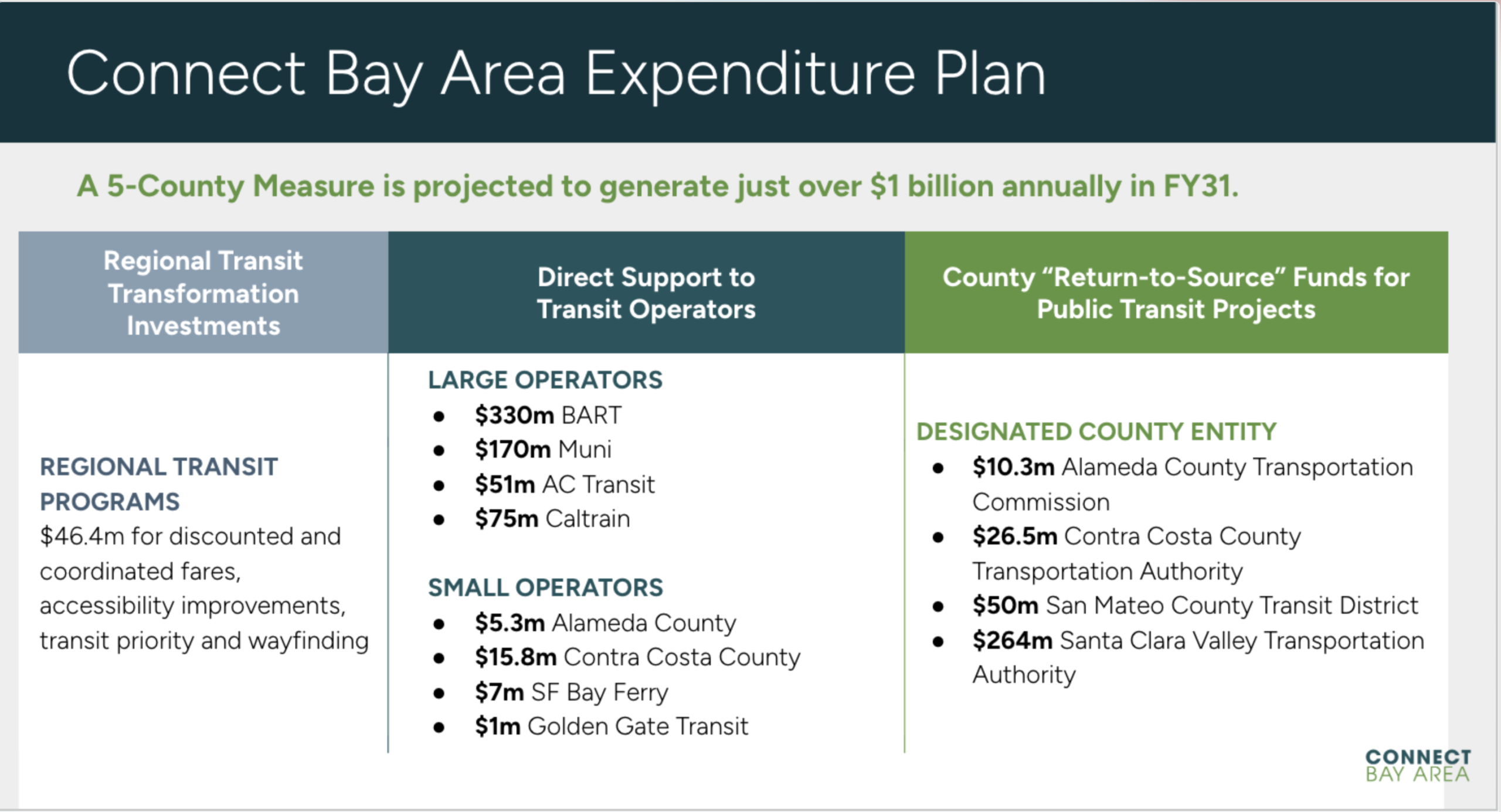
Here’s something funny about November’s so-called Muni and BART measures: The Muni measure would bring in an estimated $160 million yearly for Muni.
The five-county “BART” measure would bring in an estimated $170 million yearly for Muni. This is why backers of the “BART” measure would rather you referred to it as the “Regional Transit Measure;” BART only gets around one-third of the money.
That’s something to think about for any San Franciscan considering voting for the local measure and against the regional one because they like Muni but don’t like BART.
Calls from San Francisco’s tightfisted closet Republicans to “fix” our transit agencies before funding them do not come from a serious place; you can no more run mass transit on the cheap than you can learn French without learning grammar (on this: Trust me — I know what I’m doing).
Mission Local cannot tell you how to vote. Regardless, it is fundamentally discordant to rile up voters to “clean up” City Hall while also asking them to tax themselves — via a parcel tax for Muni and a sales tax for BART — to bail out the extant transit systems. It’s not a trivial matter: The consequences of failing to pass either or both of these transit taxes is literally existential.
Lurie’s campaign spokesperson, Max Szabo, waved off concerns about discordant messaging.
“To avoid devastating service cuts, prevent gridlock traffic and secure our economic recovery, voters are being asked to support transit agencies across the state,” he wrote.
Szabo emphasized that 100 percent of the money is going to Muni — the actual buses, trains and cable cars, which voters tell pollsters they like.
That’s distinct from the much-less-popular SFMTA — the overarching transit agency, which includes parking control officers and Poindexters who make your block into a Slow Street or eliminate the parking spots in front of shopkeepers’ stores that they like to park in all day while feeding the meter.
“Ultimately, voters love Muni and want to make it stronger.”
Every serious vestige of San Francisco political power will join the mayor in calling for the Muni tax. It only needs a bare majority to win. But the BART … sorry, Regional Transit Measure will be voted on across five counties.
To make up for likely poor showings in less transit-friendly corners of the Bay Area, the measure needs to do big numbers in San Francisco and Alameda counties.
Transit advocates are clear that they need to get every vote they can in San Francisco. They are hoping Lurie’s messaging to voters really will help him help BART.
Lurie’s popularity and overflowing war chest bode well for his trio of charter amendments. So does the popular messaging of enabling our popular mayor to do away with bloated, wasteful, redundant vestiges of a byzantine, even sinister, government.
It never hurts to have the rich and powerful spending liberally on your behalf. Meanwhile, organized labor, the only entity with either the resources or the gumption to put up a fight, is monomaniacally focused on getting Connie Chan elected to congress.
Labor is also smarting after putting millions into June’s Prop. D “Overpaid CEO Tax” — which voters spurned, at Lurie’s urging. In November, Lurie can march all the way to the capital virtually untouched.
Two of the charter-reform measures will likely run unopposed. One would centralize procurement, which is difficult to argue against. Another, weightier measure would allow the mayor to merge or consolidate two dozen city departments and have a more direct hand in hiring and firing. That’s a big deal, but will also probably be conceded even by city entities not thrilled about this.
It’s the third measure, to dramatically curtail the ease of getting items on the ballot, that may draw more than a token fight. It would eliminate provisions allowing the mayor to unilaterally put items on the ballot or a minority of supervisors to do the same — and it would quadruple the number of signatures required for citizens to qualify a measure.
At present, the city requires 2 percent of the electorate; the mayor’s measure would hike it to 8 percent (That’d still be lower than most cities in the state, but higher than San Jose’s 5 percent threshold, the percentage recommended by SPUR in a report portending these mayoral charter amendments).
This will be an interesting test of just how convincing our well-liked mayor is: San Francisco’s ballot is uniquely chaotic.
But the optics of a billionaire, backed by a cadre of billionaires, diagnosing our city’s problem as too much democracy are so bad as to veer into evil: Mayor Lurie and his allies are spending handily to gather signatures to enact a ballot measure that will make it harder for all but wealthy groups or individuals to gather signatures to enact a ballot measure.
When we get past the anodyne help me help you, Team Lurie’s arguments for limiting ballot access grow shakier. The mayor’s campaign notes that, in 2024, San Franciscans voted on 15 ballot measures, far more than any other Bay Area municipality. That’s true. But if the mayor’s desired reforms were in effect at the time, we’d have still voted on perhaps 12 or 13 measures.
Team Lurie also noted that 44 percent of items on the last 30 years of ballots could’ve been handled legislatively but were sent to voters anyway. That’s true, too.
Yet, if Lurie had legislated these three charter reforms through the Board of Supervisors — and a fourth, quarterbacked by Board President Rafael Mandelman — San Franciscans could’ve voted on one measure instead of four.
But hey, that’s complicated! And it’s not clear that arguments like these will ever be widely made. Certainly not if the discourse doesn’t advance beyond helping our likable and popular mayor help us.

Just imagine the state of the heart and soul of San Francisco if a small fraction of that money were spent on keeping community youth clinics open or expanding the shelter for seniors in the Bayview. Two coddled and overserved populations in our city of love. Maybe the mayor will hand out sherpa-lined flannel designer shirts to all the poor and sick and homeless folks.
Both Muni and BART are deserving of receiving adequate funding to enable them to keep running. And it is true that ‘Calls … to “fix” our transit agencies before funding them do not come from a serious place’. This can also be said about attempts to cover operational gaps by rolling ballot measures that has voters perpetually taxing themselves in places that should be last on the list of places to tax, property and sales taxes. Accompanied by passive-aggressive tunes guilt-tripping voters how they don’t show their “like” for Muni and BART if they don’t vote for this. Coming from elected officials who seemed to have figured, hey let’s punt this on the ballots and have them eat cake, everybody across the state does so, it’s got to be right.
Frankly, a part in me hopes both measures fail miserably and punish people in charge who think this is a viable way of running public transportation. (Of course it’s the little people who’d suffer through this)
That said, fair question: Where should the money be coming from, what are more deserving places than sales and property taxes? That’s where voters should ask questions like: How are rideshares and robotaxies chipping in anyhow? After all, these are services that squeeze out public transportation while benefiting from public spaces, running empty half of the time. Brought to you by corporations who don;’t seem to bat an eye finding hundreds of billions for the construction of data centers nobody asked for.
I hear your frustration, but the unfortunate reality is that these really were the only, dead last resort options on the table. A couple specific reasons why:
1. The Bay Area Council (a business group, not a government body, despite the name) threatened to campaign against any measure that would have levied business taxes. Even though business taxes poll a hell of a lot better than sales taxes, an active opposition was too big of a threat.
2. As another commenter said, there are very few types of revenue available to city and regional government. No income tax, and no real property tax. We tried taxing Uber and Waymo two years ago; voters loved it, but they got sweet-talked into Aaron Peskin’s tax overhaul measure even more, which spiked the Muni measure.
3. This is the reality of Howard Jarvis’s California, and it’s only going to keep getting worse. Fifty years of Prop 13 have utterly annihilated state and local revenues. The follow-up Props from that group that functionally ensure all tax increases have to go before voters means we will constantly be in Discourse cycles of “is this really the best way to do this?” and “isn’t funding this someone else’s job?” and always walking that tightrope of finding enough money that voters will approve without revolting again, and that won’t raise big money opposition.
Not buying this as stated. Members of the Bay Area Council are already accustomed to funding transit services, e.g. the Caltrain shuttles. And when you’re spending hundreds of billions on AI, there’s the suggestion they perhaps feel inclined being seen chipping in and investing in the Bay Area.
Has anyone even talked to these people, or was it simply a lazy assumption they’d say categorically no? Inquisitive minds would like to know.
Instead of folding first, if business does not want to play ball, why not force business to oppose taxes to fund transit that delivers workers to their job sites, to show everyone exactly where they stand?
They said it out loud in their meetings, and in the long slog of negotiations between businesses, labor groups, advocates, and elected officials. To our faces: “we will campaign against business taxes, sales tax or bust.”
The Bay Area Council is barking, so instead, people out in the East Bay are expected to be inclined raising sales tax on themselves to float BART operations. Good luck with that: Wasn’t it the BART board that unceremoniously canned the Livermore extension ten short years ago? Which lead to that dubious situation that had the good folks out in Livermore continue paying the extra sales tax for the project, when all they got was the privilege of staring at a dotted line on the BART map. And that’s where the money’s supposed to be coming from to save the day. Keep up the good thinking, I am so impressed.
Can you explain why progressives and organized labor have made a cottage industry over the past decade of running successive revenue measures opposed by successive conservative mayors knowing full well that these conservative mayors will use those revenues to screw progressive political priorities if they spend them at all?
I can actually! Again thanks to Howard Jarvis, if the ballot measure comes from the city, it either had to go to the general fund or clear a daunting 2/3 majority vote. If it comes from a petition, like 2016 Prop C or these transit funding measures, it can be specific and only need 50%. Howard Jarvis is trying to close this “loophole” with a state measure this year. It’s also why I and others oppose the mayor’s charter amendment to quadruple the signature requirements for ballot petitions – it would make it impossible for Progressive groups to get special-purpose taxes passed, ever.
What interests would progressives have in throwing hundreds of millions of dollars at their opponents only to be used against them?
But it is a loophole. The clear intent of the framers of Prop 13 was that you need a two third majority to pass a special (targeted) tax increase, and a 50% plus 1 majority to pass a general revenue tax increase.
The system makes it hard to pass specific taxes by design, and it was only a skewed decision by an activist judge that created the loophole.
Anyway the effect of Prop 13 is greatly diminished as the State simply replaced that “lost” revenue with some of the highest state income and sales taxes in the nation, plus a whole bunch of other taxes and user fees.
Throw in the fact that the cost bases for most homes in CA are sky high, and people sell homes on average every 7 years, and property tax revenues are still huge.
“voters perpetually taxing themselves in places that should be last on the list of places to tax, property and sales taxes”
Like it or not, sales taxes and property taxes are the only kinds of taxes that the city can easily increase. The city cannot tax income, capital gains, estates and wealth. While taxing businesses more simply has the effect of driving them to another county or state.
I will be voting for the regional measure but not for the Muni measure.
Max Szabo tells us that “voters are being asked to support transit agencies across the state”. It’s not like we didn’t know things were going to get tight. This has been known as the “fiscal cliff” since the end the pandemic. Yet, apparently, this wasn’t worth tackling by elected officials at local or state levels beyond putting this on ballots up and down California. Add insult to injury, this not-happens to a backdrop where we got a state senate that’s controlled by a super majority of the ruling party. Not easy enough?
I don’t understand the likeability of Lurie. Are people really happy with this guy? Why? I was no fan of Breed but things to me seem to look about the same as when she was in office.
Also yeah, this quote: “San Franciscans deserve a City Hall that works for them, not for insiders or special interests” definitely sounds clueless at best and hypocritical at worse.
Shouldn’t we know better at this point that the wealthy class only works for the wealthy class?
I guess Lurie is so tone deaf that he does not realize what people think of his thousand-dollar shirt.
Those three days of overpriced noise (produced by mediocrities) makes life miserable for everyone on the Westside.
The N is very crowded with entitled young people with see-through plastic backpacks.
The noise is just horrendous. Calling the noise hotline provides zero relief.
Next year we will be enduring this event — eclipsed in annoyance solely by the military propaganda festival known as “Fleet Week” — two weekends in a row.
Lurie is totally tone deaf to anything except things that wealthy plutocrats want and/or can make lucre off.
At least Breed knew what it was like to grow up in poverty!
It will be interesting to see what happens if the attempt to jack up the sales tax fails. Or the parcel tax.
In any event, the ridiculously-priced fares will rise even more while service, already bad after 10 PM, will fall in frequency even more than it already has.
Lurie could care less. He came to OL, I am sure, in the $150,000 Rivian he allows a taxpayer-funded driver to chauffeur him around in.
“The noise is just horrendous.”. Somehow Muni managed to make the new Siemens cars noisier and more annoying than the old Bredas. This was even possible? Who knew, but here we are. What took it over the top is the incessant ringing of the new kind of bells they installed. For sure residents living within earshot of this are going to vote for anything that offers a chance at finding the LRVs running less often.
I have zero interest in Outside Lands but I’m so happy it happens every year to elicit these reactions from our resident NIMBY boomers.
So you’re saying you don’t like old people, is that it? How edgy! This type of creativity unconstrained by hidebound convention is disturbing yet I’m unable to look away. And they say that San Francisco is no longer a bastion of the avant garde…
That must be Karl. Not the fog.
“entitled young people with see-through plastic backpacks”
I’m sure that poster was a total delight and never made a peep during their teens and twenties. LOL.
So glad you’re glad people you don’t like had a shitty weekend.
Sure, during a torrential crisis in affordability, let’s impose regressive taxes to fund transit that is largely aligned to provide intensive service to downtown SF office buildings where people used to work in order to prop up their faltering valuations.
And while we’re at it, why not just give the SF Mayor the same power that Trump gave to DOGE, to take a chainsaw to departments?
This move towards a unitary executive in San Francisco government is straight outta the Ed Meese, Steve Calabresi (Heritage Foundation) and Antonin Scalia, Dick Cheney, Samuel Alito, Bill Barr playbook, but it is okay, because Lurie’s a Democrat.
What we got here is Project 2026 for San Francisco.
There is nothing wrong with regressive taxes. A fair tax system has a balance of progressive taxes and regressive taxes. Progressive taxes ensure that the rich pay more tax and regressive taxes ensure that everyone pays something.
I urge proponents of new regressive taxes during an affordability crisis to support downtown SF commercial real estate valuations to center that kind of scolding in their messaging this November.
Only one item matters,
That would be taking away the Mayor’s power to put things on the ballot.
Again, the Mayor is a likable guy but when the snow melts and voters elect a serious Progressive reformer they won’t have the tools to move quickly and decisively.
go Niners !!
h.
It appears that the mayor is cleaning up DBI installing an exceptionally qualified educated engineer Director whom I am told goes to great effort to meet the proletariat individually, listens to subordinates and concerns to better the Department actively engaging rather than only relying only on a spokesman for the former Director like the former protected great OZ to respond to any questions and concerns the subordinates or public shares, rather than one that has no requisite education , but rather a chosen former director with a “North Star” to guide the department.