
After setting aside a proposal earlier this year, Supervisor Bilal Mahmood and San Francisco Mayor Daniel Lurie are resurrecting a plan to cut taxes on the sale of real estate worth $10 million or more, they announced Thursday.
Under the revamped proposal, transfers of real estate worth between $10 million and $25 million will be taxed at 3.5% instead of 5.5%. Transfers of $25 million or more would be taxed at 4% instead of 6%. The tax cut is slightly less than what was originally proposed in February — cutting to 2.75% and 3%, respectively.
Mahmood says that, this time, he has the votes for the tax cut to pass the Board of Supervisors, and expects that it will do so before the end of the year.
The hope is that passing the transfer tax cut will help kickstart housing development.
Currently, the city has almost 88,000 housing units that are planned for but aren’t getting built. Developers say that is because they cannot secure the loans they need to break ground. The transfer tax, they add, makes getting those loans more difficult because investors fronting the money regain their investment when the building is sold — and need the profit margin to be high enough to be willing to take the risk of loaning out money.
“Builders tell us that the current 6% transfer tax is the single biggest barrier to new housing that’s within the city’s control,” said Corey Smith, executive director of Housing Action Coalition, a housing industry advocacy group.
The proposal also seeks to lower costs for developers in other ways. The first time a newly constructed building with three or more housing units is sold, it would be exempt from the tax entirely.
“Development agreement” projects — large new housing complexes, such as the plans to develop Treasure Island or Stonestown — would be exempt from the tax during early stages of construction, when the main developer often sells off portions of the project to other developers to build.
These additional cuts were not included in Lurie and Mahmood’s original proposal.
Currently, constructing new housing in San Francisco costs between $700,000 and $1,200,000 per unit. The city estimates that the tax cut will reduce costs for developers by around $60,000 per unit.
Lurie described the tax cut as part of his housing affordability agenda. “Today we are moving forward on the BUILD Act to make it easier to build the homes our city needs,” he said.
The move comes on the heels of the defeat of Prop. I, which was signature-gathered onto the ballot by the Democratic Socialists of America and others. That measure would’ve locked in the high transfer tax rates on big real estate sales and directed the money to affordable housing. Prop. I also would’ve barred the Board of Supervisors from lowering the tax themselves, requiring a ballot measure instead.
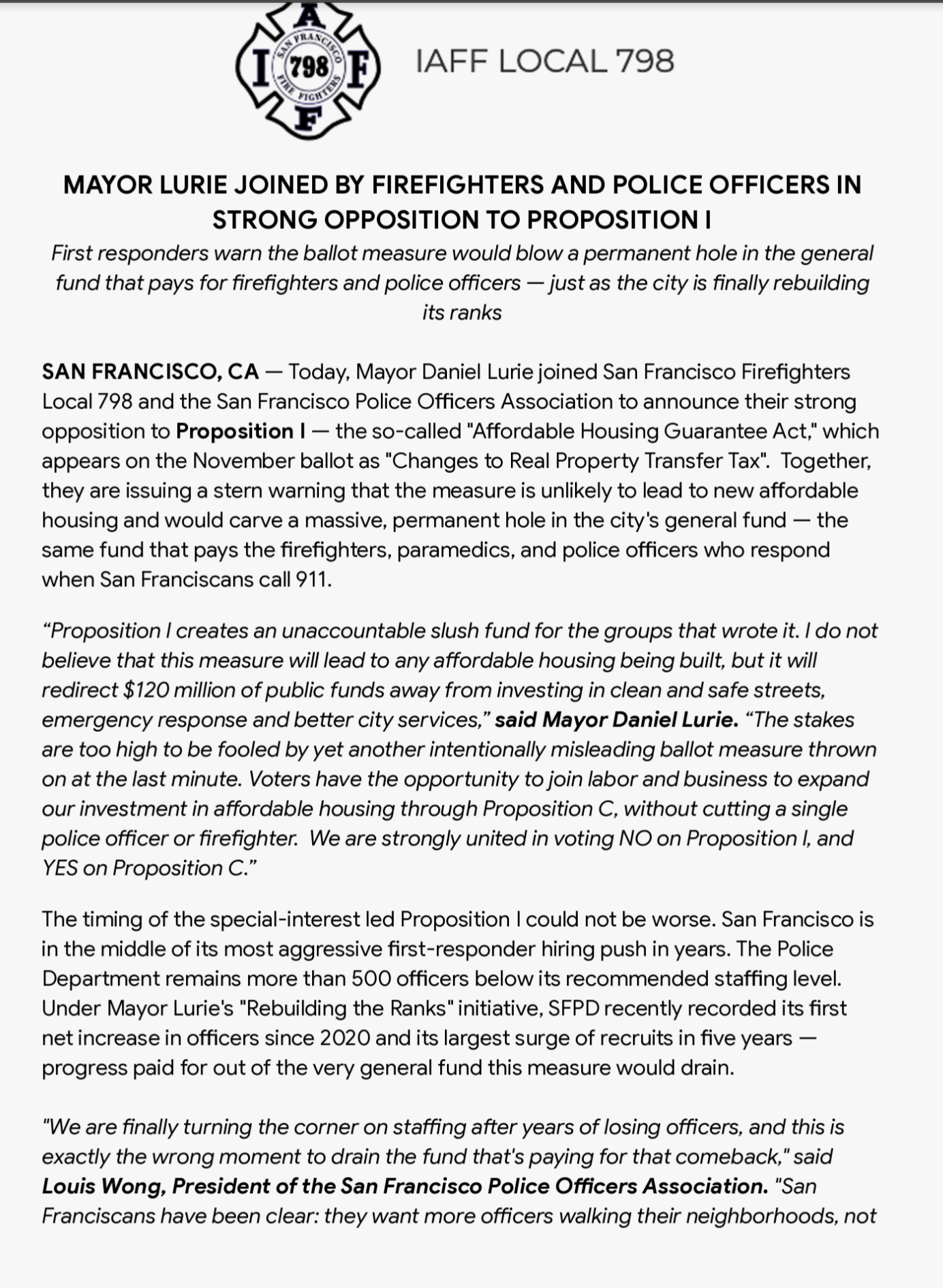
Lurie vehemently opposed the measure, and joined the firefighters union and police union in “issuing a stern warning” that Prop. I would “carve a massive, permanent hole in the city’s general fund — the same fund that pays the firefighters, paramedics, and police officers who respond when San Franciscans call 911.”
Lurie then spearheaded a $2.8 million campaign against Prop. I, largely funded by real-estate interests. It lost, 52-48.
Lurie and Mahmood feel that the new proposal will not create the same budget issue because of the passage of Proposition J this November, which requires that properties going through foreclosure also pay the transfer tax.
The city controller expects Prop. J to bring in $100 million to $150 million annually, about the same amount the transfer tax cut is expected to cost. But, the controller’s assessment also found that revenue from Prop. J would likely “decline significantly over time.”
“Our labor and housing partners told us revenue neutrality was essential, and we took that seriously. This version reflects their feedback,” Mahmood said.
Prop. I proponents, who anticipated that the transfer tax cut would be revived if Prop. I failed, are unlikely to be satisfied with Mahmood and Lurie’s new proposal.
Earlier this year, they expressed frustration that the cut would not just apply to new housing but also to commercial real estate and older apartment buildings, even though taxing those buildings does not impact housing development.
“Rents are going through the roof, but building flippers really need a tax cut,” said Dan Raile, DSA member and volunteer leader on the Prop. I campaign. “Trillions of dollars are about to flood into the tightest real estate market in the country and the response from City Hall is to give corporate landlords a tax break.”