
San Francisco’s own Jane Kim could not have chosen a more beautiful time or place to declare victory in her race for California insurance commissioner. The former supervisor on Friday morning arrived to whoops and cheers at her event atop Dolores Park, with the lush greenery spreading out below and the burgeoning skyline beyond.
As backdrops go, it was postcard-ready. But, truth be told, this event could’ve — even should’ve — been held in Vallejo, Hollister, South Central Los Angeles, Merced or Bakersfield. Or in San Joaquin County: We all could’ve been stuck in Lodi.
That’s where progressive Jane Kim won this race. Less so than in her hometown of San Francisco, where, as of Sunday, she held a solid, but not crushing, 54-46 lead in the city where she twice won a supervisor’s seat, ran for mayor in 2018 and came within a scant few thousand votes of beating Scott Wiener for state senate in 2016.
Kim sees the obscure-but-consequential post of insurance commissioner — a state-level regulator with significant power over how much insurance costs, and what obligations insurers have to their customers — as something of the people’s anger translator. In her contest against the more moderate state Sen. Ben Allen, Kim followed the trouble instead of the money, traveling far from San Francisco’s glistening towers, verdant parks — and affluent electorate. And that’s where she won.
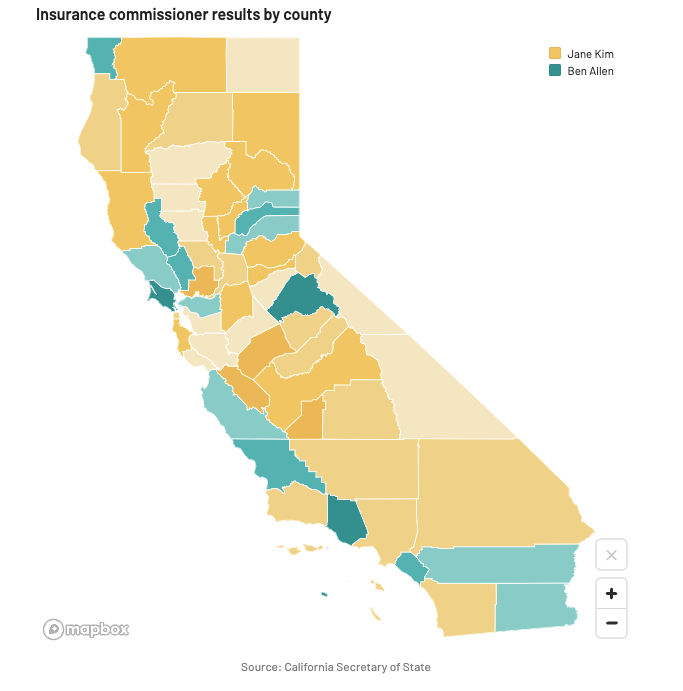
She did her best in dusty ag towns, urban neighborhoods and the overlooked, underfunded, disaster-prone parts of the state. As of the weekend, Kim was up 57-43 in Fresno County, 58-42 in San Joaquin County, 58-42 in San Benito County, 59-41 in Solano County and 59-41 in Merced County.
Yes, Republican/conservative voters may simply have skipped the insurance commissioner race. But, also: The map of Jane Kim’s statewide electoral success and a map of working-class and/or Latino enclaves is essentially the same map.
San Francisco was not a key component of this map. Nor were city residents located within the splash zone of the national blue wave. Once again, San Francisco voters delivered a near-unanimous victory to our dynastically wealthy mayor and his merry band of button-down billionaire backers. This was predicted and predictable. If anyone was surprised, Jane Kim was not among them.
In San Francisco, “our challenge is not money and messaging. Our challenge is the electorate,” she says. In her home city, “we don’t have an electorate. Think about the power players across the state — they’re all here. The billionaires: This is their base.”
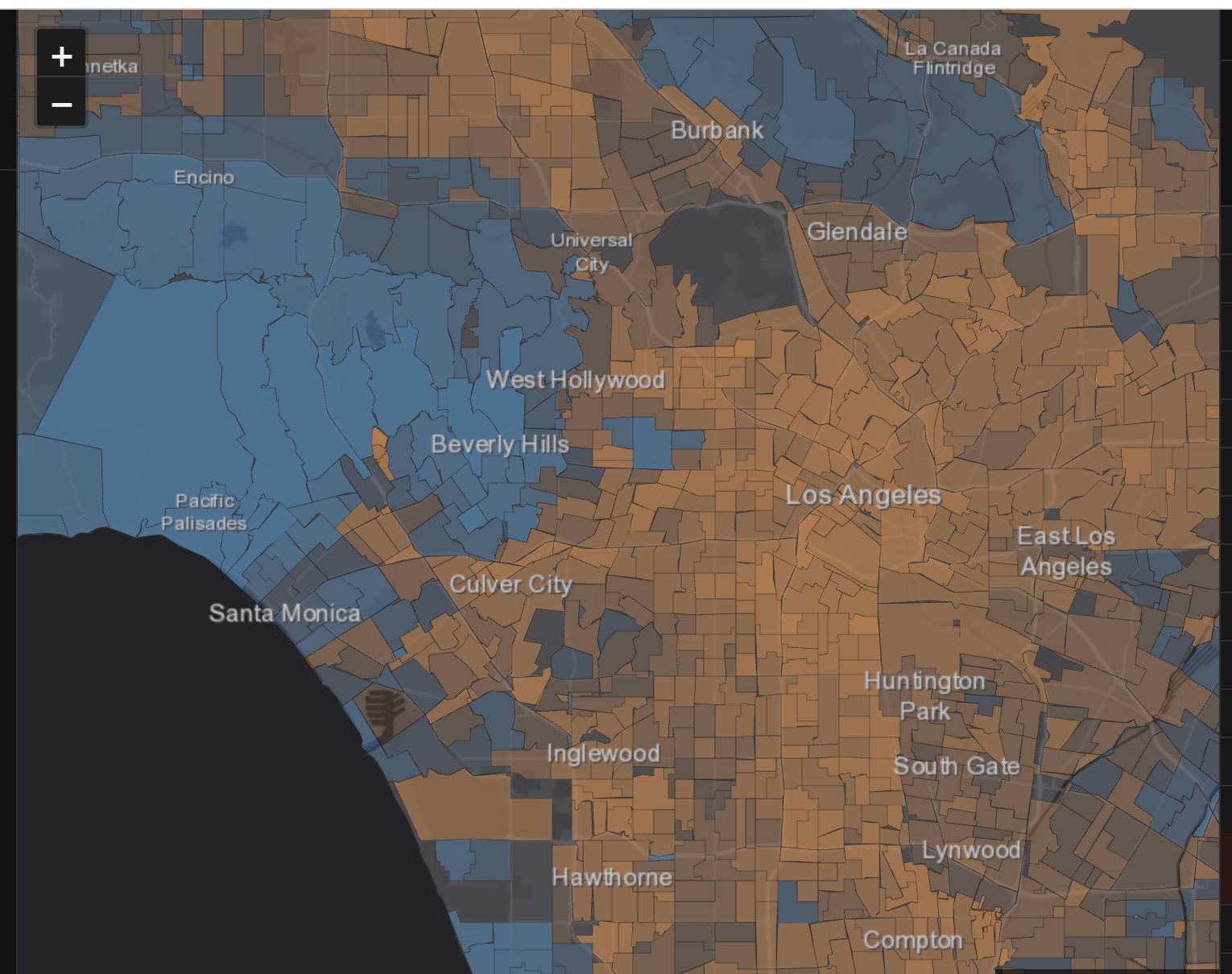
It warrants mentioning that Kim scorched Allen in large swaths of his home turf of Southern California, where he is an elected state senator. The map of Kim’s Southern California electoral success overlays neatly with working-class, Latino areas (to wit: Kim won in Huntington Park and lost in Huntington Beach).
Many of the parts of Southern California where Kim did best are places where disaster insurance — and frustration with the megacorporations administering it — are not hypothetical concepts.
Santa Ana and Indio are not yet bastions of tech wealth. But Kim said that her political allies in these places asked her about the names of the donors spending big against her. Among them were San Francisco’s Michael Moritz and Chris Larsen (PG&E also took time out from proactively readying damage control for the next time it incinerates large swaths of California to put six figures into its PAC backing Allen.)
Today’s wealthy and ascendant political players will be quick to remind you that the super-rich have tossed great sums of money into losing causes before and been trounced by San Francisco voters. Money, Kim acknowledges, matters. It will continue to matter.
“But messaging also matters. Electorate also matters,” she said.
In San Francisco, however, her messaging isn’t working like gangbusters. The electorate isn’t responding for her as it is elsewhere in the state.
Kim, Bernie Sanders’ surrogate in California, has taken on a role of the Bernie Sanders of the state insurance market. She isn’t interested in stabilizing the status quo. She isn’t interested in stabilizing anything: She wants to shake stuff up.
And San Francisco is not a place that’s looking for radical change — or at least not antiestablishment radical change. City voters in June elected a suite of staid moderate supervisors and followed Mayor Daniel Lurie’s endorsements to a T, most notably stiff-arming a labor-backed tax on “overpaid CEOs” for which the mayor made himself the face of the opposition.
Congressional candidate Saikat Chakrabarti promised he’d deliver major, institutional change and voters responded with an Oh no you won’t! He came in a distant third in the June primary, proving that progressive money can be as misspent as moderate money, if you have the wrong messaging and an unconvinced electorate.
While the city’s adrift progressives would tell you that voters were “duped” by big money, the truth is often starker: They’re just not that into you.
Jane Kim gets this. When asked about the San Francisco Chronicle’s excoriating editorial urging voters to go for Ben Allen, she laughs. A goodly portion of San Francisco voters probably took the editorial’s warning that Kim “wants to blow up the existing system” the way the Chronicle intended them to.
But that’s not how voters in Merced or San Bernardino or much of Los Angeles would’ve taken it. These are places where working-class voters live, or where voters of all stripes have dealt with disasters and government dysfunction. Tell them that a politician wants to blow up the system and the likely response is Fuck yeah. They voted for Kim in numbers.
There were, in the end, more of them. As for the San Francisco billionaires who spent big against her, Kim says: “They can have their city. ”