
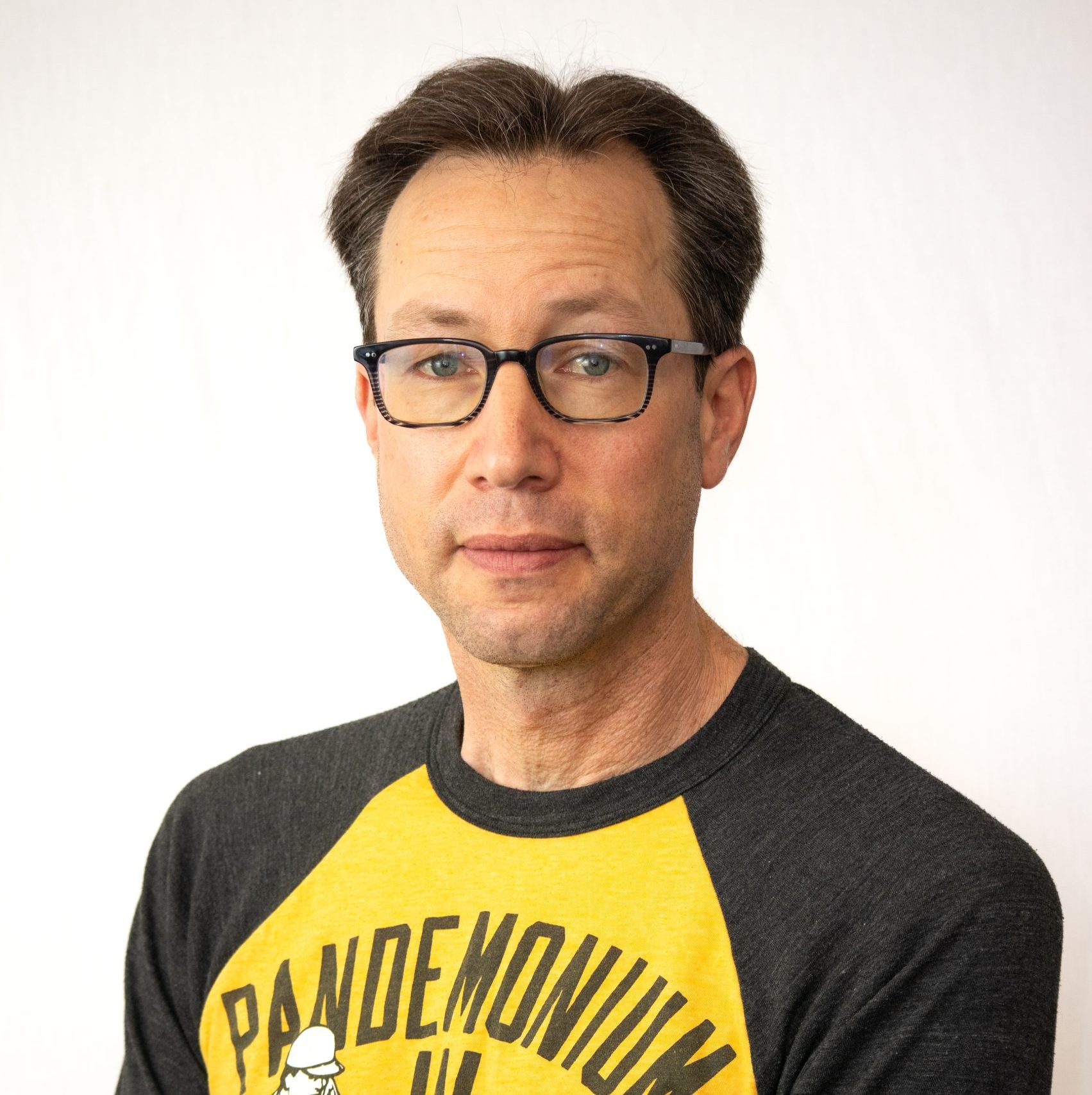

Michael Moritz turned 70 on Sept. 12 — a birthday he was never supposed to reach.
He rang in his eighth decade at a private event at Davies Symphony Hall; former “Late Show” bandleader and New Orleans keyboard savant Jon Batiste played. And Moritz assembled a crowd so counterintuitive it almost seemed designed to befuddle guests gazing at one another across the room.
You could find Moritz’s friend and multiple grant recipient, ousted progressive District Attorney Chesa Boudin. At another table, there was Moritz’s chosen candidate for mayor, law-and-order stalwart Mark Farrell (Moritz has directed $600,000 to a Farrell-controlled committee — so far). Personnel from Moritz’s various nonprofits wandered the room, as well as friends Moritz and his wife, Harriet Heyman, have known since he was a scrappy young magazine writer.
“This,” recalls one attendee, “was a strange group of people.” No surprise: Moritz finds himself in the center of any number of strange Venn diagrams. And, despite stepping back from day-to-day management of his venture capital firm more than a decade ago, in many ways he’s never been busier.
On his birthday, at least, nobody wanted to talk politics. But that’s a luxury Moritz is seldom afforded, whether he wants it or not.
Moritz — gradually, then suddenly — has asserted himself as one of San Francisco’s most seismic political movers and shakers. Since 2016, he has injected just over $4 million directly into political campaigns, on top of his much larger donations to charitable endeavors or political nonprofits.
“I had a prognosis I’d be dead by 70,” he said. “But you never know where you are in the bell curve of life.”
Moritz has not publicly disclosed what incurable condition he was diagnosed with in 2012 but, crucially, he’s stayed ahead of the bell curve of life: He is clearly on the desirable end of survival rates. Perhaps he can rent out Davies again in 10 more years, which is how long he feels it’ll take to effect “real, discernible change” in this city. But, he admits, “I am as impatient as the next person.”
Impatient? Perhaps. Busy? Undoubtedly: Moritz’s to-do list is among the most aggressive in the city. Unsatisfied by the level of journalism in San Francisco, Moritz established his own news site, the San Francisco Standard, in 2021, which now has a staff of nearly 60, including 19 editors. Unsatisfied by the level of government functionality in San Francisco, Moritz established TogetherSF, a free-spending political pressure group with aims to remake San Francisco’s political structure, in 2020. Or, perhaps more accurately, unmake it.
He’s developing high rises in San Francisco. He’s attempting to build a city from scratch on Solano County farmland. He’s attempting to obliterate San Francisco’s media and political status quo. He’s funding a lot and doing a lot — and, all but certainly more than the next person, he grasps the concept of finite time.
Moritz is using his (finite) time and (less finite) resources to fundamentally change San Francisco, his home of more than 40 years. Going through his donations and writings, a vision for this city emerges: It calls for a curtailment of citizen oversight, a return to citywide elections at the expense of neighborhoods and others he deems obstructionists, and an overarching focus that the business of San Francisco is business.
It is a vision of San Francisco’s future that, in many ways, resembles its past.
It’s also anathema to a number of the people at Moritz’s recent birthday soiree — people who’ve known him for years, and consider themselves close.
But Moritz, physically and metaphysically, contains multitudes. Long before he became a player in San Francisco politics, he had established himself as a social philanthropist here. In 2000, Moritz and his wife, the sculptor and novelist Heyman, established their family foundation, Crankstart. With $3.8 billion in assets, it is now the largest family foundation in San Francisco, larger than the Sergey Brin Family Foundation ($3.3 billion) and the James Irvine Foundation ($3.2 billion). Nationally, it ranks 27th, which means it gives away a lot of money — Crankstart reported $204 million in giving in 2023. Tax documents indicate it dispersed $201 million in 2022 and $256 million in 2021.


Moritz and Heyman are now directing much, if not most, of their charitable giving to “our backyard.” Crankstart has disbursed $361 million in San Francisco since 2020: That includes $51 million to underwrite the Summer Together initiative, which provides in-person educational camps for public-school students; $20 million to India Basin Park and $6 million to the Chinatown Community Development Center. In the same time period, Crankstart has donated more than $126 million to East Bay causes. In 2022 alone, it gave $12 million to 20 nonprofits in or near the Mission District.
This kind of giving is done quietly — and, sometimes, without even being asked. That is not typical behavior among politically involved San Francisco billionaires. For a fraction of Moritz’s charitable giving, says former mayor Art Agnos, who has a friendly relationship with Moritz, other political heavies “would want a parade down Market Street.”
This, Moritz says in a barely audible tone, “is the very last thing I would want.”
Moritz has chosen to keep mum on his most beneficent and least controversial contributions, which represent the vast bulk of his giving. But his most partisan and controversial actions and donations are widely tracked by campaign-finance reporters, and he has not been shy about expressing his views, penning articles in the Financial Times and writing two widely-read op-eds in the New York Times about the failings of San Francisco and its political class.
That’s an interesting choice. Moritz is an interesting person. But San Francisco is replete with interesting people, as well as people who compartmentalize their busy lives to a remarkable degree.

Yet San Francisco has a limited supply of people with as much to do — and undo — as Michael Moritz. San Francisco has an even more limited supply of activists with designs on blowing up this city’s political system, and the means and will to do it.
In February 2023, Moritz wrote an op-ed in the Times with the brain-melting headline “Even Democrats Like Me Are Fed Up with San Francisco.” In it, he argued that San Francisco, which has one of the strongest strong-mayor systems in America and hasn’t elected a progressive mayor since Moritz’s pal Agnos in 1987, is being run into the ground by its progressive Board of Supervisors.
At the time, we noted the bizarre nature of Moritz claiming that San Francisco government had “been crippled by a small coterie who knows how to bend government to its will.” That was an intriguing claim to make for the guy who’s dumped millions into local politics, founded his own political pressure group and had an estimated net worth of $4.2 billion.
Yet he repeated that claim earlier this month in the pages of the Gray Lady in an Oct. 16 jeremiad against mayoral candidate Aaron Peskin, laying much of the blame for this city’s deterioration at the feet of the longtime supervisor and board president. In his op-ed, Moritz describes Peskin as the chief zealot in a “coterie of longstanding political zealots.” Moritz once again used the term “Democrats like me” to describe those “fighting to take the city back.”
Well, this, too, is an intriguing framing: If it was odd in 2023 for Moritz to adopt the term “Democrats like me” when his estimated net worth was $4.2 billion, it’s that much odder in the present day, when he is now valued at perhaps $6.3 billion. The notion of fabulously wealthy people “fighting to take the city back” as a positive development and rallying cry is, again, intriguing.
San Francisco has had its strikes and gutters, but Moritz’s fortunes have shot to infinity and beyond. But it hasn’t put him at ease. Quite the opposite: In a recent TogetherSF presentation obtained by Mission Local, the Moritz-backed group pledged to “grow and sustain [a] movement of community dissatisfaction.”
This, to put it mildly, is an odd message; this exhortation to inchoate rage harks to Howard Beale urging his viewers to bellow “I’m as mad as hell and I’m not going to take this anymore!” in the movie “Network” — “Well, I’m not going to leave you alone! I want you to get mad!”
Moritz tells me his “preliminary thoughts” about a coterie of progressives running San Francisco have been sharpened over the past few years of self-education and discourse. In our sit-downs at his preferred cafe, he waves off San Francisco’s established strong-mayor system as “the narrative of the progressive left.” He politely, but firmly, said he did not want to “get into all the liturgical discussions around this.” That San Francisco is governed by a strong-mayor system is a “point of view,” in Moritz’s book. “And I just don’t happen to share that view.”
We do not discuss his views on this matter. We do not discuss his views on whether the 14-Mission runs on Mission or whether Ocean Beach is adjacent to an ocean.
Moritz doesn’t see anything untoward about a billionaire-funded organization working to incite and sustain public rancor. Quite the opposite: He described himself as being “in the fortunate position to give voice to people’s dissatisfaction.” Including his own.
Through TogetherSF, to which he has thus far contributed at least $6.5 million and is being counted on to bestow $11 million more in the coming years, Moritz says that he is giving voice to the voiceless.
There is a pause in our conversation. Moritz smiles. “Obviously, that causes you and others to smirk. And laugh. I understand the irony associated with it. Very much so.”
And now he laughs, too.
“‘Old White Billionaire Leads People’s Revolution’ isn’t the headline sitting in everybody’s typeset drawer.”

No, it is not. And Moritz isn’t that old — though he is dating himself by referencing a typeset drawer. He is, however, older than he may ever have thought he’d be.
Moritz was born on Sept. 12, 1954, in Cardiff, Wales. His parents, Alfred and Doris, were German-Jewish refugees, and his father was a classics professor at the University of Cardiff. His younger sister, Clare, became a lawyer. Moritz earned a degree from Oxford, and arrived in the United States in 1976 to earn an MBA at the Wharton School of Business.
Fabulous wealth did not appear to be in the cards, as Moritz went the route of the typeset drawer, heading into journalism. By the cusp of the personal-computing revolution some 40 years ago, he’d risen to the position of San Francisco bureau chief for Time magazine; it was just the right place for him to be, and just the right time. Moritz, displaying the prescience that would go on to mark his brilliant investing career, knew a good thing when he saw it. In 1984, he penned the influential book “The Little Kingdom: The Private Story of Apple Computer.” By 1986, he was hired on by Sequoia Capital, and a storybook career ensued. He got in early on many of the companies on your phone: Google, Yahoo, PayPal, YouTube. As well as the phone itself — Apple.
Moritz has been so successful he may, single-handedly, have distorted the average income of those who leave the profession of journalism, just as Michael Jordan single-handedly distorted the average salary earned by University of North Carolina geography majors. But that didn’t seem to matter quite so much a dozen years ago when, at age 57, he was diagnosed with the rare medical condition that he has described as treatable but incurable. He stepped back from day-to-day management of Sequoia. Last year, he retired from the firm after 38 years.
This has given him more time to reflect on his home city of 40-odd years. And, like many San Franciscans, he is disturbed by what he sees. He’s upset about people living on the street and dying on the street. He’s concerned about affordability. He’s worried about education. He’s distraught about the collapse of Downtown as the city’s economic engine. Much of his philanthropy addresses social concerns.
But, in recent years, Moritz has done a lot more than philanthropy: He’s not going to leave you alone — he wants you to get mad!
Moritz’s TogetherSF gathered scores of thousands of signatures, and commissioned the creation of a 76-page piece of legislation that will, among other sweeping changes, halve the number of city commissions. It is on November’s ballot as Proposition D; Moritz has sunk $3.2 million into it and, in total, some $9.2 million is backing it — 147 times the amount of money propping up a token countermeasure.

Margaret Brodkin, 81, ran Coleman Advocates for Children & Youth for more than 25 years; she was doing this back when Moritz arrived in the city as a young reporter. From way back when, she says she remembered Moritz and Heyman giving her group money, an unsolicited but welcome donation.
Brodkin was instrumental in the establishment of several city commissions regarding child welfare, including the Juvenile Probation Commission, on which she presently serves as president. It was only recently that she put two and two together that the guy she remembers donating to her child advocacy outfit is the same guy bankrolling the ballot measure that could evaporate the commissions she helped establish. So she requested a meeting. She got one.
“You fund all these great things!” Brodkin recalls telling Moritz at his preferred cafe. “We went through all the things he funded. God, the guy funds Juilliard! He funds the Booker Prize!”
All true. If Moritz wanted the Booker Prize to be called the Moritz Prize, it would be. He doesn’t.
While we’re at it, Moritz gave $50 million to his alma mater, Oxford, and followed it up with some $115 million for scholarship programs. He gave $30 million to the University of California, San Francisco to endow Ph.D candidates, and $20 million to the American Civil Liberties Union. Moritz’s promotion of British “economic interests and philanthropic work” earned him a knighthood in 2013.
But, as San Franciscans ought to know — because our voters are often rolled out as the bellwether for liberalism writ large — a city resident’s large-scale beneficence or views on overarching issues like gun control, abortion rights or Donald Trump do not neatly translate into opinions on municipal issues.
Moritz, for what it’s worth, has made it resplendently clear that he fears and loathes Trump, and has donated millions against him. But that doesn’t graph into predictable views on city matters. Attempting to track a coherent and consistent ideological belief system for almost any voter is a fool’s errand — simply put, most of us do not vote this way. And that goes for regular Joes or “Democrats like me.”
Asked if he sees contradictions in his philanthropic and political giving, Moritz says he doesn’t. “The thing that gets lost on a lot of people,” he says, “is that the political stuff is a tiny percentage of the charitable giving. It takes a village, and it’s difficult to seek perfect alignment. I don’t worry about occasional overlaps.”
Adds Agnos: “What’s wrong with contradictions? You’re looking for consistency? That’s your problem.”
On the morning of one of our meetings, Moritz texted and asked if it was all right if he showed up a shade late, as he was spending time in Sunnydale. It was fun, for a moment, to imagine that the man who knows Apple so well was, like the rest of us, foiled by the autocorrect function: What the duck, man? Surely this Master of the VC Universe was in Sunnyvale, not San Francisco’s put-upon and neglected Sunnydale neighborhood.
But no: Moritz confirmed that he was indeed in Sunnydale, where the Boys and Girls Club had recently opened a brand-spanking-new clubhouse. He also mentioned the new park opening up at Innes Street along the southeastern waterfront. At no point did he mention that Crankstart put $6 million and $20 million into these projects, respectively. But you could look it up.
Numerous nonprofit workers and executives tell me that the money they’ve received — serious money, in some cases the biggest money they’ve ever gotten, and not infrequently targeted to ameliorate a specific shortfall — has come with no ideological strings attached. Moritz is known to reach out and proactively ask nonprofits what he can do to help. He will vastly increase his gives without being asked, let alone cajoled.
“I consider him a friend,” said former San Francisco District Attorney Chesa Boudin. “A lot of people involved in TogetherSF were actively involved in promoting my recall. I will say, he and Harriet opposed my recall, and were extremely generous to me with advice and introductions.”
Crankstart in 2021 provided Boudin’s office with a three-year $6 million grant for restorative justice programs — the largest grant the DA’s office has ever received (Boudin’s successor, Brooke Jenkins, did not utilize the grant, leaving nearly $3 million untouched). After Boudin took the reins at Berkeley’s Criminal Law & Justice Center, Crankstart provided a three-year, $750,000 grant.
Nonprofit executives I spoke with, even those who had only positive things to say about Moritz, insisted they could not be quoted on the record.
“His grants have been transformative,” says one, “but he doesn’t want anyone to know.”
But they’re confused. They’re confused by the divergence in Moritz’s public and private personas, and the stuff he gives money to quietly vs. loudly. So is Margaret Brodkin. She says it was a polite meeting she had with Moritz, but not a successful one. He bemoaned all San Francisco’s problems: An unwelcoming environment for businesses, homelessness and drug use, our housing is too expensive and families cannot afford to live here.
Again, all true. But Prop. D does nothing about these things. Brodkin — and others — were left to wonder: So this is why we’re eliminating the Juvenile Probation Commission?
“I’m too old to talk off the record,” says 86-year-old former Mayor Art Agnos. That seems to be the case whether he’s speaking to Mission Local or Michael Moritz.
Agnos calls Moritz “one of the most generous guys I’ve met in my career.” And yet, “I kick his ass on two major things where I think he’s really screwed up.”
The first was Moritz’s involvement in the (thus far) abortive “California Forever” project, an attempt by a small coterie of billionaires to surreptitiously obtain 60,000 acres of the Central Valley for a purported $900 million and construct a tech utopia.
“When you represent the kind of wealth he and his group represent, you don’t secretly assemble thousands of acres and secretly plan a city and then say, ‘Hey folks! Have we got a deal for you!’” says Agnos.
“I said, ‘Michael, that is the biggest bass-ackwards way to approach it and it is a monumental mistake! What you shoulda done is first approach the leadership, the public and private community members.’ Maybe they don’t want a goddamn city of 400,000 in the middle of the land where we grow food for the rest of the country.”
Moritz, says Agnos, doesn’t bristle at this sort of criticism: “He takes it in a positive way.” Moritz listens. But that doesn’t mean he agrees.
Agnos also needles Moritz over TogetherSF’s Prop. D: “Who told you to wipe out every city commission and start over?” But Moritz didn’t need anybody to tell him to do this. And, city officials say, the future Prop. D was dropped on them, too, without even the benefit of a “Have we got a deal for you!”
Mayoral officials say they were unaware of the future ballot measure until they checked the Department of Elections website in late 2023. TogetherSF had crafted and submitted legislation to remake the San Francisco city charter all on its own.
And this would be a questionable way of revamping the charter, San Francisco’s underlying constitution, even if the legislation didn’t contain serious drafting errors. But — have we got a deal for you — it did.
As initially submitted, legislation meant to weaken the Board of Supervisors and strengthen the mayor would have blithely done the opposite. It would’ve provided the board with sweeping new appointment and jurisdictional powers. Police oversight would’ve been moved from the Police Commission and Department of Police Accountability to the supes. Rent challenges would’ve been moved from the Rent Board to the supes. If you wanted to get a permit for a picnic table at McLaren Park for your toddler’s birthday, you’d have to go to the supes.
The jarring misstep by Moritz’s TogetherSF was, dutifully and thoroughly, covered by Moritz’s San Francisco Standard. If nothing else, Moritz could take solace that his journalists took him seriously when he told them at all-hands meetings that his own activities were fair game for reportage. Standard employees have told Mission Local that they have never felt their editorial independence to be directly circumscribed, and the paper’s coverage of Moritz’s preferred mayoral candidate, Mark Farrell, has not been deferential.
On the other hand, Moritz has so many poles in so many pools that it inevitably creates awkwardness for his media outlet. Earlier this month, Crankstart, in partnership with McKinsey, released a report on homelessness in San Francisco. It was given exclusively to the Standard (Moritz notes, correctly, that it would’ve been odd to leak it to the Chronicle, and the Times didn’t want it). The report does not paint a glowing portrait of the status quo under Mayor London Breed, and Moritz says he hopes it will be embraced by challenger Mark Farrell.
Seen one way, everything here is on the level. Crankstart has an unimpeachable reputation, and its reports are the sorts of things newspapers cover and politicians adopt. Seen another way, however, Moritz’s foundation fed a study to Moritz’s news site to the benefit of Moritz’s candidate.
In the latter half of December, at a time when City Hall is normally moribund, Mayor Breed’s office joined with TogetherSF to reformulate its flawed legislation.
The revamping and resurrection of the legislation, Moritz says, proved “we’re happy to listen, learn, modify and incorporate. We did that and we’re all the better for it.” He smiles: “The mayor was very enthusiastic.”
The criticisms now emanating from her office, he says, came only after Farrell established a ballot measure committee and used the TogetherSF legislation as a lucrative soft-money vehicle. This, Moritz says, was a move that caught him “completely by surprise.” Breed now opposes the measure, and call’s Farrell’s PAC a “slush fund.”
Farrell has, to date, amassed $2.5 million for his committee pushing Prop. D — and, unsubtly, publicizing his mayoral candidacy. Moritz says he didn’t foresee Farrell forming this committee, but that didn’t prevent him from donating $500,000 to it on Sept. 10 and giving another $100,000 on Oct. 24. This comes in addition to the nearly $2.6 million Moritz gave to TogetherSF’s Prop. D committee.
Moritz says there was “no Waterloo” in his loss of faith in Breed. Rather, “She’s had six-and-a-half years. And I never felt she could express a coherent plan for San Francisco for the next 20 years, with milestones along the way of what we need to get there.”
Moritz likes that Farrell has private-sector experience and a “more refined understanding” of attracting businesses back to the city (he’s pushing for tax breaks). Moritz likes Farrell’s “sensible attitude toward reasonable housing expansion.”
He also thinks Farrell will “be more forceful about getting uniformed officers on the street, which is the most effective, cheapest way to make everybody in San Francisco feel a lot safer.”
But with the election only days away, recent polls have indicated Farrell’s momentum is flagging.
“This is a small town,” Moritz says. “And I’ve told this to all the mayoral candidates: ‘If you win, call me anytime you need me to help San Francisco.’”
“Poor devils,” he continues. “They’re going to need all the help they can get.”

Charter reform, in the past, has been a deliberate procedure, with the idea of getting more, not fewer, critical eyes on the work product. More than one government veteran likened the process of altering the city charter to brain surgery.
Nobody but nobody would want a surgeon to operate on them in the manner resembling the crafting and rollout of Prop. D.
Moritz defends his approach. “If you seek perfection,” he says, “you’ll never do anything.” Longtime City Hall residents liken his strategy thus far to tossing a grenade into the room and counting on the resulting cleanup job to produce something that works a bit better for the city.
Put simply, big-tent coalition-building does not appear to be Moritz’s M.O. Thirteen years ago, he surfaced on city politicos’ radars when he underwrote public defender Jeff Adachi’s sweeping plan to rejigger city pension costs, running head-to-head against the big-tent coalition of virtually every last vestige of the so-called City Family helmed by Mayor Ed Lee. Adachi associates tell us that Moritz was the only financier willing to join Adachi and take on the city’s entrenched power structure.
That tracks: Moritz, then and now, didn’t think San Francisco needed an incremental course change. It needed disruption. “Old White Billionaire Leads People’s Revolution” isn’t the headline sitting in everybody’s typeset drawer. But it is the one in Moritz’s typeset drawer.
And, when you’re Michael Moritz, you don’t need to sweet-talk people into your coalition. You can finance your own.
Prop. D, he says “will be the greatest gift anybody has given to a mayor in the recent history of San Francisco. It’ll be more important in the long run than whoever becomes mayor.”
That’s a hell of a thing to say for a man who’s put $600,000 behind one mayoral candidate, Farrell.
But it may well be true. And that’s the case, no matter how well Prop. D ever works, or how much remedial effort is required to resuscitate it.
“It shows,” Moritz says, “that substantial change to the political architecture is possible.”
With mere crumbs of his vast wealth, Moritz has the potential to initiate a transformational era in San Francisco politics. Prop. D is points on the board. More possessions are forthcoming.
Michael Moritz is extremely cognizant of the long line of wealthy, powerful and generous San Francisco families who made their mark before him. He rattles them off: Zellerbach, Straus, Haas, Swig, Goldman, Dinkelspiel. Like his own relatives, many of them fled antisemitic persecution in Central Europe before finding untold success in this city.
“If I’d stayed in Wales, I’d have never had any of this good fortune,” he says. “If I’d been born in Fresno, chances are I’d have never had this same good fortune.”
When asked what he desires for this city, Moritz speaks quietly, but forcefully: “All Harriet and I have ever wanted is a San Francisco that’s better for everyone. Of course, the cynics are very skeptical about that. They think there are ulterior motives: A desire for control or power or for more money. It’s none of those things.”
That also tracks. Even Moritz critics I spoke with took pains to differentiate him from other politically involved wealthy people whom they felt were operating out of desire for control or power or more money. Yet “a San Francisco that’s better for everyone” is a subjective and malleable concept.
What does Michael Moritz want for all of us? Much of what the long list of city mothers and fathers who preceded him would have wanted: A more inviting environment for businesses and development, a more sensible and less convoluted tax structure, more centralized power, less clout vested in public sector unions and a higher bar to place items on the ballot. He questioned the citywide reach of legislators elected to represent small districts, and called for “streamlining” government so “a mere mortal or set of mere mortals can run it.”
These, again, are all views that would not have stood out among prior generations of city patricians. Those families supported cultural institutions — and Moritz does that, too. Those families backed individual politicians — and Moritz does that, too.
Where Moritz differs — his disruption — is that he has embarked upon creating his own alternative San Francisco establishment. He has studied the failures of past political movements. He learned lessons from being vanquished in Adachi’s pension crusade. Rather than getting up at a podium and announcing a plan for San Francisco, he says, his move was to “build support for your plan and have people providing support for it, and do it very quietly and systematically.”
So, that happened.
Moritz also faults his wealthy predecessors for expecting too much, too soon. TogetherSF, he says, is built to survive more than one boom-and-bust election cycle. Its internal documents call for it to “launch and win 2-3 ballot measure campaigns” in the next four years. Following Prop. D, it may work to create a “performance-based contracting system.” Also on the docket: “Government gridlock,” which — surprise, surprise, surprise — could involve citywide seats on the Board of Supervisors.
“This is a multi-year, multi-election effort to rectify things,” he says. “I told everybody at the beginning when we started with TogetherSF, we need to be here for the long-haul and have all sorts of setbacks and disappointments along the way and grit and persistence and tenacity and make ourselves an essential part of the political fabric to be essential ingredients if we’re ever going to have change.”
Moritz reveals that, sometime after the election, the San Francisco Standard will go to a subscription model — the model that is failing most every newspaper in America.
“If people don’t think what we’re providing is worth paying for,” he says, “that is a very telling vote.”
But, in the most telling vote of all, Moritz himself won’t stop paying — for either the Standard or TogetherSF. Not for at least the next “five or six years.” That’s not quite the long haul, but it’s plenty of time to make and unmake a great deal in this city. Moritz’s backing alone would figure to keep these organizations not just alive but highly relevant.
“I am finding people who have a similar point of view. Who are capable. Who are really interested in this,” he says. “This is a young person’s game. Not an old person’s game. I am helping them succeed to the best of my ability.”
At the close of our last meeting, Moritz grinned tightly when asked if he could provide any longtime friends or colleagues to speak about him. “You’ll write what you’ll write,” he replied. “I’m a big boy.”
We shook hands and he walked off, at speed. He was, as ever, staying ahead of the bell curve of life.
What are we supposed to conclude? That money talks?
Much about Mr. Moritz draws my sympathy.
But in spite of his apparent genuine altruism, he is as much trapped by circumstances as the people his venture philanthropies target to help.
There is nothing odd about this– and that is why the US is tobogganing toward world war, why our climate puts us in mortal danger, why a plague persists, and even why many (less circumspect) billionaires are betting on Trump and swifter fascism.
The munificence of billionaires like Moritz creates an illusion that all our serious problems can be reformed and fixed, and that all will be well if they are simply allowed to give back to those they helped impoverish, a fraction of what they took.
Like most people in the US who think we live in the best of all possible worlds, Moritz too, is deceiving himself.
Poor, poor, little rich boy!
(I note that the San Francisco Standard recently incorporated a new “chat” feature. Clap.)
Excellent work and some great insight into Moritz. I find it interesting that he says The Standard is going to a subscription model after the election, but says that both the paper and Grow SF will be getting major funding from him for the next five to six years.
It’s going to need more and better content to garner subscriptions. It’s presently far too sparse to get any money from me.
Very interesting interview!
I come away from it more sympathetic to Moritz than I expected to be. In particular I believe the people quoted who say his political spending isn’t about control, exactly, or greed; and I believe he really thinks the agenda he’s pushing is what’s good for the city’s people at large.
But gosh does that not make it a good thing that he (and other billionaires) have so much power to shape our politics. The incompetence of Prop D’s drafting is a perfect illustration of what happens when one person’s whims get amplified because they have billions of dollars.
“more refined understanding” of attracting businesses back to the city (he’s pushing for tax breaks)” — wow. brilliant. what a “refined understanding”. That’s never been tried in SF, never anywhere!! How innovative can you get. Twitter got that. So did a host of tech companies who fled — when the going gets tough, the the tough really get going really fast. One question, which wasn’t asked of Moritz, or any candidate as far as I can tell — with all the tax cuts, tax waivers, etc. for biz and developers, where is the money going to come from to do little stuff like clean up the streets, put cops on the block, fund services for homeless etc. If the City failed during and post pandemic, philanthropies such as Moritz’ apparently failed as well. As decent as philanthropy may be (see Oscar Wilde), it cant replace publicly financed public services. We learned that over 40,years. As for Mortiz’ family foundation, it gets far more in tax breaks than it does in donations (which is why, obviously, private foundations exist) . It is also an error to assume the donations Moritz gives to nonprofits is Moritz’ to give. In fact it should be public funds via taxes. It is also this kind of “generosity” that has kept a dysfunctional” nonprofit public sector” afloat.
When extraodinary wealthy people are free to wield extraordinarily outsized influence on politics, “democracy” is a sham. Without the “social” modifier, as in “social democracy,” there can be no democracy. Self-appointed, self-interested oligarchs like Moritz deploying their wealth like a water cannon in order to blast away obstacles to whatever their “vision” may be, is the antithesis of democracy.
Relying on billionaire philanthropists (and their intertwined, opaque networks of cadres and foundations) to fill in the void left when “social” is expunged from social democracy, leads to this situation where random billionaires use money, media, and minions to further their personal “vision,” which inevitably and not-coincidentally leads to a neo-liberal police-state paraside of business deregulation, commons privitization, and ever-increasing disparity between the haves and have-nots.
It’s a zero-sum game. Billionaires never have enough, and all their gains come at the people’s expense.
well written, interesting..money money money. So sick. Quite interesting to see Farell and Co complaining about Lurie’s money and connections to paint him in a unflattering light.Money is everywhere is this city, Money talks, Money buys, Money even corrupts and Money even influence justice: DePape got life in prison yesterday without parole because he attacked people connected to Money and power.If it was me that he attacked, he would probably be already on the street.
Money, Money, Money… San Francisco collects 14.6 billion dollars every year now for their bloated, ineffective budget. You would think that would be more than enough for a great livable city, but you would be wrong.
That’s a symptom of the problem. The City government is bloated and is run inefficiently and ineffectively. It’s spending 2x to 3x per resident as the nearest California city in the same size range. Drastic measures are warranted.
Like an Inspector General who has the power to audit departments and commissions for corruption and wasteful spending.
The City Attorney has that power RIGHT NOW, but under crooked Breed is instead insisting that deleting texts and emails (in direct contravention of Sunshine Ordinance provisions no less) is both legal and “good phone hygiene” instead. Breed and Chiu should be facing major fines at the very least for their wilful intransigence. Without even sunshine laws being enforced, we can’t have nice things. The inspector could just as easily become regulator-captured by the corrupt city family as the City Attorney currently is.
It’s an inconvenient truth to point this out.
You’ll get back “but it’s a county too”.
Nevertheless, I postulate that per capita, we are the most monetarily endowed, in terms of government spending, of any municipality on the planet. Including an astounding number of countries to boot.
But we need more.
Ever more.
There will never be enough money.
So now we’re on the bond money binge.
All measures will pass.
Why not?
Just put it on the credit card, bro.
Best case scenario – property owners (the ultimate enemies of the dictatorship of the proletariat) will get stuck with the bill.
Yay.
There is no group in history who has made more money while doing less than 21st century California property owners. The bill has gone to the best of us- young urban strivers, earning 200k and up for their hard work and talent, and having it flushed down on outrageous tax and rent prices, and living middle class lives in a city full of drugs and filth as they build the future.
There’s a technique called “steganography”, whereby a whole bunch of stuff is used to obscure a smaller payload. So goes The Standard.
There are plenty of unbiased, well-written articles. But dig in a bit, and you’ll find stuff that’s little more than advocacy of Moritz’s business interests and political opinions. Always keep your guard up when reading that thing.
Obviously a metric shit-ton of work went into this one. Job very well done Joe.
*******
>”Standard employees have told Mission Local that they have never felt their editorial independence to be directly circumscribed…”
One would not expect it to work that way and the word “directly” may have deserved to be italicized. I suppose that’s a story in and of itself.
You’d hope that someone would gain compassion if not wisdom when the end is in sight. Instead of doing good for others, Moritz is corrupting our democratic process for his own piggish benefit.
Joe, I’m surprised to see you drinking the multibillionaire koolade. You must know Moritz’s new San Francisco would eliminate height restrictions and formula retail restrictions. Highrises, blue bottles and chain restaurants everywhere. North Beach, Bernal Heights, Noe Valley? Memories. Even the Marina would be sealed by a wall of highrises (swamped in our kids’ lifetimes by a rising ocean flooding our inadequate seawall – which nobody except Peskin and Agnos seems to be talking about). Those of us who love San Francisco would like to preserve it. Sir Moritz wants to remake it. We should let him build his emerald city for billionaire in Solano County and leave us San Francisco.
Things change. It’s inevitable. Sad you’re clinging to the past and current level of dysfunction.
Love the line about the 14-Mission running on Mission and Ocean Beach being by an ocean. Indeed they are. And a mayor who can give orders to and fire the city’s department heads, and who controls the vast bulk of the city’s budget (with the board left to fight over a small sliver), is a strong mayor.
Great reporting. Support Mission Local!
The Standard is clearly and palpably a steered vessel for monied agendas. (We already have Hearst for that, thanks.) Paraphrasing Scoop Nisker, if you don’t like the news (because it’s inconvenient to Billionaire power brokers) go out and buy some of your own, I guess.
*If MisLoc ever goes to a subscription model I’d pay it, but it’d be such a shame.
If not for excellent reporting on the insiders like this I’d have long lost all hope for SF.
Thanks for an excellent and insightful piece!
While Moritz comes across as a tad more sympathetic, his arrogance is still quite apparent. He still shares with other billionaires the conviction that obscene wealth is a sign of competence across the board. Even when that fortune was the result of some lucky bets, such as Moritz’s.
“Democrats like me” is the rallying cry of the obscenely rich who using their pocket change to remake the city in their own image. The more they behave like oligarchs and conservative, using those methods to support conservative “solutions,” the louder and more insistent their cries of “I’m a Democrat!” As for Moritz’s eclectic birthday guest list, it seems meant for show (though it could be genuine) .
Overall, the secretive effort to build that city seems an apt metaphor for Moritz and his ilk: “I’m a billionaire and I’m here to help”.”
Hey,
Harry Truman said that it didn’t take long in Washington to realize that the Country was in trouble because the only people who knew how to fix it were too busy cutting hair and driving cabs.
A little Levity never hurts.
Chomsky’s still wisest.
h.
Well-written, thorough, relatively even-handed. But it does read as though you want to paint him as a Republican, but keep coming up with evidence that counters that thesis. Maybe go where the evidence leads you? Wanting to get rid of wasteful commissions and get some more police on the street does not MAGA make. Democrats, like most things, exist on a spectrum.
In SF, only the craziest of conservatives call themselves Republicans. The rest, do their best to blend in as Democrats. But, their loud and repeated insistence that they are Democrats (like me) combined with their objectives and tactics, betray their inner reality.
Kudos to Moritz for his philanthropy. But his attempts to reshape the city to fit his own vision with little to no public input is straight up oligarch behavior.
he is an evil, self-interested billionaire throwing money at politics via slimy groups to lessen the attention of his involvement.
Joe,
Fabulous piece as always with your interviews.
Harari says the problem is that people like this are creating Algorithms that search for greater power w/out regard of the social consequences.
The Algorithms have discovered that they get the most clicks by appealing to hate and greed and violence which is how Trump operates and how Moritz is feeding the local electorate.
So, all of his election literature is negative.
I disagree with him on the most important Proposition being D and far more important than who is elected Mayor.
I think it’s Peskin’s ‘C’ and my windows are full of ‘C’ signs.
Again, it’s all about the Algorithms and an Honest City Controller with a sudden legal connection to NCIC and the powers of Warrant and Subpoena could shake things up in the Crooks Corner.
Did they dump Matt Smith ?
Next to you I always made him best overall political writer in Town.
3 days and 23 hours and 9 minutes til polls close.
Niners deep enough to win 8 straight.
We’re gut shot and should still be 6-2.
h.
San Francisco government is wildly wasteful and dysfunctional. Moritz realizes this all too well and cares deeply about our city.
Moritz wants to make the city better. We should applaud him and thank him for it.
It’s a big contrast to the Boudin supporters who don’t care at all about the quality of life in the city, but only about social theories they learned in college.
Don —
Maybe you should read the article. You’d be surprised who was funding those “social theories.”
Yours,
JE
Dylan for Mayor