

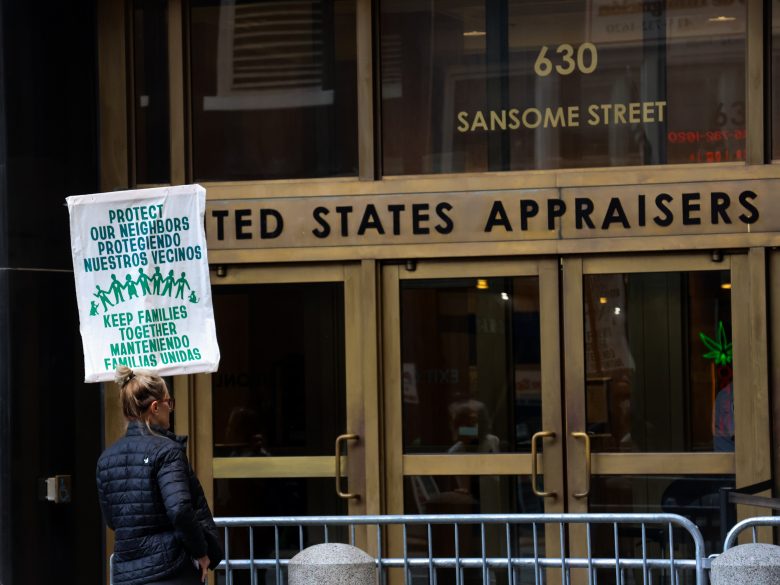
The coalition of California civil- and immigrant-rights organizations behind Pablo Sequen v. Albarran, a class-action lawsuit on behalf of immigrants arrested at immigration courts and detained by Immigration and Customs Enforcement, filed motions on Thursday that, if successful, would have a nationwide effect.
The motions seek to invalidate Trump administration policies that discarded decades of precedent by allowing ICE to go to immigration courts and arrest and detain people who were there for routine hearings.
They also challenge ICE’s practice of keeping arrested immigrants for up to three days in holding cells that are meant for short-term stays.
Immigrants arrested in courthouses are kept in small, allegedly “freezing” holding cells until they are transferred to long-term detention centers.
In June, ICE waived its 12-hour detention limit in temporary holding cells, saying it could hold immigrants up to 72 hours instead. Mission Local in August found that those arrested were subsequently spending longer and longer in cells inside 630 Sansome St., ICE’s headquarters in San Francisco.
The Lawyers’ Committee for Civil Rights of the San Francisco Bay Area and other groups filed Pablo Sequen in September 2025. Among other things, the lawsuit alleged squalid conditions at 630 Sansome St., including overcrowding, absence of basic items such as blankets, pillows, and sanitary products, medical neglect, and barriers to accessing legal counsel.
In November, U.S. District Court Judge Casey Pitts granted a preliminary injunction requiring ICE to improve conditions at the Sansome Street holding facility.
On Dec. 24, 2025, Pitts also paused Trump administration policies that allowed arrests at immigration courthouses across Northern California. Since then, courthouse arrests appear to have stopped in the area.
If Thursday’s motions succeed, that decision would become permanent, and the rulings would extend nationwide, barring ICE from arresting immigrants at courthouses when they attend hearings, and reinstating the 12-hour detention limit at ICE holding facilities across the country.
The motions were filed in the U.S. District Court for the Northern District of California and asked Pitts for a final decision, without holding a trial.
“The motions seek to put a stop to Trump administration policies that have wreaked havoc on people’s lives,” said Nisha Kashyap, an attorney with the Lawyers’ Committee for Civil Rights.
Kashyap said the courthouse arrest policies have put immigrants in an impossible situation: Attend their mandatory hearing and risk being arrested and detained, or miss their court hearing and receive a deportation order.
“That is a choice that no one in the American legal system should have to make,” she added.
The first motion argues that the courthouse arrest policies violate the Administrative Procedure Act by reversing a longstanding practice without a reasoned explanation and by disregarding the serious impact that these policies have on access to justice.
The second motion contends that ICE did not consider alternatives and ignored the humanitarian and constitutional consequences of keeping people days and nights in short-term holding cells.
“The goal of these motions is to put a stop to these harmful policies and ensure that non-citizens who have upcoming hearings, people who are in temporary detention in ICE custody, have their rights protected,” Kashyap said.
Government lawyers now have 28 days to respond to the motions, said Mark Hejinian, an attorney with Coblentz Patch Duffy & Bass LLP, which is part of the coalition suing the federal government.
After both sides have completed their briefing in March, Judge Pitts will make a decision.
“We’re optimistic that the court will build on its previous decisions,” Hejinian said, “and conclude that the administration’s two policies being challenged in this lawsuit are both arbitrary and capricious and need to be set aside on a nationwide basis.”