


San Francisco has been spared the widespread raids and sweeps that immigration agents have conducted in other cities, Milli Atkinson, head of the San Francisco Immigrant Legal Defense Collaborative, told a packed house at a panel Tuesday hosted by Mission Local.
But, Atkinson continued, “with the money from the ‘Big Beautiful Bill,’ we expect that is something that could happen here in the future, and we want to be prepared.”
That tone of hope — and pragmatism — carried through a panel of speakers, who spoke to a crowd of several hundred people packing the theater at Gray Area in the Mission.
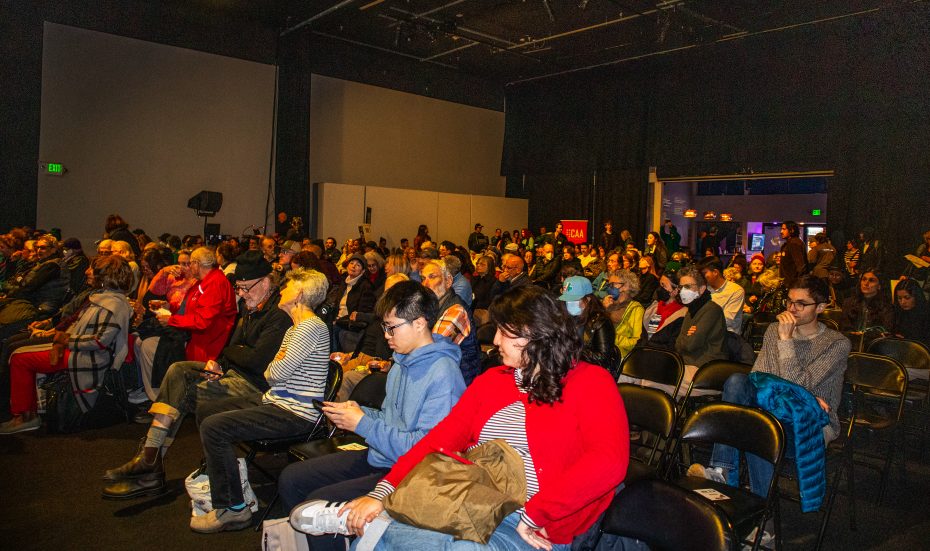
The panel — composed of Atkinson; assistant chief at the public defender’s office Angela Chan; Shira Levine, a former immigration judge fired by the Trump administration; Marissa Hatton, a senior staff attorney at the Lawyers’ Committee for Civil Rights of San Francisco; and a Peruvian asylum-seeker who was detained by ICE — reflected on the past year of immigration crackdown and resistance in San Francisco.
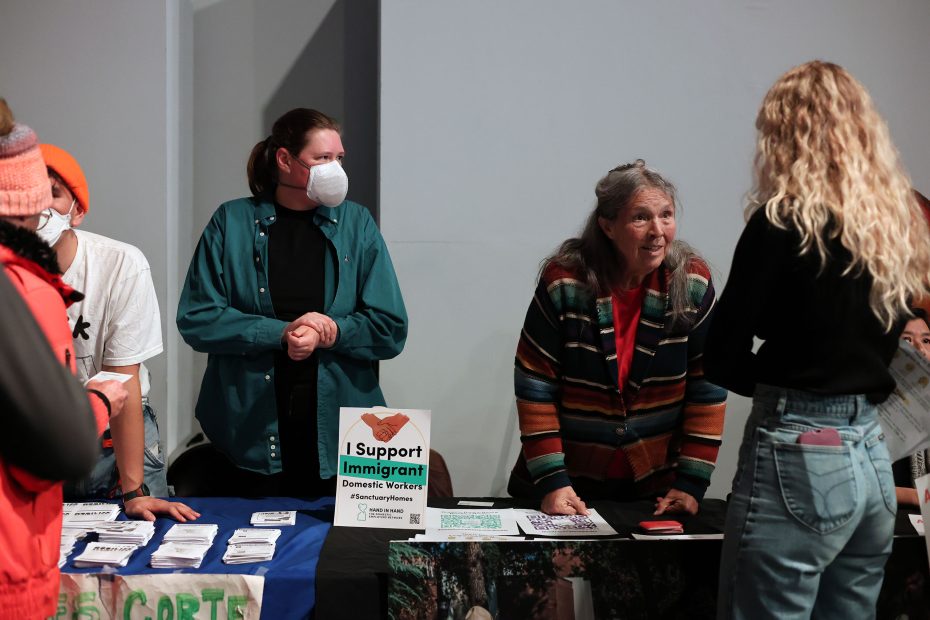
The bilingual panel was moderated by Mission Local immigration reporters Margaret Kadifa and Sage Ríos Mace. Eleven community organizations, including legal services, advocacy groups, translation services, set up tables with resource flyers and volunteer forms. Some decorated their table with handmade monarch butterflies, a symbol of migration.
Here are the highlights of what the panelists had to say:
San Francisco’s resistance to ICE is built on years of organizing
Over the past 10 months, San Francisco has witnessed courthouse arrests, protests, and a federal deployment that was called off at the last minute.
But the city’s resistance to treating immigration as a criminal matter began decades before that, said Chan from the public defender’s office. San Francisco has been a sanctuary city since 1989, meaning that city employees, like police officers, are forbidden from helping federal agents with immigration-related matters.
Making sure that sanctuary legislation actually works, said Chan, has been a long process as well. The legislation has been updated several times, and it’s taken plenty of work along the way to make sure that police are actually following the ordinance.
It took further work to establish California as a sanctuary state, Chan continued, and to help pass protections in other Bay Area counties as well. Today, many of those counties have stronger sanctuary protections than San Francisco does.

When the city braced for a “surge” of federal agents in October, it directed an additional $3.5 million to immigration services. But in the coming year, the city needs to cut its budget by $400 million, and it is unclear if pushing back against deportations will be a priority for the mayor going forward.
Immigration attorneys and advocates have also built a response network that includes legal and translation services, court observer shifts and “adopt a laborer corner” neighborhood watch.
From courthouse arrests to more private places
Attorneys have seen more aggressive enforcement in the Bay Area in cities outside of San Francisco, like Santa Clara, Alameda and Sacramento. There, federal agents conduct larger-scale operations at Home Depot parking lots or day laborer meeting locations.
In San Francisco, arrests at immigration courts have been rare in recent months, but there has been “a huge increase” of arrests at check-ins at ICE’s field office at 630 Sansome St., Atkinson said.
Arrests are now moving to more private spheres, Atkinson said: Routine check-ins, marriage green card interviews and asylum interviews outside of court.
Such tactics have already been seen in San Francisco and elsewhere in California. Immigrants were arrested and sent to detention centers out of state after regular in-person ICE check-ins. In San Diego County, federal agents have started to arrest foreign spouses of U.S. citizens at green card interviews since mid November.
These arrests, unlike those at court, are harder to track publicly. At 630 Sansome St., Atkinson said, federal agents target 10 to 20 individuals every day and detain them. Many come from outside of San Francisco.

Antonella, a social worker, moved to the United States from South America two years ago. She was one of the asylum-seekers arrested at court by ICE agents in July.
At the time, Antonella told the audience in Spanish, she was terrified. The ICE officers arresting her only spoke English, and forcibly separated her from the interpreter who had been helping her in court.
“They chained me at my wrist, at my feet and on my waist. And they were patting us down constantly,” she said.
The agents kept pressuring her to sign a document that was in English. (Ariel Koren, executive director of Respond Crisis Translation, a nonprofit that provides emergency translation services, interpreted for Antonella at the Tuesday panel.)
Antonella was ordered into the back of a van crowded with other detainees, and the group was driven for six hours to a detention center in Mesa Verde near Bakersfield.
“We could barely breathe. There was no air in there,” she said. “I was so desperate that I was banging, asking for help. But I was ignored.”
Back in San Francisco, a team of immigration attorneys frantically filed a habeas corpus petition.
These petitions are a novel maneuver that uses a federal district court to pull a person out of detention at immigration court, on the grounds that a courthouse arrest in immigration court (which is a civil court, not a criminal one) violates due process, and that the person must be released.
“They filed for her, not knowing what the outcome would be,” said Atkinson. The habeas petition worked. “And then her case helped us build up for the next case, and the next case after that.”
By September, Atkinson said, “every single person” who was arrested at court would immediately have a habeas petition filed. “Some of them, we were able to get out before they even left San Francisco,” she said.
Atkinson, Levine, the former immigration judge and other organizations are developing a Bay Area Habeas network. Its goal — “a really ostentatious goal” — is to file a habeas petition within a couple of hours for people arrested at ICE check-ins.
“It’s a project!” Levine exclaimed, as the crowd applauded. “But we are already seeing results on the ground.”
The class-action lawsuits going up against ICE
Antonella was one of many asylum seekers who experienced “terrible” conditions at ICE’s 630 Sansome St. facility. At the panel, she described only being given beans and water; attorneys say their clients were held for days without a toothbrush, shower or medication.
When detainees asked for medical help, ICE ignored them unless the requests were in English, said panelist Marissa Hatton, senior staff attorney at the Lawyers’ Committee for Civil Rights of San Francisco.
“What we were finding is that ICE was arresting people at such high rates that they just didn’t know what to do with them and didn’t have the capacity to hold them.”
Hatton is one of the lead attorneys on Pablo Sequen v. Albarran, a lawsuit challenging ICE’s practices of arresting people at immigration courts and holding them for extended periods in inhumane conditions.
The Pablo Sequen legal team won a preliminary injunction in November, requiring ICE to improve the conditions at the holding facility at 630 Sansome St. in downtown San Francisco. ICE is ordered to provide beds, bedding and medical care from professionals and language access to people in its custody.
Another motion in the lawsuit is challenging ICE’s courthouse arrest tactic, arguing that ICE can’t arrest people at courthouses because of the chilling effect of deterring people from showing up in court. Hatton said she anticipated the judge to rule in favor of this motion.
“Once we get that ruling, what we’ll do next is not just to invalidate the practice here in San Francisco, but to declare the ICE policy invalid for the entire nation,” Hatton said.

What comes next
San Francisco’s immigration court has the largest backlog of any immigration court in California, so high that final hearings are being scheduled for as far out as 2029.
But it has fewer and fewer judges; the Trump administration has fired 12 judges in San Francisco since April, and two judges are retiring by the end of the year, leaving only seven to hear more than 120,000 cases.
In recent weeks, Department of Homeland Security lawyers have been proposing to close asylum cases in the United States and instead reroute those asylum-seekers into other countries like Honduras, Ecuador or Guatemala.
Attorneys are figuring out how to respond, said Atkinson. The remaining judges seemed to be under pressure to approve the government’s motion, and have signaled to the attorneys that they should appeal these decisions.
In the meantime, however, asylum-seekers are at risk of detention, which means, Atkinson continued, that some will either go undercover or leave the country entirely, because they are so afraid of being detained.
It is part of the administration’s plan to “get rid of the cases as soon as possible, in whatever way you can,” added Levine. “What we’re really seeing is just a desire to slice through the cases. I think that’s really scary.”
Levine told the audience that, about two weeks before her September firing, she and her fellow judges had received a memo stating that immigration judges who granted asylum at higher rates than the average must be “biased.” Now an incoming deputy legal director at the Immigration Institute of the Bay Area, she is outspoken about the administration.
“What’s happening here is clearly not about improvements or making things fairer or even making things more efficient,” she said. “What we’re seeing is a dismantling that is attempting to undermine the ability of anyone to have a hearing, to have due process, to see a judge.”
“What’s happening here is clearly not about improvements or making things fairer or even making things more efficient,” she said. “What we’re seeing is a dismantling that is attempting to undermine the ability of anyone to have a hearing, to have due process, to see a judge.” . Typical “Orange man bad!” comment. No introspection, zero self reflection on the role of her own actions in her firing. She approved 98% of her immigration cases! No unbiased immigration judge would possibly do that. And now her participation in this very obviously one-sided panel just further proves the point.
All this means is that even more illegal immigrants will decend upon san francisco. They broke the law to come here, and were unwilling to put in the REAL hard work to legally emigrate to the united states. If any American pulled the same stunt in any of those countries, they’d be back stateside in weeks. California needs to stop embracing degens and welfare recipients. We don’t need more orange and strawberry hawkers on street corners and home depot parking lots.
Elon Musk broke the law to come here. Melania Trump broke the law too.
You talk of real work, do you know what it even means?
Or do you just say it to hide obvious racism, like Trump.
Racism? Melania and Elon are both white!