

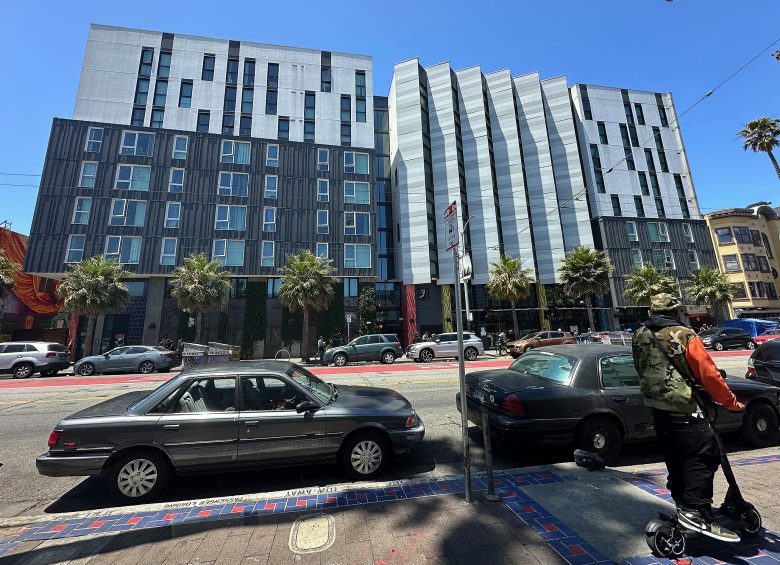

Al Casciato, who oversaw the Mission District during his long career as a San Francisco police captain, suggested recently that one of the city’s biggest urban planning mistakes at 16th and Mission streets occurred in the 1970s, when planners failed to include housing and retail as part of the BART station.
This failure, he said, meant there are no “eyes on the street,” a concept that comes from the journalist Jane Jacobs.
“There must be eyes upon the street, eyes belonging to those we might call the natural proprietors of the street,” Jacobs wrote in her 1961 book, “The Death and Life of Great American Cities,” a classic on urban planning.
When Casciato referenced Jacobs, I thought: But wait, there are eyes on Mission Street. Some 400 tenants, plus three nonprofits with active programming, reside at La Fénix, the four-year-old public housing development between 15th and 16th streets at 1950 Mission St.
The building’s stylish facade features differently textured materials, colors and angles, giving it the look of a market-rate building. Inside, walkways between the buildings, a well-maintained courtyard and a rooftop garden make the affordable housing complex its own little Eden.
Step outside, however, and you’ll feel like you’ve been cast out of that garden. What awaits residents on most days, and especially on the weekends, is the dismal reality of open drug use and unpermitted vending.
“A fentanyl cloud,” said Sophia Thibodeaux, a tenant, who says she sometimes tells those who loiter in front of the building: “This is a sidewalk, not a standwalk.”
I mentioned the building to Casciato when I requested an interview to talk about his theory that “eyes on the street” would help. His interest piqued, he visited the site, parked across the street and, “just for fun,” observed the street life.
Nearly all of the ground-floor windows are tinted, he pointed out the following day. So, no one on the street recognizes that there is life inside. To people scoping out a quiet place to use or sell narcotics, it appears that “those spaces are vacant.”
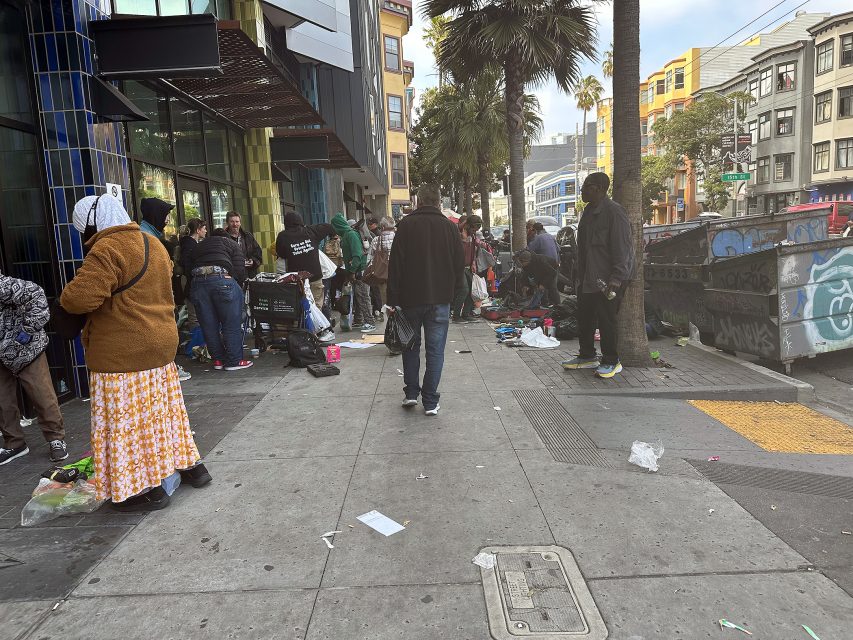
The setback at the southern entrance, a large recessed area, “created a safe space for someone to sleep,” he noted. The inset is in front of the Youth Art Exchange, which runs art programs for local youth on La Fénix’s ground floor. The setback, says Casciato, “has become a dealer hangout … they are buying and using and you can see it.”
His takeaway: “That building,” which sits in the middle of the block and takes up nearly 40 percent of the real estate along the west side of Mission Street, “has done nothing for the block.”
It’s a no-nonsense, cut-to-the-chase assessment that would make the architect and developers flinch. And Casciato would be the first to admit that La Fénix also brings important benefits to the area. Most importantly, it is home to some 400 residents, many of whom had been homeless before moving in four years ago.
“The building is what protects us from the outside,” Thibodeaux said. “Once you enter the door, the atmosphere is like a nice deep breath. “
However, neither Thibodeaux nor her nephew, who lives in another unit, wants to live in a cocoon. They want an environment safe enough outdoors that their children can ride their bikes on the sidewalk.
Mayor Daniel Lurie would agree, and the city is now 118 days into an operation to change the street culture at 16th and Mission. Everyone is trying, but, except for a limited success this weekend, the results have been disappointing.
Architecture may be part of the problem. Can it become part of the solution?
Neighboring areas suggest that’s possible. Still, transforming 16th and Mission, or even making it more livable, would require a significant commitment of resources to the physical environment, beyond a police mobile unit parked on the southwest BART plaza.
The street-facing windows
Urban buildings, Jacobs wrote, must be “equipped to handle strangers and, to insure the safety of both residents and strangers, must be oriented to the street.” Buildings, she added, “cannot turn their backs or blank sides on it (the street) and leave it blind.”
At present, as Casiato pointed out, the ground floor appears vacant, despite being fully occupied.
Perforated metal grates cover the windows to the lobby. Nearly all the floor-to-ceiling windows that run along the front of the ground-floor commercial spaces that house three nonprofits are tinted.
As a result, anything behind the windows is concealed to the outside. Instead, the windows serve as a mirror, reflecting those on the outside to themselves.
To find Bicis Del Pueblo, a nonprofit that helps people learn to use and maintain bikes, I had to ask at the front desk of the housing development. Open the unmarked door, and there’s a jumble of bikes, parts and tools. On Tuesday afternoons and evenings it comes alive with people fixing their bikes, but there’s no sign to passersby that anything exists there at all.
Faith in Action, a nonprofit that works with immigrants, has a small sign in front. Again, it looks empty to a person passing by, but open the mirrored door and the space is bustling. Dozens of people at a time can be there for training, organizing or preparing materials.
Youth Art Exchange is the only nonprofit with a partially open window and clear signage. Inside is a gallery and workspaces that wind back into a lounge, podcast studio and darkroom. The illegal activity in the front makes it impossible to keep the gallery door open.
Imagine if those on the street knew what was happening inside the three spaces. Would they be as likely to slump against the building and pull out glass pipes and tinfoil? To urinate or defecate against the windows?
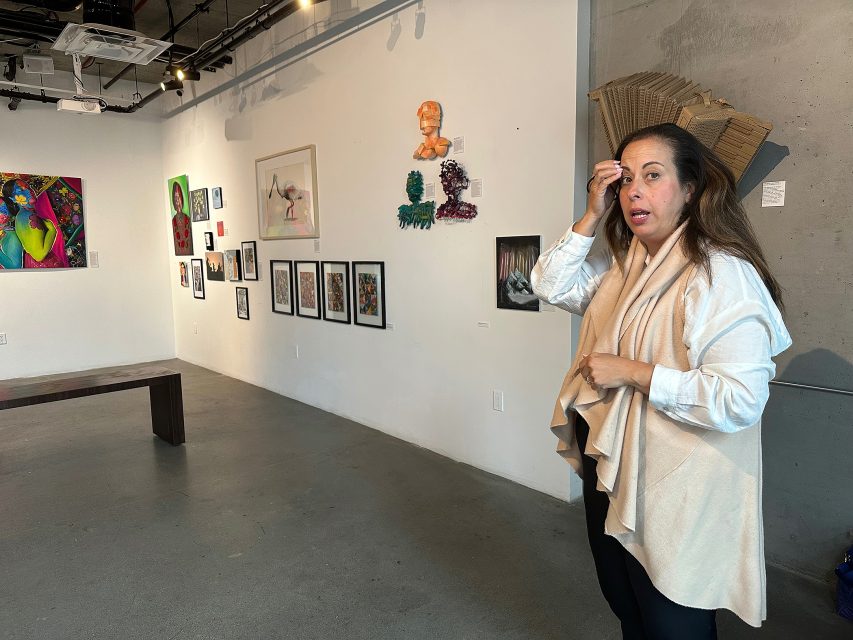
Raffaella Falchi, the executive director of the Youth Art Exchange in the gallery that faces Mission Street. Photo by Lydia Chávez. 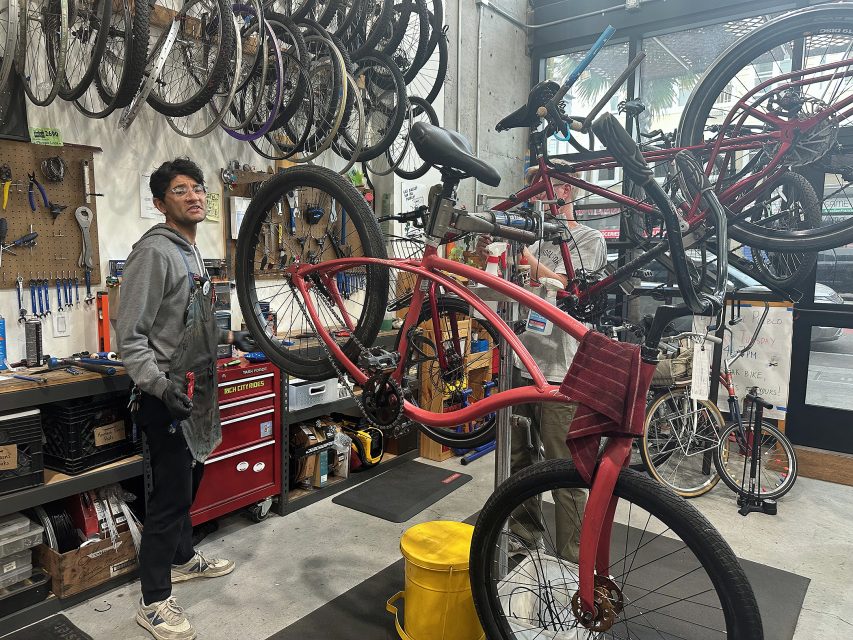
Jesse Fernandez, who runs the Bicis del Pueblo bike shop at 1950 Mission St. Photo by Lydia Chávez. 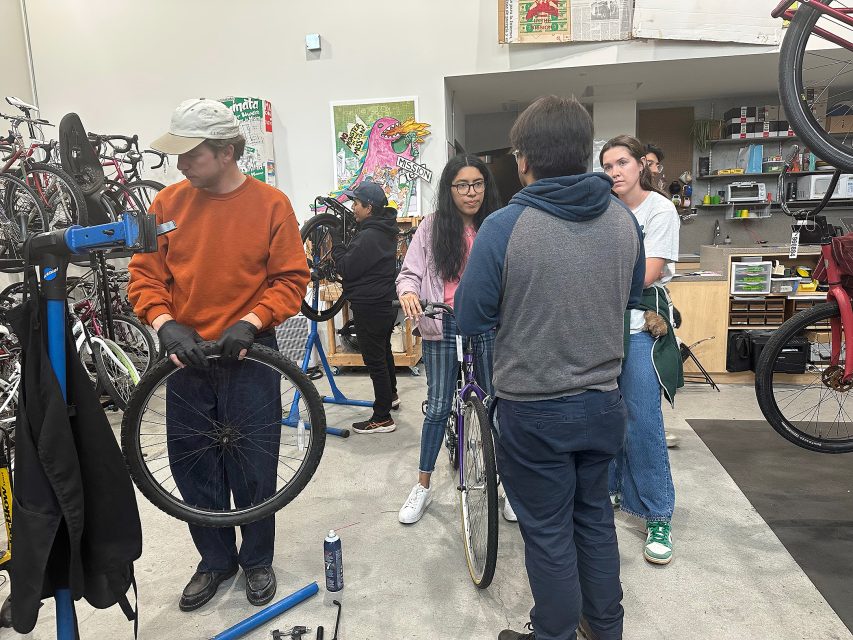
Community members using the Bicis del Pueblo bike shop at 1950 Mission St. Photo by Lydia Chávez. 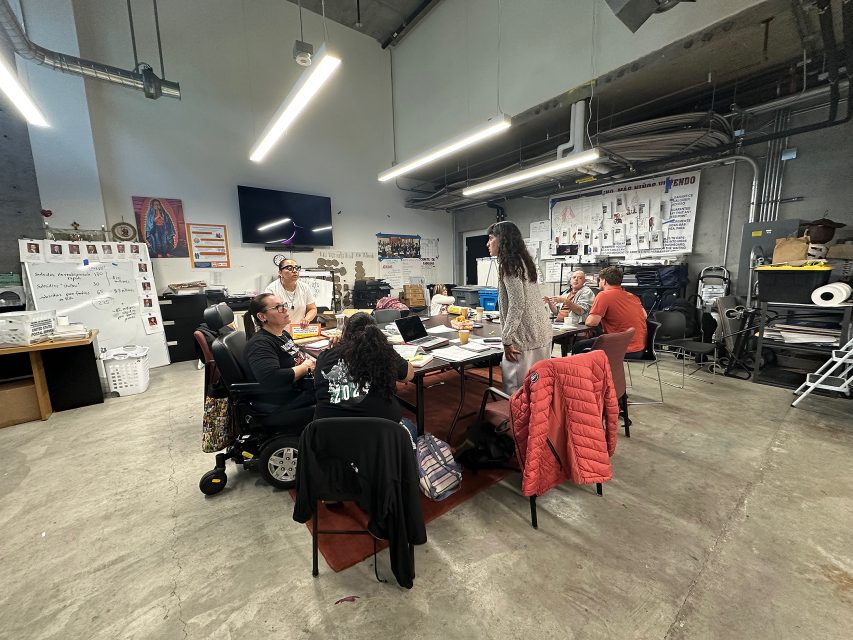
Lorena Melgarejo, executive director of Faith in Action at 1950 Mission St. Photo by Lydia Chávez.
I asked people at all three nonprofits what they thought about getting rid of the tinted windows and launching a “conversation” with Mission Street. Maybe optimism is in the DNA of nonprofits struggling to make a go of it, but the response was overwhelmingly positive, albeit with caveats.
Jessie Fernandez, who runs the Bicis bicycle program of the nonprofit PODER, said that at present, the workshop is only open one day a week, but might be open more frequently if the street conditions were better and if funds were available.
He calls what happens outside their door “a tragic testament to the wealth disparity and same old tired response.”
Fernandez said his group would be open to rethinking the windows and at least putting out more signage. Theft is a concern, but he, like others, seemed open to finding solutions.
Lorena Melgarejo, executive director of Faith in Action, loves her new space, but fondly recalled the previous office around the corner on 16th Street where the immigrant group, at work behind clear windows, could catch the eyes of passers-by.
“They could see us,” she said. “It was nice.”
“The gaze,” she continued, “is part of encountering … it is not nice to feel like we are separate.”
Raffaella Falchi at the Art Exchange, who would also be open to having all of her windows clear to the street, agreed. Although her signage is clear, she recently won a grant to improve and illuminate it.
David Baker, the architect whose firm designed La Fénix, was similarly enthusiastic. “I’m all for it, and I think it would help.” But he cautioned that it has to go along with increased security and continued street cleaning.
Falchi, who is a trained architect, has other ideas as well. Pedestrians can be informed and included in what is happening inside by something as simple as sidewalk designs indicating the services provided by the nonprofits. These are subtle indicators to signal activity and care, she said.
In fact, Baker’s early proposals included colorful tile inlays on the sidewalks in front of the building. The city’s reaction, he said: “No way.” The upkeep would be too expensive and the city was already dissatisfied with the blue tiles on Mission Street, which easily chipped and were sparingly maintained.
But with the city’s attention on 16th and Mission, it’s possible there’s an opportunity. And marking the sidewalk doesn’t have to be done with tiles or mosaics. Paint could do the job, said Falchi.
Falchi and Melgarejo would also like to see planters. Falchi devised an interim solution for theft: “We could roll them in at night.”
Still, even the most enthusiastic say added security will be part of the solution.
More on architecture and the city’s efforts at 16th and Mission Streets
‘Jane Jacobs’ approach at 16th and Mission will require more security
Rethinking the front of the large affordable housing complex at 16th and Mission could change the dynamic, but security will be needed.
100 days after S.F. pledged to clean up 16th St., drugs and vending rage on
“I love the Mission, and I have never seen this,” he said. “I don’t understand it. I don’t know what we’re supposed to do.”
One thing that San Francisco does not need more of is paint on the streets or sidewalks. It is an eyesore – and the kids shouldn’t be riding their bikes on the sidewalk anyway.
The city has abandoned the Mission other than to consider it a containment zone. Building more low-income housing will concentrate the problem, not solve it.
How about we get back to basics and stop tolerating antisocial behavior?
I still don’t see any value in having plazas for the BART station there at all. That land would certainly be better used for housing/retail and would also put more eyes on the street at that intersection.
Why not just eliminate open space altogether? What’s the point? There are rents and profits waiting to be extracted! People waiting for buses taking them to clean penthouses or prep the food at exorbitant restos can get sunlight on their own time.
And why does the reserve army of the unemployed actually have to take up physical space? Can’t they just serve their function to put downward pressure on working class wages like good sports without being seen, making messes, and requiring civic services? If they’d all just go hang out somewhere else, we could all get back to brunch!
Yes you’ve accurately captured the mindset of neoliberal low income housing residents who don’t want crackheads lighting up and pooping outside their kids’ elementary school.
Yes, the only solution to “crackheads lighting up and pooping” in the scarce and hostile public spaces we have here in the US – a problem that doesn’t seem to exist in any other country – is to eliminate that minimal open space and turn it into condos and offices.
no matter the architecture, the people aren’t going to magically disappear. We can push them from street to street, doorstep to doorstep, but in the end, it doesn’t do anything but move the people around.
Gotta house them somewhere. Gonna be expensive. But… otherwise we’ll just keep having this bubble of our population being pushed from one neighborhood to another.
The ‘progressive’ article of faith, that every drug addicted vagrant should be given an $800,000 apartment in the city is …. INSANE and can and will never happen ! Additionally they are not “our population” they are vagrants that don’t belong in our city. The longer this charade goes on, the worse the city gets, unless you are a drug addled vagrant, well then it’s your paradise right now….
Let’s ask a more basic question. Do buildings that are 100% low income/supportive housing help to fix the social problems in the streets around them?
lots of research in urban planning suggests that concentrating poverty in a building is a bad strategy.
A mix of market rate housing and low income tends to work much better -more skin in the game…. It’s why the planning code requires the subsidized low income housing be included in the same building (usually a 10-20% mix).
San Francisco has been doing it all wrong (at least at the board of sillyvisors level).
You ask a valid question. I think the city’s argument is that there are so many people who are without housing that the focus should be on housing as many unhoused people as possible.
People who live in the four newish affordable housing buildings in the North Mission in general make between 60 to 80% of the Area Median Income and in general not less. That is basically more or less $80-$100K+ for a household of four.
Are you suggesting that people who work for a living and make less than is needed to afford an apartment in San Francisco are a problem? To my mind, these people are normal people who are not in need of intensive wrap around nonprofit services who stabilize our neighborhood and vice versa.
Our 490 South Van Ness neighbors have chilled out significantly since moving to our residential neighborhood. Their kids play in the street with homeowner neighbors’ kids a block away from the local elementary school. This is the way it should be.
There is a ton of new market rate housing in the Mission as well, more than almost any other neighborhood in the city (outside of SoMa, Mission Bay, and Dogpatch) has built in the last three decades. Within a few blocks you can find large, recently-built market-rate buildings at 15th & Mission, 17th & Mission, 15th & S Van Ness, 19th & S Van Ness, 18th & Mission, 18th & San Carlos (between Valencia and Mission), 19th & Valencia, just off the top of my head.
Love any action where folks are looking for solutions.
I think a lot of folks reading this article were waiting for it to address public vs private housing/retail. Private housing and retail is when folks spend their own money to invest in the area. These folks tend to complain more about the goings on outside their establishments or homes and are more willing to call police when they don’t like the look of things.
Folks in public housing want a nice neighborhood just like everyone else does, but they may not complain as much about homeless/drig issues as they may be more sympathetic and won’t call police.
Rich neighborhoods where everyone owns the homes don’t have these issues.
There is a correlation that should be at least discussed here.
Retail on ground floor is the biggest part of eyes on the street
Yes that’s an interesting point. We have done a couple of articles about the tenant and the parents who use the ground floor day care – and they have had plenty of complaints. Here is one: https://missionlocal.org/2025/04/sf-parents-16th-street-mission-street-conditions/. And it is likely true that city officials often respond more quickly when property owners complain, but the city is paying a lot of attention to this area now.
The City and their nonprofits have been paying too much attention to our area, the wrong kind of attention that doesn’t balance whatever good they might do.
At this point, the they are doing Munchausen by Proxy, where they harm our neighborhood and then swoop in to try to be the heroes that save the neighborhood, monetizing every step in the process while insulting residents.
The east side of Mission between 15th and 16th by the Muni stop was as ripe as I’ve seen it early last evening.
The Jane Jacobs book is called “The Death and Life of Great American Cities”. I recently made the same mistake of calling it “The Life and Death of Great American Cities” since that matches the more common colloquialism.
https://en.wikipedia.org/wiki/The_Death_and_Life_of_Great_American_Cities
Thank you. I’ve corrected the mistake.
It seems to me there may be an important story to tell about La Fenix, the low income/formerly homeless complex. Nothing in today’s article seemed to indicate that La Fenix is working less than well. If that’s the case, and it is occupied by formerly homeless people, that’s definitely worth a story.
I think the “Marvel in the Mission” complex at 16th and Mission will help that corner.
Do you really think that Phase I of “The Marvel In The Mission,” permanent supportive housing at 16th and Mission, between the BART plaza and Marshall Elementary that will handle the toughest substance and psych cases, will help or harm the neighborhood that’s become a concentrated containment zone?
All of this work to catch the insults that the City is pitching at us distracts from organizing to have the city not pitch all undesirable activity into the North Mission in the first instance.
Cut the non-profits and see these problems disappear. SF has too much money, and is too liberal, we have destroyed the city.
Not mentioned in the comments so I will insert this. I’m impressed. In which other city would a police captain (retired) have so many ideas and so much to say about urban design, responsive architecture, defensible space, mixed use, zoning, and Jane Jacobs (I suspect he even read the late Allan Jacobs)? Thanks for this article.
Thank you Lydia for this thought provoking piece. I first moved to the San Francisco and the Mission in 1991. Riding the 49 last month down Mission Street, I couldn’t believe what I saw between 14th and 16th Street on Mission – total lawlessness, human despair, garbage, and illegal sales of drugs and stolen goods everywhere. The residents and non-profits in that area deserve and need a safe, clean environment to live and operate. “Eyes on the street” sounds like a great start.
It’s interesting that you specifically did not include the “for-profits”, i.e., businesses, as well.
They are, after all, the one’s that not only serve the daily needs of the residents, but also provide a significant amount of the taxes revenues that support the community, including the “non-profits”.
Karl, I didn’t intend to exclude for profit businesses. The for-profit businesses, their staff, and customers also deserve and need a clean, safe environment to operate.
Anmarie, I moved to SF and the Mission Dolores in 2000 and I have seen little change between 14th and 16th streets in that entire time. You must have some really powerful rose-colored glasses if you think it’s ‘worse’ now than in the late ‘90s—maybe the gang war that was raging then kept it in check a little more? Sheesh
This article should serve as yet ANOTHER warning to anyone that lives in the surrounding area of 1979 Mission. MEDA who brings you “the marvel in the mission” wants to develop 3 buildings, one to include 136 units of Permanent Supportive Housing right smack across the street from the street mess in front of the Fenix. As usual, MEDA, nor this City of SF have any plan to address the same issues that will undoubtedly come with this development. Why should we the neighbors believe that the street conditions would be any better with this new development? Clean up the mess first!
It’s likely that every one involved in new development will pay more attention to the consequences. And, the city, for its part, is trying to address the mess. Let’s see if they succeed. It was inspiring to talk to the nonprofits on the ground – instead of complaining, they offered solutions.
“trying to address the mess. Let’s see if they succeed.”. DPW playing concierge for dealers and fences every weekend and everything else “try”, clearly not good enough.
I guess I’m glad that Mission Local is, for once, highlighting a strategy other than policing. But this feels like a flip side of the same coin: if better architecture makes people suffering from addiction feel it’s disrespectful to use in this particular place, then they’re just going to use somewhere else. Cue the complaints from that somewhere else.
We’re a small city, and we’ve run out of somewhere elses to push people to. Instead of all this use of force that has displaced the problem without solving it time and time again, what’s missing is to actually help people at the levels required. Implement the Four Pillars framework. Fully fund treatment on demand. Fully fund affordable housing.
Displacing people, whether with cops or planters, should be a complete non-starter because that is exactly what moved folks to 16th & Mission in the first place. We’re at the end of the line for that strategy. Some of these other suggestions like more signage, and more transparent windows, are fine as far as they go, but having a discussion of the finer points of architecture feels like missing the forest for the trees. There is obvious human need out there that is not being met.
I hear you. We’ve done a lot of pieces on treatment, what it takes to get someone into treatment, deficiencies in what is available and other aspects. But yes, you are right and we will be doing more on treatment and housing. This was an effort to look at other possibilities for influencing the illegal vending and open drug use happening in front of a building filled with families and a child care center.
” Implement the Four Pillars framework.”
Unfortunately this is further away than a colony on Mars, and at this point, more unrealistic to boot.
One of the four pillars includes a safe consumption site. There will be no safe consumption sites, addict magnets, in San Francisco near any residential or commercial or mixed use areas.
The remaining three pillars are based upon a foundation of universal access to health care, psych care included. San Francisco is not going to be seeing any of that anytime soon.
The nonprofit cartel knows this full well, they know that opiate treatment is rarely successful under the best of circumstances, which street addicts have none of. But they see this as an opportunity to further monetize human misery, slow walking the treatment for maximum revenues.
What you’re seeing on the streets is the result of a decade of “funding treatment on demand and affordable housing.” Sorry the funds weren’t adequate for you, but they were substantial and entirely wasted. As our next trick, we should start fully funding jails for the out of town drug addicts to sober up before changing their lives or else.
So long as the rule is that the nonprofits get to decide behind closed doors what kind of buildings the city is going to fund for our neighborhood, they don’t have to care about any of the downside consequences of their choices. None of them live anywhere near here.
North Mission neighbors have never opposed and always welcomed affordable housing. Yet we are barred from having any say on building performance (design) and the kind of affordable housing being programmed. The City and nonprofits tell us what we’re going to get. And they often change their mind over time. 490 South Van Ness had two previous incarnations before settling on standard affordable. And even then they used units to house Potrero SFHA residents during reconstruction.
When SFUSD owned the parcel at 1950 Mission, the west side of Mission sidewalk frontage btwn 15/16th regularly had the worst street conditions in the neighborhood.
With the influx of addicts over the past year, conditions there deteriorated significantly. Mission Housing, as a self described “community leader,” had to know of circumstances but they didn’t or couldn’t care less. That costs money.
Corporations are here to make money. See also: Caritas, MHDC’s for-profit building operations subsidiary, one of a few that the Mayor’s Office of Housing insists recipients of city money use, an attack on Community Land Trusts that were to be self governed cooperatives. These people really hate SF residents.
The inclination to use ground floor retail for nonprofits sounds good, but in practice it reveals the shallow reach of the nonprofits, either for lack of funding as in bicis or because the nonprofits just don’t serve that many people and don’t generate foot traffic and eyes on the street. Ground floor office is less activating than ground floor retail. Ground floor boutiques are less activating than ground floor community serving businesses.
I learned serving on the Western SOMA Citizens Planning Task Force that planning for mixed use that works is really really difficult and requires comprehensive, forward thinking and strong controls to defend against developers’ impulse to spend less and make more money.
The solution here is for comprehensive community based planning that takes into account all urban systems that is not constrained to people associated with nonprofit developers.
And we need for there to be formal structures in city funded nonprofit boards of directors so that 1/3 of the seats are held by residents, neighbors of the communities in which they operate so that they can’t disrespect residents whose taxes fund their projects like adversarial obstacles.
Imagine how a community planned 16th BART plaza centered around Mexican food stalls could drive out bad uses with good.
We’re never going to see that at 1979 Mission from Mission Housing or MEDA because they have no incentive to and that costs money when the goal is to make money.
Sam Moss’ $275K salary don’t pay itself.
“The nonprofits don’t serve that many people” – Jesus, Marc, even for you this is a new height of absolute blither blathery nonsense. The Youth Art Exchange, for example, is a simply awesome organization that offers a huge number of *free* classes to high-school-age kids and paid summer & school year programs for yet more youth and also adults. It would likely serve even more if the entrance to the gallery weren’t such a grim scene of urban filth and misery. But you wouldn’t know about any of this because you hate kids and resent that the northern Mission isn’t filled with nightclubs anymore.
But oh no, let’s clutch our pearls some more because some ‘corporation’ needs to get their rent paid for a project to pencil out. It seems like La Fenix is quite successful and there just needs to be more thought put into the details.
For someone so damned self important you sure are short on realistic ideas on how to help those who clearly need help.
Residents of La Fenix are asking to be moved to safer affordable housing buildings.
The Head Start classrooms have seen addict incursions.
This has been reported in Mission Local.
My friends at Medithrive who are eyes on La Fenix more than either of us told me last evening that security at La Fenix is nowhere AWOL. Cashing checks and marking time is the hallmark of the cartel.
City funded poverty nonprofits often get things wrong and are in need of intensive hand holding from residents of the communities that they purport to represent, because we have to live with the consequences of their projects, not them.
YIMBY means:
Yes
In the
Mission’s
Back
Yard
This article says that one critique of the designs is that the nonprofits in 1950 Mission don’t provide enough foot traffic to activate the street, either due to funding constraints as mentioned in the article or by shallow reach when the foot traffic is needed.
The number of our neighbors served by city funded nonprofits is minimal, especially by the politically connected ones like Mission Housing who have been granted political dominion over our neighborhood.