

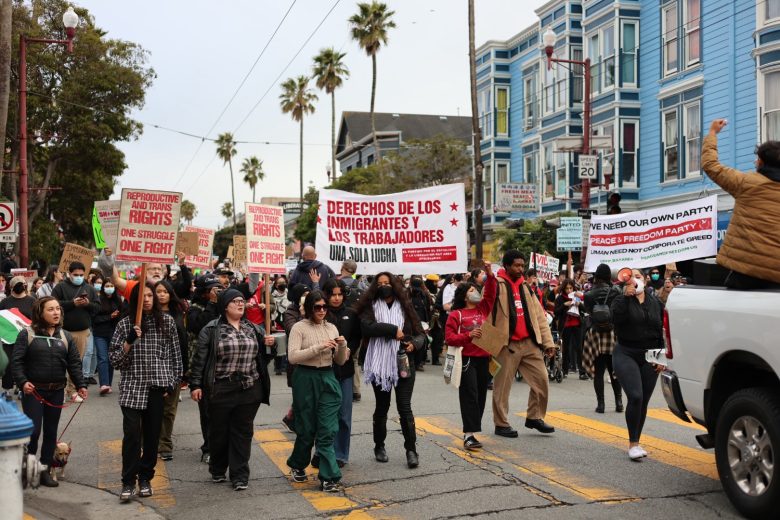

Hondurans and Nicaraguans in San Francisco are shaken after President Donald Trump announced the end of “temporary protected status” for some 80,000 people from both Central American nations on Monday.
“It’s a really terrible day,” said Lariza Duran-Cuadra, the executive director of Central American Resource Center of Northern California, a nonprofit that offers immigrant legal aid. TPS, as that aid is known, has allowed Hondurans and Nicaraguans affected by Hurricane Mitch to stay in the United States legally since 1999.
“Can you imagine? So many people have built their lives in this country … [They] own businesses, own homes and many are in mixed status families,” Duran-Cuadra said.
TPS holders from both countries have until Sept. 8 to leave the country.
Under the program, eligible migrants legally live and work in the United States because unsafe living conditions in their home countries prevent a safe return. That can include civil war, natural disasters like Hurricane Mitch, and epidemics. The program has covered migrants from countries like Syria, Afghanistan, Ukraine and Nepal.
The designations are usually renewed by the president, usually for periods of six, 12 or 18 months. The program effectively leaves immigrants on tenterhooks waiting for a decision from the executive branch, since Congress has, for decades, failed to offer permanent status for TPS holders.
Selina Bonilla, an employee at the Honduran-Mexican Martha’s Restaurant, said she has many friends who will be affected by the decision. Frustration, she said, is running deep.
“This is a tool that we have to work here,” said Bonilla, who has been living in the United States for 20 years. And now, she said, “my friends feel like that tool has been taken away from them.”
Karen Reyes, a Honduran national who has lived in the United States for three years, said her home country “has not been able to recover since Hurricane Mitch.” She was speaking from behind the counter of Oye Managua, a Nicaraguan restaurant at Mission and 30th streets. “The impact will be felt by everyone.”
TPS has covered Hondurans and Nicaraguans for more than a quarter century. It was put in place the year after Hurricane Mitch swept through Central America in 1998, killing 11,000 people, mostly in Honduras and Nicaragua, and leaving behind $6 billion in damages.
Secretary of Homeland Security Kristi Noem made the announcement on Monday morning after the administration said living conditions in both countries had improved. Immigrants, the announcement read, would have 60 days to leave the country.
Duran-Cuadra said anyone affected should seek legal consultation and explore whether they already qualify for another form of relief. She emphasized, however, that doing so is hard when people have only 60 days left in the country, especially for many of the affected, who are older adults.
Jennifer Friedman, the interim immigration unit head at the San Francisco Public Defender’s Office, said she expects to see legal challenges to the administration’s decision, similar to those filed when the administration announced the termination of TPS for Haiti and Venezuela early in the administration.
“This will impact tens of thousands of community members who have been here with work authorization for more than two decades, and have been following the immigration rules,” said Friedman. “It’s going to throw them into the kind of limbo that we’re seeing impact so many other immigrant communities.”
In the case of Haiti, a U.S. District Court judge ruled on July 1 that the administration’s decision had been unlawful because it failed to provide sufficient notice to recipients. The decision is expected to be appealed.
About 350,000 Venezuelans had hoped to retain their status after a federal judge temporarily blocked the administration’s decision in March.
In May, however, the U.S. Supreme Court ruled in favor of the administration in what the American Immigration Council described as “the biggest instantaneous de-documentation of immigrants in U.S history.”
District 9 Supervisor Jackie Fielder called the decision cruel, and said it will cause chaos for immigrant families, employers and communities throughout the country.
“This administration is summarily attempting to remove all legal avenues for immigrants who are established in our communities to adjust their status, and will lead to increased deportations of beloved neighbors, friends and family members,” read a statement from Fielder, whose district has the highest population of Latinos in San Francisco at 26.2 percent.
The Latino Task Force called the decision “cruel and unjust.”
The decision is expected to affect 72,000 Hondurans and 4,000 Nicaraguans nationwide. The TPS holders represent a small fraction of the 1.1 million Hondurans and 450,000 Nicaraguans who reside in the United States.
California is home to 72,585 TPS recipients from 16 different countries as of May — the largest number, just behind Florida, Texas and New York. The state is also home to about 112,000 Nicaraguans and 110,000 Hondurans, as of 2021.
It is unclear how many of those recipients live in San Francisco, but according to a U.S. Census report from 2023, 3,552 Nicaraguans and 2,546 Hondurans live in the city, making them 1.2 and 0.9 percent of all foreign-born people here.
As of 2024, Nicaragua remained one of the region’s poorest countries and it registered a 66.9 employment rate. Honduras also remains one of the region’s poorest countries, but it recently made gains in its economy and reduced its poverty rates and annual inflation.
People once laughed at anyone who had predicted less than a year ago what is taking place now. Unless we unite to intervene, worse will come. Going after immigrants, as cruel, ignorant, and bullying as that is, is simply practice and prelude for the Trump administration going after anyone who tries to get in its way. We must always remember that they are petrified of us because we are the majority, that we all share more than we differ, and we know the difference between right and wrong.
It was clear that the insistence by the Democrat apparatus of painting most voters who are facing increased precariousness as “privileged” in favor of immigrants and trans people who were the most vulnerable centered those who don’t vote or don’t vote in numbers over those who do vote and have become increasingly impatient at Democrat non-responsiveness.
This happened nationally and here in San Francisco–the nonprofits decided that the needs of the most vulnerable had to be taken first, promising us that if government catered to most people, that would men “throwing the most vulnerable under the bus.”
Turns out they were being paid to be wrong. The path to favorable political consideration for the most vulnerable only runs through addressing the economic anxieties of the broader, non “most-vulnerable” electorate.
Now that San Francisco’s ersatz Trump mayor is going all DOGE on the nonprofits, look who’s being thrown under the bus now.
QED.
Can someone explain to me why a person who’s been in the US for 20 years – allowed to be in the US…..did not go through the process of getting a Green Card or getting US citizenship?
How would they get a green card or citizenship? The article even says, “Congress has, for decades, failed to offer permanent status for TPS holders.” – “permanent status” is a green card. There is no way for them to do that.
Most people aren’t eligible for a green card at all, even people here legally, and you need a green card before getting citizenship. If you don’t have family who can sponsor you, you generally need to get a very specific type of job where your employer will sponsor you. Working at a restaurant isn’t one of those jobs, usually it’s the type of job that needs a Master’s degree or PhD. Even if they are eligible, there are per-country quotas of how many people can get them per year – I know someone who will probably have to wait 60 years to get their green card at the current rate of processing applications.
It’s an expensive, time consuming, complicated process. The forms appear to be straight forward, but are not. It is best to use a lawyer (expensive) to assist with the process.
Why does it matter? Is it okay to mistreat people or suddenly send them to a concentration camp if the administration changes their minds? How do you know that none of the people in this group did not try? It takes actual decades to get citizenship. Then there’s this gem, which you appear to not have read: ” The program effectively leaves immigrants on tenterhooks waiting for a decision from the executive branch, since Congress has for decades failed to offer permanent status for TPS holders.”
You could just admit that you care more about your feelings than the facts.
Ok, takes “decades” – like the 20 years that TPS people have been in the US.
And, “individuals in the U.S. with Temporary Protected Status (TPS) can apply for a green card, but it’s not a direct or automatic process. TPS itself doesn’t provide a pathway to permanent residency or citizenship.”
I am asking for facts – how many people tried to get the right to stay in the US beyond depending in the TPS program – which is a temporary stay program (T)?
You’re not asking for facts. You’re asking to have your prejudices validated.
And you also didn’t answer my other questions.
Thanks for reporting
All those that are here legally due to asylum etc are really now running from fear
Of course anyone here illegally should be processed and removed .
Unfortunately , with Mr Trump in power , things will only get worse .
We welcome everyone here as long as you come legally .
I imagine those here for 25 years have bought homes, raised children and hoped to retire and die here. But Republicans racism is way to strong and they will cheer when families are ripped apart.
What happens to property owned by those who they want to deport in a few weeks?