

Mission Local is holding exit interviews with elected officials leaving office after the Nov. 5, 2024 election: London Breed, Aaron Peskin, Hillary Ronen, Ahsha Safaí and Dean Preston. You can read our other interviews as they are published here.
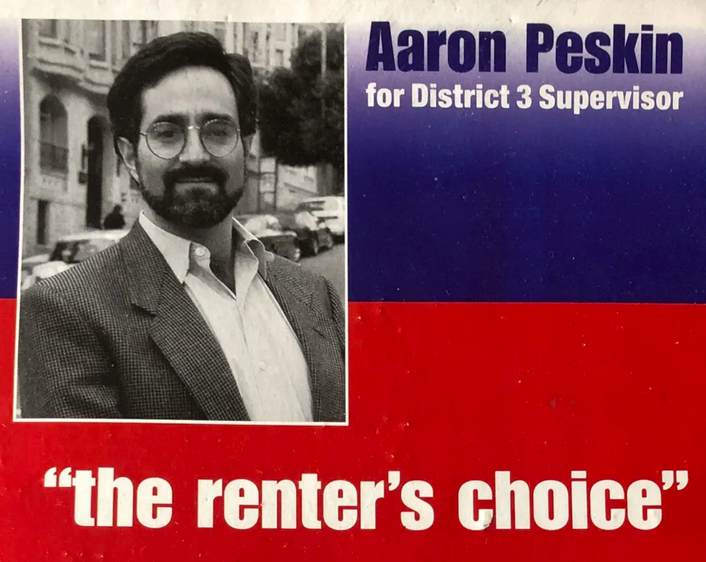
Aaron Peskin was first elected as a member of the Board of Supervisors’ Class of 2000. That was the first group of supervisors elected by district, instead of citywide, since district elections were curtailed after former District 8 Supervisor Dan White murdered District 5 Supervisor Harvey Milk and Mayor George Moscone in 1978.
The Class of 2000 brought a progressive majority to the board and, while they often disagreed with each other, they did join forces in reining in the excesses and rampant cronyism of the Willie Brown administration. One of Peskin’s campaign buttons read: “Annoy Willie. Elect Peskin.”
Peskin gained a reputation as a prolific and effective legislator, which ranged from legalizing new in-law units, blocking some developments, approving others, rezoning the Mission, SoMa, Dogpatch and Potrero, and banning the feeding of wild parakeets. He showed an evident and particular delight in taunting billionaires, particularly Don Fisher and Ron Conway, as well as a more chaotic tendency to chew out other figures in local politics, particularly during late-night drunk-dialing sessions.
Despite this, a lot of people liked the guy. After terming out in 2008, he ran for supervisor again in 2015, won two more terms, announced he’d stopped drinking, and ran for mayor. He came in third, but — in an unlikely-to-be-final act of billionaire taunting — simultaneously defeated Prop. D, a billionaire-funded ballot measure that would have reshaped City Hall.
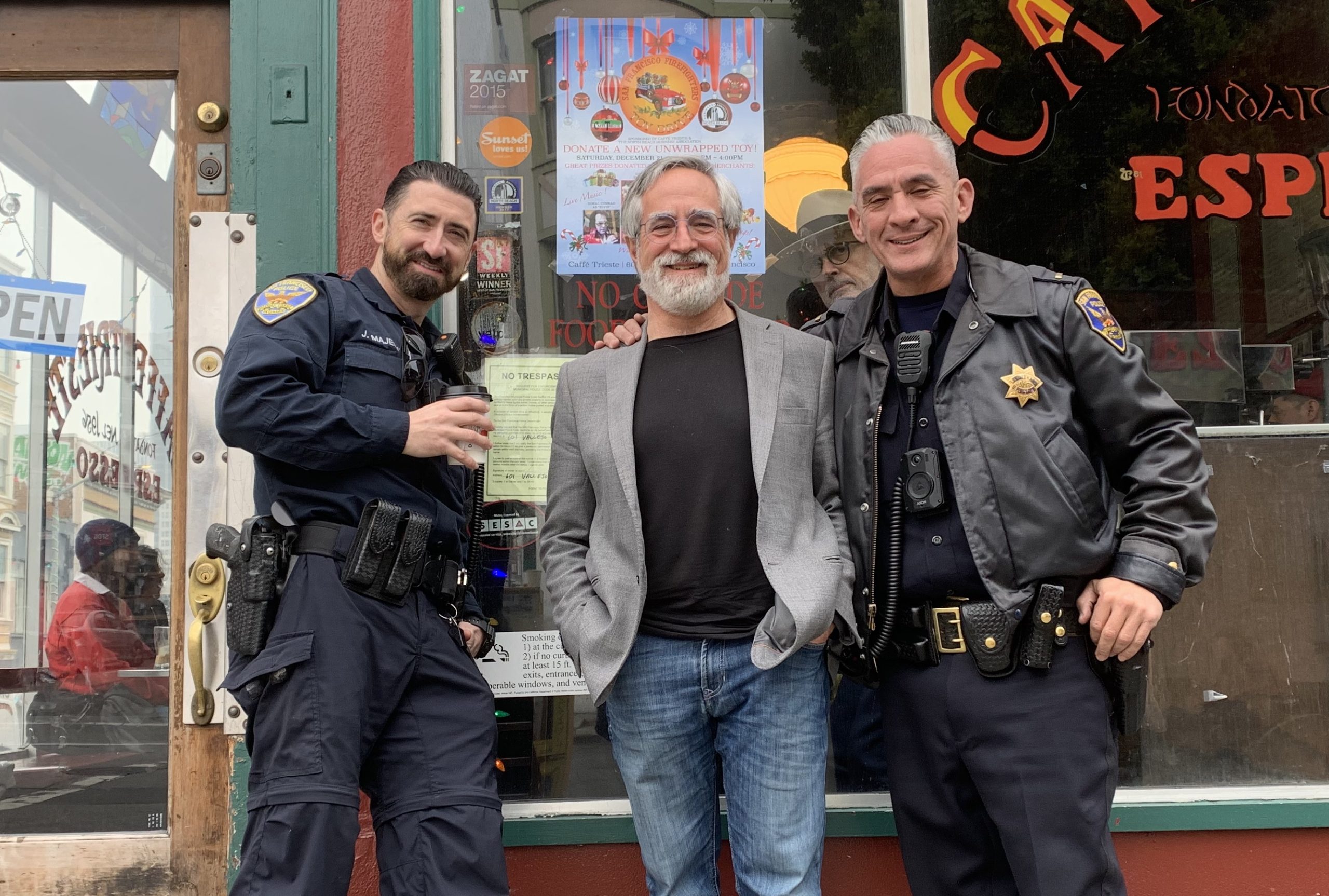
Peskin met with Mission Local at his old haunt of Caffe Trieste, where he was greeted by a near-constant procession of Frank Capra-like North Beach characters and a series of Central Station police officers. He greeted everyone by first name.
This interview has been edited and condensed for clarity.
Mission Local: What accomplishments are you most proud of during your time in office?
Aaron Peskin: That’s a hard question to answer when you’ve taken almost 35,000 votes and been to almost 2,000 board and committee meetings. Being a supervisor is a little bit like going to college; you can do as much or as little as you want. You can be as specialized or as widespread as you want.
I was kind of interested in everything. If you would have asked me if reforming governance on the Caltrain board was gonna be on the top of my list when I got into office? No.
I’m also proud of what the laissez-faire capitalists like to point to as obstruction. I think is precisely the role of good government: Taking well-intended ideas that could have had disastrous consequences and making them better.
We were just having this conversation at dinner last night, marveling that I took on the juggernaut that was filling in two square miles of the bay, a preposterous runway expansion plan that the city couldn’t have afforded and that would have been environmentally devastating.
The president of the United States, George W. Bush. The Federal Aviation Administration. The governor of California, Gray Davis. The head of the California Senate, John Burton. The mayor of San Francisco, Willie Brown. The senior senator from the state of California, Dianne Feinstein. They were all in lockstep. We were going to build these runways.
ML: Matt Smith went to Honduras for that story, right?
AP: That turned out to be a very interesting side aspect. Who would have known that we had a for-profit corporation under the airport that was privatizing airports in Honduras? Matt Smith published that article, if I recall, on Sept. 11, 2001, and nobody ever read it. [Actually 9/12/01, but same difference —Ed.]
SFO Enterprises, it was called. This whole discovery ended up putting it out of its misery. The airport prevailed upon me to give them an opportunity to sell SFO Enterprises. I was like, “Okay, but you’ve got to do it fast.” And they actually ended up foisting it off on the greater fool, Vancouver Airport.
ML: What got you interested in the airport?
AP: My entire upbringing. I was a Bay Area kid, and my lovely parents let me do what I wanted, and I was attracted to all things environmental from an early age. I remember as a young kid going on a boat that was teaching about the biology of the bay. I remember being enamored with these three women: Esther Gulick, Kay Kerr and Sylvia McLaughlin, who started Save the Bay. I got my first job out of college at the Trust for Public Land. Sylvia was very involved with the Trust for Public Land and used to drive me around in her Mustang. Amazing woman. And long before I became a supervisor, I started bay swimming. I wanted to save the bay.
ML: How old were you when you took on the airport ?
AP: I was 36.
ML: And how long had you been a supervisor?
AP: A year.
ML: So what you just talked about is a willingness of a 36-year-old, who’s never held elected office before, to take on the city’s entrenched private and public players. Who’s gonna do that now?
AP: Who knows? But part of what I remind myself about not only myself, but about the 2000 board, was that we didn’t know enough to know what we weren’t supposed to be interested in. It was, in some ways, very liberating that we were outsiders.
ML: And there were a lot of you all starting at the same time.
AP: Yeah. It kind of created this atmosphere where we didn’t know what we were doing, but we also weren’t inhibited by — and this is where the Michael Moritzes of this world are so vastly wrong. We weren’t exactly on anybody’s team. They have made independent, thoughtful people who are working in the public interest seem like some kind of left-wing cabal.
We were actually much more interested in how everything works. We were curious. I mean, yeah, we all believed in the social-welfare state. We all believed that government should be helping the people who were at least able to help themselves. But everybody was super interested in rolling their sleeves up and getting their hands dirty and holding people accountable. And we didn’t know that you weren’t supposed to do that. Willie Brown was at the end of his tenure. It was a great place to grow up.
ML: It seems like things were extremely adversarial between Willie Brown and you guys back then — “Don’t you know that I’m a killer?” — for example. Was Willie just being theatrical when he said this kind of stuff?
AP: Part of it was entertainment. Part of it was real. It was also kind of fun. I think that while there may have been some dainty people in society who were horrified by it, a lot of people thought that was San Francisco politics. Even in the worst parts, as we were calling each other names and whatever, we would go out to dinner at Tommaso’s.
ML: That’s a different dynamic. It’s like Sam Sheepdog and Ralph Wolf: The sheepdog guards the sheep, and the wolf tries to catch them, and then they clock out at the end of the day and talk about stuff.
AP: Yeah. It was much more that way. In many ways, the kind of rigidity and toxicity of the venture capital astroturf organizations have created much more stark lines.
You’d go into Willie Brown’s office, and you would say, “Hey, Willie Brown, I have an idea.” And Willie Brown would say, “Mr. Peskin, that is a fantastic idea. We are going to implement that, and I am going to take credit for it. Thank you very much.” And I would feel really good, because it actually validated my idea, and I wanted the thing to succeed.
ML: What was an idea of yours that he took credit for?
AP: One of them I remember very specifically was settling the litigation that 51 multinational corporations brought against San Francisco for our business tax structure, which Willie and Louise Renne and I negotiated the settlement of. This was a lawsuit that could have literally bankrupted San Francisco. This was in 2001, and they had a billion-dollar demand, which we thought might have been viable. It was a very interesting federal constitutional theory wherein the way our business tax structure, which had existed since the days of Dianne Feinstein, was unconstitutional. Anyway, we settled it for $77 million and financed it with judgment bonds, which we paid to the tune of $7 million a year, for 10 years, plus interest.
ML: How did you learn how to do this job? You mentioned it was like going to college.
AP: There is no training. There is no school you can go to. For me, the most important life experience that I brought with me was that I had come out of a world of real-estate negotiation. I intuitively knew that politics was the business of negotiating and using leverage to achieve the outcomes that you want to achieve in the public interest. But the rest of it is you just have to figure stuff out and make mistakes and learn.
You don’t have to be a lawyer. You just pick up the charter and read what it says. Then go ask an attorney a question. People give me all this credit for being Machiavellian. Whatever. If you are willing to ask people questions, you can figure stuff out.
ML: It was also a part-time job then, right?
AP: It was a part-time job. I got paid $37,585 a year, as set in the city charter. My aides were paid twice as much as I was.
ML: How did you pick your legislative aides?
AP: The first time around, we only had two legislative aides. I ran for supervisor in the year 2000 against an appointed incumbent. This is before ranked-choice voting, so we had to go into a runoff five weeks later.
ML: Was he the appointee?
AP: No, the appointee came in sixth out of eight. Alicia Becerril was her name. We all thought we were running against Alicia, so we were all piling on Alicia. Alicia comes in sixth. I come in first. Lawrence Wong comes in second. The next morning after the November race, the other candidates — we’ve all kind of gotten to know each other and like each other during all these debates and whatever — by the time I called them, Willie Brown had already locked every single one of them down to endorse Lawrence Wong. Except for one, Rose Chung. Rose endorsed me.
I won five weeks later. I said, “Hey, you speak Chinese. You’re born and raised in the neighborhood. Would you come and work with me?” And she was there from my first day to my last day, for my first eight years. When I got re-elected in 2015 I asked her to come back, and she was like, “Nah, I retired.” Man, Rose Chung.
And then Wade Crowfoot, now the Secretary of Resources for the state of California, worked for my pollster, David Binder. He was a big supporter of mine in the campaign, and was a policy guy and an about-town political guy. Wade then went to the London School of Economics.
ML: Had either of them been legislative aides before, or were you all new to your jobs?
AP: None of us had a clue. There was one kid named Jesse Arreguín …
ML: The mayor of Berkeley?
AP: Well, now he just got elected to the State Senate. He was Alicia Becerril’s intern. When we showed up at City Hall, we had no clue how anything worked, and he was like, ”Let me show you the ropes. I know how to make certificates of honor. Don’t fire me.” And we were like, “Well, you’re welcome to stay.” I mean, it wasn’t paid. He was my first intern.
ML: I had a conversation with Calvin Yan once about how he came to work for your office, and he said that you actively recruited him.
AP: I’ve known Calvin since Calvin was 15 years old. He was a Chinatown alleyway youth tour guide with Chinatown Community Development Center.
ML: What was it about him that made you think, “This person would make a great legislative aide.”
AP: He worked at the food bank. He understood logistics in the community. He was bilingual. Great, dry sense of humor.
ML: So, funny people tend to do well.
AP: Funny people with good bullshit meter. People ask for the most outrageous things. It’s really, really interesting to me, how the — whatever you want to call them, the moderates — they accuse the body politic of being obstructionist when the body politic is making sure that they’re not being taken advantage of.
ML: This has come up every so often; people talk about incivility at City Hall. But it seems that you have remarkably little turnover in your office, and good relations with your former staff.
AP: Yeah, I’m friends with David Owen, David Noyola, Beth Rubenstein …
ML: [interjecting] Even when they do things you don’t like.
AP: Yeah.
ML: To what do you attribute the ability to make people enjoy working with you when it’s a really brutal job? Had you ever been a manager before?
AP: I had never been a manager before, but I always worked in collaborative environments. A lot of supervisors think that they’ve got to be the king of the office. I always, not jokingly, referred to Sunny [Angulo, Peskin’s chief of staff] as my co-supervisor. Everybody knew that she was as capable as me. She didn’t have to say, “Oh, let me go talk to Aaron and see if that’s okay.” She knew that she could make those decisions. Same with Calvin.
ML: We’ve got very wealthy people — Michael Moritz, Chris Larsen — saying the mayor is weak. Grow SF actually had a treatise that essentially says, “Let’s trace back the decline and fall of San Francisco to Aaron Peskin winning office in 2000.” How do you address this?
AP: The egotistical part of me would love to embrace it and glory in it, save for the fact that it’s not true. But I’m happy to take credit for it. Standing up to these guys is something that I’m really proud of.
ML: So when did the venture capital types start showing up?
AP: It first manifested with Conway, under Ed Lee.
ML: Have you ever interacted with Ron Conway one-on-one?
AP: I’ve been in the same room as him, but no, never.
In the old days, the titans of capital actually wanted to sit down and talk to you, figure out who you were, then attempt to work things out, and then go to war. Even Republican titans of industry, like Don Fisher, would call you up and say, “Let’s sit down to have breakfast.” And then you’d be like, “No, I’m not gonna give you this kind of a tax cut.” And then they’d be like, “Great, I’m going to the ballot.” And you’d be like, “Great, I’m gonna beat you at the ballot.”
These guys just rolled into town and figured out that they knew who you were and that there was nothing to negotiate. I mean, it was never clear to me, like, other than being a bunch of assholes — what is it that you guys want? Like this whole thing with their charter amendment. Did you guys ever come in and say you’d like to propose some charter reform? Did you sit down? You don’t have to sit down with me. Did you sit down with, I don’t know, Ben Rosenfield or Sean Elsbernd or London Breed?
ML: Even the Committee on Jobs, which had it out for you from the beginning — you would talk to each other?
AP: The Committee on Jobs would have little old supervisor Aaron Peskin come to their board meetings.
My first one, I was nervous as hell. They had coffee at seven o’clock in the morning. It was in Rocky Fried’s office at Farallon Capital, in the Alcoa building, or what they now call One Maritime. February of 2001. I brought Wade Crowfoot with me.
I’ll never forget this morning, because it was stormy. There was the president of Wells Fargo Bank, Dick Kovacevich. And Don Fisher, Warren Hellman and Paul Weiss, 15 or 20 of them around a long conference table. I’m at one end of the table, and at the other end is this glass wall looking out at the Golden Gate Bridge. As I am speaking to them, a ray of sunshine comes in and a double rainbow appears over the Golden Gate Bridge out of the dark clouds. This is the most spectacular thing I’ve ever seen.
I’m answering their questions: “Hey! I’m a reasonable guy! I believe in capitalism! I do real estate!” So I’m like, “Time out, everybody! Beauty alert! If you all swivel around in your chairs, you will see the most amazing thing!” Because they’re all looking at me.
They swivel around. Look at it. Swivel back around. And they’re like, “And you were saying … ”
ML: When did they decide they hated you? Was it after that meeting?
AP: They already didn’t like me. But they wanted to sit down and talk. And I was like, “Let’s find areas of common interest. I want your businesses to thrive and I want you to hire” — all that basic stuff.
And actually, we did find many places that we worked together. This a true story: I was campaigning for office in the summer of 2000 and I knock on this woman’s door. Her name was Irene Young. She says to me, “You seem like a reasonable young man. I’m a small landlord, and the way the city treats us is unfair. I have to pay interest on my tenant security deposit of 7 percent, but I only get 1 in my interest from the bank. That’s not fair.”
And I said, “Well, ma’am, if I’m elected, I’ll do something about it, because it doesn’t sound fair.” I get elected. She calls me up. It turns out there’s a long story about why this was in chapter 37 of the Administrative Code. It was, weirdly enough, a gift that the Board of Supervisors gave the landlord industry in the days when Jimmy Carter was president of the United States and interest rates were at, like, 18 percent. But now we were in a totally different interest-rate environment.
So I was like, “Oh, well, this is an obvious thing. We will just have the rent board choose some kind of market index, and every year the rent board will say “This year it’s 2 percent. This year, it’s 1 percent.” And so, I went and passed that legislation. Tenants said, Well, that’s fair, but we don’t like it.” And the landlords were like, “Why are you doing this for us?” And I was like, “Because it’s fair.” I think I’m the only supervisor in modern times who, in the same election, was endorsed by the San Francisco Tenants Union and the San Francisco Apartment Association, because I was fair. I mean, it’s no secret, I’m a small landlord.
ML: Let’s talk about this election in which you played no small part. Why did you run for mayor?
AP: Because not having done so would have been to capitulate to the wall of noise and intimidation that Mr. Moritz and Mr. Obendorf and the Rasputins that they have surrounded themselves with have been putting out there, which was, “We’re on a roll. We recalled the DA. We bought the Democratic Party. We are an insurmountable inevitability.” I wanted to show that normal, everyday San Franciscans are still there. They still care about their neighborhoods. A candidacy like this is still viable. If we didn’t do that, it would have perpetuated their entire Potemkin village.
ML: Did you think you could win?
AP: I entered knowing that I was a viable candidate. But I never thought that I could raise the kind of money — I mean, we raised a million dollars, the good, old hard way, from over 5,400 individual contributions from about 4,000 individuals. With public financing, that got us to $2.2 million, We were $24 and change a vote. Lurie was at $150 plus.
ML: You saw the polls; your negatives are very high. And this is a ranked-choice election. Is there any amount of money that can surmount that?
AP: It’s hard, but not impossible. Interestingly enough, if you look at my negatives prior to April, and my negatives at the end of the race, they went down quite a bit. So there’s nothing like a campaign and traipsing all over San Francisco and actually meeting people. You can change those numbers, and we did.
ML: So you didn’t win, but you feel it could have been worse.
AP: I mean, a handful of megalomaniacal, extremely wealthy interests band together to anoint their right wing-chief executive and imbue him with extraordinary powers, and they lose everything that they supported on the ballot by wide margins, and their candidate comes in a distant fourth. Absolutely worth the price of admission.
ML: Are you the tiniest bit relieved that you did not win?
AP: Absolutely.

ML: What are the big challenges up ahead for San Francisco?
AP: The transportation fiscal reality is daunting. The city fiscal reality on the general fund side is daunting. I was up to the challenge, but it wasn’t a challenge that was going to be any fun.
ML: I wonder if Daniel Lurie has any idea what he’s gotten himself into.
AP: I don’t think so.
ML: Is there anything you can intuit from things he’s done or things he said as to what he’ll do moving forward? Being a cipher worked for him during the race. That won’t work for government. Is he going to try to be Newsom 2.0?
AP: That wouldn’t be the worst thing. I don’t say this with any personal animus to the man; he’s just got to be careful that he doesn’t become Frank Jordan 2.0.
ML: What’s the distinction here?
AP: I mean, the Jordan administration was, by everybody’s account — no pun intended — a bunch of Keystone Cops. They couldn’t shoot straight. Everybody was freelancing. Everybody had their own agendas. There was no command and control.
The Breed administration, itself, was tight. That doesn’t mean that they performed. But you didn’t read front-page stories about fights between the Chief of Staff and the Deputy Chief of Staff. They kept that together. The department heads actually didn’t play out of school.
ML: Can you see any way for the city to counter the Trump administration?
AP: I think one of the frightening things is that so many of the city’s new tech elite political investors are, it turns out, either investors in the Trump administration, or more than happy to acquiesce to the Trump administration. I mean, whether it’s Sam Altman, who’s on the transition team, who, it turns out, is, oops, also lobbying for tax breaks, which I don’t think Daniel Lurie knew.
Ron Conway, who was a Republican who changed to “decline to state” for the purpose of being less of a target as he invested in San Francisco politics. This guy Stephen Carter Sherrill Jr, who’s the son of Stephen Carter Sherrill Sr., who’s invested heavily in Republican politics.
Part of what makes San Francisco San Francisco is that it has been a high-profile city of resistance, and we cannot let that get hauled away by the same folks who these billionaires just elected to become our Democratic Party. Like, I’m not hearing a word out of Garry Tan crying bloody murder about the Trump administration.
ML: Do you have any advice to your successors on being a good supervisor to this district?
AP: The most important thing is to keep your feet firmly planted in the community, with everyday people. Listen to, but keep powerful special interest groups at arm’s length. And be interested and curious.
ML: What’s the range of things you have to deal with as a supervisor?
AP: Cracked sidewalks. Tree planting. Tree pruning. Much more complicated things like social issues in families. Lonely people. Hoarders. I mean, people generally don’t call you when they’re happy. You’re kind of a group therapist and a social worker.
Nobody should get in this business if they don’t care about people. Passed legislation is just as important as — yesterday, I spent some amount of time trying to deal with a guardianship for somebody who can’t take care of themselves anymore.
ML: What is next? Where are you going to go after this?
AP: I’m going to, as I did last time, stay involved. Hold the government accountable. Advise folks, and offer what needs offering.
I’m going absolutely nowhere.
Great interview. Thank you. He would have been a wonderful Mayor even with all the tough times ahead. It is the City’s loss.
These exit interviews are a nice idea but I have to say that you avoid all the tough and probing questions, and certainly duck serious and aggressive criticism.
I could have a field day skewering Supes, particularly Peskin, Ronen and Preston. But all you did is throw them soft pitch questions enabling self-serving answers.
But I will hold off judgement until you do the Breed exit interview. Maybe you will then bring out the knives?
Correction: It was Ralph Wolf who clocked out with Sam Sheepdog. His resemblance to the more famous Wile E Coyote makes this an easy mistake to make.
Beware of wolves in coyotes’ clothing!
Sir and/or madam —
Jesus Christ! You’re right! I’ve been wrong on this for 40-plus years! I’ll fix it.
JE
You’d think Aaron was the supervisor for billionaires, tech and republicans with how much they are discussed in this article vs the actual residents of D3.
As a resident of D3 for 14 years it seems Aaron spent a lot of his time being an opponent to the people he didn’t like vs helping make his district better. Hopefully the new supervisor does take his advice and tries to focus on uplifting the community.
Aaron Peskin is correct about our needing to be frightened about the incoming Trump administration’s influential friends and the influence they can have locally.
Even as the US Congress, being presided over by Vice President Harris, tries to reassure us that our institutions are robust and resilient, while certifying Trump’s return to Washington (and also while the Fourth Estate cautions us to focus on the people’s daily struggles)– we the people are coming to the realization that we live in a country of, by, and for the oligarchy.
Lurie may be a cipher to many, but not to me.
He is a capitalist, who wishes to implement reforms within an economic system that cannot be reformed. Rather than implement, he will be implemented upon.
By the way– yesterday I was surprised to view dozens of parrots being fed from feeders attached by wires to trees by the path that leads down to Taylor Street near the Ina Coolbrith Park on Russian Hill. The feeders looked as if they had been there a long time, and they were full.
I once worked as a security guard and regularly observed people feeding pigeons. The pigeons ate so much that hours later, they popped. It was horrible.
I wish people were more thoughtful of other creatures.
Herb Caen called pigeons “rats with wings.” (Perhaps that is one reason why he is more well-known than Charles McCabe, who Alistair Cooke regarded as perhaps the best writer ever to come out of San Francisco. Mark Twain, by the way, was from Florida, Missouri.)
Great interview. Both the interviewer and interviewee prove astute.
Only part that bothers me is the cop cozying, caressing, schmoozing (see exhibit A). North Beach cops put on the sheep suit for Trieste, but the animals come out at night. I learned the hard way.
What you didn’t ask is the real “why”. You’ve got a mayor who was just “not great” and is 99% gonna lose. We all knew it. Then we had Farrell, who was in just about every billionaire pocket he could get into, taking money from republicans and libertarians and every outside business he could get into. Then, this silver-spoon rich guy who had great intentions, but really never had a job other than giving away his mom’s money – seriously, the guy didn’t have a great chance.
So Peskin stepped in, without a real chance of winning. Why?
I’m convinced Peskin looked at the options and decided that Lurie would be a better mayor, and he knew if he stepped into the fray, Farrell’s people couldn’t help but target him (they HATE him) and Lurie would walk into office with no problem.
I mean, I certainly saw that the day he announced, I assumed the plan was “either I actually win this or Lurie does, but either way, it won’t be Mark Farrell and his billionaires.”. That guy never does anything without a plan. He’s cleverest politician I know.
Park privatization and neoliberal ideologies are not discussed above. While Aaron Peskin knew that turning the Strybing Arboretum into an overpriced tourist trap was bad, that Outside Lands was destructive to Golden Gate Park, that two-tier pricing is an absolute travesty and that Phil Ginsburg and other department heads continually acted as tyrants and bullies and avoided (and often circumvented)public discussion of their policies, he did nothing to change these fundamentals.
Now, we have a mayor who idealizes the idea of turning the city into a giant tacky events space and theme park for the benefit of techies and tourists.
Even when he spoke out, he generally compromised and voted for bad legislation.
He also supported neoliberal regressive initiatives such as congestion pricing downtown (which has failed in London, while accruing revenues from many financially struggling drivers) and the (fortunately never enacted) congestion charge to drive up the “crookedess street.”
With SPUR, McKinsey and other corporate conservatives in power, we will only see things getting worse. These people are responsive only to themselves and serve only their corporate interests.
Like billionaires are the actual problem…. They are the solution! Hell the billionaire Jensen Huang made me 10 million dollars last year and 1.3 million dollars so far just this month. Talk about trickle down! The real problem is delusional neo Marxists who blame the successful people for all the losers, vagrants and drug pushers. Enabling the lowest of society creates the lowest society. San Francisco is in a leftist dystopian downward spiral and only a u turn from dysfunctional leftist ideology will reverse it. The USA is crushing China and we have billionaires to thank for it. Leftist activists have done little but turn our cities into no go zones! If the billionaires all leave for safe pastures ( Singapore, Dubai ) no one will be paying any taxes going forward. The bottom 50% of Americans only pay 4% of federal taxes. Who is going to buy $800,000 free crash pads for drug addicts then?
I’m sure the moderators are good at detecting such stuff, but that post reads a lot like AI-generated “slop”.
“1.3 million dollars so far just this month. Talk about trickle down! “. That’s awesome. I can literally see a homelss guy in a wheelchair across the street, and I know there’s a dude passed out by my office door. The restaurant downstairs is closed again, the guys working at the cafe are basically being forced to work more hours than they get paid for. The entire city is turning to crap, but YOU make over a million bucks a month and that means Trickle Down works great! Trickle down from Billionaires to Millionaires means we have a bunch of whiny boot licking millionaires who do nothing but threaten to go to Dubai to live. ———— GO. GTFO. People like you are the reason Luigi was just a good start.
Nvidia employee taxes are more or less why California expects a balanced budget. I’m thankful for Jensen Huang.
So we’re going full simpleton? Huang is no saint, more like a gangster CEO whose empire is fading. He never produced a product he didn’t try to charge double for. Watching him repeatedly kill his own stock price in dumb commentary for no reason is reminiscent of Elon.
I am reminded of Jonathan Winters who once impersonated a “Fritz” or Sergeant Schultz-type character in a television skit.
Annoyed at having his bleary-eyed, sentimental song of the Fatherland interrupted by some sudden annoyance, Winters blast out an order to: “drive a Mercedes or get out of zee neighborhood!”
(Which suggests I need to get out of this neighborhood and find something better to do– ciao!)
Nice logic: You made made millions therefore billionaires are the solution for everything. Such a reductionist and self-centered way to see a problem. Time to get your head out of your butt and see that not everyone has the same privileges as you!
Just think that instead of spending 24 billion dollars on vagrants in the last five years California had invested those funds in fire suppression and prevention… Dumb ideologies have consequences.