

Mission Local is publishing campaign dispatches for each of the major contenders in the mayor’s race, alternating among candidates weekly until November. This week: Mark Farrell. Read earlier dispatches here.
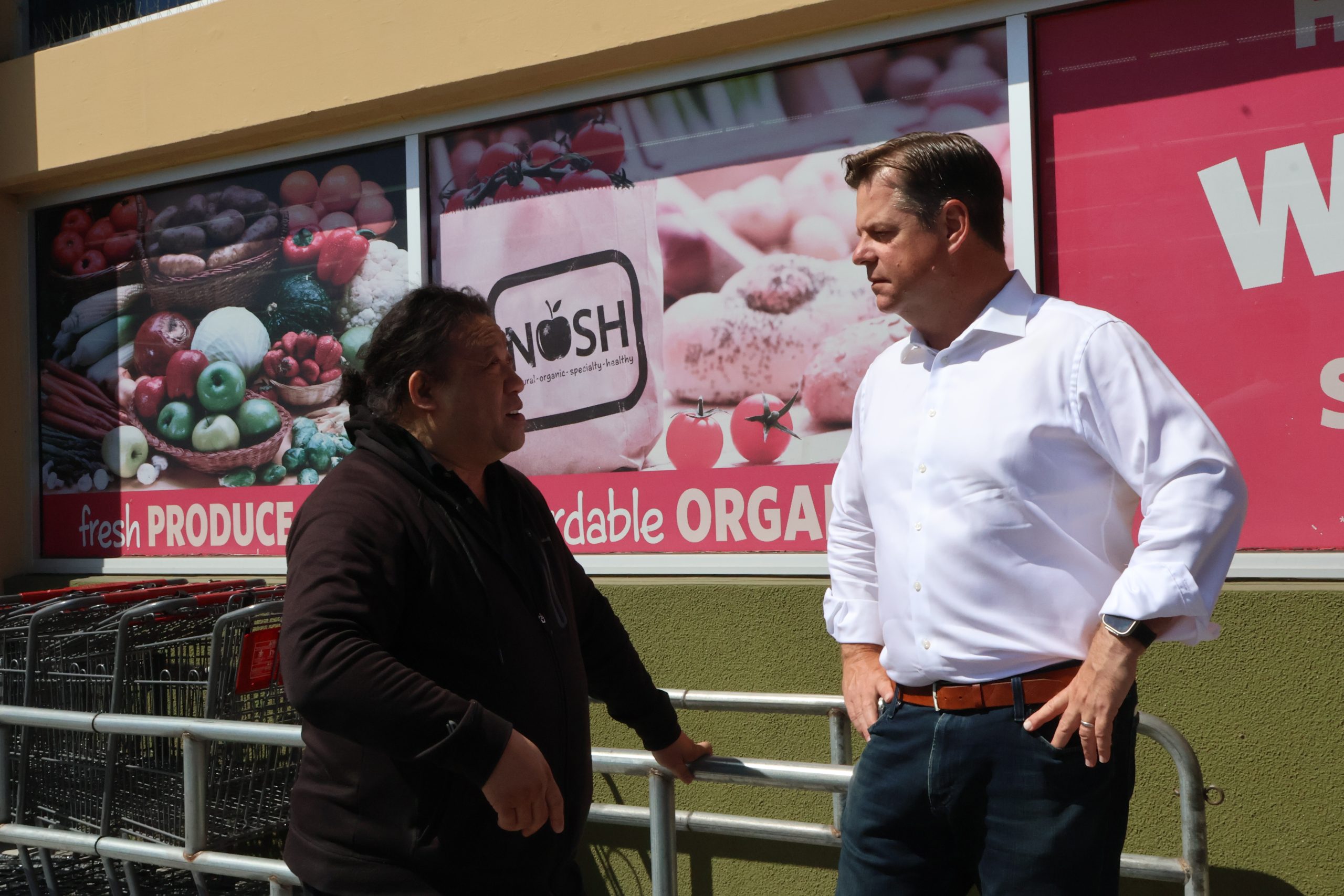
Mark Farrell’s No. 1 campaign issue is public safety. On the campaign trail, Farrell often decries the state of crime and street conditions across San Francisco, laying most of the blame at the feet of Mayor London Breed.
He frequently talks about San Francisco being “a city in decline” since he left office in 2018, though crime decreased across the city by 8.2 percent in 2023, compared to the previous year (and has decreased some 34 percent so far this year). Homelessness has increased since 2022, while the number of tent encampments has shrunk dramatically since the pandemic.
Breed is not the only mayoral candidate with a record. Farrell served as a district supervisor from 2011 until 2018, and as caretaker mayor for six months in 2018. As supervisor, he represented District 2, which includes the Marina, the Presidio, Cow Hollow and Pacific Heights.
What does his tenure tell us about his own public safety policies?
Here’s a look at some of the notable measures he worked on during his time in office.
1. Proposition Q
In November 2016, San Francisco voters passed a measure prohibiting tents on public sidewalks: Proposition Q, which was sponsored by Farrell and three other supervisors. Almost six years later, the measure has made little impact on street conditions, according to multiple city officials who have worked on addressing homelessness.
Under Prop. Q, before clearing an encampment, the city is required to issue a 24-hour notice to denizens, store any personal property for 90 days, and provide housing or shelter, although the measure does not specify the number of days for which shelter should be provided.
Farrell, and other moderate supervisors (Katy Tang, Scott Weiner and Malia Cohen) supported the measure, and it received financial backing from billionaires Michael Moritz, William Oberndorf and Ron Conway. Current mayoral opponent Supervisor Aaron Peskin opposed the measure.
The proposal itself was divisive. Those who opposed the measure argued that it further punished homeless individuals without providing any solutions. The measure did not provide for any new shelter or housing, and it hinged on the availability of existing housing and shelter options, but that stock was limited then, as it is now.
To date, the law is still in effect, but oftentimes city officials cite other laws when sweeping an encampment. The San Francisco Chronicle reported that few encampment sweeps were ever cited under the law. More recently, the city has been empowered to clear encampments following a U.S. Supreme Court ruling and has begun doing so without 24-hour advance notice or storage of personal belongings.
2. Police staffing
Farrell frequently touts his record on police staffing and attitude toward law enforcement during his time in City Hall. For the most part, that is for good reason.
The police union endorsed Farrell during his 2014 supervisorial campaign. As a supervisor, Farrell was considered a staunch police union ally, although that relationship was tested during tumultuous 2018 police union contract negotiations during Farrell’s brief tenure as mayor. Now, Farrell is seeking the Police Officers Association endorsement once again.
But some of Farrell’s claims are more far-fetched, namely that he “grew the police department.” While Farrell was supervisor, the police department did reach its highest level in recent years of full-duty sworn officers — 1,872 officers in 2017 — but this is not something Farrell, as one of 11 district supervisors, did alone.
Farrell chaired the budget committee for four years from 2013 until 2017. As such, he did have some input on the allocation of funds toward the department, which increased year-on-year during his time on the committee.
As mayor in 2018, he also advocated for more funding and proposed $34.2 million to cover hundreds of new hires and purchase new equipment. Eventually, it was Mayor Breed who approved the budget for that year. The final budget earmarked $22 million to train new officers and hire more administrative staff and $7 million to purchase new equipment.
Despite these allocations, staffing levels declined again between 2019 and 2022, with the number of full-duty sworn officers dropping from 1,840 to 1,537.
3. Laura’s law
In his campaign-launch video, Farrell noted that he “spearheaded Laura’s law,” which compels treatment for certain mental health patients.
Laura’s law is a state-level law which counties can opt into. It uses the court system to compel individuals to seek treatment when they are too ill to realize or accept that they need it.
Farrell sponsored the legislation, and ultimately managed to pass it through the Board of Supervisors in 2014 by striking a deal with then-District 9 Supervisor David Campos. It was Farrell’s District 2 predecessor, Supervisor Michela Alioto-Pier, who first attempted to pass the law four years earlier.
The law, however, only applies to individuals in specific circumstances. For instance, the patient must have a history of non-compliance with treatment for their mental illness. It is not clear how many patients have been referred through the program since the law was enacted in 2015; the city’s last report was published in 2018.
Those who opposed the law at the time argued that it risks infringing on a person’s civil rights. For several years, the Board of Supervisors bickered on and off about the law: The progressive faction of the Board of Supervisors fought against the notion of forced treatment, while the moderate faction tried to pass it.
In a statement regarding his record, Farrell stood by his past accomplishments. “Public safety has and will always be my top priority. As budget chair and supervisor, I fought to help grow our police force to a record size, established a citywide ban on tent encampments, and got mandated treatment for the most severely mentally ill in San Francisco,” he said.
As mayor, Farrell vouches to do much more than he did as supervisor — and he would have wide latitude to do so. His policy priorities include increasing the number of police academy classes to train new officers, firing current Police Chief William Scott, clearing tent encampments, and generally approaching public-safety issues with a zero-tolerance policy.
And so far, as a campaign tactic, Farrell’s stance on public safety is drawing support. Just this week, Farrell received the endorsement of the San Francisco Deputy Sheriff’s Association and GrowSF, a moderate political-advocacy group, which touted Farrell’s stance on public safety. He last week received the backing of the firefighters.

Please don’t equate “public safety” with police, homeless encampments, and crime. This is the language of the sweep-’em-away conservative groups and billionaires trying to buy our elections. True public safety means being able to cross the street or wait for a bus without being crushed by a speeding car. It also means being able to afford your rent. We need to take back this term.
I’m with you, Fran,
I’m a retired Reform School teacher and the bottom line with the 4 Knuckle-Dragger candidates is Anti-Science.
The Research confirms this …
Reform Works
Revenge does not work
And, here’s a real shocker …
Early prototype projects with a $1,000 per month UBI cut the crime rate in HALF (in Stockton) when given to Homeless and Addicts.
I’d add $10,000 tax free for Voluntary Sterilization too but there’s loud voices down that road.
lol
Peskin for Mayor cause he’s only one who isn’t into creating more Criminals.
h.