


The scissors are six inches long, with blue plastic handles, just like a pair Target might sell for $9.99. They can easily go unnoticed by passengers. But for the driver who keeps them tucked in her car door, they also have an ominous use.
“They’re sturdy,” she said. “Like, they wouldn’t bend if I poked somebody hard with them.”
The driver, who asked to remain anonymous, began carrying the scissors after one afternoon in mid-2021, when a male passenger in the back seat suddenly started rubbing her shoulders and kissing her neck. Even now, she begins to sob, telling the story of that particular ride on the I-5 in San Diego.
“Doesn’t that feel good?” the passenger asked her.
The female driver finished the ride. “I thought, ‘I’m just going to get this ride over with.’ I didn’t want him to complain that I left him off on the freeway,” she said.
Scissors are far from the only weapon stored by Uber and Lyft drivers, who face myriad safety concerns. Others carry air pistols, pepper spray, and knives. The weapons are rarely used; instead, they provide a sense of security.
And the sense of security comes in handy. A February report by the advocacy group Gig Workers Rising found that at least 31 app-based workers across the country were killed on the job in 2022; 39 percent of them were working for Uber, which had the most deaths behind the wheel of any platform, and 77 percent identified as people of color.
Nicole Moore, president of gig worker group Rideshare Drivers United, said the report is just “the tip of the iceberg” about the dangers drivers face. “There’s so much more, and so many things that don’t end up in somebody actually being deceased.”
Lyft, however, maintains a total “no weapons” policy, threatening to deactivate drivers who carry weapons in their cars; Uber only allows guns in the trunks of cars. Lyft passengers are also encouraged to report possession of weapons in Lyft vehicles to customer services.

The scissors are six inches long, with blue plastic handles, just like a pair Target might sell for $9.99. Photo courtesy of a female driver, who asked to remain anonymous. 
The scissors are six inches long, with blue plastic handles, just like a pair Target might sell for $9.99. Photo courtesy of a female driver who asked to remain anonymous. 
The scissors are six inches long, with blue plastic handles, just like a pair Target might sell for $9.99. Photo courtesy of a female driver who asked to remain anonymous.
That does not stop drivers who feel they must arm themselves. A driver who has been working in the Bay Area for two years said, “Every rideshare driver will have at least one knife in the car.” For six months, he carried an air pistol in his center console that looked identical to a real one — something Uber’s policies officially discourage.
A while ago, he replaced his air pistol with a six-inch folding knife when he traded in his car for an SUV. “If something really happens, taking out a fake gun will put me in more trouble,” he said.
Still, he could recall “very successful” cases of ride-hailing service drivers defending themselves. In January 2022, a West Philadelphia Lyft driver shot two suspected carjackers, who later faced federal charges. It is unknown whether the driver was deactivated by Lyft because of the case.
According to data from The Markup, at least 431 app-based drivers were carjacked between 2019 and 2022, including 171 Uber drivers.
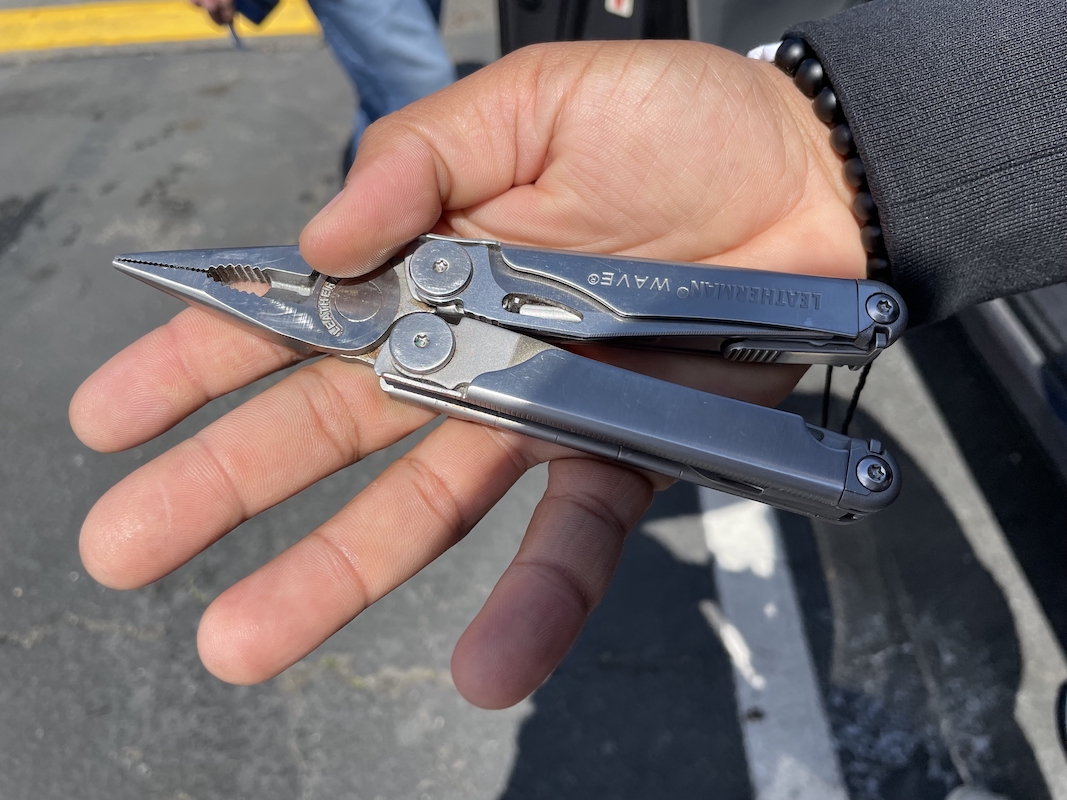
James, an Uber driver since 2021 who now lingers at the San Francisco airport parking lot, keeps a pair of foldable pliers in his center console, though he stressed that he was not carrying them as a weapon. “Once you are driving, you are exposed,” he said. “There’s nothing you can do. The only thing that can protect you for safety is dashcam.”
Other drivers have adopted even more passive tactics. Li, an Uber XL driver, said his wife insisted he put the pepper spray she bought next to his driver seat. He complied, knowing that using pepper spray in the car would probably hurt him just as much as any attacker. But he had also made up his mind: In case of a robbery, he would simply surrender his car to the perpetrator.
On an online forum specifically for ride-hailing drivers across the country, a post asking “What weapons are best for protection as an Uber driver?” received abundant feedback from drivers.
One comment claimed: “I have an open utility knife in my column, and a sharpened end rat tail comb plus an automatic knife in my pocket.” Another said: “I keep a 24” breaker bar next to my driver seat for changing tires. And cracking skulls / breaking kneecaps if the need arises.”
Drivers might disagree on their choice of weapons, but all of them on the forum and who have spoken to Mission Local agree that the best way to stay safe as an Uber driver is to “trust your instincts” and “always be aware of your surroundings,” said a post on UberPeople.net.
Still, Moore finds the very fact that Uber drivers need to consider weapons upsetting. “That’s not how people want to go to work,” she said, emphasizing her belief that Uber and Lyft aren’t doing enough to ensure driver’s safety. “A good thing about government is it’s supposed to regulate safety for workers, and people have really dropped the ball.”
So what could the ride-hailing companies do? Offer to install safety partitions, which can cost as much as $900 a piece, some said.
Drivers also said it would help to know more about their passengers. Some want Uber to run background checks on riders to filter for criminal records; others simply pray that the companies will make sure the passenger’s names and pictures are correct. The woman with the blue-handled scissors did not file a police report, because she did not know the identity of her assailant: He had booked the ride using a woman’s name.
“If I had reported that incident, it would have been ‘Linda,’” she said. If Uber took a selfie of the passenger or used facial recognition, “passengers would start to learn that that was happening, and they would start being more honest with who they are,” she said.
An Uber spokesperson said the company is working on requiring ID in certain instances, freezing illegitimate accounts, providing an in-app “live safety agent” for drivers, and allowing drivers to share their location with police.
Lyft said it provides an “around-the-clock safety response team” and works with alarm company ADT during emergencies.
Neither Uber nor Lyft has commented on the distribution of free safety partitions.

The closest thing to a weapon she carries is Victoria’s Secret perfume and a tiny sculpture of San Judas — St. Jude. Photo by Yujie Zhou, May 30, 2023. 
Yong Liu carries an unusual weapon: $39 in cash ready to bribe robbers, a lesson he learned from a driver friend. Photo by Yujie Zhou, May 30, 2023.
Not all drivers have bought into the need for weaponry. Edith Castaneda, a five-year Uber driver, described herself as “very spiritual.” The closest thing to a weapon she carries is Victoria’s Secret perfume and a tiny sculpture of San Judas — St. Jude.
Castaneda instead protects herself by only doing fares from the airport, because it’s much safer, she says. She usually drives overnight, from 4 p.m. to 5 a.m. To date, she has not experienced any violence.
“I’m blessed for that,” she said. “Everytime I come home, I thank God.”
Yong Liu, an Uber driver since 2018, carries an unusual weapon: $39 in cash ready to bribe robbers, a lesson he learned from a driver friend. The latter had been held at gunpoint twice within a month when he was waiting for better passenger fares in Oakland in the middle of the night — and both times he survived on the $20 or $30 cash in his pocket.
“We’re in a Catch-22,” said Moore with Rideshare Drivers United. “If we’re assaulted or we push back on assaults, we often will even get a bad rating, that is uninvestigated, but results in our termination from work.”
According to “Driving Danger,” a report conducted by multiple labor unions and gig-worker advocacy groups, 56 percent of drivers of color reported that they continued a ride that made them feel unsafe, due to fear of deactivation.
She’s still unsure if she would have actually tried to stab the perpetrator with her scissors. “I could have done that, but I probably still would have been afraid that he would complain.”
I feel like rideshare companies should let you have somebody ride with you so you can feel safe at all times that way you can drive while the other person watch your passenger and make sure they are not up to something cause thus world is dangerous and cruel but you get in trouble if someone reports your riding somebody else with you because they didn’t pay for the ride.
I drove for Uber for almost 10 years. I was under the impression that Uber had readily info concerning each ride (Name of account, address, etc.) which can be provider to law enforcement and help for drivers to facilitate filling a law enforcement report. Once the ride has ended, all info concerning rider, contacts, pick up point, and destination is gone. Makes it impossible to file a police report or complaint.