

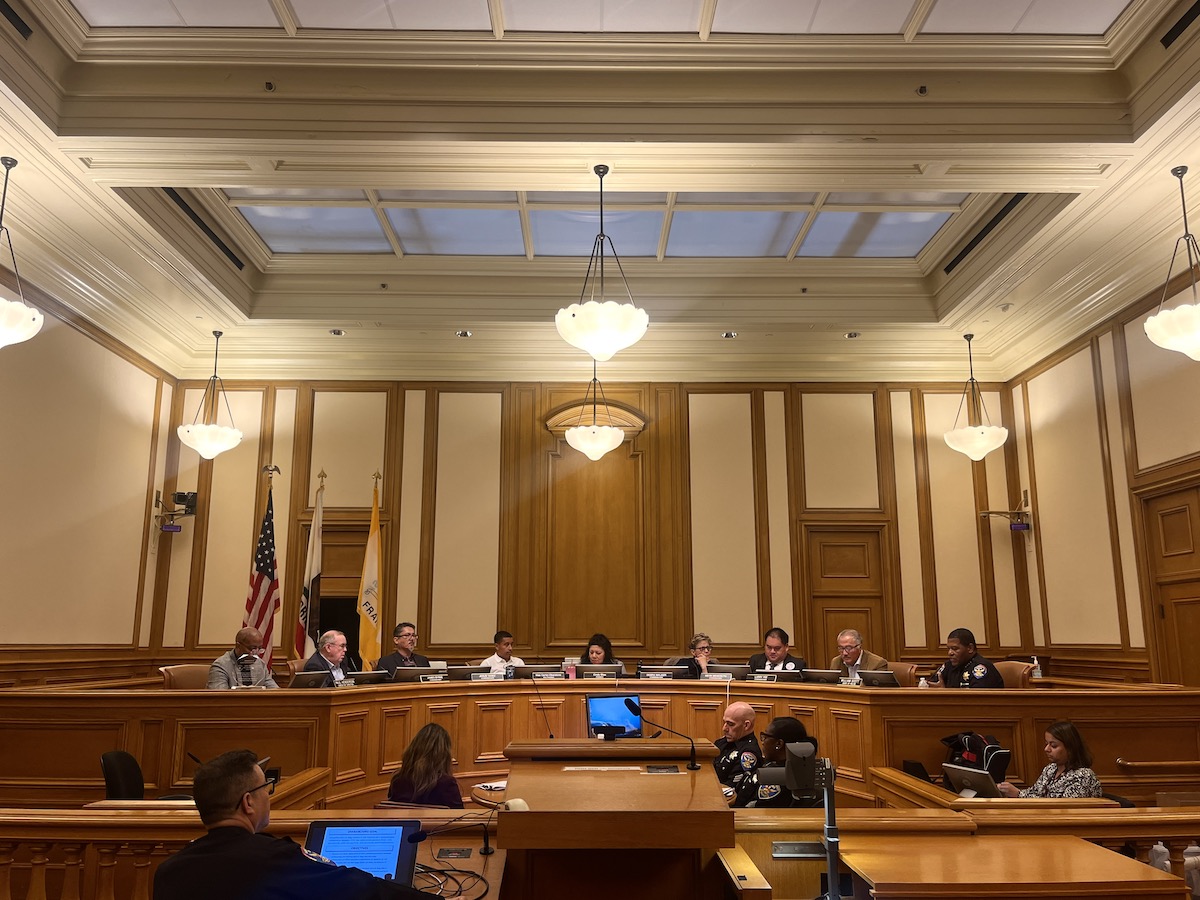

Police commissioners held a lengthy and testy probe with SFPD Chief Bill Scott on Wednesday night, questioning him over the mayor’s promise to arrest drug users and dealers through a recently announced unified command center.
The center, formally called the Drug Market Agency Coordination Center, was established Monday at an undisclosed location in Civic Center as a hub for agencies to strategize and implement a recently announced crackdown on “open-air drug markets,” which includes arresting people publicly using drugs.
As the evening progressed and commissioners moved to the subject of arresting drug users, exchanges between the commissioners and SFPD Chief Bill Scott grew increasingly tense.
Scott made it clear: the priority of officials’ crackdown on public drug consumption is to eliminate it from view.
“It’s not meant to solve addiction,” he said, adding that “people are horrified” when they walk down the street. “We are here to give some relief to these people.”
Scott said eight SFPD officers and one sergeant have been moved from their usual unit to focus on narcotics in the Tenderloin.
“I’m calling them task force officers,” said Scott. He explained that the additional officers are undergoing training by the California Highway Patrol to learn to identify and detain someone who is intoxicated. They haven’t yet been deployed.
“It will happen. I can’t give you a date, but it will happen soon.”
Experts told Mission Local this week that there is an outside chance drug consumption would be swept from public view, but that San Francisco’s crackdown was unlikely to save lives or ease addiction.
And the Police Commission, for its part, is experimenting with programs that might: Earlier in the meeting, the commission unanimously passed a non-police alternative program called CART (the Compassionate Alternative Response Team), one of several pilots that would allow mental health and social workers, not officers, to respond to certain 911 and 311 calls.
Supporters at the meeting, including several police commissioners, pointed out that CART and similar programs could respond to street conditions in the Tenderloin, instead of the police, for less cost: Commissioners estimated that the cost for a six-month pilot for the multi-agency drug bust is $5 million. CART’s proposed budget sits just under $7 million — annually.
Still, the police department showed no signs of reversing course. When pressed, Scott went on to list instances where an arrest would be made: “When they see people using in public, when they see people highly intoxicated from using illegal drugs, they will make arrests.”
“We’re focusing on people who are actually using,” he said, adding that it could include people who are “down on the ground, slumped over, semi-conscious … somebody passed out.”
“That’s behavior that is unsafe, and that people have been complaining about the most.”
Throwing yet another number into the ring of figures relayed to media by officials, Scott said SFPD has made 45 arrests of people specifically for public intoxication since May.
Scott mentioned several times that only three out of the 45 self-reported a San Francisco address as their residence. He confirmed that none of the people arrested accepted service.
Commissioner Jesus Yañez thought for a moment before remembering: “The definition of insanity is doing the same thing over and over again and expecting different results,” he said to laughter.
Yañez cited a study that found displacement may contribute to “between 15.6 and 24.4 percent of additional deaths among unsheltered people who experience homelessness or inject drugs.”
“We have a harm-reduction policy in San Francisco,” said Yañez, “but SFPD is doing things that statistically undermine that approach.”
Scott emphasized that the goal of the policy is not to save people from addiction.
“It’s meant to do our job,” he said.
Yañez and other commissioners pushed the chief for a rundown of the program, including possible community partners and how they plan to measure success. As of now, there are no clear measures of success, beyond fewer people passed out on the sidewalk, Scott said.
Vice President Max Carter-Oberstone referenced several studies, including a recent report on drug addiction and policing in Indianapolis, Indiana, that showed doubled overdose rates in the areas following a police raid of drug supply.
Carter-Oberstone asked the chief for “evidence-based” explanations of the crackdown, noting that “the folks who are supporting this never have an answer. Just anecdotes.”
“We haven’t seen anything that says this produces high-quality outcomes,” said Carter-Oberstone. “We’ve only seen the grievous harm they’ve implemented.”
“If there’s a better one, I want to hear it,” said Scott curtly.
“CART,” said several meeting attendees in unison.
Commissioner Kevin Benedicto said with a small smile that it was “fortuitous timing we have the CART coalition here and unanimously passed an alternative solution to policing.”
Last night’s resolution urges the Board of Supervisors to “fully support, fund and implement” CART as an alternative to policing in San Francisco. Advocates have been developing it since 2020. CART’s intent is to engage qualified, unarmed community workers to respond to complaints lodged against homeless people.
Despite the contract being awarded to Urban Alchemy in January and years of lobbying, there’s been no word from the mayor or supervisors on the timeline for the implementation of CART,
In his remarks backing the resolution, Carter-Oberstone praised the “avalanche of evidence” supporting community alternatives to policing. He cited the estimation that “15 percent of calls for service would be issues the CART team would address, amounting to roughly 8,000-10,000 calls a year” that would be redirected from officers to public health responders.
“It’s long past due for us to enact something like CART,” said Carter-Oberstone.
Anti-homeless sentiment has been on the rise, and hits home for day laborers in the city, who often have to find temporary shelter, said Francisco Herrera from the Latino Task Force in public comment.
“Day laborers face the street,” he said. “Last year, one of our day laborers was burned alive sleeping on the sidewalk on South Van Ness.” Herrera said that CART, and compassion itself, are “solutions-based,” and must be implemented immediately.
It’s time to can Chief Scott. He’s always wanted to go back to LA. Let the commission send him back. It appears that former NYPD Commissioner Keechant Sewell could use a job.
Why can’t they combine efforts? Have the CART social workers relocate the drug addicted into a facility that forces them into rehabilitation, but implemented in a humane way. We want them off the street, but we also want them off drugs for good so the problem doesn’t persist. We have quite a few empty buildings in the this city to help facilitate this.
Relocating them to another neighborhood won’t fix the problem. Arresting them and throwing them in jail for a week without rehabilitation won’t fix the problem.
Also, a dumb question: why aren’t they focused on arresting the dealers? You’d think that would help solve the problem as well.
‘foreigners’ coming to the city to do drugs…xenophobia
her ‘zonor attacking a supervisors for their skin color…racism
our city government has become pathetic.
How much longer are these delusional public officials going to enable drug users to ruin the city? “Community alternatives to policing” is the reason the city is unlivable and businesses are leaving. The false sense of compassion these leaders profess is sickening.
Meanwhile, the tax paying residents of San Francisco can’t enjoy public spaces and are forced to live in squalor in areas like SoMa or the Tenderloin
Forget harm reduction. Sight reduction is the answer. Sweep it under the rug. It’s been the number one solution to the homeless and drug issues since the days of Frank Jordan. Newsom and Gascon made tweeks to the policy, but basically kept it at a “see no evil” level. Let’s be clear: to the City, problems like homelessness or opioid use are perception problems which are solved by altering perceptions. Instead of drugs, they ramp up the propaganda. Drive the homeless out of the City, arrest them for “quality of life” crimes, call them drug addicts, or just throw them in jail because they are sleeping on the sidewalk (and therefore must be either addicted, or crazy, or both). Cover it over with some “progressive” rhetoric about the compassionate jails, or start a new “pilot project” and everything will be fine. Breed now adds another dimension to the propaganda, saying the other day at the Super meeting it didn’t matter what the studies and statistics say, she’s a black woman and her sister was addicted, so she knows better than the privileged white males who raise questions and do studies (she actually said that!). Are you surprised the streets are grimier than 40 years ago? “Get rid of them” is a noble, thoughtful and cheap policy prescription.
Having worked in jails and prisons as a mental health professional, I can say they do offer treatment inside and it saves lives. It is a controlled environment and that is what some people need to get clean and sober. SF has become NYC in the 1980’s during Crack Cocaine epidemic. It is unsafe and the streets are unsightly. Some how with the police crack down the city is much safer and cleaner now. You see homeless there here and there,but not like in SF. Harm reduction is meant for drug use, not inhumane living conditions this is people we are talking about. They should be sectioned to mental health court to get help or jailed end of story.
Agree but why must we let – if not encourage – addiction to play out on our streets? You wanna shoot up, pass out, poop yourself? Go right on ahead but not in front of my house.
Mission Local is the only publication giving serious, granular, thoughtful analysis to the current State of Play in San Francisco. Regrettably the MSM (48 Hills excluded), and I am only referring to print media since I DO NOT watch local TV news, continues to run the regular “If it bleeds it leads” Nightcrawler type journalism. Heather Knight(crawler) being the most shameless practitioner of this New York Post style journalism.
“Experts told Mission Local this week that there is an outside chance drug consumption would be swept from public view, but that San Francisco’s crackdown was unlikely to save lives or ease addiction.”
Experts… These addicts don’t get better. And they’re destroying our city. Can’t save lives that don’t want to be saved.
Do I think we should criminalize addiction, No.
Should Dealers be jailed, and held there until their Trial, Yes.
But I also take the stance that any person suspected of repeated theft or crimes should be kept in jail until the completion of a Trial.
You’ve heard people talking about a death loop? Apparently, it’s going over the heads of the police commission. Let’s look at the facts. Homeless drug addicts are not accepting services when those outreach teams approach them
To help. Harm reduction does not work. These people need money to support their habits to they go out and steal and then sell their items on Mission street while everyone including the police watch. They then buy their drugs and go to a center where staff watch them shoot yo and make sure they are safe. Multiply that by the thousands and you have San Francisco!
These people are a big reason why retail is closing up shop and leaving downtown. Add in the thousands of car break ins and the burglaries and the picture is complete. This administration, city council, and SFPD are all complicit in this mess.
The only people the bureaucrats care about are these homeless addicts all at the expense of everyone who lives in San Francisco or has a business here.
And they wonder why everyone is pulling out of the city.
The death loop is self imposed….
I’m curious if more info is known/available about the large percentage of people Scott said did not provide a San Francisco address. Was that because they didn’t have an address to provide, or because they provided addresses that were in places outside of SF?
Jesus Yañez: “The definition of insanity is doing the same thing over and over again and expecting different results,”
In this case, the same thing over and over is harm reduction and offering services that addicts aren’t interested in.
I gather from reading this article that some people foolishly believe that the police will somehow curb drug addiction. How did that thought come to be? I think the city needs to review what the police are being asked to do and what they can actually do. San Francisco has a well know drug culture that has endured every administration, local, state and federal, since the before most readers here were born. The fact that it’s been a responsibility for the police to solve is the reason it still exists. COPS ARE COPS, they’re not psychologists or psychiatrists or social workers or counselors and jails are not rehab facilities. It has failed for a six decades but people still keep applying the same ointment to a gaping wound that has never healed. The cops need to be relieved of that unfair responsibility that has not worked and will never work.
Ridiculous. CART will not work and the law-abiding citizens are getting marginalized through the coddling of drug abusers. I’m happy to hear that the streets are being cleaned up from these zombie-like drug users. A step in the right direction to course-correcting this city. Personal accountability is a thing and it’s not to say that living assistant programs need to go away, but the emphasis needs to change for law and order.
If you measure CART success by how many cases non-police handle after taking away the job from the police , then I guess you can call it a success. It’s circular reasoning. One thing for sure, the CART system will pay a lot of people to have compassion while making the police out to be the bad guys. Also, you can be sure CART workers will call on the police as soon as it gets dangerous.
These people have confused leniency and enablement with compassion.
The insanity comment applies to the police commissioners and their harm reduction approach. The city has been trying it, and the problem still gets worse. The druggies always turn down treatment when offered. Arrest the druggies and just as important, keep them in jail. I’m glad the mayor and police chief are starting to recognize the gravity of the problem and are trying to crack down.
The fact that you keep on saying “druggies” tells me you have no idea what you’re talking about. Arresting and keeping the “druggies” in jail will not stop the problem. This is a societal failure, and a human condition that can’t be arrested into submission. Next time think about it a little harder before you decide to comment.
Exactly. Yañez’s approach is, and has been, the status quo.
In what universe is a police force going to “solve addiction”? How can we expect any govt to “solve addiction”?
Addiction is deeply personal and the state cannot rid people of their trauma and addictive habits without their family support, or personal agency.
No one has any illusions that the PD involvement is more than pushing the issue out of public view. As reported, “Scott made it clear: the priority of officials’ crackdown on public drug consumption is to eliminate it from view.”
Remember folks the APEC summit is coming to town in November, so they’re “cleaning up” around town. Anecdotally, this is already having an impact: I have business at West Portal on the occasion, and sure enough, this morning there’s somebody sitting on the ground at the 48 stop on Ulloa, smoking fent and another “client” down the street. You’d never see that out there.
There actually is a good chance “drug consumption would be swept from public view” in the affected areas Civic Center/downtown. So expect complaints rising from lower/upper Haight, Duboce traingle, the Castro, Clement St, the Inner Sunset, West Portal and over down into the Mission of course
I think you mean “tense” exchange. If it’s “lengthy,” it can’t be “terse.”
Couldn’t a lengthy exchange between Scott and a group of commissioners have consisted of a series of terse interactions?
Jail is a much safer place to sleep off an incapacitating drug intoxication than the street. SF needs more practical progressives and fewer ‘slightly smiling’ performative progressives.
“Scott said SFPD has made 45 arrests of people specifically for public intoxication since May. Scott mentioned several times that only three out of the 45 self-reported a San Francisco address as their residence. He confirmed that none of the people arrested accepted service.”
There is the key “evidence-based” point IMHO. The legislature enacted the Penal Code. The police need to arrest those who violate it. If you don’t think certain conduct should be a criminal offense, Lobby the legislature to change the law (by the way, I’ve worked, successfully, to help reform juvenile justice and bail laws to be less punitive – it can be done). The job of the police to enforce the laws that are on the books, not what activists think the law “should” be.
Do you know what would happen if the police stopped to take enforcement action on every violation they saw? Activists aside, that would be totally impractical. Perhaps that points to a larger problem (too many laws/regulations, too little compliance), but that is the reality that they have to currently operate within.