

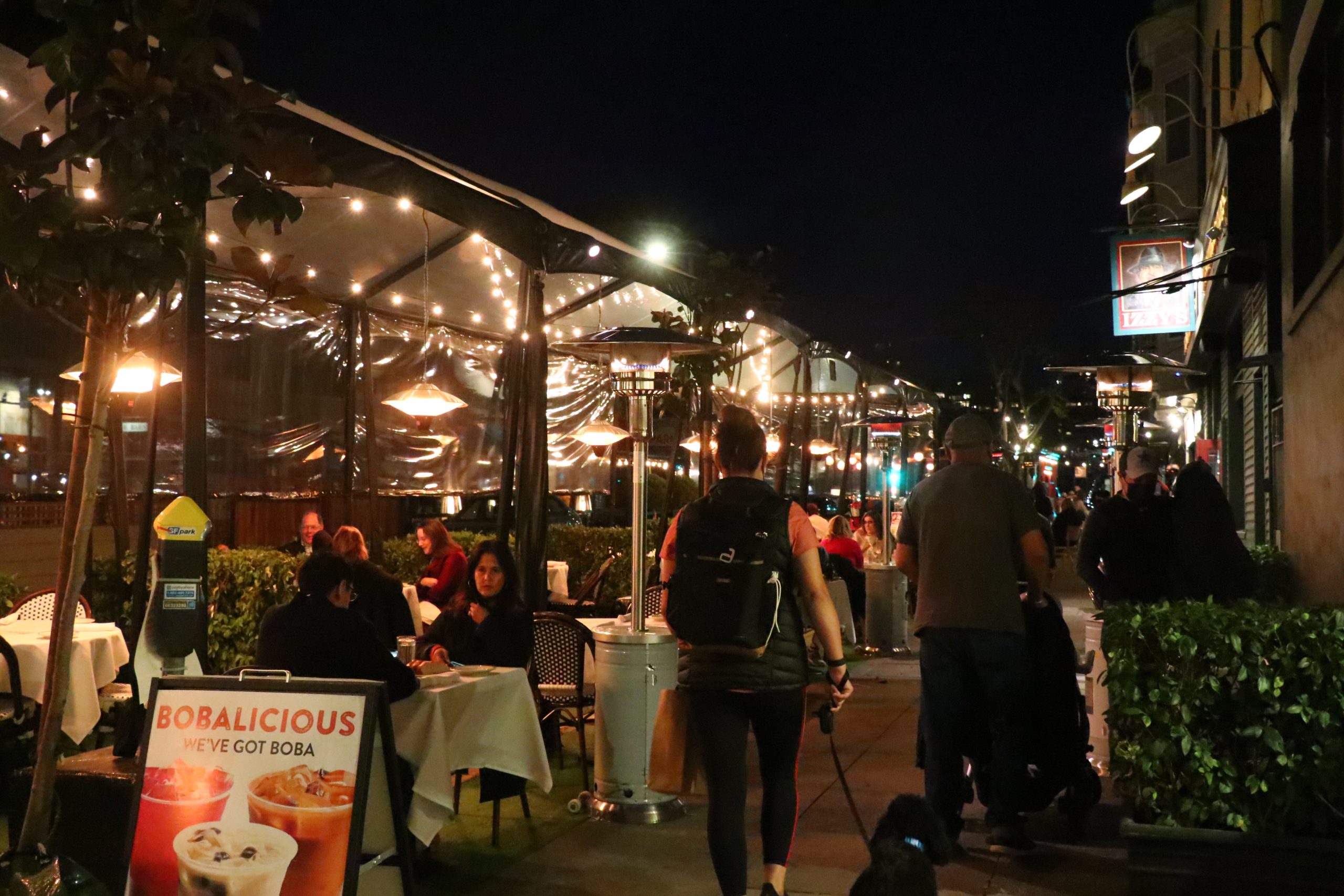

San Francisco enters a less restrictive reopening tier on Wednesday, ushering in at least 15 percent more people into indoor restaurants, gyms, places of worship, as well as outdoor bar service sans food.
Mayor London Breed and San Francisco Director of Public Health Dr. Grant Colfax today said the move occurs on Wednesday, March 24, at 8 a.m.
And businesses that weren’t previously open to certain extents during the former tiers can now do so. Some of these include outdoor breweries and bars, which no longer need to sell food to qualify, and some indoor family recreation and non-essential indoor offices at 25 percent of normal capacity.
“This year has been so tough on so many — from our kids and families, to our small businesses and their employees — and this move to the orange tier and reopening more activities and businesses than we have since last March gives us all more hope for the future,” Breed said in a press release.
Though most of the activities will match the state’s standards for reopening in the orange tier, which denotes “moderate” Covid-19 transmission and is the second-least restrictive, both emphasized that a few activities will be more restrictive in San Francisco.
For example, indoor retail will increase from 25 percent capacity to 50 percent capacity, though the state’s guidelines allow full indoor reopening for these industries with modifications.
However, the majority of industries will be permitted to bolster their capacities, including indoor dining and places of worship, which can jump from 25 to 50 percent under the city and state guidelines, and indoor gyms from 10 to 25 percent. Personal services like nail salons may also expand to 50 percent capacity.
Indoor pools, sports, and recreation can open with 25 percent capacity, and indoor museums, zoos, and movie theaters can increase patrons to 50 percent.
Some other activities waiting in the wings may be perfect as the weather warms up: On April 1, San Franciscans may enjoy outdoor performances with a 50-person audience, as long as the performers submit a Health and Safety Plan at least five days beforehand and members are socially-distanced. Outdoor sports venues can also welcome back fans with assigned seating and a Health and Safety Plan starting then. June 1 will bring the start of overnight summer camps.
Meanwhile, the city is reporting 31 new daily cases of Covid-19 a day. The new cases and hospitalizations are “trending in a positive direction,” but officials cautioned that new variants should still cause people to be cautious, especially if they are unvaccinated.
Moreover, the R number — which monitors the rate of transmission — has started edging up slightly.
The UCSF/Latino Task Force Unidos en Salud testing site at 24th St. Mission BART Plaza has appeared to be following similar trends, according to its reports in the last week. On Monday, March 22, the site reported only one positive, bringing the positivity rate to 0.64 percent that day, and the Latinx positivity rate to 0.83 percent.
Colfax said in the press release, “We need to keep up the good work so that we can continue on this forward trajectory.”
While vaccine efficacy to new variants is still being researched, many medical experts believe that the current vaccines will be effective against them.
“So far, studies suggest that antibodies generated through vaccination with currently authorized vaccines recognize these variants. This is being closely investigated and more studies are underway,” the Centers for Disease Control and Prevention site states.
And, these vaccines are rolling out in San Francisco. Just last week, vaccines became available to those 16 and older with qualifying health conditions, for the homeless, and for those living in certain congregate settings in the city.
At present, nearly 40 percent of San Franciscans have been vaccinated with at least one dose, and 77 percent of those 65 and older have, too. The city is reporting the capacity to administer 20,000 shots per day, but said lagging supply has prevented it from reaching this goal.
The Unidos en Salud site at 24th and Capp streets, which is also referring people to Zuckerberg San Francisco General Hospital, has recently increased its hours and upped its capacity to 300 vaccines a day. So far, it has administered more than 6,600 shots, of which more than 4,400 were first doses. Of the 6,600 shots, about 2,000 were given to those 65 or older, according to the organization’s reports. Approximately 65 percent of total shots were given to Latinx residents.
As of Monday, March 22, the Capp Street site had more than 200 slots available, according to Diane Jones, the former UCSF HIV nurse and a leader in the Unidos en Salud campaign.
If you are seeking a vaccine, visit here.
If you are wondering if you are eligible, go here. San Francisco is vaccinating those who live and/or work in San Francisco and who also qualify under the above requirements.
To register at the 24th and Capp street sites, visit the location from Sunday through Wednesday between 9 a.m. and 4 p.m. If you are not currently registered there, enter the wait-list line or ask to be registered at its Covid-19 rapid testing site at the 24th St. Mission BART Plaza.