
On my second day at Mission Local, I was tasked to go into SoMa. I grew up there, but I hadn’t been back since graduating from Bessie Carmichael K-8 Filipino Education Center in 2019.
I didn’t feel there was anything left in SoMa for me. I knew the neighborhood had changed during and after the pandemic. The Westfield mall, one of the few third spaces in the area where I could hang out as a teen, was long gone (for those who braved the journey to the Main Library there was also the Mix, but I went there just once).
Like me, my middle-school friends grew up and moved away. My family went to the Mission District.
Yet, the first five minutes back in SoMa reminded me why I became a journalist.
Growing up as a student at Bessie Carmichael, our teachers told us to document what we experienced here. We were told that our neighborhood was rapidly changing, and that the only way to preserve our history was to document “proof” that we were there.
Through images, writing and sound, documentation became an integral part of my childhood.
The “proof” I documented currently lives in clear plastic bins and shoeboxes across multiple closets, occasionally taken out when my family feels the need to show guests pictures.
Carefully organized by year and grade, my retrospective takes up perhaps 80 percent of my family’s shelf space. When preparing for my assignment to cover SoMa this summer, I knew where to start.


I had a list of eight landmarks I wanted to visit and write about: StarCo, the Korean grocery store at 1070 Howard St.; Archipelago Books, the Filipino bookstore inside the Bayanihan Center, All Stars Donuts at 399 5th St.; and a few others.
After a lap around the neighborhood, I realized that all eight were gone. Some had been replaced by newer, trendier businesses. Some were vacant husks. I realized much of what I considered home was nowhere to be found.
Growing up, I learned about gentrification from the adults around me, and saw it happen in realtime with every new tech office that moved into the neighborhood. I can see how it’s continued to change the neighborhood I love today.
My grandmother first immigrated to the United States from the Philippines in the late 1960s, and landed a tiny apartment on Minna Street where many of my other family members lived.
Four decades later, I officially started my residency in SoMa, becoming the fourth generation in my family to attend Bessie Carmichael School PreK-8 Filipino Education Center — my uncles first attended in the ’70s, my mother in 1987, my older cousins in 2002 and me in 2010.
Though my family relocated from SoMa to the Mission in 2002 after being priced out, there was never any question where I’d go to school.


Documentation went hand-in-hand with school learning. My kindergarten teacher took pictures nearly every day of class on her clunky Canon digital camera, which she later converted into 22 personalized photo albums she gifted us at the end of the year.
My fourth- and fifth-grade teachers assembled photo slideshows shown at our promotion ceremonies and shared them on USB flash drives to each student. Our music performances were posted on YouTube, and our artwork was displayed in our hallways and cafeterias.
I got my start as a “historian” of SoMa in an art collective called SoMapagmahal. At age 11, I was given a 35 mm camera, and marching orders to photograph what life was like for me as a student in SoMa.
With no prior photo experience, I remember thinking that my pictures would be terrible and uninteresting. Who cares what these Filipino students are doing in SoMa? I thought to myself the first few times we took shots around the neighborhood.
I never understood the importance of all this — the creating and keeping of an archive of my time as one of 600 kids in a school. But I understand now: Looking back at all the pictures I rummaged through for this piece, I am immensely grateful all four generations of my family have proof we once existed in SoMa.
Through my lens, I captured the everyday life of my friends around our neighborhood: $5 fry Fridays at All Star Donuts, photo shoots at the defunct Disney Store downtown, rainy days at the Gene Friend Recreation Center.
Many pictures also served as remnants of dearly departed institutions, like my favorite frozen yogurt place, Icebee Yogurt, the three-story Forever 21 in the old Bank of America building, Blondie’s Pizza on Powell Street, and the sorely missed Zpizza.


The photographs we took were later published in a zine called “Brown Joy,” and displayed in galleries like Bindlstiff and SOMArt. I wrote little blurbs to go with those photos about my life at the time, and the problems our community faced.
As students, we were impassioned by the stories we learned in class about places like the I-Hotel, and rippling effects of the numerous evictions that displaced hundreds of Filipinos.
That led my friends and me to speak out at a Board of Supervisors meeting against a proposed seven-story high-rise in SoMa that would’ve cast a shadow on the closest park to my school, and one of the few in the neighborhood. It was rejected unanimously after multiple comments from our community.
The SoMa issues getting headlines are real. Undoubtedly, there is heavy drug use, homelessness and displacement. There are too many traffic accidents, gun violence and robberies. It isn’t the safest neighborhood. I was always told to watch out for needles wherever I stepped.
But there is also joy. The everyday moments from SoMa I remember most: Getting to McDonald’s on Bryant Street before school with my parents, sandwiches from Tony Baloney’s for field trips, playing “Fortnite” at Microsoft on Fridays after school, skipping my after-school program to hang out at Yerba Buena Gardens and race on our bikes to AT&T Park, and watching all the new Marvel movies at the Century Theater in Westfield and trying boba for the first time at Café Central at the food court.
I remember getting all As and picking out a reward from the Sanrio store, getting our friends in the neighborhood to buy us a cup of noodles from StarCo to throw over the fence during summer camp, and mornings at BrainWash with my dad.
I remember scrounging enough money with my friends to buy sisig fries at Señor Sisig, working late to help decorate a parol for the Parol-decorating competition, and Boudin Bakery at Macy’s after being an altar server during Sunday mass with my lola, or grandmother.
There is happiness, culture, and tradition. There is the Parol Festival every Christmas, Pistahan during the summer, 9 a.m. catechism classes at Saint Patrick’s Catholic Church and a haunted house at the Gene Friend Recreation Center every Halloween.
The history of our ancestors is taught through the Filipino Foreign Language in Elementary School. Youth are introduced to activists like Larry Itliong, Dawn Mabalon, MC Canalas and Al Robles alongside learning about U.S. history.


SoMa cannot be conceptualized as just the Filipino Historical District. SoMa is wide, grand, and full of rich history, shaped by every manong and manang that lived there prior. Most importantly, SoMa is shaped by those who breathe life into it: the children, the elders, the advocates. It is evolving and will always evolve.
While gentrification continues to push more and more families out of the neighborhood, pieces of culture survive through these classes, yearly cultural performances like Flores de Mayo and field trips to places like the Alice Street Community Gardens.
This is no remedy to replicate what our community used to look like, but it is a testament to the advocates and leaders who continue to tell the story of what came before us and keep the culture alive.
Returning this summer and witnessing the same events I grew up attending was proof of what has remained, even if it was overshadowed by all that has been lost.
And looking back has been a gift. As my lola (grandmother) has instilled in me, “Ang hindi lumingon sa pinanggalingan, hindi makakarating sa paroroonan.” If you don’t look back to where you came from, you’ll never reach your destination.
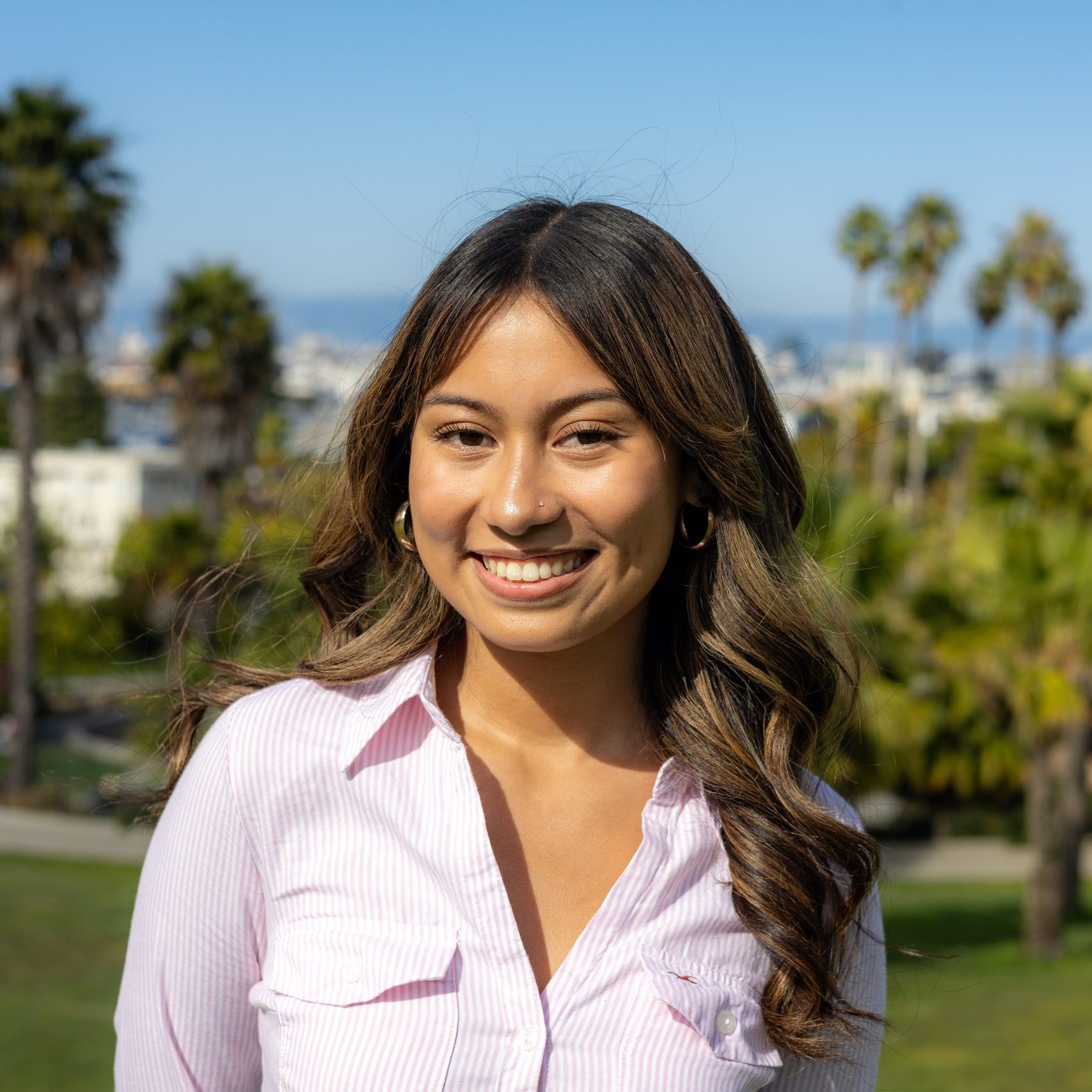
Aaliyah Español-Rivas was an intern with Mission Local for the summer of 2026.