


The general consensus among political analysts is that Sen. Scott Wiener is going to come in first place on June 2 no matter what.
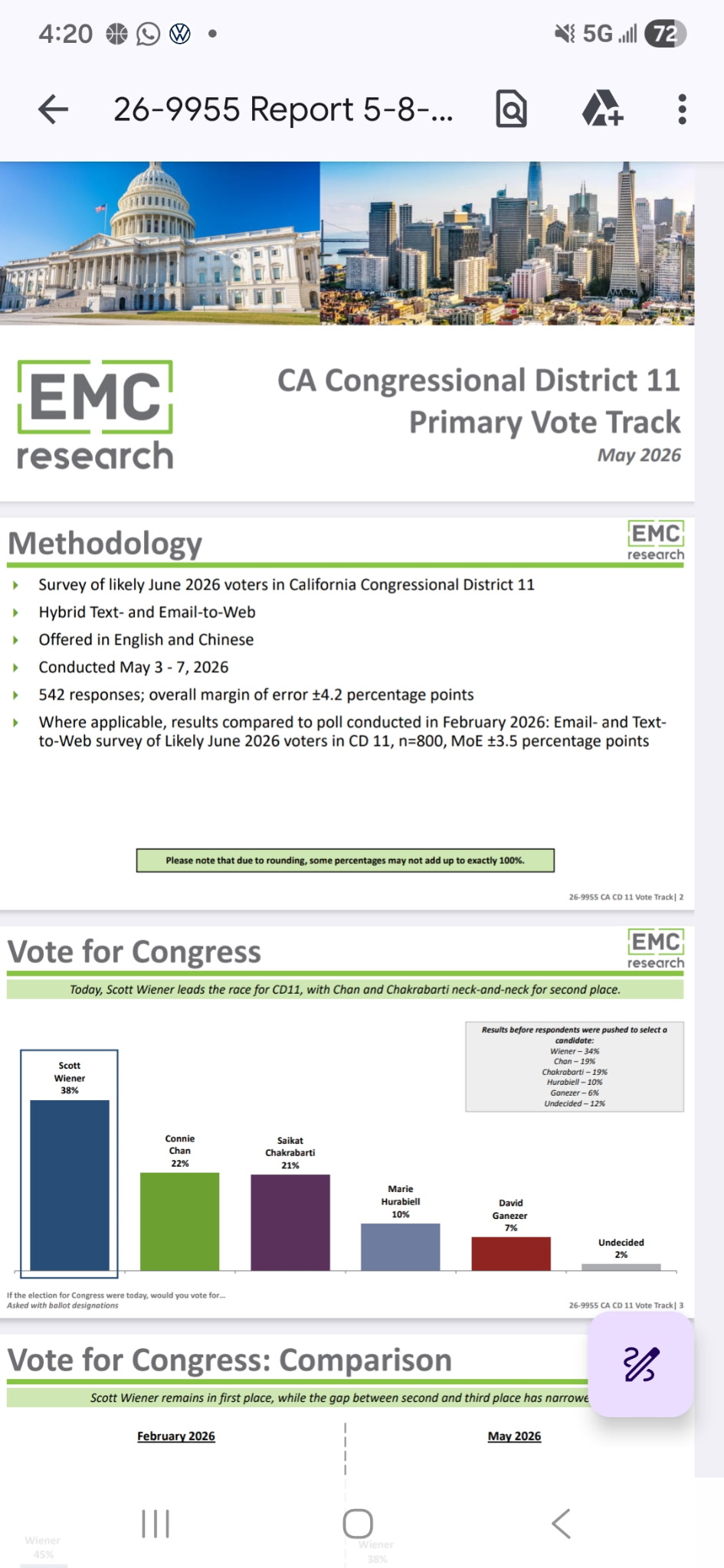
Polls indicate that Wiener will likely receive some 40 percent of the votes in the primary, while the other leading candidates, District 1 supervisor Connie Chan and tech centimillionaire Saikat Chakrabarti, are likely to each receive about 20 percent.
The only path for Chan or Chakrabarti to ultimately win in November is to win over all of the other’s supporters, those numbers show. But, to Wiener’s benefit, the fierce competition unfolding between supporters of the two progressives for the June 2 primary may be undermining that possibility.
“F**k Connie Chan,” tweeted one Chakrabarti supporter. “Saikat is a fraud,” a Chan supporter tweeted.
Ouch. And it’s only an appetizer of the enmity between the two rivals.
Wiener, for his part, appears to prefer to face Chan in November over the deep-pocketed Chakrabarti, according to political advisors watching the race. He’s so keen to see this happen that Wiener’s camp has contributed to Chan’s recent comeback: The state senator praised Chan in a recent video while criticizing Chakrabarti, and the Wiener camp also recently sponsored a poll which reinforced the idea that Chan and Chakrabarti are tied for second place.
Before May, Chan tanked in polls. But the race outlook has been reset after the release of three polls over the past two weeks, including the one conducted by a pro-Wiener super PAC.
Chan led Chakrabarti by 3 percent in an internal poll released by Chan’s campaign, 1 percent in a poll commissioned by a pro-Wiener super PAC, and was just 1 percent behind Chakrabarti in a San Francisco Chronicle poll, all within the margin of error.
Being neck-and-neck with Chan may actually mean Chakrabarti is behind, political consultants say: He needs to be at least several percentage points ahead of her in polls now to be comfortable of a June victory.
That is because Chan’s base, the Chinese American community, is almost always undercounted even in bilingual polls — many are hard to reach. Those voters are likely to give Chan an extra boost at the ballot box.
Moreover, the broad labor coalition rallying behind Chan is known for effectively mobilizing volunteers to get out the vote in the weeks leading up to Election Day, giving Chan another last-minute boost.
The math problem in June
Making it into the top two in June doesn’t require many voters — perhaps as few as 50,000, according to back-of-the-envelope arithmetic by political consultants.
Congressional District 11 has 470,539 registered voters as of May 15, according to the city’s Department of Elections. For a primary election that has few exciting ballot measures and no compelling gubernatorial candidate, consultants say voter turnout will be no more than 50 percent.
If Wiener gets around 40 percent of that, and Republican and conservative voters account for another 15 percent, any candidate with 50,000 or 60,000 votes will be in a good position to come in second, said political consultant Jim Stearns.
“As a strategist, I probably need 25 percent to be number two. I could be really sure I would come in number two if I had 30 percent. Thirty percent would be 65,000 to 70,000,” he said. “Maybe your vote goal would be 75,000 votes.”
That’s good for Chan, who has lagged behind in the money race. “Even with less funding, if Connie can focus and target her campaign communications, she might be able to be effective because she has a base to start with,” said Stearns, who said a Chan victory is “within reach.”
“Honestly, 75,000 votes is not that expensive,” Stearns said. “You can focus your resources on a smaller group, and that’s a benefit for Connie.”
By way of comparison, Aaron Peskin, the leading progressive candidate in the 2024 mayoral election, won 89,215 votes, or 23 percent of first-choice votes. Chan has picked up almost the entire Peskin political coalition, and she has her own additional Asian community base.
Chan has over $1 million backing her now, but during the months when she was severely constrained by a lack of funds and personnel, Chakrabarti and Marie Hurabiell, the conservative candidate in the race, had nonstop communication with her base.
A free-for-all for votes from different groups
Chan and Chakrabarti share a progressive ideology, with Chan running a bit more of an identity campaign focused on her working-class and immigrant background, and Chakrabarti running a much more ideological campaign, said political consultant Jim Ross.
While progressive groups have generally endorsed Chan, progressive voters are divided on the congressional race, consultants said.
Chakrabarti’s anti-establishment, anti-Pelosi message has gained popularity among many, especially younger voters who don’t usually tune in to city politics. The caveat is that many who have created online hype for Rep. Alexandria Ocasio-Cortez’s former chief of staff may not actually turn out to vote — and many others don’t even live in California, let alone the 11th congressional district.
“Remember, the people who actually come to vote in June are going to be primarily older,” said Stearns. “If in the city you have an overall turnout of 45 percent, which is what I would expect, the turnout among voters under 45 is more likely to be 30 percent.”
Similarly, Chan’s Chinese American voter base is also known for low turnout in most races. Both candidates are focused on getting their main supporters out to vote.
Chakrabarti’s wealth has helped, but will it be enough? Daniel Lurie, the last candidate who had relatively little name recognition but won a citywide race, had some $18 million behind him, a figure difficult to match. Chakrabarti’s latest filing as of the end of March shows a mere $5.2 million. “He needs to move dramatically,” said Ross.
Chakrabarti has been pouring money into the race, but the full picture will remain unclear until the next filing deadline on May 21, which will cover activities from April 1 to May 13. It’s likely to be an astronomical number since he reported another $1.1 million contribution on May 14, the first day candidate committees need to start filing notices for larger contributions every 48 hours
Also, unlike New York City, which has produced national Democratic rising stars like Ocasio-Cortez and Zohran Mamdani, San Francisco doesn’t have a good track record of electing insurgent candidates, said Jeremy Lee, president of Rose Pak Asian American Club. Its contributions to higher politics are typically establishment figures like Nancy Pelosi, Gavin Newsom, and Kamala Harris.
Emphasizing affordability and cost of living is the solution for Chan, a progressive who can marry that message to a pro-car, anti-upzoning appeal for a Chinese voting bloc concerned about public safety, said Stearns.
“She needs to braid together moderates and progressives and she needs to do that through an economic, non-ideological lens,” said Stearns. That’s Chan’s main message: helping working families.
Chan has “the potential to unite the Chinese community,” Lee said. But this community, which accounts for 14 percent of votes and around 67,000 voters, according to stats from political consultant David Ho, who is leading a pro-Chan PAC, is also coveted by all major candidates.
Chakrabarti especially has pursued that bloc. He has more than 20 paid Cantonese canvassers, following a strategy that Lurie used successfully to lock down the Asian electorate.
For his part, Wiener has invested hundreds of hours over the years participating in numerous Chinese community events. “The Chinese community really values just showing up … it means more in the Chinese community than it does in other communities,” said Lee. (Over the years, many city officials have earned a poor reputation among Chinese voters simply by skipping events.)
Thomas Li, president of the Edwin M. Lee Asian Pacific Democratic Club, said that even though the Chinese community “had a history of supporting folks who identify as Chinese,” the bloc has become less reliable for Chinese candidates.
“The new generation of Chinese Americans look beyond racial identity,” he said. Immigrant Chinese families or low-income earners, for instance, have very different priorities versus affluent Chinese homeowners.
Hurabiell proves that point. She has earned the support of some conservative-leaning Chinese American figures and groups, including former school board member Ann Hsu, the Association for the Advancement of Asians, and the historic Wah Ying Club. Hurabiell “shares the same values as most of Chinese Americans in San Francisco,” said Hsu.
Chan was also supposed to get the non-Chinese conservative NIMBY voters on the Westside, but Hurabiell has come in and taken some of them, too.
Wiener has a moderate ideology by San Francisco standards. He’s pro-housing and a little more fiscally conservative and supportive of business. “He has pretty solidified that [middle] lane in the primary,” said Ross.
Chakrabarti also wants the urbanist voters — a recent notable ad said the candidate would focus on “building new housing” — and many YIMBYs in San Francisco have been attracted to his agenda. Still, this is a base Wiener has cultivated for years.
Chakrabarti “should be making the case that it’s him, not Wiener who can actually forward this YIMBY agenda,” said Stearns.
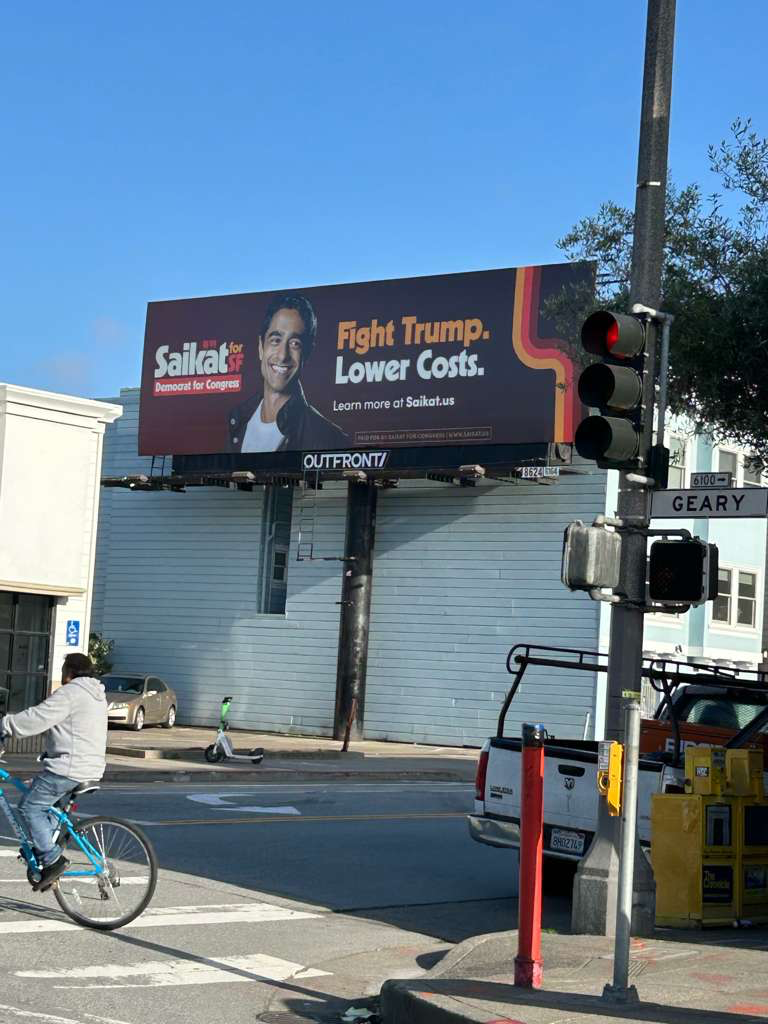
Chan, who has relatively low name recognition on the east side of the city, would most likely win the half of the voters in her Richmond District who backed her in her 2024 race. The other half, which voted for Marjan Philhour then, would perhaps go to Wiener, who shares Philhour’s moderate ideology and connections. Chakrabarti, though, has also put in efforts in courting Richmond District voters — he even has a billboard at Geary and 25th.
Chan also enjoys popularity in the Sunset, where she has the support of three of the five candidates running for District 4 supervisor; the other two have not pledged. What works even better for her is that District 4 may have a higher turnout in June because of its supervisorial race. So will District 2, which is generally considered a Wiener stronghold, though Hurabiell is also vying for its votes.
Chan’s two main rivals are not as fortunate on the Westside. Chakrabarti will be constrained by his vote for Sunset Dunes park. Wiener, who was a strong supporter of Joel Engardio, Sunset Dunes, and upzoning, has to address the frustration of some Westside voters; he has long acknowledged that he does less well there because of his YIMBY stances.
Regardless, San Francisco’s next congressperson will need to fill the shoes of one of the House’s foremost power brokers — no easy task.
“She is able to bring together donors, like few other people in the Democratic Party, and bringing those donors to bear on behalf of other politicians has allowed her to build power, to hold power and to exercise power,” said Eric Kingsbury, manager of former mayor London Breed’s 2024 campaign.
Without that, Kingsbury said, “San Francisco will be left in a worse place than we were under Nancy Pelosi.”