

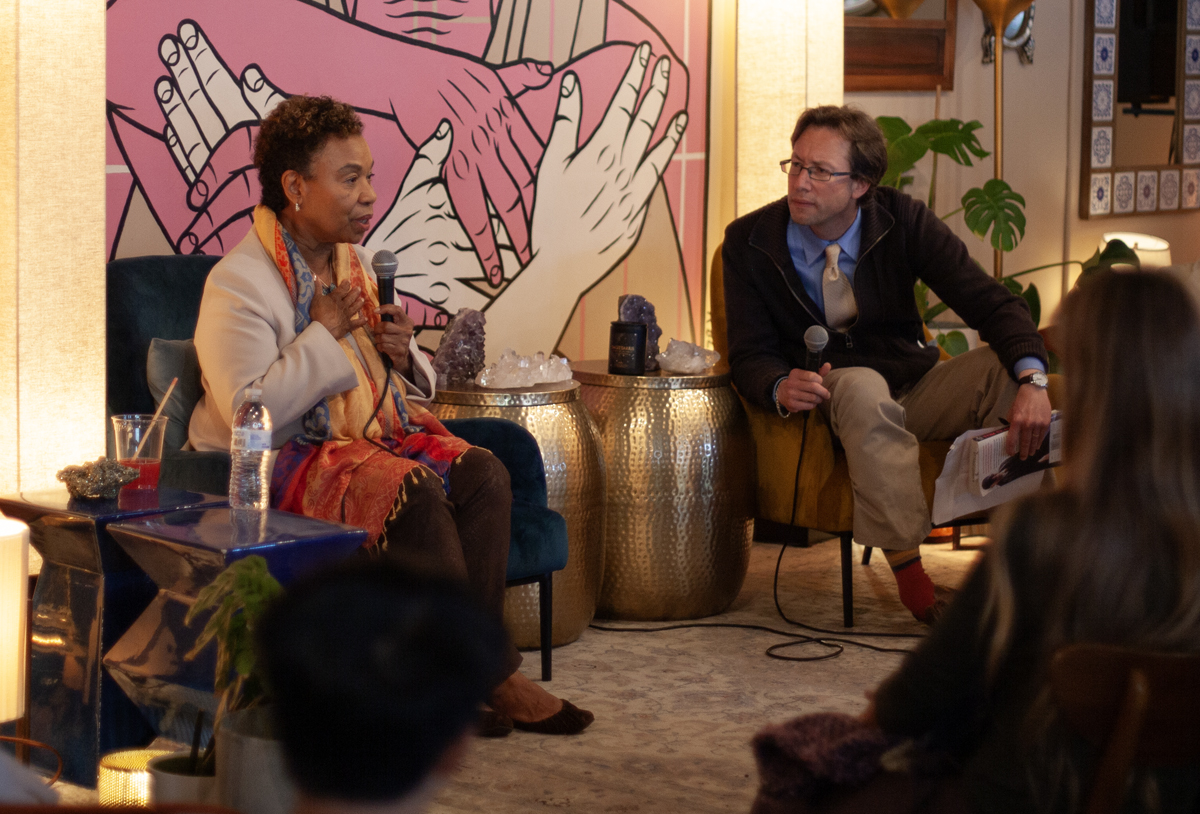

Mission Local Managing Editor Joe Eskenazi is interviewing Congresswoman Barbara Lee at Manny’s tonight, from 6 to 7 p.m.
Congresswoman Lee has represented the East Bay — including Oakland, Berkeley, Alameda and Emeryville — in the House of Representatives since 1998. She plans to run for U.S. Senate in 2024, for the seat of Sen. Dianne Feinstein, who is planning to retire after a three-decade career in the body.
Lee is facing a stacked field: Rep. Adam Schiff and Rep. Katie Porter have also announced, alongside others, and both boast large war chests, weighty endorsements, and dominant polling numbers.
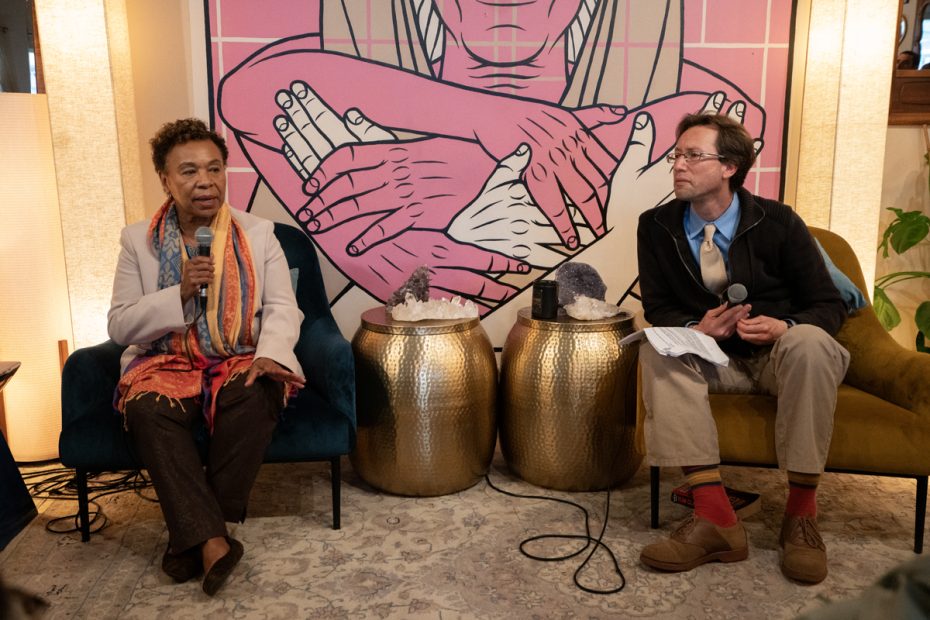
Rep. Barbara Lee and Joe Eskenazi on Manny’s stage, speaking on Lee’s long career including the AUMF vote, Iraq, Ukraine, and more. Photo by Gustavo Hernandez. July 31, 2023. 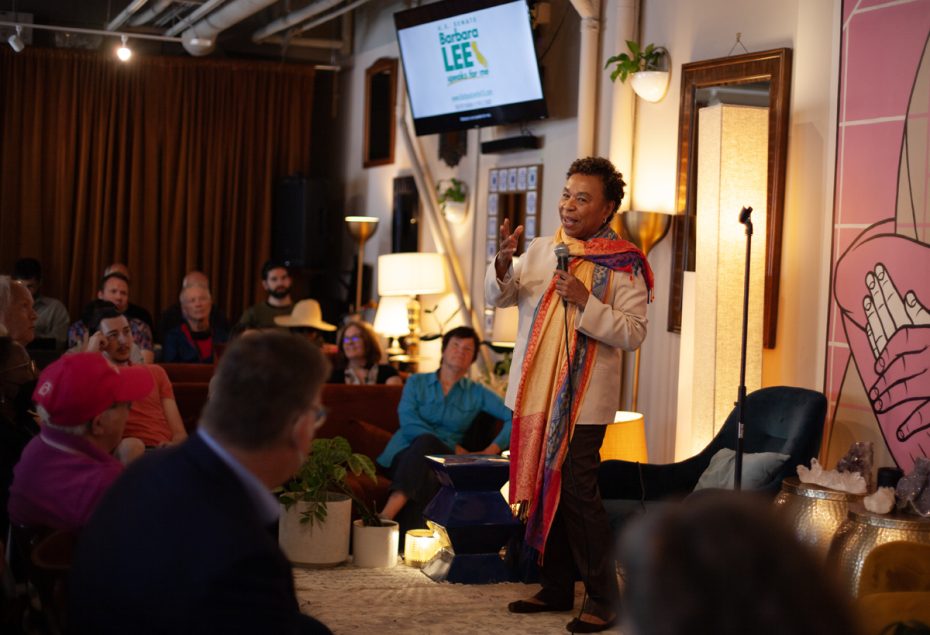
Rep. Barbara Lee address the crowd on Manny’s stage. Photo by Gustavo Hernandez. July 31, 2023. 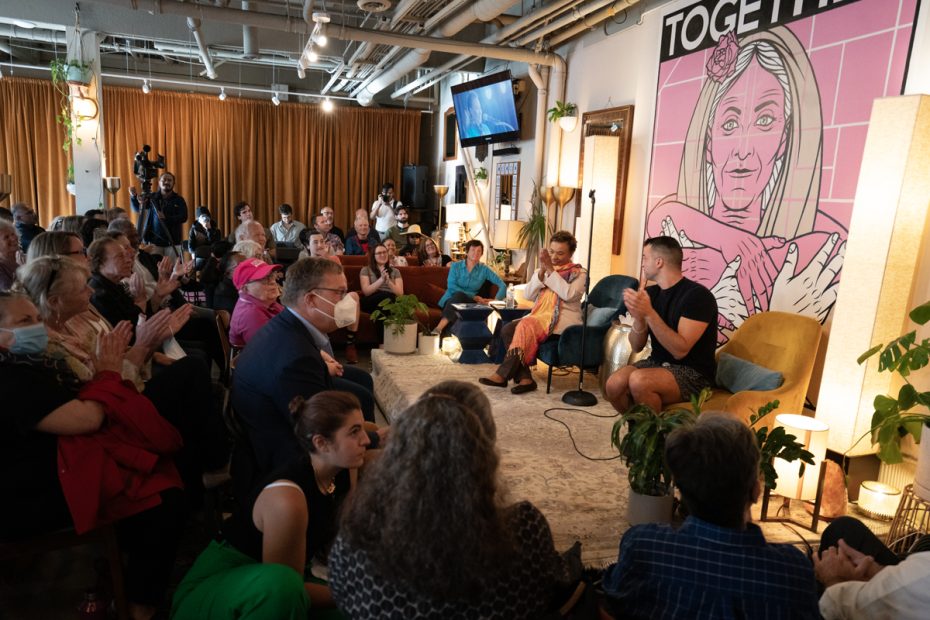
Rep. Barbara Lee address the crowd on Manny’s stage. Photo by Gustavo Hernandez. July 31, 2023. 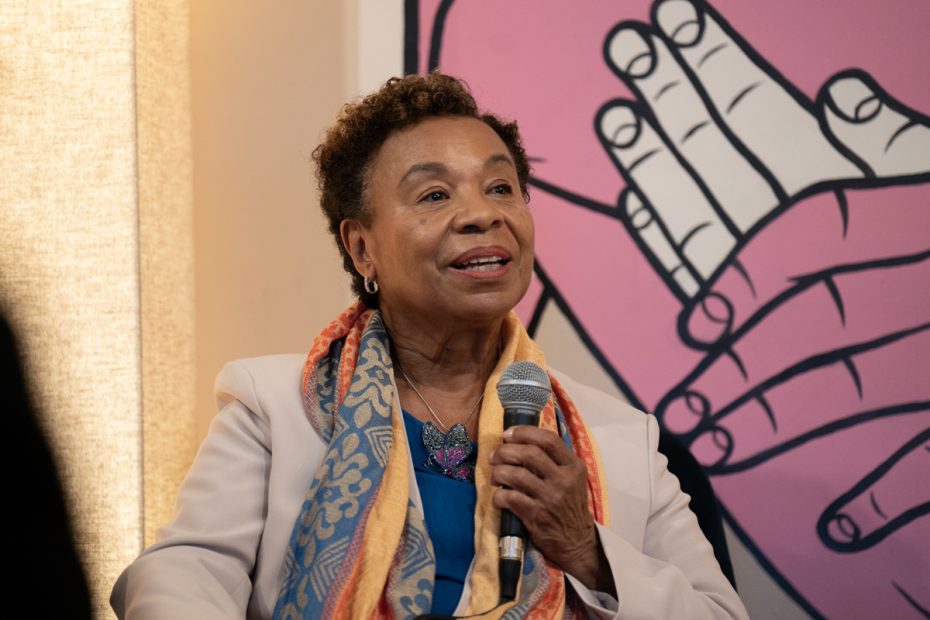
Rep. Barbara Lee address the crowd on Manny’s stage. Photo by Gustavo Hernandez. July 31, 2023. 
Supporters of Rep. Barbara Lee are seen applauding during her apperance on Manny’s stage. Photo by Gustavo Hernandez. July 31, 2023. 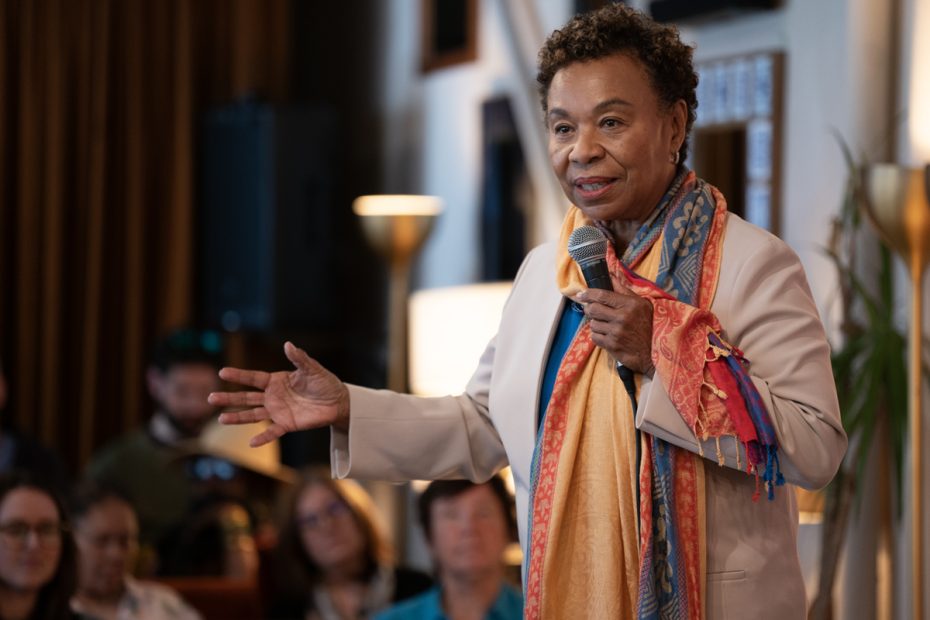
Rep. Barbara Lee address the crowd on Manny’s stage. Photo by Gustavo Hernandez. July 31, 2023.
Lee also has big endorsements: Rep. Ro Khanna, California Attorney General Rob Bonta and Mayor London Breed are all pulling for her, among others. She has raised less money and is polling lower than the other two, however — though the election is still more than a year away.
If Lee won, she would be the third Black woman ever to serve in the Senate.
Listen to the entirety of the conversation below, or read along with our liveblog for the highlights.
Yekutiel comes back on stage to close it out. The room, which he says used to be a massive walk-in fridge, is even fuller than when we began, and the audience cheers as the stage clears.
“What made you decide to embark on a career in politics?”
She says it was an internship with Rep. Ron Dellums, and seeing the ways that policy could harm the vulnerable. He later brought her on as his Chief of Staff.
She recalls Shirley Chisholm encouraging her to get involved, because “these rules weren’t made for us.”
Along the way, she said she often felt reluctant to run, but was urged on by mentors.
“It’s still about making life better for people. Trying to make the world safer, trying to fight for peace.”
An audience member says we need to limit weapons spending in Ukraine.
“How are weapons funding going to help on the issues we really all care about?”
Lee says we need to “help the Ukrainian people defend themselves.” She says she helped pass legislation, with Republican support, requiring the Department of Defense to be audited — audits it has repeatedly failed.
“I think the weapons industry is too big … but I do think, with regard to Ukraine, we’ve got to find a path to peace.”
Maria from the audience asks how Lee feels about elected officials having an upper age limit.
“People in the democracy have a right to elect who they want, based on whatever criteria they use.”
She says elected officials should not have an age limit or term limit. She says appointed officials, such as the U.S. Supreme Court, ought to have age limits.
Eskenazi asks: “What does it matter who the Senator of California is? And why should it be you?”
Lee says it’s goes beyond than the Democratic status quo.
“You have to look at a candidate who has gone beyond the call of duty, not just the voting record, but who stood up, and who’s has brought people along, who’s mentored young people, who’s dealt with the climate crisis.”
“I don’t think you have too many candidates who’re talking about poverty. And who will put throw down for people who are struggling and who’re living on the edge.”
“I see people, and understand their needs, understand the affordability crisis, I’ve had lived experiences many Californians can relate to.”
Eskenazi suggests that the money in this election could be better spent elsewhere.
“People in this country have a lot of money … and people have enough money to elect Democrats.”
“We have to make sure that they’re not going to be a factor that leads to the erosions of our democracy… [but] people need to be able to organize.”
She says third parties can help push Democrats and Republicans to see new perspectives.
“I do think we have to be rational about the outcome, and what the dangers are” of third parties affecting the outcome of elections.
“The public needs to know not to vote for them, because there’s a risk of electing Donald Trump.”
Eskenazi asks, “Do more mainstream members of the Democratic party lean on you to say these things?”
“As a progressive, and as an African American woman, I have to step out there, like on issues around poverty, HIV and AIDS,” Lee says. ” I have to step out there, then others came.”
Eskenazi asks how she’ll face Adam Schiff, who has more funding for his Senate race than any candidate running for president.
“Connecting with people, inspiring people to get to the vote to the polls, that’s what we have to do, and that costs money,” Lee says. She says there’s no chance she’ll raise as much as Schiff — but it’s just another challenge for her as a Black woman candidate to overcome.
“Black women know how to get things done,” she says. “Black women know these things, because we’ve had to survive in this country. I think people are ready [for a Black woman in the Senate.] And if they’re not ready, I’m gonna make sure they’re ready.”
Eskenazi asks how she plans to get the Democratic Party endorsement.
“I’ve been a party person since Shirley Chisholm got me to register.”
She says she was the youth director of Northern California, is a member of the DNC, and has been a drafter of the platform for the entire party.
“I helped start the poverty caucus, the peace caucus, the progressive caucus with the Democratic Party, so, you know, I’ve been a party person …
“So, I hope they remember.”
Eskenazi asks Lee how she will extend her voter base to the Central Valley.
“Everywhere I went [in the Central Valley], there were Democratic party delegates there supporting people farmworkers, immigrants, people who supported or anything, it was like everywhere.”
She boasts being the only Democrat on the Appropriations Agriculture Committee.
“I do ag! A lot of people don’t know I do ag … but I don’t think they should vote for me because I do ag. They should vote for me because Im going to be the best representative for them.”
Eskenazi asks: “What is the dynamic here, being the only candidate from Northern California?”
“Well, history has shown that Northern California votes in higher percentages.”
Eskenazi asks whether she feels Schiff is “part of the establishment.” Lee says yes. “You can look at our records, and look at who’s progressive. I mean, he voted for the Iraq War.”
Eskenazi asks about “the situation with Senator Feinstein … and how she must be handled in a sensitive way.”
Congresswoman Lee says she hopes Senator Feinstein can remain well.
“She’s back at work she’s doing her job … and I’m running for her seat. She said she’s not running!”
The room laughs.
Eskenazi turns the question to Congresswoman Lee’s age; she’s 77.
“Adam Schiff and Katie Porter are younger, and it’s likely they will make that an issue. Is that an issue in this race?”
Lee: “Oh, they’ve already made that an issue.
“Myself personally, regardless of age, I’ve been on public assistance. I’ve had to raise two kids of a single mother … I have had a lot of struggles that ordinary Californians can relate to …
“Young people, you know, Gen Z is for Barbara Lee. “
Eskenazi asks if her perspective as a career social worker — her opponents were lawyers — informs her campaign.
“I think I’ve been so successful in delivering for people because I listened a lot. And I try to understand the needs of people; I’m not always yakking about me. I’m trying to understand what people need. I’m trying to put together legislation that’s going to make their lives better. And I’m not going to be out there showboating about it. I’m going to do the work.”
She says that mental-health care needs to “take into account the social determinants of mental health,” such as the realities of economic and racial inequality.
As a student at the University of California, Berkeley, she turned her thesis project into a proposal for a mental health center; they gave her $2,000. She parlayed that into a community health center that she lead for ten years, until the Reagan administration cut her funding.
“I know how to do all that.”
Joe Eskenazi: “How do we figure your thoughts and feelings in 2001 to the present conflict in Ukraine?”
“I don’t believe that we should use force unless it’s absolutely necessary to prevent further deaths and destruction,” Lee says. But Ukrainians “deserve to preserve their democracy … we have a duty and a responsibility to support the Ukrainian people.”
“It’s a very dangerous moment.”
She says we need to avoid U.S.-Russia conflict at all costs. And the use of clusterbombs, which she says harm civilians.
“The United States needs to understand we can’t cross certain lines in this war.”
“We’re gonna start by playing the hits,” Eskenazi says.
He’s asking Lee about being the sole congressperson to vote against 2001 Authorization for Use of Military Force after 9/11, which has since been used to carry out war in Afghanistan.
Lee says one of her staffers had a cousin on Flight 93.
“I’m as angry and as upset and is worried and afraid as anybody else,” she says.
She recalls hearing the following in a eulogy:
“Let us not become the evil we deplore.”
She knew then she couldn’t stand by the authorization of military force, which she said was brief and “overly broad.”
She says her friends and colleagues told her to take it back, for the safety of her and her family. They said she’d lose her next election.
“It was the most difficult vote I ever cast … the death threats, you would not believe.”
Since then, the “tide has turned,” and now she’s working to repeal the authorization, with bipartisan support. She hopes to have it repealed this year.
After opening remarks from Manny Yekutiel, Joe Eskenazi and Lee take the stage.
 Lee is shaking hands and taking pictures with the crowd. The line is wrapped around the room, and people are mingling. She’ll begin her conversation with Joe Eskenazi soon.
Lee asks for donations to her Senate campaign.
“This is a campaign that’s being powered by people … and it’s a campaign that’s very costly.”
The back room is totally full, with people standing in the back. Maybe 100-150. Congresswoman Barbara Lee is kicking it off with a video promoting her upcoming Senate campaign.
“We have a lot of work to do,” she says.

Note, I checked it against audio and actually Lee did recommend SCOTUS term limits – not age limits.
Term limits makes more sense for SCOTUS than an age limit does. Also would’ve liked to have seen Lee endorse RCV instead of warning of a 3rd party spoiler.