


In 1966, San Francisco-based painter Marlene Aron graduated college, packed her bags and hopped on a chartered boat to Europe. She was a free-spirited 23-year-old, and the art-world abroad beckoned her. Though she only planned on staying on the Continent for six weeks, she ended up in Holland, where she went to art school and worked as an au pair for two years. In 1971, four years after the summer of love, Aron settled in San Francisco—where she’s been living ever since.
But a couple of years ago, as rent prices shot up throughout the city, Aron’s studio space on 9th and Mission significantly raised its asking price. Like many artists, Aron was forced to look for other affordable studio options—except for one problem: there didn’t seem to be any reasonably priced artist studios left.
But Aron knew one thing. “I’m not leaving San Francisco,” she insists.
Luckily, she didn’t have to. She contacted a friend on Facebook (“I love it, it’s how I connect with people,” she says), who directed her to Code and Canvas, a collective on 15th and Potrero formed by four tech entrepreneurs with an appreciation for the arts.
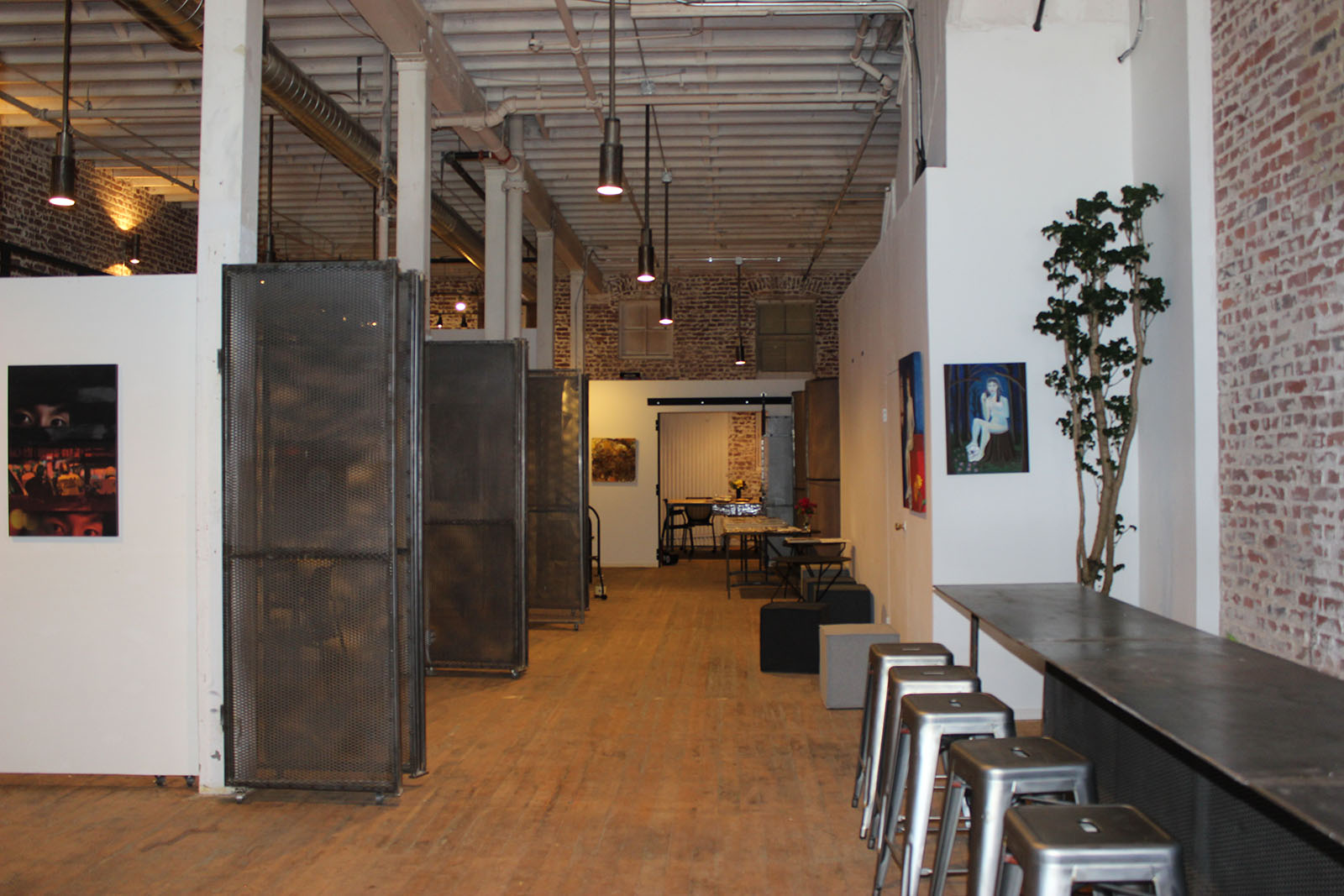
The tech-art collective’s creation story began in December 2013. The family who owned the space (which was formerly dubbed the Live Art Warehouse), brought the rent to market rates, which was far beyond the means of most of the artists renting studio space.
One of them, an illustrator named Julien Lallemand, reached out to his friend John Yi of Facebook, who was also an aspiring novelist. Lallemand asked Yi if he was interested in renting a desk for a writing studio. Yi agreed to the deal, but when it looked like the space needed more artists to keep the lease, he commissioned the help of three other tech entrepreneurs to lease the entire warehouse. The idea? Keep rent reasonable for artists by licensing desk space to local tech startups, while creating a place for techies and artists to coexist and “cross-pollinate.” Shortly after, Code and Canvas was born, which now houses artists whose disciplines range from printmaking to painting.
Aron moved into her studio at Code and Canvas about a year ago, after the rent hikes at her 9th and Mission location proved unsustainable. She’s been there ever since. Though it’s no Bowery Street in the ’60s, the rent “is good for San Francisco,” she says with a smile.
On a Saturday afternoon just a few weeks after Code and Canvas’s “Soft Launch Party,” Aron—who is in her ’70s with shoulder-length auburn hair and bangs—gave me a tour around the warehouse. It looks exactly like what you may expect of a tech-art collective in San Francisco: well lit, with exposed brick walls, hardwood floors and white walls dotted with paintings from artists in the building. In the front of the room, a woman in a flowing floral dress strums a guitar, alongside a bearded man in a cream fedora.

Aron leads me to her studio at the end of the room. Her paintings, which are made of elements from the earth, hang on the walls. “I’ve known since I was five what I wanted to do,” she says, “and that it would have something to do with nature.” A painting called “Memory in Time,” is composed of soil, sawdust, rose leaves, wood ash, calendula flowers, cloves, acrylic, oil, alkyd, melted beeswax, cocoa bean hulls, coffee grounds, mulched, and crushed oak galls. Aron picks up an older painting—bright streaked with vivid colors—which she produced while living in New York in the late 1960s; and another, small piece made of materials from nature. She brings it to her nose and inhales. “I love the way this smells,” she says, holding the edges tightly.
Down the hall, an artist of a younger generation and different industry entirely, examines the space. Vivien Sin, a self-proclaimed “wannabe” artist who works at the tech company Tagged, also rents a studio in the warehouse, where she paints. Sin, a techie-artist mash-up of sorts, is helping to coordinate “Monday Nights on the Couch”—Parisian, salon-inspired meet-ups to debate and discuss ideas. “Artists think big,” Sin says, adding that if the two interface more in spaces such as Code and Canvass, perhaps techies can learn to see the world through the artist’s lens.
Aron nods her head in agreement. “I hope this is the beginning of something broader in the artistic community,” she says, “ and that the culture of tech and art will support each other.”
You guys do realize that it takes an awful lot of creative talent to build anything of value right? The best engineers in the business are artists.
QOTD: “Techies are creative!”
There are different kinds of creativity — building a product that people can use is one sort, designing a beautiful logo is another, but fine art is essentially an intellectual discourse based on years and years of history. This level of depth and breadth is something that tech hasn’t yet had today, so there’s definitely benefit in the two worlds intersecting.