A large crowd of people gathers in a public park, with a police officer and several individuals standing in the foreground.
Carnival 1980. Photo by Henry Baca

To understand the Mission District in the 1970s and ’80s was to understand the collective heartbeat of its people. It was a neighborhood where survival and celebration went hand in hand, and where daily life was a beautiful tapestry woven by both the young and the old.

Walking down 24th Street — the bustling, undeniable main corridor of our community — was a sensory immersion. You were greeted by the sweet aromas drifting from our beloved panaderías, and the sight of neighbors catching up on the sidewalks.

The sidewalks were our community living rooms and open-air workshops alike. Here, you would see regular folks buying groceries, walking right past men hunched over open hoods, working on their vehicles over oil-stained concrete.

But more than a commercial hub, this street was our lifeline. It was home to essential sanctuaries of neighborhood support, like the La Raza Information Office and Centro de Cambio, alongside Centro Latino, where the youth could safely gather and channel their energy into sports.

The community thrived on shared space and a shared cultural pride. On any given afternoon at Mission Dolores Park, a circle of young boys would gather to play the congas, filling the air with rhythms that felt as old as the earth.

These pages capture a snippet of the 1980s Carnaval energy, a milestone explosion of color, dance, and unity right on our streets. Yet, the collection also finds beauty in the quiet, domestic details of the era: the simple, rhythmic sight of clotheslines heavy with laundry hanging out behind the houses, a common neighborhood sight.

Here, you will see muralists at Garfield Park & Pool, their brushes brought to life on a beautiful, sprawling public canvas that has long since vanished. You will see the original three-floor Army Street housing projects, captured before they were redeveloped and flattened into a single-level landscape.

And, plastered on the windows of local music stores, you will see the vibrant promotional posters announcing the next grand Latin and Salsa baile — legendary dances that would draw crowds from every corner of the barrio to pack the floors of the Longshoremen’s Hall, California Hall, or even the local high school gymnasiums.

This book is a tribute to that unbreakable spirit — a testament to a time when the Mission didn’t just feel like a place to live, but like a family.

A person in coveralls and a hat works on the engine of a car with its hood raised, parked on a street in front of a house.
991 Shotwell St. by Taqueria Guadalajara between 23rd and 24th streets. Photo by Henry Baca.
A person standing beneath a structure with a “No Hard Ball Playing” sign.
Garfield Park, CIA Diary 1975 sowing. Jamie, DogPaw, Carillo, Domingo Rivera, main artist. Photo by Henry Baca.
Two men sit at the base of a large tree in front of a wall mural featuring a triangular structure labeled “DIARY PHILIPAGEE.”
Garfield Park. Domingo Rivera. Photo by Henry Baca.
Clothes drying on lines stretched between apartment buildings.
Clothes hanging. Photo by Henry Baca.
Two men and a child walk along a sidewalk on a city street lined with businesses, including a currency exchange.
Centro de Cambio, 24th Street. Photo by Henry Baca.
A person walks along a city sidewalk past a building with a sign reading “La Raza Information Center.”
La Raza 3174 24th St. Photo by Henry Baca
Black and white street scene with pedestrians walking on a sidewalk, parked cars, and a delivery truck driving down the road.
24th and Capp streets. Photo by Henry Baca.
Concert posters for The Brothers Owens and the Primer Festival Danzante de Tango displayed in a window.
Posters for dances, hung at Discolandia. Photo by Henry Baca.
A group of people standing around a large bell monument, with several individuals taking photographs and “CARNAVAL ’80” posters attached to the base.
Carnival 1980. Photo by Henry Baca.
People sit and stand on a grassy hill overlooking Mission High School in San Francisco.
Young men at Dolores Park. Photo by Henry Baca.

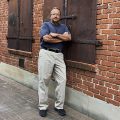
Born in El Paso, Texas, Henry Baca moved with his family to San Francisco’s Mission District in 1965. His artistic journey began in the halls of Mission High School (Class of 1974), where he took art classes under the legendary sculptor Ruth Asawa. After picking up a camera at age 18, Baca went on to study photography under the influential documentary photographer Pirkle Jones at the San Francisco Art Institute, later earning an Associate of Arts degree from City College of San Francisco. For 41 years, Baca balanced his creative passion with a career in the gas manufacturing business. Now retired and residing in Placerville, California, his self-published photo paperback books offer a rare, intimate, and deeply authentic look at the everyday life, businesses, and cultural milestones of the Mission District during the mid-1970s and 1980s.

Leave a comment

Please keep your comments short and civil. Do not leave multiple comments under multiple names on one article. We will zap comments that fail to adhere to these short and easy-to-follow rules.

Your email address will not be published. Required fields are marked *