
Korean artist Ha Chong-Hyun, whose career spans four decades and who continues to work at the age of 91, attributes his creativity to an unlikely factor: birth order.
As the fifth child of nine children in his Korean family, being in the middle meant he was relieved from the pressures his older siblings faced.
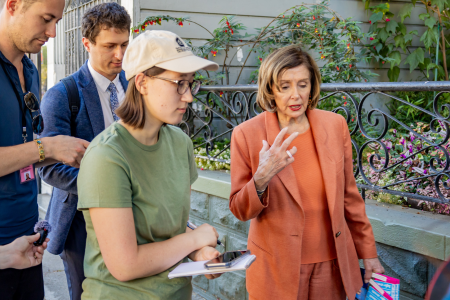
“He explicitly said it was because he was not the oldest that he was able to become an artist,” said Soyoung Lee, CEO of the Asian Art Museum of San Francisco. “It wasn’t expected that he would provide for the family.”
The door of possibility cracked open, and led to a career as one of the most influential Korean artists, a leader in the country’s avant-garde Dansekwah movement and a pioneer in the painting technique known as the “back-pressure method.”
His retrospective, guest-curated by Sunjung Kim, contains two new pieces recently created for the exhibition, as well as six decades of work that demonstrate his evolution as an artist. “Ha Chong-Hyun: Retrospective” opens to the public Friday and will run through January of next year.
Ha’s expansive creative career is often at odds with the preconceptions of what an artist’s life looks like. The nonagenarian’s work exemplifies hard work and a response to lived reality, and labor is the thread holding the retrospective exhibition together.
“He really thinks of himself as a laborer,” Lee said. “Yet he’s not easily categorizable or divinable, and the arc of his 60-year career really shows what a renegade he is in some ways.”
The effortful, yet artistic, manifestation of labor becomes apparent in the series for which Ha is most famous: Conjunction.
In it, the Korean artist develops his signature back-pressure method technique of painting, in which paint is pressed through to the front of a canvas. The series moves from monochrome to color and his experiments include those on hemp cloth, his most popular canvas, wood wrapped in paper, and even mirrors.

“21 Conjunction” (1974). It’s difficult to get a loan of this piece given its fragility, Lee said.
The materiality of Ha’s work is so tactile it’s impossible not to want to touch it — perhaps explaining the white lines on the floor in front of each piece, a reminder of where the viewer can safely gaze from.
All the senses become engaged while looking at the Korean artist’s work. While sight and touch are obvious, one also can imagine taste with the oil paint looking like spread frosting or hearing given the hemp cloth backdrops that look uncannily like speaker fabric.
“I really think of his work as an all-sensory experience,” Lee said.
It’s an exhibition that requires presence, one’s labor to arrive there in person, as images of the “Conjunction” and “Post-Conjunction” series — the latter of which has more color — cannot possibly capture the unctuous quality of the paint.
“In that sense, these are actually moving images,” Lee said. “They’re not set.”
Ha’s evolution over the decades includes him moving from his signature monochrome palette — so fundamental as to become the name of a movement, “Dansaekhwa” — to canvases saturated with pigment.
“His explorations of color are not being timid about color, but really going all in,” Lee said.
On view are the tools Ha used to create his often colossal tableaux — instruments like wire brushes, wide spatulas and what appear to be simple kitchen wooden spoons — as well as videos of the acclaimed artist at work in his studio, all of which underscore the effort needed to complete his pieces.
Earlier works, like “Work 73” (1973), demonstrate the influence of Christo with the physical wrapping of barbed wire around canvas, a technique that feels physical while also nodding to the rampant censorship in 1970s Korea.

Another early work in his career showcases a year’s worth of printed newspaper pages next to an equal height of blank pages, a pairing that introduces questions around the utility of information in a time of widespread authoritarianism.
“You couldn’t talk about art, you couldn’t talk about culture,” Lee said. “Artists like him knew that political sensitivity was very important.”
Ha’s work is often a response to his immediate environment, and his art can’t be separated from his lived experience, whether it’s the urban planning in Seoul, the development of Korea’s first highway in the 1960s, or the dictatorship of the 1970s. For that reason, a detailed chronology of his life is included near the end of the exhibition.
“The timeline was really important for us, because it’s so important to his practice, who he is, and the moments that Korea was developing,” Lee said.

Yet physical labor is not only a path for understanding the effort behind Ha’s paintings and his vitality as a human being. It’s also a metaphor for the longevity of his career, four decades of being at the forefront of contemporary art — in and of itself a formidable feat.
Ha Chong-Hyun: Retrospective
Asian Art Museum
Sept. 25, 2026 to Jan. 25, 2027
On Sat. Sept. 26, there is a conversation with Director Soyoung Lee and Guest Curator Sunjung Kim exploring the artistic techniques and creative process of Ha Chong-Hyun. Register here.