


Prop. G, the ballot measure to reopen the Upper Great Highway to cars on weekdays, would “significantly increase the cost of government” by about $9.8 million in one-time costs, plus $500,000 to $1.9 million a year, according to the San Francisco controller’s office.
A majority of the $9.8 million one-time cost, $8.8 million, is for adding new traffic signals at eight intersections on the Upper Great Highway, the controller’s letter says.
A full signal upgrade would be necessary about every 30 years, according to the letter. Had the road not been closed to cars via Prop. K in 2024, an SFMTA spokesperson said in early July, the cost would have been similar.
“Proposition G will charge San Franciscans millions of dollars to close a beloved park,” said Lucas Lux, campaign manager of the “No on G” campaign, adding that the measure would “waste taxpayer money to replace a thriving park with a failed road.”
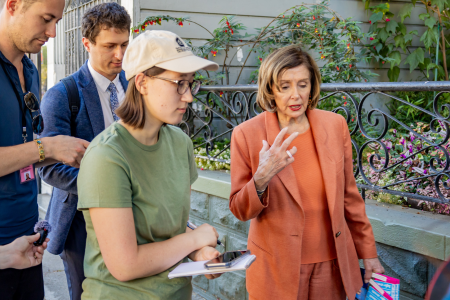
Otto Pippenger, campaign manager of the Great Highway for Everyone campaign, disagreed. He said the “bulk of the cost is for pedestrian-safety measures.”
“San Franciscans understand that our loved ones are irreplaceable,” he said. “These moderate costs are a small price to pay for the safety of our families.”
Another $750,000 would be dedicated to “removing existing park elements,” such as the skate park, the art installations, and benches, among other amenities. About $200,000 would be spent on re-striping and signage on the roadway.
The cost estimate turned out to be lower than the initial quote of $14 million in early July from the SFMTA and the Recreation and Parks Department. But the departments cautioned at the time that the estimates were preliminary.
On top of that, there is also a recurring annual cost of $500,000 to $1.9 million for road maintenance and sand removal.
Whether the Upper Great Highway is a road or a park, the city has to remove sand from it. But doing so costs more when the Upper Great Highway is a weekday roadway, compared to when it’s a full-time park.
The measure, if passed, would also require a coastal development permit, which could lead to an unclear cost to the city.
Countering the cost additions, reopening the road, the letter says, would decrease staffing needs and park maintenance, which would likely reduce staffing costs. Staffing at the park costs about $300,000 every year.

> Otto Pippenger, campaign manager of the Great Highway for Everyone campaign, disagreed. He said the “bulk of the cost is for pedestrian safety measures.”
It’s absurd to try to call $10M worth of highway costs “pedestrian safety measures.” What are the pedestrians being kept safe from? Why does Pippenger want a ballot measure that’s apparently so dangerous that it requires $10M worth of expenses just to keep pedestrians safe on this one street?
said Lucas Lux, campaign manager of the “No on G” campaign, adding that the measure would “waste taxpayer money to replace a thriving park with a failed road.” Yes, a thriving park, visiting by a few hundred to few thousand on days with city sponsored events, all to reopen an uninterrupted roadway used by 15,000-20,000 in their daily commutes and family transportation needs, safely used for decades, one of the safest roads in the city. And with Prop G, the closed roadway, aka Sunset Dunes, would still be free and open for park purposes on weekends.
Granted, the passage of Prop G might put a dent in the real estate developer plans for buildouts along the coastal zone, and may interfere with future job plans and paycheck for Lux and company
Watching Proposition G fail on Election Night will be delightful entertainment. Be sure to have plenty of drinks and snacks on hand for the festivities!
You won’t be watching from the Sunset though, tourists!
Leave it CLOSED
My vote is to keep it closed for the recreation area that many people enjoy.
The word you’re looking for is “open.” As in, leave the park OPEN and say no to big oil and their constant foreign wars.
Its not a compromise if it means taking away the skate park, the gym, the benches, the hammocks — all the things that make it a park, rather than “a two-mile asphalt road.”
Those things, which will be thankfully gone, will restore a park-like environment to the stretch, while we can then enjoy the former stretch of lonely road on weekends. No more nylon banners, rusting giraffes, offensive fake “art,” signage, etc.!
Vote to restore the highway, even though it will not raise property values the way the closed road pretending to be a “park” will!
Move them to the bike path or the existing promenade south of Noriega.
There are literally six lanes on most if not all of this stretch of the Great Highway. There are two highway lanes for cars separated by narrow stretch of dunes that were covered by succulents. There are paths on either side of most if not all of this part of the Great Highway, so there is plenty of room for everyone all the time. What is happening in Golden Gate Park where entire streets were cleared for playing and stating and whatever else the kids need to entertain themselves. There is open access to everyone.
@sebra leaves – Lanes alongside the Great Highway north of Lincoln are fine. But for the former Upper Great Highway south of Lincoln, they are not suitable and never have been.
There is a path (not a “lane”) that extends all the way from Sloat to Lincoln, but it is far too narrow to be a multi-use path according to the state’s bare minimum specifications. There is another path (also not a “lane”) that is also too narrow and only goes from Vicente to just short of Noriega.
Bring it on.
Prop K — closing the highway and establishing the public park in its stead — passed 55% to 45%.
Prop G — closing the park and reestablishing the highway– will be defeated 70% to 30%.
But of course the real problem was that these are city-wide votes. And since this road is at the far western fringe of the city, a good part of the population never use it anyway.
It should have been voted on only by the two districts that border the ocean there, who are the only people impacted by the closure.
As for a “park” it is right next to GGP and the beach. No part of the city has as much recreational space already as that area.
@Bill – That’s not a problem, that’s how the City Charter works. It is extremely revealing that the anti-park crowd thinks it’s okay to only count D1 votes along with D4 votes, just because of how D1 voted.
There were four — count ’em — four votes on taking down the Central Freeway, where onramps and offramps spewed exhaust and particulates and noise directly into people’s second-story bedroom windows in the Western Addition. In all four of those votes, the majority of D1 and D4 voters approved of that. Was that “the real problem” then or nah? Did you speak out about that or only for this?
I reject the framing this article takes, it should be about turning Sunset Dunes Park into a road. It hasn’t been the “Great Highway” or had cars for a while now.
@Duh – Prop G has a cumbersome official name, “Allowing Private Vehicles on the Great Highway in Sunset Dunes Park,” and I agree that “Great Highway” is bad framing even though less cumbersome.
The precision is bad, as well. The “Great Highway” is and always has been a stretch of road north of Lincoln, and there’s still a “Lower Great Highway” alongside Sunset Dunes. The stretch within Sunset Dunes is the former “Upper Great Highway” (UGH), so abbreviating that to “Great Highway” is erroneous.
It’s always going to be the Great Highway – tourists be damned.
Back when Prop. K was on the ballot, the estimate was $4.3 million to replace the traffic lights. Today it’s $8.8 million?
The numbers for annual maintenance were also much lower.
It’s all right there in the November 2024 Voter Information Pamphlet on page 158.
https://www.sf.gov/sites/default/files/2024-09/N24_VIP_EN.pdf
If one opens the highway most of the need to control the side streets may also be eliminated. Separating cyclists from pedestrians by assigning separate paths may also be considered to eliminate accidents. A fast path on one side and a slow path on the other makes a lot of sense when you have that option.
As for safety, there have been three major injury accidents in the “park” since it was closed 18 months ago, the last one just a few weeks ago. They have done a very poor job of separating pedestrians from e-bikes and other vehicles.
https://missionlocal.org/2026/07/great-highway-pedestrian-unicycle-collision/
it should never been closed in the first place.
I get why Sunset residents don’t want cars driving down their streets. Maybe we can end through car traffic on the 35+ north/south lanes west of 17th Ave and turn Sunset Dunes into the only through street for cars in the Sunset.
Compromises can be great!
As you point out, drivers already have 35+ north/south streets in the sunset to drive on, including two major throughways. Making one single road car-free is already a compromise, and one that disproportionately benefits drivers.
People live on those streets and so you have to allow vehicular access, even if it is only for residents, visitors, emergencies and deliveries.
I want to use an actual, bonafide highway for its intended purpose. Imagine that!
You people are the height of arrogance, greed, and selfishness. Golden Gate Park, Sutro Heights Park, Lands End, the ENTIRE Ocean Beach with its esplanade, zoological gardens, Lake Merced, Fort Funston. There is more parkland and open space within minutes in that one part of town than anywhere else. Still it’s not enough.
As a native San Franciscan, I remember the 1989 redo when the underground pedestrian tunnels were demolished and the roadway and pedestrian path redone.
Don’t talk to me about traffic, something of which you know absolutely nothing. Also, don’t talk to me about use of public land. You people won’t stop until you’ve closed Marina Blvd, Lombard going to the GGB, etc. Hell, one of your lot wants to close General Hospital and turn it into another branch of the public library. You people are way beyond nuts.
It is a shame that the very workable solution of opening the Great Highway to traffic Monday through Friday and closed to traffic on weekends was discontinued. It was a great compromise. There are plenty of real parks in SF open and available 7 days a week.
Let the money Dude for ‘that park’, who does not live in the area, pay to put the streetlights back in place, and maintenance it, for the thousands of commuters that used it! Keeping the road open is a necessity for Emergency use, you know, all the accidents that are happening with the Cycle-Centic, speeding, young, work-at-homers! What, too lazy to maintain an automobile?
So, according to the some of you, it must be unnecessary to maintain the GREAT HIGHWAY, unless it is a ‘park’, nor have any of you considered the Inflation, that effects that road either way, is that right? You know, the constant wind tunnel of sand, debris, or just the all-present wind, and cold, and don’t forget that’s where Karl the Fog Lives !
Here’s something to think about, the noise that you ‘park’ dwellers make with musical instruments, handmade or not, intensely resonates, and echo’s off of water at a high percentage, and goes straight into the homes of the tax paying citizens, who live along the Lower Great Highway, disturbing their peace…Yes, It Does!
A question, are any of you so unaware of The Historic Golden Gate Park, 1,017 Acres, that you have to disturb thousands of Outer Sunset residents just for the opportunity to walk onto the beach at Noriega, which you can do over the Weekend, which is when most of you go to the Great Hwy, anyway?
The Controllers Office has no idea what it would cost, just like they had no idea what it would cost to close it and they’ve continuously put out misleading statements. Sand Removal is performed by DPW and charged to SFPUC and there’s been no change in those charges since UGH closed. Its a cost born by SFPUC ratepayers, not SF Tax Payers – not entirely the same group
Thanks for pointing out one of the issues few people are aware of. No department does a complete job of anything. Each department sends out a request for work to other departments. The working department bills the requester for the work it does. They create some juicy invoices that keep the bureaucracy humming. Not sure if or how the invoices are paid.
Did you mean [closing+reopening] cost of $9.8M? While not closing was not far from zero.
Great idea, time travel, damn why didn’t I think of that. I’m going to go back and think of it in the past right now!
…or…
Where we’re going, we don’t need roads
…just a Mr. Fusion in the back of the DeLorean!
Sand removal costs have never exceeded $800k per year, and that was only once, in 2023. Otherwise since 2011 it’s never been over $350k, very often in the $250k range.
Which is exactly what it’s been costing to remove sand since Sunset Dunes came into being. There is no measureable difference in cost, I don’t know what the deputy controller is thinking when she puts down $1.9mil per year.
Larry can get downvoted but these are facts
Let’s unpack Lucas Lux’s “No on G” argument.
Lucas Lux says Prop G would “charge San Franciscans millions of dollars to close a beloved park” and “replace a thriving park with a failed road.”
That’s misleading.
Prop G does NOT close Sunset Dunes Park. The 50-acre park remains. Prop G asks voters to share the existing 2-mile asphalt road within 50-acre Sunset Dunes Park on weekdays, access open to everyone, including private vehicles, so commuters, seniors, ADA users, visitors and families can access it, while the 50-acre Sunset Dunes Park remains available for recreation.
And “waste taxpayer money”? Remember who promoted “No Cost to SF.” Lucas Lux.
The reality after permanently closing the 2-mile road? Sand removal didn’t disappear.
Instead of once a month, the city is now dealing with sand removal much more frequently, while taxpayers are also paying for park staffing and maintenance.
Even Mission Local reports the city estimates about $300,000 a year for park staffing. And the $9.8M reopening estimate includes $8.8M for traffic signals, safety infrastructure that would have been needed regardless if the road had never been closed. Maintenance taxpayers have already paid for and budgeted.
Why are we being told that SHARING a 2-mile road means CLOSING a 50-acre park?
Prop G is about sharing access, not taking a park away.
Vote YES on G.
The Great Highway Compromise works.
Its not a compromise if it means taking away the skate park, the gym, the benches, the hammocks — all the things that make it a park, rather than “a two-mile asphalt road.”
It has become clear this was the city’s plan to reduce costs. Call it a “park” via a city wide vote so the locals lose control and now defer as much maintenance as allowed just like the rest of the city parks….9.8 million saved…Lurie’s coat tails indeed will remain long…at least on paper
City had no real interest either way. It was voters like me who closed that stupid, pointless road before the ocean could eat it. And we’ll keep closed in November!
Typical self interested “Karen” attitude…you obviously never had to use this street as a way to your job. I’ve been surfing this beach for more than 40 years and have used this road to access work and for pleasure….closing this street is ridiculous…This neighborhood has access to a 4 mile beach, Golden Gate Park and a Zoo. But apparently all the “Karen’s and the Kevin’s “ want even more places to stroll around with there latte’s during the day.
This is the only north south bike route and you want to close it? 30% of the city’s land is dedicated to streets servicing cars and that isn’t enough for you? How entitled.
AJ, the road is closed, and Sunset Dunes Park is a hit. Sorry that you miss the road you’ve cultivated a 40-year relationship with, but it’s over. No amount of name-calling or latte-shaming is going to change any of this!
The Park passed easily before, and anyone thinking San Francisco is going to vote to remove a park to restore an old road that only a tiny, albeit loud, minority misses is not trafficking in reality.
Go ahead, have some fun in the comments, hang a Yes on G sign from your surfboard, but when this is all over (again) in November, it’d be great if y’all could find something more useful to protest and activate around. This City has issues, and sore losers whining about a popular park isn’t what I’d call progress. Best of luck to you.
As independent voter. The extreme cost was from closing great highway and not implementing a compromised plan that allowed GREAT HIGHWAY FROM SLOAT TO LINCOLN WAY to remain open on weekdays and closed on weekend. They closed and kept closed while doing outreach when supposed open it up first before outreach. Great Highway belongs to all users (including drivers) it does not belong Anti Car/Walk SF Political group scoring political points for Joel which deemded unsafe. It was political and not about safety,
It needs be open up and send to the high court to “prevent political closure”
—“It needs be open up and send to the high court…”
Nah. It’s simple, and no court is needed: we’ll vote down Prop G and enjoy the park for generations to come.