
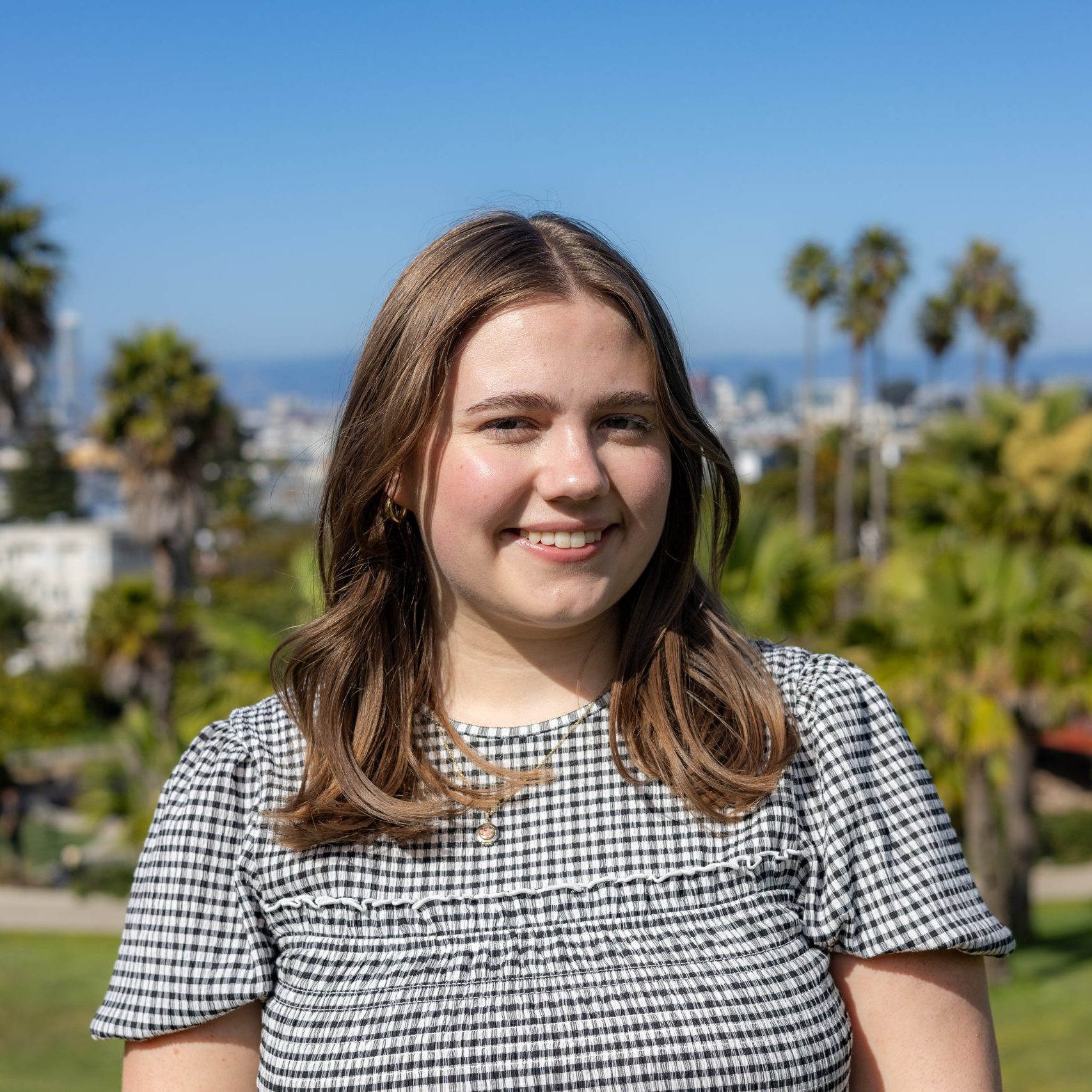

For District 5 Supervisor Bilal Mahmood, there are positive and negative externalities everywhere in life, and in politics.
“My general perspective is that you tax negative externalities and you don’t tax positive externalities. Tax the things that are bad for society, but you don’t tax the things that are good for society,” Mahmood told Mission Local managing editor Joe Eskenazi onstage for a Wednesday event, a day after the election, at Manny’s Cafe.
That’s why he co-sponsored a signature tax cut — the BUILD Act — with Mayor Daniel Lurie to cut the rates sellers of properties worth more than $10 million have to pay to the city. It’s been billed as a means of augmenting development and providing work for union construction workers.
But sellers would receive a hefty tax break even if no housing was produced, or no tenant improvement work was undertaken. And they would be putting less into city coffers when the deficit is hundreds of millions strong. Mahmood told Eskenazi on Wednesday he’d be open to revisions.
“The principle we always had at the beginning is it has to be revenue-neutral,” Mahmood said. “We are taking another look to see how we can restructure this package in a way that is responsible.”
San Francisco’s real-estate transfer tax applies to buildings worth $25 million and is 6 percent, far higher than surrounding municipalities. It raises money for the city but, Mahmood said, adds cost to construction.
The legislation was advertised as a jobs measure, but Eskenazi noted that recent office sales have resulted in construction work being done by non-union and out-of-state crews, and asked if this was something the city should be incentivizing via a tax break.
Mahmood replied that it didn’t have to, and that he would be open to changes here, too.
“That’s something that we’re working on with the trades, to ensure that the type of work that we are incentivizing goes to union labor,” he said.
Mahmood, incidentally, did not initially recall what the acronym BUILD stood for in the BUILD Act. Eskenazi, who had the advantage of written notes, reminded him it was “Balanced Update to Incentivize Local Development.”
When asked who devised these killer acronyms, Mahmood admitted that this was his creation. Eskenazi complimented him — but told him it might end up being “Bury Us In Luxury Development.”
“Touché,” Mahmood replied.
Mahmood, who represents the Tenderloin, Hayes Valley, Japantown, and NoPa, said his district has diverse needs: Some weeks he’s focused on homelessness in Hayes Valley, and the next on the Fillmore’s empty storefronts.
Wednesday’s event came less than 24 hours after the election. That was the subject of Eskenazi’s first question of the night: What, in the supervisor’s view, comprised the good, the bad and the ugly from the previous night?
Mahmood is an ally of Mayor Daniel Lurie, and Lurie had a great showing. Both incumbent supervisors Stephen Sherrill, himself a Lurie ally, and Alan Wong, appointed by Lurie, were handily elected in District 2 and District 4, respectively. That was the good, in Mahmood’s view.
“I’m excited that both of my colleagues on the board are staying and that they won by overwhelming margins,” Mahmood said. “I think just speaking to them, I’ve really grown to see their sincerity and their authenticity.”
But Mahmood diverged from the mayor in his support for Prop. D. Mahmood was for it, and Lurie was a vocal opponent: Mahmood sees the income inequality produced by billionaire-run companies as a negative externality, and he’s okay with taxing that.
The poor showing for the “Overpaid CEO tax” — it is hanging by a thread after Tuesday’s election, trailing by a 55-45 split — was “the bad” on election night, according to Mahmood.
To overcome a heavy deficit in early voting, Prop. D would need to win 55 percent of the outstanding 122,400 ballots, an improbable outcome, Mahmood said.
“To borrow the line from the film ‘The Princess Bride,’ ‘It’s only mostly dead,’” Eskenazi joked.
While Prop. D looks unsuccessful, Mahmood does have his affordability package to focus on going forward, including the SHADE Act, which aims to eliminate shadows cast by buildings in environmental impact reports as a means to prevent new housing projects, and the No Hidden Rent Act, which would enforce the disclosure of the full cost of rent fees.
Mahmood is also collaborating with Mayor Lurie on the BUILD Act, which Mahmood said is part of his overall affordability package.
It aims to broadly slash the transfer taxes paid by sellers in real-estate transactions of $10 million or more to “unlock stalled projects” and increase real-estate and housing production.
With Anthropic’s $1 trillion IPO looming, Eskenazi noted that newly minted multi-millionaires could drive the city’s housing situation to infinity and beyond, and asked what benefits might accrue to the city of San Francisco.
Mahmood said it’s still beneficial to the city for some of the taxes it collects. The new wealth is funneled into the local economy, subsidizing small businesses. But he said that the reliance on technology is a mistake, and the city must have economic diversity.
When asked if the city was still doing that and, in fact, relying on a sliver of the tech industry (AI), Mahmood replied that it is.
“Technology has an important role in San Francisco,” Mahmood said. “I’d say the mistake is that we relied on them as the only golden goose.”

We should not be taxing one form of housing to pay for another form of housing.
Nevertheless if we decide impose a “mansion tax” — pitched to the electorate as a tax huge luxury single-family homes — such a tax should not apply to apartment buildings as, obviously, that’ll only make the creation of much-needed new apartment buildings (that typically must be sold by the original developer once they are created and stabilized) prohibitively expensive to finance and, therefore, these new apartments won’t be built in the first place.
Utter stupidity.
I guess that livability and vibrant urbanism are incompatible with public parks that are not shaded by high rise luxe condos in a city where shade and wind means cold and unpleasant.