
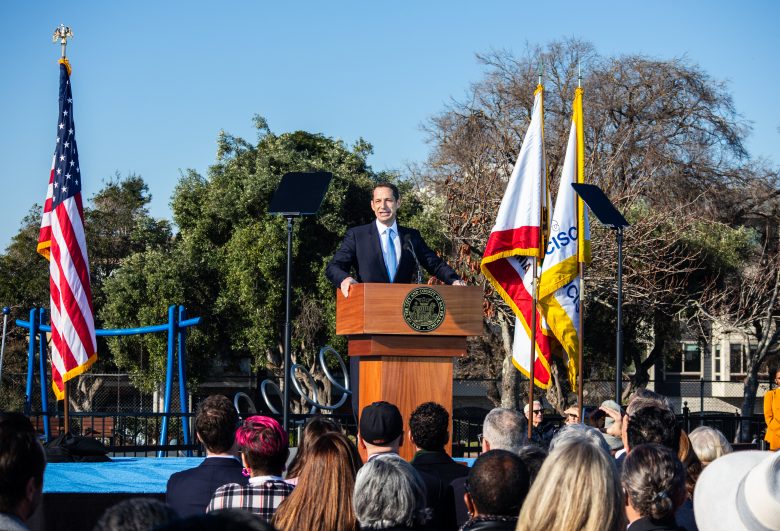

Daniel Lurie’s first big round of applause on Thursday morning came after he recited a litany of public safety statistics: “Citywide, crime is down nearly 30 percent, car break-ins are at 22-year lows and traffic deaths have dropped by 42 percent,” the mayor said, standing under blue skies at Rossi Park in front of a crowd of several hundred.
“Homicides haven’t been this low since 1954. Applications to join the police department are up 54 percent and, for the first time — you can keep clapping, go ahead,” Lurie said, as the crowd erupted. There was laughter, then cheers. Once it died down, Lurie continued: “And for the first time since 2018, we are growing our ranks of officers and sheriff’s deputies.”
Lurie’s first “State of the City,” which he delivered Thursday morning, came with a dose of nostalgia (“I kid you not, right here on this muddy grass, right here, I played soccer”). But it kicked off with tough love.
After the public safety stats, Lurie ran through his first-year attempts to cut down on open-air drug use and visible homelessness on San Francisco’s streets: reorganizing street-outreach teams, adding beds for recovery and treatment, hiring police officers, and opening a detox center for arrestees.
“San Francisco is no longer a safe haven for those who want to sell drugs, do drugs and live on our streets,” Lurie said, to yet more applause.

Lurie spent the first 10 minutes of his 40-minute address on public safety, a clear winner for residents polled on the mayor: His numbers are sky-high when it comes to how Lurie is handling crime and neighborhood cleanliness.
Still, it’s not clear how much his administration has actually impacted crime. It’s down nationwide, though San Francisco has had a particularly steep drop in violent and property crime, according to an analysis from the San Francisco Chronicle.
But the bulk of the mayor’s speech focused on affordability, seemingly tapping into nationwide messaging from the Democratic Party.
Lurie’s take on “affordability” was broad: It included things like streamlining through his PermitSF initiative, which is meant to do away with rules that make it harder for, say, owners of restaurants to set up tables outside or homeowners to fix a crumbling deck—rules which require permits that add up in cost for small business owners and residents.
“We eliminated the requirement to come to the permit center to put candles in your restaurants,” Lurie said (that permit cost $436). “You shouldn’t have to fill out three applications and go to four hearings for two different departments just to get permission to fix your back deck,” which elicited the cry of “Sick!” from a gentleman standing in the back.
The annual address is a chance for mayors to tout their successes and lay out a roadmap for the coming year. This year’s was standing room only.
The few hundred seats set up in a semi-circle around Lurie’s lectern were full. More attendees gathered, standing, in the back. Those who did nab seats in the front row included State Senator (and congressional candidate) Scott Wiener and District Attorney Brooke Jenkins. Public Defender Mano Raju was also in attendance, but two rows back, behind a row of city supervisors.
Former Mayors London Breed and Willie Brown also sat up front. Lurie introduced Breed. But when it came to Brown: “I want to acknowledge Willie, but he’s late” — which indeed he was. Brown showed up about five minutes after Lurie started his address.
Lurie also plugged two new initiatives meant to help with the cost of living. One is expanding free child care for San Francisco families who make up to 150 percent of the area median income (or $233,800 for a family of four), up from 110 percent right now. Families earning 200 percent of the area median income would also qualify for subsidized childcare in the fall, up from 150 percent.
“And we’re not going to take four years to roll this out,” Lurie said, seemingly taking a jab at a recent announcement from Mayor Zohran Mamdani in New York to roll out universal childcare over that time period. “We’re going to be the first major city in the nation to actually get this done.”
San Francisco’s rollout, however, is actually years old already: The money for this childcare expansion comes from a 2018 ballot measure that was tied up in lawsuits until 2021. During her final year in office, London Breed expanded eligibility to current levels, and Lurie is expanding it yet again.
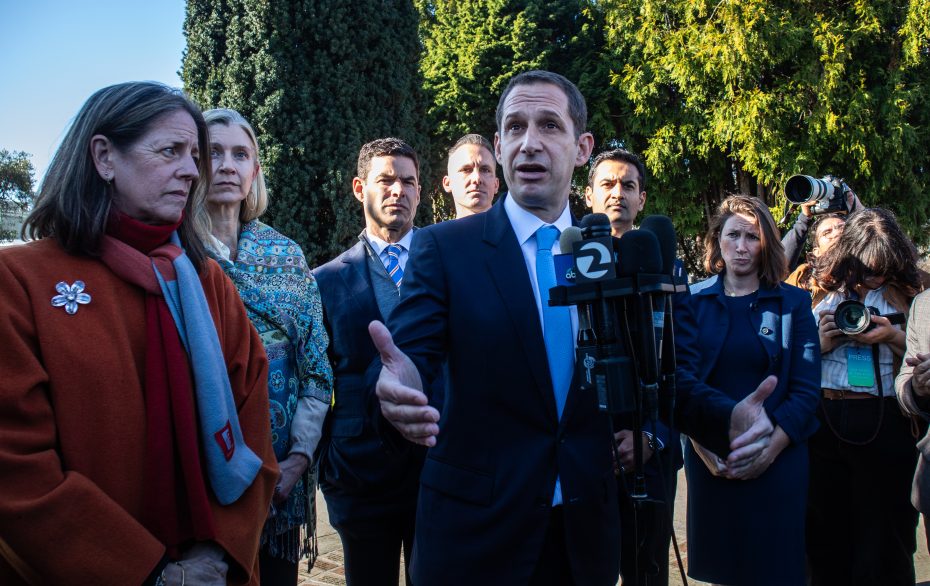
Lurie’s second major affordability policy was a plan announced this morning to merge the planning and building departments with his permit streamlining initiative, part of the mayor’s plans to reform San Francisco’s lengthy and convoluted charter in the coming year.
“Now, I know this is not a sexy topic,” Lurie said, to yet more chuckles. “San Francisco’s insanely long, 550-page governing charter — I’ll tell you what. It does work. It works for the insiders and the special interests, but it does not work for everyday San Franciscans.”
Lurie has taken inspiration for governance changes from the think tank SPUR, which put out a report last fall on charter reform. SPUR’s proposals also served as the basis for Lurie’s use of policy chiefs, a deputy mayor-like system intended to streamline how many department heads report to the mayor.
Lurie’s got a tough battle ahead of him. He and Board President Rafael Mandelman announced 30-odd people to a charter reform commission, which has just a few months to pull together a proposal for the November 2026 ballot.
Lurie will also have to throw political capital behind a parcel tax to fund Muni, which is several hundred million bucks in the red, that voters would vote on this November.
Lurie’s politicking on that was already in full swing, promising the tax wouldn’t just keep existing services but, calling upon now-dated Democratic branding, build it back better: “We will also improve and expand services so more people will want to ride Muni again,” Lurie said.
To sum it all up, Lurie said, “the state of our city is resilient.” And then he bowed out, with his typical, “Let’s go, San Francisco.”
Fund muni direct with muni fares. Stop sticking it to the 35% of residents (property owners) to pay for 100% of muni deficits. Parcel taxes are not free money.
Otherwise I fully approve of the Mayor and feel a bit duped by how much Breed couldn’t get done. Granted she had to deal with the likes of Preston & Peskin, good riddance to them all. Let’s go S.F., let’s clean up this City. No more layabouts on the street doing or selling drugs and stolen property.
The muni tax is a drop in the bucket compared to the massive subsidy to drivers that is $200/year street parking.
Mr. Mayor,
All activity at that intersection should revolve around the 3 Officer Koban feeding 2 block alternating Foot Patrols with one officer being ‘Cop in the Box’ which will be where there is Always a cop supported by a Coterie of exotic Vendors offering goods and services from their City designated Sidewalk Flea Market size stalls.
And, music … use some of those tax deductions to sponsor a monthly party at Jerry Garcia Amphitheatre and some Salsa bands for the Mission BART stops ?
Hell, Gonzalez had a free wine and art show every month he was in office.
That, and for guaranteed Foot Patrols and Kobans …
Let the people choose a Police Chief with power to Hire and Fire and Suspend Without Pay !!!
go Niners!!
h.