

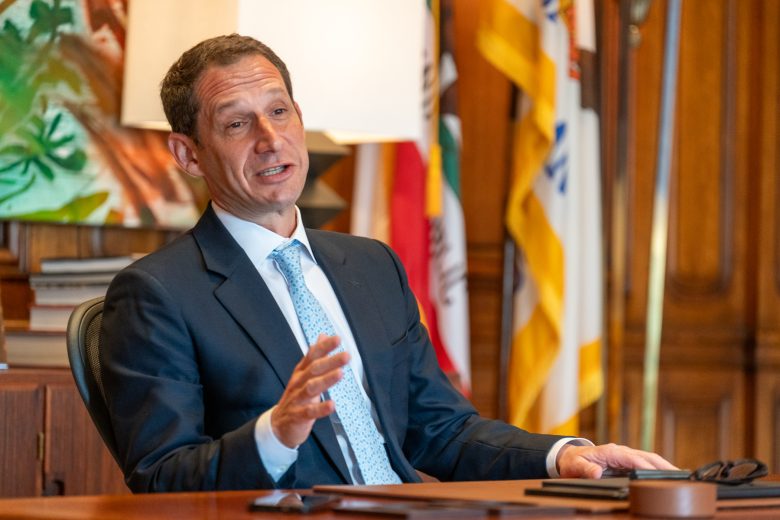

Over the course of the prior year, non-political, non-journalist San Franciscans reached out to me with grave concerns about Mayor Daniel Lurie. They were, in short, alarmed by his caffeine intake.
The general public has no idea how much coffee Mayor London Breed drank. For all we know, her predecessor Mayor Ed Lee started each morning by wading into a kiddie pool full of macchiato. That’s because neither of these mayors had their staff post even a fraction of what Lurie’s team has to social media. Lurie, on the other hand, is seemingly perusing all the cafes in the Yellow Pages, A to Z, and taking his Instagram followers with him. Improving San Francisco’s curb appeal and business climate, it turns out, is thirsty work.
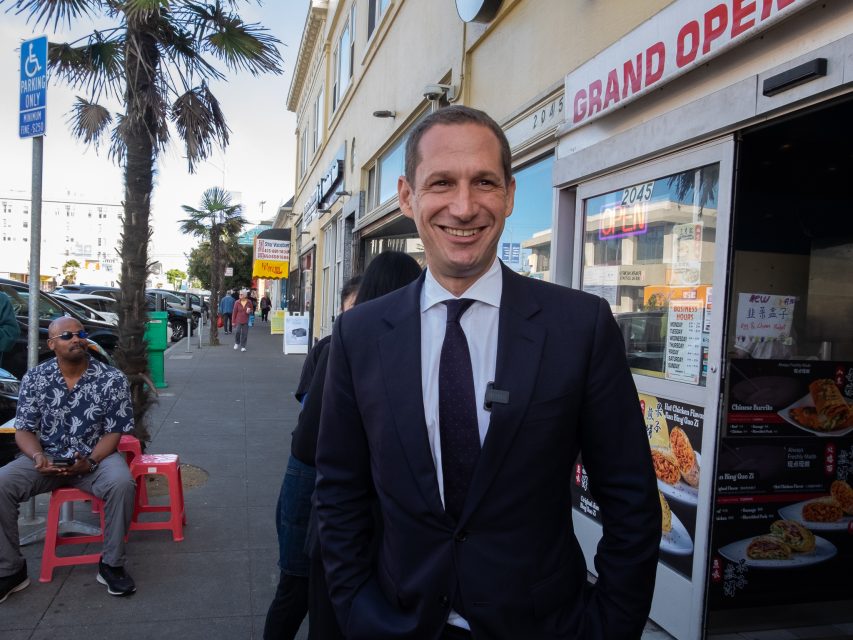
“People didn’t know we existed before they came,” Umit Sener, the proprietor of Gyro King, told the Bay Area Reporter. But then Lurie and his entourage visited the City Hall adjacent restaurant and the mayor posted about it on his Instagram feed.
“Now they come and say, ‘We saw you.’ We have new customers. Some businesses come to me and say, ‘How did you do that? We want to do that too.’”
A photograph of the mayor’s visit to Gyro King now graces the restaurant’s wall.
This all feels an awful lot like a microcosm of Lurie’s first year in office. Gyro King is the Turkish place across from the Main Library. People may not have known it by name, but diners dropped in with enough regularity — including your humble narrator on quite a few occasions — for the place to stay in business for decades and decades under Sener’s family.
But Lurie visits once, and he’s the one credited with putting a generational family business on the map. He’s the one with a picture on the wall.
And here’s the thing: People like it. Other businesses want the same. Sener feels his life has improved. He’s not alone.
Daniel Lurie is positive, optimistic and ever-present. Many people — political, journalistic and caffeinated — underestimated how important this is. Me included. We can dismiss the mayor’s relentless and extremely online boosterism as a little too glib in the face of the very real problems the city and its residents are facing . But this critique is also more simple than the situation warrants. People are watching. They like what they see. And they feel better about this city. The perception of San Francisco has improved in a way that could lead to tangible change.
The mayoral candidates who made a practice of echoing dishonest propaganda about the city having been “destroyed” by criminals and drug-users have been relegated to private life and unelected positions in the city’s political septic tank.
Lurie, who didn’t do this, is mayor. And he has his picture on the wall of Gyro King.

San Francisco remains a city with issues. Reports of its death were greatly exaggerated, but reports of its rebirth depend heavily on where you choose to look and what you choose to see.
Mayor Daniel Lurie’s ability to make San Franciscans feel good about San Francisco and counter the lazy and counterfactual doom loop narrative is important. So, you would think, is what Lurie’s administration is doing with the actual work of governance. On the campaign trail, Lurie promised that “an unprecedented level of change and accountability” would be coming.
With that in mind, we asked the mayor’s office for a brief list of tangible moves Lurie has made to improve the city in the last year. This is what we received:
- Opening a 16-bed stabilization center at 822 Geary, where street teams, police and EMS vehicles can drop off homeless people in crisis 24/7 to get medical care — instead of taking them to jail or a hospital emergency room.
- Adding 500 beds (mostly for recovery/treatment) to the city’s shelter system.
- Reconfiguring the neighborhood street teams model for homeless outreach;
- Launching PermitSF to simplify the city’s byzantine permitting process and doing away with onerous requirements for things like restaurants putting seating outside.
- Streamlining the process for recruiting and hiring new police officers, resulting in the first net increase in SFPD ranks in seven years;
- Drafting and passing the mayor’s plan to upzone the city’s western and northern neighborhoods.
While these are all arguably good things, if you look closer, this is a curious list. To wit:
- The stabilization center on Geary was bought and planned under Mayor London Breed.
- Some 361 shelter beds were also in the pipeline under the former mayor.
- The street team reconfiguration follows a comprehensive 2023 audit and a 2023-24 annual report. And while there is promise in this reconfiguration, it remains to be seen if it’ll make a lasting and significant impact on city streets.
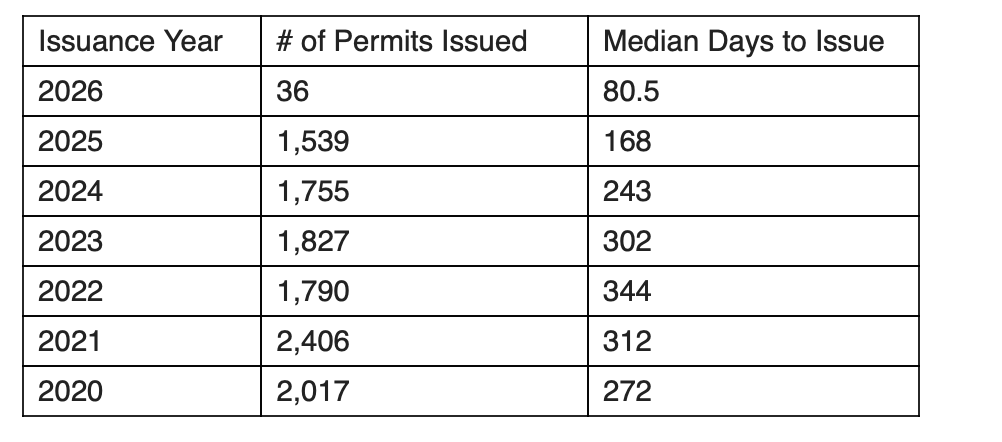
- Doing away with dumb permitting requirements so places like the Glen Park Cafe can have sidewalk seating is an unmitigated good, but it ain’t exactly the Norman Conquest. Moving to untangle the Gordian knot of permitting is also good, but the rollout of PermitSF was marred by mayoral deputy Ned Segal unilaterally awarding a $5.9 million contract over the objections of frontline staff and despite far less costly alternative bidders. So let’s call that one a work in progress. Data from the Department of Building Inspection shows that the median number of days to issue an in-house permit dropped from 243 in 2024 to 168 in 2025. But the biggest factor in that change seems be AB 1114, a state law that, as of Jan. 1, 2025, mandated quicker approval times and prevented approved permits from being appealed.
- Increased police hiring is a positive, but it warrants mentioning that the police were awarded a highly generous contract under Breed in the 2023-2025 budget — which, if properly advertised to potential recruits, should render hiring easier. It also warrants mentioning that this contract lapses on June 30, and must be re-negotiated by the Lurie administration as a $400 million deficit in the city budget awaits.
- The mayor’s shepherding of the upzoning plan was no given and a political win. But this was a move mandated by the state and already underway for several years when Lurie took office. Its impact on the city remains unclear: City economist Ted Egan predicted limited rental savings for future tenants and the construction of, at most, 14,600 units over the next 20 years.
To the mayor’s list of tangible successes, your humble narrator would add two tangible examples of crisis averted.
- San Franciscans ought to be proud that this city established a public-private partnership to fund food benefits for more than 112,000 city residents during the shutdown. The abrupt loss of those benefits would have devastated not only city residents, but the grocery stores in low-income neighborhoods that depend on their business.
- Whatever the mayor did or did not do to prevent trigger-happy federal goons from being unleashed on city streets is much appreciated.
It remains to be seen how this citywide era of good feelings holds up once we hit the 2026-2027 and 2027-2028 budget process. This year’s figures to be far bloodier and more excruciating than last year’s, in part because of decisions that were put off last year. Our revenue shortfall has not yet been solved.
San Francisco’s revenue cratered during the pandemic because its downtown was, by and large, dominated by a sliver of the economy — tech. City office space is now dominated by a sliver of a sliver — AI. This, too, could work out poorly. We should’ve figured that San Francisco was in a vulnerable position, eggs in basket-wise, when every downtown worker was wearing the same puffy vest.
Labor negotiations during times of budgetary privation are a test for any mayor. Lurie will also need to sweet-talk voters into approving a revenue measure to forestall a transit meltdown (both municipally and regionally). This, too, figures to be an effort. The mayor’s 31-person group tasked with building a better city charter is scheduled to wrap up in March, and then the work will begin persuading voters to actually approve the thing in November. That’s a fast turnaround for major charter reform: You can listen to podcasts in double time, but doing government is harder.
Daniel Lurie is positive, optimistic and ever-present. That won’t be enough to solve all the problems looming ahead. But even a mastery of government would be insufficient if he were negative, pessimistic and absentee. Lurie won’t always be the mayor but, who knows: He may yet be our once and future Gyro King.

“Our revenue shortfall has not yet been solved.”
Ah but do we actually have a revenue shortfall? Or is it more a case of a spending surfeit?
It seems to me that a crucial issue for Lurie in 2026 is how he balances any revenue measures with spending cuts. How well e pulls that off may inform whether his approval numbers continue to soar like a bird. Or sink like a stone.
My goodness, Joe you are SO out of touch. The business class might be feeling great about SF, but the working and middle class, and renters are STRUGGLING under Lurie. Rents are skyrocketing to pre-pandemic levels. Traffic is snarled since Lurie made 30k city workers trudge back to the office. Tech companies are run amok and have us all feeling like unwitting test subjects for harmful and extractive technologies. Things ARE BAD for anyone who isn’t rich.
Kurt —
Polling consistently shows that the mayor is up at around 70 percent. You would appear to be in the 30 percent. That’s how polls work. Your complaints are legit but, take a breath and say it with me, they are not yet reflected in the mayor’s polling numbers.
Best,
JE
So the question is, why? Who answers polls? Mostly older people in fixed addresses who are also quasi-political. Those were/are the loudest voices against crime and homeless type issues consistently over the last 5 years. Lurie has made a lot of PR and whatnot about those issues specifically, and those people are at least somewhat appeased after years of Breed’s incapacity and grifting. So Lurie gets “approval” compared to that past, for that demographic. I would push back on the idea that 70% of SF thinks Lurie is prioritizing correctly as he pushes his massive gentrification sellout to big development while hardly touching the aforementioned lingering issues that are getting, frankly, worse.
But you are correct, polling data is polling data FWIW. It has to be interpreted IMO.
More FWIW: I get lots of polls that I’m pretty sure originate from Lurie world, including the notorious beya d4 trial balloon. At age 40 I guess I’m slightly older than the mean, not sure if this is what you have in mind when you say “older”. And yeah, quasi political I guess but that seems like a label you can trivially apply to anyone who answers political opinion polls, right?
So now we have a completely unsupported speculative statement about polls in San Francisco from you and a marginally, barely supported n=1 anecdatum from me. Maybe someone more well informed can enter the discussion but I’m not holding my breath.
In case you are wondering I get some jollies describing my views on Malibu Dan whenever they ask…
I didn’t limit that to polls in SF, btw. I’m saying that applies to polling in general. Having a fixed address and the interest in answering polls is a non-zero correlation with age, in my experience. YMMV.
I’d suggest that people who are older and own property see Lurie’s actions in a more positive light than those who are not. That’s my hypothesis that nobody has to agree with, but may be accurate. There’s statistically no strong way to know that for sure without spending millions, which is neither here nor there, but Lurie is a Billionaire. That adds.
Over 40 I would personally consider older, or at that median. You’re right, that’s ambiguous, but the point stands. You’re responding to a political comment on a news site, so I’d call that politically interested.
I’m not calling your opinion trivial FWIW. I’m suggesting the people who answer polls are a subset of the larger whole, which is true. That’s actually all.
You didn’t “interpret” the poll results, you ignored them.
You are ignoring the points made by choice. That’s as useful as that is.
Texting in particular has become a common means to engage respondents across all demographic and partisan groups, often as part of a mixed-mode approach. Kevin Collins is the co-founder of Survey 160, a firm that focuses on SMS text-based surveys in its work with Democratic pollsters and nonpartisan organizations, largely via text-to-web sampling (text messages that link to a survey on a web browser) or live interviews over text. “We do text message surveys, but really what we believe in is mixed-mode surveys,” Collins told me. “Texting offers a very important additive benefit and cost savings over phones.” The firm ran an experiment while polling Kentucky’s 2023 gubernatorial election and found that its weighted sample’s vote preferences were much closer to the election’s final outcome when it mainly texted or used interactive voice response calls with younger respondents while prioritizing live phone interviews for older ones.
Though no demographic or political group is close to absolute on a preferred method, pollsters have uncovered some patterns in which different groups are more likely to answer polls using different modes. SSRS and other survey houses, such as the Pew Research Center, found that using physical, paper-based approaches like postcards for recruitment and poll completion actually improved response rates among more Republican or conservative respondents, potentially because they seemed to find those modes more trustworthy. By comparison, those answering by web tended to be more Democratic-leaning. Younger respondents, including young conservatives, were more likely than other age brackets to use QR codes in SSRS’s polling. Multiple firms presented findings that some voters of color and those with lower educational attainment and income levels were comparatively more likely to respond by phone.
Of course, multi-mode approaches present other challenges as well. For instance, Collins emphasized that establishing a polling firm’s credibility in its text message outreach is a key consideration in text-to-web surveys. “People are reasonably cautious about clicking on links from phone numbers who have contacted them out of the blue,” he said
-ABC news, which you probably would call “fake” etc…
And don’t forget the disabled people!!!
YIMBY doesn’t care about poor or disabled or working-class people.
YIMBY cares about enriching developers and gentrification.
YIMBY supports projects like the affordable senior housing project in the Sunset.
The gated community of the Sunset fought that. They don’t care about poor people. They do, however, care about keeping their property values high. And they want the private Great Highway for their BMWs.
You hit the nail on the head as to why I , a high school dropout, went to the trouble to get rich. It’s way fucking better than being poor !
Nice piece Joe!
You know that saying about attitude is 90% of it? Well, this is an example of just that. I think the mayor is doing a pretty good job and is shining a positive light on our city by using his position as a vehicle to promote its better aspects. This article is doing the same ! I like our mayor and I loved reading this piece. I believe in our city and better things are on the horizon.
Thanks Joe
Ned should go His actions were clearly corrupt. Why should we tolerate this?
Downvoters cordially invited to defend this behavior if they think they can cobble together something convincing…
I agree that the PermitSF headlines look damning, but buying business software is a bit of an art because software vendors sell (and often genuinely believe) that anything is possible with their solution. This becomes a problem because startups universally sell that dream to too many customers at once. Customers whose executives have personal relationships with the decision makers at their software vendor greatly improve the odds of their project’s success (mostly through “escalations”). Though a competing software vendor bid less in this case, some reporting also mentions that this low-bid vendor hadn’t delivered on its promises and was behind schedule on a different government project. That cheaper vendor is also much smaller, and less likely to deliver on an additional big project. Frontline workers may have preferred that different vendor based on RFP answers, but they might not have been privy to the on-going project’s delivery issues. Enterprise software purchases rarely come down to price alone. I could be naive about the real world, but I’m very familiar with the fake world of b2b software. What might look like clear corruption in the context of city government looks like normal, experienced software buying to me.
YIMBY does not question development.
This mayor’s major accomplishment has been to do tap dancing backflips on Market Street whenever a business throws a press release over the transom, while ignoring the neighborhoods other than as opportunity sites for business people, especially developers.
marcos, Lurie’s priority is to get downtown firing on all cylinders again, as it is downtown that is the financial engine of the city. So we fix downtown before we fix the rest.
And downtown is a neighbothood too.
Would love to see him do a photo op. at 16th or 24th and Mission street, along with that invisible supervisor, Ms.Stanford graduate, that was elected there.
Just curious does Lurie know any Black or Pacific Islander people? The photo op, he had with CBS news last Friday, only showed 2 Asians, that did not look Asian,{Maybe they were doubling as Native Americans}, Blacks, or Pacific Islanders, or disabled people, and the majority of the people in the photo were middle aged, white people.
Campers,
Always a basically good guy, Daniel Lurie has gone from living a sheltered life to living a ‘Silo’d’ life where he’s now driven down what the staff calls, ‘the Mayor’s corridor’ where everything get’s a quick clean before he arrives in the excuse of security.
If you want to see what effect all of your efforts around 16th and Mission have come to just drive there unannounced in a cab and after you’ve circled a couple of times get out with the one cop you’re allowed in a hoodie and walk around.
We still a return there of Feinstein’s Police Koban and our historic long line of legitimate vendors.
And, have Tipping Point sponsor a concert there for the People of the Mission just as they used their tax deductions to toss parties for themselves down at the Armory ?
Elect our Police Chief !!
And, did I call the Niners game perfectly in advance ?
Key plays were weird trick passes not seen since I don’t know when.
Go Niners !!
h.
another billionaire failure.