

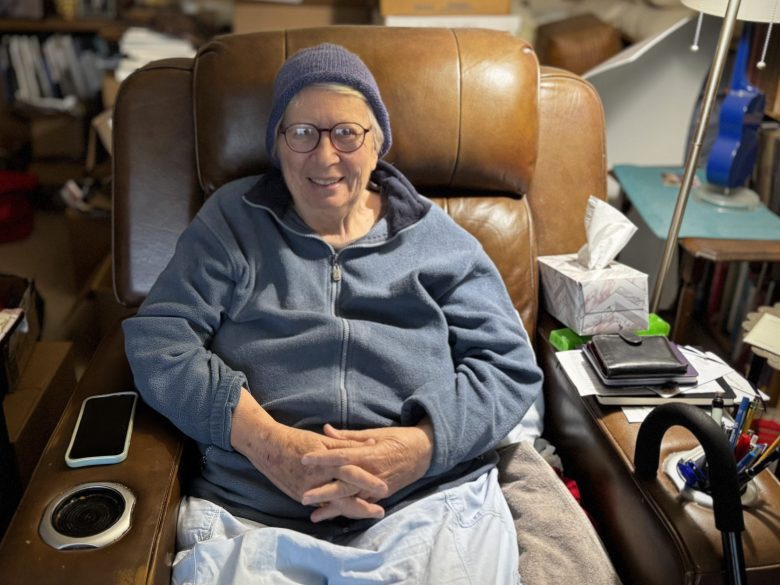

Le’Troy Andrews, 74, had to crawl from his bedroom to his front door during the PG&E power outage on Saturday night to let paramedics into his Inner Richmond apartment. He thought he was having a stroke.
Andrews, a former Air Force medic who lives alone with his dog, Cooper, underwent brain surgery last August, and also has congestive heart failure. His apartment had lost power earlier that afternoon. When he went to bed that night, he didn’t use his CPAP machine — a device commonly used to treat sleep apnea — since there was no electricity.
Around 10:30 p.m, he called 911 with stroke-like symptoms.
After he struggled to let medics in, and they stabilised him, Andrews asked to be taken to the hospital. He was transported to University of California, San Francisco Health Stanyan Hospital, where doctors said the neurological episode was likely brought on by stress, but were unable to provide a clear diagnosis.
“I was frightened because I’m much older, and my body and my reflexes and everything are different,” he said. Most of Andrews’ family is on the East Coast, and his few friends were scattered throughout the city, many busy with the power outage themselves.
Seniors across the Richmond District felt cut off from the outside world on Saturday and Sunday, with no electricity or even cell phone service.
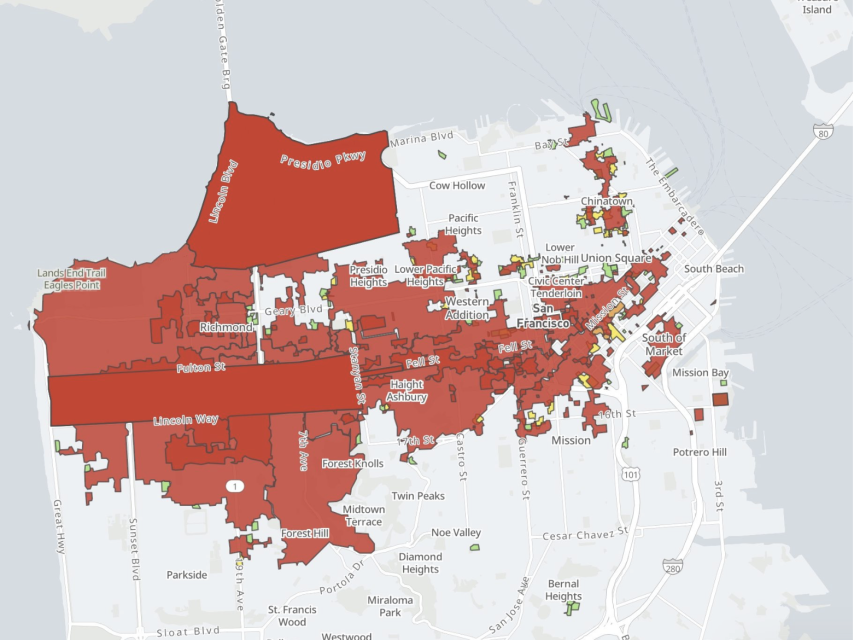
The PG&E outage left about one-third of San Francisco residents without power and was, in part, attributed to a fire in one of the company’s substations at Eighth and Mission streets. While power returned for most on Saturday, the company’s outage map showed large areas of the Richmond in red, without power, well into Sunday evening.
As of Monday evening, power had almost completely returned.
In a three-story building a stone’s throw from Balboa Street in Outer Richmond, senior residents described a nightmare 48 hours without electricity or information from the city.
Many of the residents on the top floor of the building are over the age of 65, with mobility issues and disabilities. When the power went out, a lot of them were ill-prepared: No fully charged mobile phones, flashlights or backup batteries.
Without a working elevator, a stairwell that had a railing only on one side, and no emergency lights in the common areas, most top-floor residents could not step out of their homes.
A younger resident, who did not want to be identified, was instrumental in organizing support for the seniors, they said. She described them as “cold, anxious and panicking,” and said that if neighbors like herself had not checked in, the situation could have been dire.
The resident collected everyone’s phones and went to charge them at her sister-in-law’s house elsewhere in the city. Another neighbor, who himself had a leg injury, drove to buy portable power banks from a nearby store, all in the pouring rain.
Christina Cordi, 72, has rheumatoid arthritis. She pays $1,150 every 90 days for medicines that must be refrigerated at all times. She couldn’t afford to lose her stock.
Eventually, a younger neighbor went out to buy some ice, and the residents created a makeshift icebox to keep Cordi’s medicines cool.

Since most of the outreach by the city departments was done via social media and cellular networks, residents did not receive much information once their phones died or lost signal. There were numbers to call for help, but DeStafanis wondered: How could you call them when the phones were dead?
“If you’re gearing all of your outreach toward social media, the tech-literate and the able-bodied, that’s not covering the whole city,” said the neighbor who helped organize support for the seniors. “It’s definitely not covering a good chunk of D1.”
Residents were not aware that they could call 211 for a hotel stay, for instance, as advertised by Mayor Daniel Lurie and Supervisor Connie Chan in an Instagram video.
When PG&E set up the Richmond Rec Center on Sunday with water, charging outlets and other resources, it didn’t make much of a difference to the seniors — they didn’t know how to get themselves there.
Cordi and her neighbor, 77-year-old Nancy DeStefanis, remember freezing the first night and sleeping under piles of comforters to get warm after the resident manager had told DeStefanis that the heat wouldn’t work — though, it turned out, it did.
The property manager also seemed to believe the building did have electricity based upon PG&E’s faulty outage map, slowing response to the tenants.
Margaret Rosano of Rosano & Co., the company that manages the property, said that when she checked the PG&E outage map on Saturday evening, it showed that the building still had power.
She later realized the PG&E map was not accurate, she said: At 4:50 p.m. on Saturday, the PG&E outage map showed most of Outer Richmond, including the building in question, without electricity.
In an email sent to DeStefanis at 12:24 p.m. on Sunday, Rosano wrote that there was a box of emergency supplies in the building and Rosano was “checking on the status and location of that.” She also said that there may be additional blackouts, and that she would send information soon about onsite supplies.
As of 4:30 p.m. on Monday, tenants Mission Local spoke to had not received any more information.
Even now, residents are in a flurry, preparing so they don’t get caught off-guard again. They are ordering batteries from Amazon, stocking up on non-perishable foods and wrapping up errands before the possibility of another PG&E outage.
“If it wasn’t for the neighbors,” DeStefanis said, “we would all be up shit creek with no paddles.”
Not to call out any of the individuals profiled here, everybody gets caught unprepared once in a while, but I’m getting extremely tired of the way media outlets have been blithely ignoring that we have been told, over, and over, and over, and over again, that we need to have supplies for a three day emergency.
And that should include power. If you have a CPAP machine, or you have medicines that need to be refrigerated, you need to have a battery backup sized to power those devices for three days. Why is that not the takeaway message from this event?
It’s not if, but when, that we have another event that shuts off power. This should be a warning to everyone to get their shit together and get a home power station. They’re affordable and user friendly, and they’ll save your ass next time the power goes out.
And before anybody starts with any – things are just soooo expensive – crap, get over it. Things cost money, it is what it is. This is how you stay alive when the big one comes. A reasonably sized one costs around $500 at a big box store, find the money.
“We were all scared. We felt abandoned by the city and by our landlord, said Nancy DeStefanis, 77, who uses two canes and lives on the building’s third floor.”
It isn’t clear to me what a landlord could do in such a situation. So although Nancy’s situation was deplorable, is blaming her landlord fair?
Although it is worrying that elderly people needing canes etc. are living on the top floor of multi-story walk-ups. Isn’t that the real problem here?
Oh, and of course even if the elevator is in good repair, it naturally won’t be working in a power outage. So again, the building these residents are in is a perfectly reasonable choice overall for their needs. The landlord just needs to do some basic things so that in an emergency with no power, the hallways and stairs don’t become unnecessarily dangerous.
At face value, you may be correct. But seniors might have moved into their highet floor flats when they were young and stayed for many reasons. Moving to a more sensible place might be beyond their means. Emergency equipment and exits are seldom maintained as well as mail collection, lobbies and corridors, but should be–admittedly at a cost that residents must share.
San Francisco rent control is a little more than 45 years old (so Google tells me). Easy to imagine that we have a big demographic of people who are now seniors – living in a place that’s less and less suitable and yet they can’t leave because rent control keeps their housing cost far below “market rate”.
From the paragraph just before that:
“Without a working elevator, a stairwell that had a railing only on one side, and no emergency lights in the common areas, most top-floor residents could not step out of their homes.”
Putting in some emergency lights, and fixing the stairwell so it has railings on both sides, are pretty clear steps which there’s no good excuse for the landlord to have not done.
The reference to a *working* elevator also suggests that the building is supposed to have an elevator, and it’s just not working right now. In other words, these residents didn’t move into a walk-up — they moved into a building with an elevator. And then it’s the landlord’s responsibility to keep that elevator actually working.
Greg, how can a landlord keep an elevator working when there is no power?
This wasn’t the city’s fault.
It is wonderful and kind that samaritans helped people in need. But why are they not prepared as everyone in earthquake country is supposed to be? I agree with K Ash that these seniors should take the blame for their own lack of preparedness. Pool their money and buy a communal generator, Or a long life battery source. Maybe keep a block of ice in the freezer to use in a small cooler?
Good grief, what are they going to do after an actual earthquake? The good Samaritans are going to be really busy trying to save themselves.
My heart goes out to the seniors and the businesses that were so affected by this outage. PGE needs to do better. A lesson for all of us , if there was to be a major earthquake, I would not be prepared. A wake-up call. Merry Cy
I learned when the 1989 earthquake left me without flashlights and I had to borrow them from my housemates. Since then I collected flashlights and battery lamps whenever I shopped and bought potable chargers and radios with power banks, solar panels and cranks. When I was a child, my parents kept kerosene lamps and candles and if there was a power outage we went on with our lives. We got through the Ice Storm of 1973 with the power out for days in Connecticut with only the heat from the fireplace in 20 degree cold. I worked on papers for High School. The telephone still worked when the electricity was out so I kept my land line here until I moved. I spent alot of money for a large battery with a solar panel and a portable electric cooler but I haven’t charged them up yet. Now I wouldn’t use candles or kerosene lamps because of the fire danger.
While it’s an added expense,I keep my land line, in case of events like these,and I keep my cell phone, charged each night.The time has come for not just S.F but the state of Calif. to own it’s own utility company. On 2nd thought nick that idea, cuz neither the city or the state, function very well.