

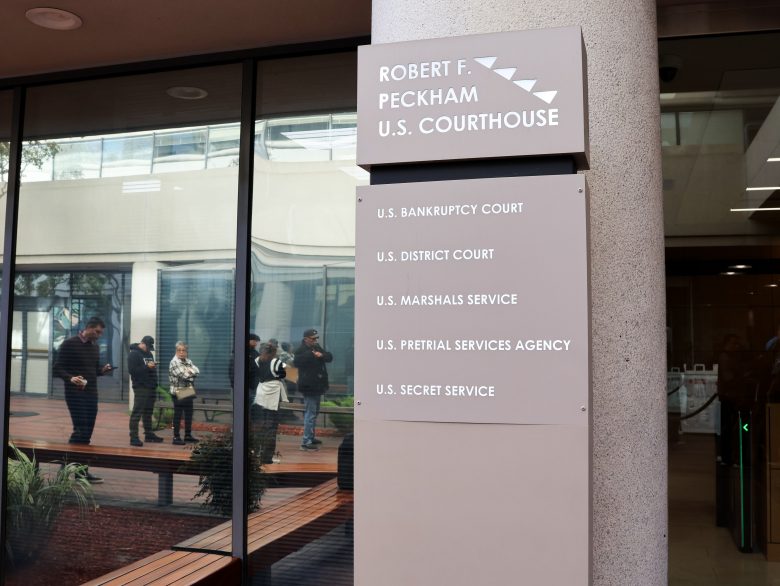
San Francisco attorneys asked a federal judge on Monday to halt the practice of keeping immigrants detained for up to three days in holding cells across the country while they await transfer to long-term detention centers.
The attorneys, who represent four immigrants held in San Francisco holding cells, say conditions inside the cells are so poor that they violate immigrants’ constitutional rights.
The demand was the first major action in a hearing that kicked off Monday after the American Civil Liberties Union joined with other groups to sue Immigration and Customs Enforcement over conditions in its holding cells at 630 Sansome St., the city’s ICE headquarters.
Attorney Nisha Kashyap, who is with the Lawyers’ Committee for Civil Rights of the San Francisco Bay Area, appeared before Judge Casey Pitts in the U.S. District Court for the Northern District of California in San Jose to ask for a pause to an ICE policy that allows the agency to hold immigrants for up to 72 hours in its holding cells.
ICE started that policy in June.
ICE uses holding cells in its facilities nationwide to detain immigrants before they are transferred to detention centers. Until June, ICE could only hold immigrants in those cells for 12 hours. ICE then issued a waiver that month to extend the cap to three days.
Mission Local subsequently documented an increase in immigrants being held at the San Francisco ICE holding cells for longer periods of time, including at least two who were held more than 72 hours.
The attorneys also asked the judge to order ICE to immediately improve conditions in its holding cells at 630 Sansome St., in San Francisco.
Immigrants who were detained by ICE there over the last six months say they were kept in small, cold spaces for up to six days without prescribed medication, access to restrooms, clean clothes, and other essentials.
Plaintiffs allege that the Sansome Street facility was never meant for more than short stays, and that current practices violate immigrants’ constitutional rights.
In the lawsuit, those detained at Sansome provided firsthand testimony describing freezing temperatures, little or no privacy in single-room metal cells, lack of beds or blankets, and fluorescent lights left on continuously.
In the hearing, attorney Marissa Hatton of the Lawyers’ Committee for Civil Rights said the holding cells can cause “serious psychological harm.”
One plaintiff said he told ICE that he needed his blood pressure medications, but he received no medical attention. As a result, he suffered a medical crisis that may have caused permanent brain damage, according to the lawsuit.
If the judge makes a ruling in the plaintiffs’ favor, these conditions will have to be improved.
The plaintiffs’ attorneys also sought to expand their case to cover all immigrants who had been detained at 630 Sansome St., or may be detained there in the future, by seeking class-action certification.
“The four individuals who brought this lawsuit seek to represent and advocate on behalf of all the folks affected by this policy,” Kashyap said, adding that the certification would ensure that “not every single individual detainee has to come into court with their own individual lawsuit.”
The government’s attorney argued against the class-action certification, saying the experiences of those detained at Sansome are too different to satisfy the legal standard. The attorney also sought to dismiss the ask for a stay of the 12-hour waiver.
While Judge Pitts did not issue a ruling Monday, he said a decision would come soon, given the sensitivity of the lawsuit at hand.
Kashyap left the hearing cautiously optimistic.
“The government had the opportunity to rebut and they failed,” Kashyap said. “That’s significant, because I think it shows what’s happening in San Francisco is unconstitutional, and it mirrors what we’re seeing happening in New York and Chicago.”
Since when do illegal immigrants have rights? Their only rights should be the right to a speedy repatriation. Not enforcing and/or enabling immigrants to move to the US illegally only opens the floodgates for more illegal immigration. America needs immigrants, but not just any immigrant with a pulse. No one should be upset with the trump admin for how it is handling immigration when in 2009, democrats controlled the executive and legislative branches and failed to create a lasting, meaningful, and effective policy to humanely deal withthe problem.
“Since when do illegal immigrants have rights?”
Since 1776, maybe you’re new here or just never read the Constitution?
Yes, 72 hours is too long. Can’t they get them out of the country any faster than that?
Keep up the good work of Keeping US informed 💯