

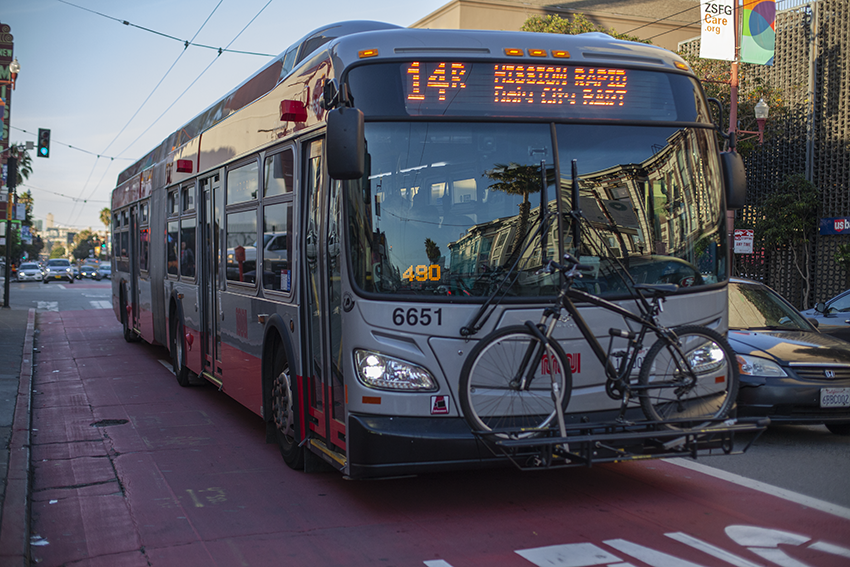

Well, here’s a shocker: Muni, the fiscally strapped transit service that slowly moves people and Takis wrappers around San Francisco, is insanely clean.
We’re not talking about the insides of Muni vehicles. You still need to look hard before you sit down.
Rather, we’re talking about the tailpipes. Muni’s contribution to the city’s total emissions, as a percentage, reminds us a bit of the Crazy Eddie commercials that Dad and Uncle Steve used to flip through the channels to find in a pre-cable, pre-internet New York City: They’re so low, low, low that they’re — insaaaaaaane.
How low? We’ll get to that shortly, and in great detail. But the thing is: It’s not low enough to satisfy the state of California.
In 2019, the state mandated that public transit agencies start transitioning from diesel buses to zero-emission buses. By January 2026, half of all new bus purchases must be zero-emission. By 2029, all new purchases must be zero-emission. And by 2040, the entire fleet should be zero-emission.
Muni’s emissions are low, low, low. But they’re not nonexistent. Ergo, they are not zero-emission. How much will it cost to get to zero? A lot more than zero.
Bhavin Khatri, the Municipal Transportation Agency’s zero emissions program manager, tells Mission Local that bringing Muni into compliance would run “in the hundreds of millions of dollars.”
Muni is facing a $300 million deficit starting in July 2026 and is considering Draconian financial measures that could eviscerate a service that has rarely worked better in recent memory.
Muni does not have the money to invest in long-term zero-emission fleet upgrades and infrastructure renovations. It doesn’t even have the money to buy the Takis chips scattered through its buses and trains.
Barring unforeseen lunacy, Khatri says that Muni will apply for an exemption and continue to run the bulk of its service via diesel hybrid buses: The cleanest bus is a full bus, and Muni needs to focus its money on that. This is an absolute no-brainer and, in a sane world, Muni will get what it’s asking for here.
Khatri believes the SFMTA will be among the first, if not the first, California transit agency to apply for such an exemption. But somebody has to be first: “A lot of them are probably waiting for us,” he explains.
If and when Muni takes the plunge, here’s hoping that its request for an exemption will be granted — because the standards it is being required to meet are insaaaaaaane.
In the past, Muni has been more than a little cavalier about environmental regulations. We’ve reported on this. In 1996 and again in 2013, Muni was caught needlessly idling its diesel buses for hours early in the mornings at bus yards. In 2017, we caught Muni needlessly idling its brand-new $750,000 diesel-electric hybrid buses.
Even low-end new cars now automatically cut the engines to prevent excessive idling, but these expensive buses did not, because Muni inexplicably had that program disabled. After first claiming it would cost $1,200 per bus to install this program, the SFMTA, facing blowback, got it done for free.
So there’s a history here, and it’s not a uniformly glorious one, especially if you live next to a bus yard.
But forcing a transit agency into prohibitively expensive upgrades when it’s struggling to fund basic service is bad governance — especially when you factor in how minuscule Muni’s emissions are compared to the city writ large.
How minuscule? Well, how about we put on everyone’s favorite Steve Martin album: “Let’s Get Small.”
In 2019, Muni accounted for more than 25 percent of all the recorded trips in San Francisco. That same year, it also accounted for three-hundredths of one percent (0.03 percent) of the greenhouse gas emissions from transportation in the city.
Three-hundredths of one percent is small. But the true number is actually even smaller. That’s because transportation is just one of many sources of greenhouse gas emission in San Francisco.
According to 2020 data, “transportation” accounted for 44 percent of the city’s greenhouse gas emissions (“Buildings” also generated 44 percent).
That means Muni is responsible for three-hundredths of a percent of 44 percent of the city’s emissions. Which, doing the math, comes out to only around 0.013 percent of all the emissions.
But wait, there’s more: 2020 was, admittedly, a weird year. Two years later, 2022 was more up to speed. Still, according to the data from ’22, Muni was only responsible for not just a tiny sliver of all transportation emissions but a tiny sliver of all public transportation emissions.
Ferries accounted for 68 times the emissions as Muni. San Francisco’s own municipal fleet of cars and trucks at the disposal of city employees emitted 43 times the greenhouse gases of the transit agency carrying hundreds of thousands of riders daily. And private citizens’ vehicles spewed 3,423 times as much emissions as Muni buses and trains.
The 2022 numbers, like those from two years prior, put Muni’s emissions as around one-hundredth of a percent of the city’s total.
Where is the environmental virtue in saddling Muni with orders to spend hundreds of millions of dollars on upgrades while leaving 99.99 percent of the city’s emissions untouched? There wouldn’t be any.
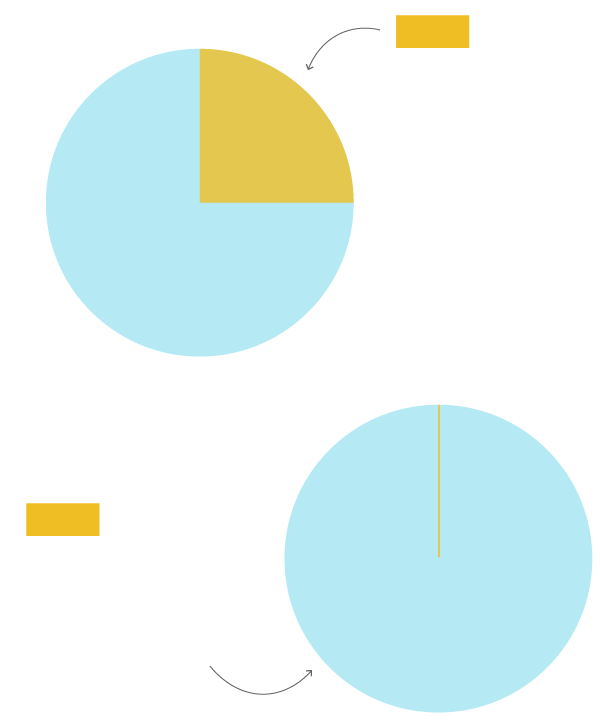
Daily trips
Muni carried
26% of trips in
S.F. in 2019
Transportation
emissions
The same year,
Muni accounted
for 0.03% of
transportation
emissions in S.F.
Chart by Kelly Waldron. Source: SFMTA 2019 annual report.
Public transit can be complicated, but this much isn’t: The cleanest bus, again, is a full bus.
Muni’s diesel buses have gone gentle into that good night, replaced by diesel-electric hybrids. Our trolley buses run on Hetch Hetchy hydroelectric power, as do the light-rail vehicles and trams. San Francisco has 12 battery-powered buses. Cable cars, we are told, run on dilithium crystals. There are not a lot of emissions there to reduce.

San Francisco is a city that really shouldn’t be encouraged to gloat about its bona fides. But, in Muni’s case, we’re doing pretty well here. But we could screw that up. In some ways, we already are.
Ostensibly smart people have said that the solution to San Francisco’s transit ills will come via thousands and thousands of autonomous vehicles being deployed to the city. That may happen anyway, and the AVs on city streets today are, by and large, low-emission compared to other private vehicles.
But the congestion, if this becomes more widespread, will be immense. There’s a reason transit times in San Francisco are often no better than they were more than a century ago, when people took their deceased relatives to the graveyards of Colma via rail: Congestion has exploded in the era of ubiquitous private automobiles, which also accounts for the plurality of city greenhouse gas emissions.
“You want to get people out of their cars and encourage transit use,” says Khatri. “Well, that is also the best way to reduce emissions.”
The best way to get people out of their cars is to have safe and reliable transit nearby and running frequently. Muni should be given free rein to better achieve this until such time as it can afford to be a caravan of perfect virtue. Anything else would be insaaaaaaane.
It doesn’t make sense to throw out buses that are working well, but hopefully we can stop buying additional fossil fueled buses. I believe IBEW has a proposal for extending the overhead wire and running more trollybuses that no one’s really been listing to.
We desperately need congestion pricing for single occupancy vehicles in this city.
No, we ‘desperately’ need faux-futurist YIMBY transplants who think SF = Paris to be run out of town on a rail, never to return.
Hundreds of thousands of SF residents rely on their vehicle to get to work. Pretty much anyone except those who live close in and work downtown.
So your idea would lose badly in any proposition.
This would be the right thing for Muni and the State to do. Transit advocates have been pulling their hair out for years over the zero emissions rules, especially how they incentivize expensive, oil and gas based boondoggles like hydrogen over hybrids or even trolleybuses. One slightly complicating factor, though, is the enormous impact diesel emissions have on public health. Diesel particulates from trucks and buses and the like are only ~10% of emissions from traffic, but account for ~90% of the cancer risk. The State may have seen cutting into that as a driver for the rule, even if buses are still small compared to big rigs.
And one other small note, those AVs are probably still comparable to any other car, because the batteries and tech make them so much heavier. That creates way more dust from the road and tires than they save from being electric.
Which diesels are you asserting are 9x more particulate emitting? This article is about Muni bus fleet. They are not very old, as in common rail electronic direct injection vs the mechanical injection still wandering the streets in non Muni service.
The emitted total from EV’s surpasses ICE vehicles that have been on the road for up to 300,000 miles or so, at the production line. Then they power up from a grid that is somewhere about 1/3 renewable, the rest emitting sources, and the transmission losses for that generation is estimable at around 70-80% by the time it gets into the EV after all the various hops. (That’s if the TESLA charging station doesn’t just have diesel generators running full time, which many do.)
It’s not that clean. Vehicle emissions equal somewhere under 4-5% of the total, and while you watch Methan emissions from leaky wells dumping a 50x thermally insulating gas 24/7 all across the nation, the drop in the bucket that is EV emission reduction becomes entirely negligible and pointless.
However, they do make the virtue signaling tools feel good about themselves, so that alone is worth over 100k… to them.
How about sources on your assertions. Many assertions that may have a possibility of being somewhat true nationally or in some location but not here.
Where are your sources for questioning the stats? AFAIK that’s pretty close.
San Francisco would be better off modeling itself after the Ten Minute City strategy where neighborhoods become more self-sufficient, instead of trying to resuscitate the old Downtown Hub strategy. Why are people still travelling down to 450 Sutter to visit a dentist? Why are planners even now casting in stone the old model of building thousands of housing units for commuters along our old streetcar lines that feed into Downtown? Instead, why don’t city planners encourage shared work space offices in our many residential neighborhoods, enabling residents to take a short walk, bike, bus, or uber trip to commute? That way, having a steady stream of customers in each neighborhood throughout the day, will help revive and support neighborhood businesses for lunch, bars, gyms, doctors, shopping, and services like grocers and dry cleaners that deliver to the office. And to round it out, since many of our residents are families, why not encourage the shared work spaces to include space for day care and after school program services. This whole strategy could be seeded by the city by offering limited term tax breaks for developers of such a community-oriented building. They just need to stop thinking of our residential neighborhoods as a dormitory belt for Downtown.
“San Francisco would be better off modeling itself after the Ten Minute City strategy where neighborhoods become more self-sufficient, instead of trying to resuscitate the old Downtown Hub strategy. Why are people still travelling down to 450 Sutter to visit a dentist? ” Sky-high real estate value (and rents) prevent this from EVER becoming a reality.
Thank you for the analysis and opinion. I hope this article gets shared a lot. Muni’s hybrid buses were an expensive and welcome improvement. Back then, I bragged to visitors that we had the privilege of being chauffeured in a vehicle that cost more than 3 Rolls Royces–and the new articulated New Flyers cost even more. Since the 2022 survey we can thank Caltrain for electrifying and getting down to 0 emissions. Now WETA is working on electrifying its fleet. The state needs to concentrate on those two 44% polluters and allow our transit agencies to do their jobs. BTW, I had to look up Takis chips and agree that passengers shouldn’t eat and drink on public transit–just one “oops” can spoil a bus for everybody else for a whole day.
The real emitters are A: Airplane travel and B: Container ships. Personal transportation in ground vehicles does not come close to either, it’s orders of magnitude away.
Just wait, there will be more operators than equipment coming soon
1. Yes, it’s silly to force a transit agency to effectively rock the old busses until they can afford battery-based (please, guys, let’s ditch the overhead wires, even if SFFD wood ladders are pretty…).
2. And it’s absolutely true that the contribution to greenhouse gasses is proportionately low (though oxides of nitrogen and particulate emissions proportions are certainly higher — diesel), though let’s look through the lens of per person-mile cost, because that’s what we do for private jets and other big bads.
3. But this is why the “every little bit helps” mentality of environmental legislation mixed with the “we have to act before it’s too late” call to arms is so broken. Plastic straws? Wood fireplaces or charcoal grills on spare the air days? Classic cars from… Oh no! 1977?! (Because there would be sooo many of those running around) — Each and every time that we make a new “every little bit helps” regulation, especially one we’re going to have to wind back (remember the California electric car mandate in the 90’s?), it costs us future rule-making chances and public trust.
“Let’s ditch the overhead wires…” Really? You realize that our trolley buses, light rail and trams run on Hetch Hetchy hydro power, don’t you? They are a significant reason why SF transit is as green as it is. It’s really not about “pretty” SFFD wooden ladders at all.
That’s actually not quite true. SF gets a subsidy on the power generated at HH but it’s not like “free power” on a direct line from HH. It all goes through the Cal grid no matter who buys it. Very very few public systems are self-supported entirely and MUNI is not one.