

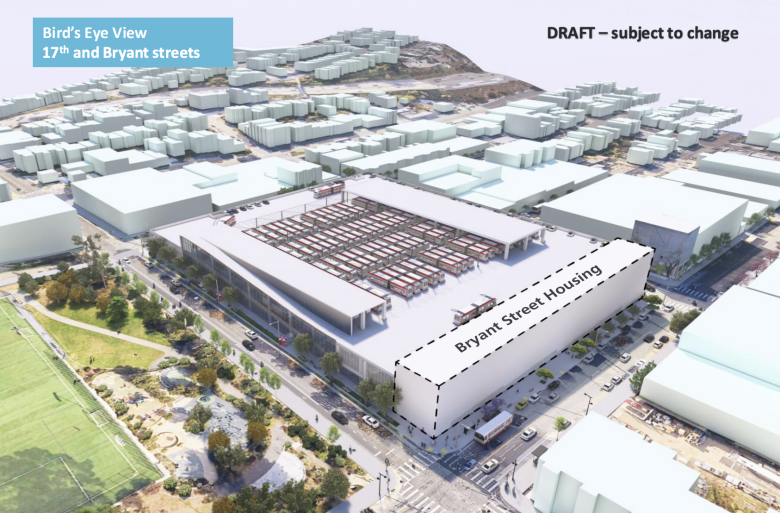

The Potrero Yard Modernization Project was ambitious: 513 affordable rental units, comprising over 700 bedrooms, atop the sprawling Muni bus yard at 17th and Bryant in the Mission.
There would be three ground-floor storefronts to add foot traffic to what can be a desolate stretch of pavement, and a sprawling rooftop park.
It would have been the largest Mission District affordable-housing project in recent memory. No longer.
After first cutting it down to 465 units last year, the San Francisco Municipal Transportation Agency announced on Sept. 30 it would downsize again, building just 100 units on the site, an 80 percent reduction.
“Unfortunately, the current scope of the project is well beyond what we can afford,” read a post from the transit agency. “To move forward with this critical investment in Muni service, we have to make very difficult decisions to lower costs.”
The SFMTA declined further comment.
The estimated cost to modernize the 110-year-old Potrero bus yard was approximately $560 million. A significant portion of that cost was dedicated to the structural challenge of making the roof of the new bus yard strong enough to accommodate the weight of housing above it.
SFMTA considered the possibility of downsizing since at least last year. At the time, the agency had already shrunk the number of units from 513 to 465, citing a need for larger units to accommodate families. It said if it did not find funding for the project, it would build just 104 units.
It is now going with a version of that plan. In the current proposal, the Potrero Bus Yard will change from a sunken parking and maintenance area for city buses into a one-story building, with a narrow strip of affordable housing at the western edge of the yard along Bryant, between 17th and 18th streets.
The mix of incomes for those subsidized units is unclear. The prior version of the project would have been open to tenants making anywhere from $30,250 and $121,000 for a single person, or $43,350 and $172,900 for a family of four.
The agency wrote that the “primary focus” of its efforts on Bryant Street now is “making the bus yard financially feasible.” Construction of the bus yard would last four years, and it would reopen in 2030.
The agency struggled to find the funds needed for the more ambitious version of the project, which would have required “funding from a mix of sources,” including local, regional, state and federal dollars, according to a December 2024 presentation.
In January 2024, SFMTA reported that it was still searching for that funding, but expressed confidence that it would come through.
The agency is now in a bind, it says. The entire project to modernize the bus yard is in danger if a project agreement is not approved by the SFMTA Board of Directors by March 31, 2026, it says. Neither the new bus yard nor the 100 units of affordable housing would be built if that comes to pass.
Chris Arvin, a member of the SFMTA’s Citizens Advisory Committee, said that the city should have stepped up to provide more funding.
“This is a failure on the part of the city,” said Arvin, referring to the Mayor’s Office of Housing and Community Development. “The SFMTA is just working with what they have.” SFMTA is currently balancing a $307 million budget shortfall.
“The Mayor’s Office of Housing and Community Development remains committed to delivering affordable housing at the Bryant Street site,” said Anne Stanley, a spokesperson for the housing office.
“Specific funding levels will depend on the availability of state and federal resources, which are often competitive and fluctuate year to year,” she said.
“At the same time, MOHCD continues to work closely with SFMTA to ensure the Potrero Yard project is financially viable, which is a critical step toward advancing both infrastructure and future housing development,” Stanley said.
It’d be better to just leave a portion of the block vacant until a tower can be built. Low rise housing is a very wasteful way to use expensive city land.
High-rise housing is very expensive to build. Unless it’s subsidized, it will never be offered up at affordable rates.
What? This change is entirely the result of NIMBYs and PHIMBYs spending a decade gathering public input and debating over whether to allow market rate apartments on public lands. Always amazes me how Mission Local readers manage to be less informed than if they didn’t read anything at all.
Yes, the intense focus on subsidized housing as opposed to just building more housing has been one of the many obstacles to construction. Add in the insistence that less expensive building techniques (such as modular construction) are not acceptable and it is not surprising nothing gets built.
Market rate condos do nothing for the housing crisis.
That is why they focus on actually doing something useful instead. Of course the YIMBY tools won’t be satisfied until it’s 100% millionaires in SF…
Subsidized housing does nothing to solve the housing crisis for 99.9% of humans. It simply gifts housing privileges to an exalted few lottery winners.
@LarryW – As I understand it, the city is on track to comply with the Scott Wiener/Sacramento building mandates for market-rate housing, but not for affordable housing. So as a practical matter, there has to be a way to build it.
(Alternatively, to challenge state law requiring an untenable number of units to be built.)
Um.
This is a plan to build lots of non-market-rate apartments. But because billionaires refuse to pay their fair share of taxes, there isn’t any money to build them.
That’s okay — if we build lots of $4,000 studios, they’ll magically become $1500 three-bedroom apartments. I’ve been told.
As opposed to NIMBYs, who think that if we don’t build new market rate housing, tech workers will just disappear instead of competing for the existing 100 year old houses.
That’s why housing costs go up!
Cynthia, billionaires pay taxes according to the laws on the books. They get audited more than regular people so they have to play by the rules.
You should be mad at Jackie Fielder and all the politicians who have not proposed legislation to raise taxes on the billionaires in San Francisco even though they say they believe it should happen.
Quit taking lip service and demand your elected officials do what they preach
The fact is that San Francisco needs housing and increasing the supply will over time reduce/stabilize rental costs — that’s not magic, it is basic economics. This project doesn’t work because, for some reason, people like you expect that billionaires will pay for everything rather than being realistic. “Fair Share” is just a vapid slogan for “I think other people should pay for it.”
By this miscontruing of “basic economics”, building into a glut of Ferraris will lower the cost of scooters. After all, it’s simple supply & demand! It’s basic economics!
Fans of political economy know that neo-classical marginalist micro theory does a very poor job modeling complex markets. Most people nod off when they hear the word “economics,” so they never learn that market operations for commodities or consumer goods are very different than those for social goods, let alone social goods that have been turned into speculative assets.
Beware those who deploy vapid slogans like “basic economics” and “simple supply & demand.” They assume the intended audience are clueless about those subjects and will blindly accept socially-destructive policies stated to be inevitable and inviolable, but which are really just policy choices of a small group for their own benefit.
It’s funny you picked a car example because it completely proves you wrong.
A couple of years back when there were supply chain issues manufacturing new cars, there was a shortage. And some of those rich through upper middle class people who would have bought new cars couldn’t. So since they still needed cars, they bought used which drove up the price for the middle and lower class people who always only had used as an option.
I wonder if anything else works like that…..
Unfortunately for your premise LarryW, there are multiple studies that contradict the “basic economics” idea that increasing supply of housing will reduce the prices. There’s this study published by the Federal Reserve Bank of SF https://www.frbsf.org/wp-content/uploads/wp2025-06.pdf and https://www.strongtowns.org/ has much more information. If you want to stick with the “common sense” approach, the amount of housing in SF has been increasing relative to the population for years, yet house prices have not been going down. Actually, house prices going down results in a complete stop of all development because loans become too risky. The issue is the commoditization of housing as an investment; and the same issue that’s happening all over western Europe: It’s a very convenient way to launder money internationally.
Other people already do pay for billionaires, dear. Everyone else pays for them.
A perfect example of why you shouldn’t leave housing to government. Make developers make a percentage of the new building affordable and approve anything that fits within the existing laws. This will lead to more affordable housing than trying to do huge projects with everyone and their mother’s input.
“A perfect example”
No it’s not. The land and the property on top, a bus yard, are owned by the City (government). This means if the City didn’t pursue this, no housing would be built in the first place.
SF already has an Inclusionary Housing Program. Projects of a specific size (more than a dozen units) have to dedicate a certain portion of the project to BMR or put money in the fund and build units off-site. Ironically, a lot of projects promise more than the minimum required units and still get dragged through the dirt by so-called housing activists. More times than not, this delays projects, brings up prices and leads to developers abandoning projects due to financial infeasibility. In short, most of these activist groups (well-meaning, but disillusioned) kill more housing than they’ll ever build.
This is on Shamann Walton, Roberto Hernandez and groups like Calle24 who insisted that no housing other than 100% subsidized low-income housing could go on this site. The original plans included 288 units of deed-restricted housing for low income residents. But they fought it hard. And now we may at best have 100. Maybe. It’s another reminder that opposition to market rate housing in the name of capital-A Affordable housing simply results in just less of either kind of housing.
““funding from a mix of sources””
Where are those YIMBYs when you need them?
I’m reading “Abundance” by Ezra Klein. Democrats simply cannot build anything; we cover everything in endless regulation and review. Further proof here.
This project was such a tortured Willy-Wonkaesque contraption of an idea that never had any serious chance of getting off the ground, especially with an entity like MTA and their questionable record when it comes to executing capital improvement projects. Nobody should be shocked by this outcome.
Exactly true. Technically that bus facility is considered an essential facility by SFMTA, whereas housing is built to a much lower standard (yes, even the expensive stuff: Mil”lean”ium tower). Putting housing onto this facility pushes the housing to a much higher construction standard that no developer will touch — even for market rate.
The article says that “In the current proposal, the Potrero Bus Yard will change from a sunken parking and maintenance area for city buses into a one-story building” but from reading the SFMTA slides from the Sept 30th meeting it is a 4-story building.
YIMBY doesn’t stand for ‘subsidized housing paid for by private investors who will see zero return for below market rents on an apartment built at market rate cost.’ What a joke…the far left is (un?)intentionally helping the very people they claim to despise, limiting the supply of housing and driving up the demand and thus (equity) value of existing homes for the lucky few able to get in on their game of regulated to death musical chairs. Abundance is right…keep up the good work and keep wondering why SF gets ever more expensive thanks to the regressives.
Really? You thought the MTA, who proves every day that they can’t manage their core function, would be able to build housing in a city that kills housing every chance it gets, then you are completely delusional. The building regulations are completely out of control.
Good – this city needs people who can help with the tax revenue. We can’t afford to subsidize everyone.
Go live in Hillsborough and say “we” as if you represent them either, thanks.
Hilarious, Katie can go live in Hillsborough, but people who can’t afford San Francisco can’t go to Modesto…. Cognitive dissonance on steroids.
Thanks YIMBY liars! You promised and promised and we finally see what it is now.
Fraud.
What are you even saying? How did “YIMBYs” have anything to do with this project’s shortfall?
Great, the carrying cost of San Francisco moochers is over the top already. They desperately need to be trimmed to restore the city to health.