

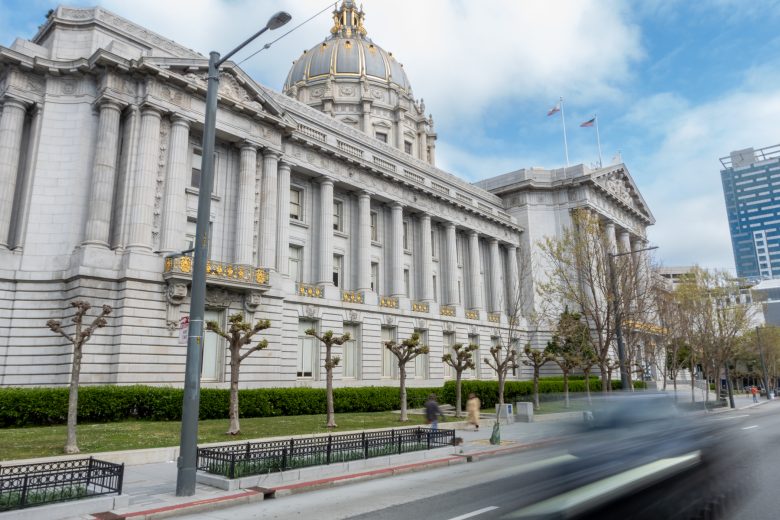

President Donald Trump’s tariffs will mean more jobs associated with tech manufacturing, but job losses in all other sectors in San Francisco, according to a new report from the San Francisco controller’s office.
Job losses are predicted to particularly affect business and professional services, trade and transportation, and construction in the city.
“The United States imports a lot of electronics from Asia, and that industry is getting nailed with very high tariffs. So the customers are going to start looking at U.S.-made alternatives that don’t have to pay the tariff,” San Francisco’s chief economist, Ted Egan, said.
California is well positioned to capitalize off this new demand because it has the largest electronics manufacturing capacity in the country, Egan added.
San Francisco’s technology manufacturing sector currently has around 3,000 jobs, including companies that create electronic prototypes, satellites, and lidar products for self-driving cars.
As a result, San Francisco and California’s economies will fare better than the rest of the country on average, the report found.
However, the city will lose more jobs than it gains, Egan said. According to the report, the tariffs will lead to more than 17,000 fewer jobs — 1.6 percent — in the next 20 years.
The report does assume that all of Trump’s tariffs will remain in effect, though. A few weeks ago, a federal appeals court ruled that two of his tariffs — the “fentanyl tariffs” imposed on Canada, Mexico, and China for contributing to America’s opioid crisis, and the “reciprocal tariffs,” imposed on the United States’ trading partners — were an overreach of presidential power.
Trump justified those tariffs by declaring national emergencies.
The U.S. Supreme Court is set to hear the case in November and, in the past, has generally sided with Trump’s expansive use of executive power.
Another key assumption the report makes is that the Federal Reserve will not take action to mitigate the impact of tariffs causing unemployment and inflation.
That combination is a difficult scenario for the Fed. Inflation is typically counteracted by raising interest rates so that fewer loans are taken out and less money is spent. Unemployment, on the other hand, typically requires the opposite solution of cutting interest rates, which stimulates purchasing and hiring.
Despite a slight rise in unemployment to 4.3 percent in August, the Fed is expected to cut interest rates when it meets on Sept. 16 and 17. Locally, unemployment is 4.4 percent.
Egan stressed that, even though the report anticipates some economic losses, particularly in the next year, the controller’s office is not predicting a recession.
“The Federal Reserve and the federal government could do things to stabilize the economy,” Egan said. “They’re certainly going to be motivated to stave off a recession.”
The controller is ignoring second order effects. Anger over the tariffs has resulted in a big drop in international tourism which is absolutely hurting the SF economy
And small business imports = retail, the sector they’re trying to prop up.
The controller must have gotten a script from Lurie’s office to read…