


In weeks of attending asylum hearings at San Francisco’s immigration court, Mission Local reporters have seen dozens of people arrested by Immigration and Customs Enforcement without ever getting a lawyer’s help.
Then there are those who may encounter ICE agents on the street, and don’t know their rights. Or family members whose relatives are arrested and sent to detention centers, but who don’t know how to look them up.
We put together this resource guide for asylum seekers, people with Temporary Protected Status, and anyone in need of immigration counsel to answer the questions: How can you prepare if you or a loved one are detained by ICE? And what comes after?
We consulted with attorneys to create this, but this is not legal advice and you should always speak to a lawyer.
If you encounter ICE
- Know your rights
Catherine Seitz, legal director at the Immigration Institute of the Bay Area, said that, first and foremost, “People should make sure that they are informed about their basic rights.”
You can access free, online know your rights presentations along with written materials from the American Civil Liberties Union to help navigate different scenarios. In particular, says Seitz, you have a right to keep your door closed if ICE shows up at your home or work.
To enter, ICE needs a judicial warrant, which must be signed by a judge and issued by a court, not an administrative warrant which is signed by an ICE agent. Here is an example of the difference between the two:
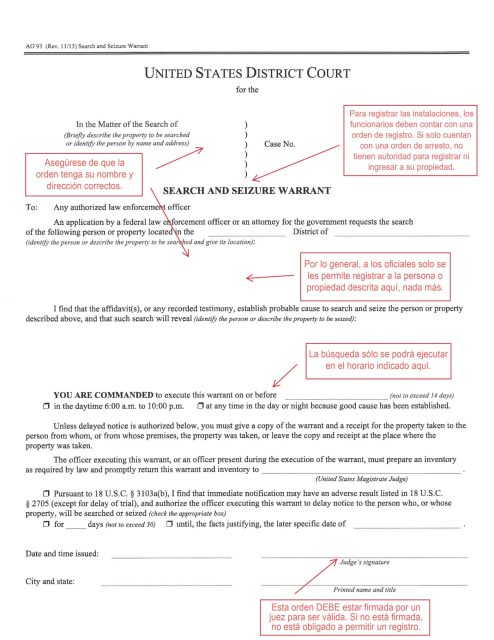
This is what a judicial warrant looks like. It must be issued by a court and signed by a judge. It must also show your correct name and address. Courtesy of ACLU Northern California. 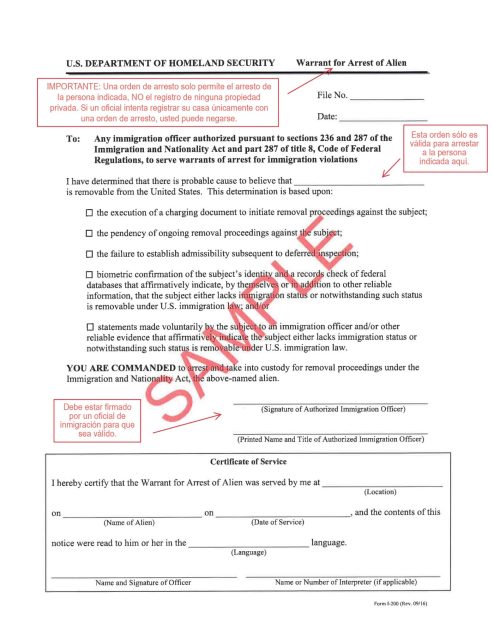
This is what an administrative warrant looks like. It is issued by the Department of Homeland Security. It must be signed by an immigration officer to be valid. Courtesy of ACLU Norther California.
In any encounter with ICE, says Jazmin Preciado, an attorney with Centro Legal de la Raza in Oakland, you have the right to remain silent. Any information you share with ICE agents can be used against you in court.
If you are arrested, Preciado advises talking as little as possible, and refusing to sign any documents until you have legal representation. “Zip it and wait until you’re in front of a lawyer. It doesn’t matter how much they probe.”
- Make a plan
The Immigrant Legal Resource Center has developed a template for creating an emergency preparedness plan. Talk to trusted loved ones to develop a plan of action for what you will do in the case that you or someone you know is detained.
For parents with children, Seitz says this means making sure you’ve “talked with someone about who they want to take care of the kids.”
Make sure that trusted contacts have access to critical items like A-Numbers, car keys, and house keys before you attend asylum hearings and other ICE check-ins.
Asylum seekers have left their cars parked on the street while attending immigration court and then been detained with no way for a friend or relative to move the car. Others have gone in without giving their house keys to anyone.
If you do have to go to court, Faith in Action provides court watchers in San Francisco who will accompany you. You can reach their community response hotline at 206-666-4472.
If you are not represented by an attorney, there are sometimes volunteers at immigration court known as Attorneys of the Day, who are certified by the Bar Association San Francisco.
- Call for assistance
If you witness a deportation, Seitz says that “the best first step is to call a rapid response hotline and let them know that the person has been detained so that a rapid response attorney can go down to the detention center and try to meet with the detained person as soon as possible.”
An attorney might ask you for the detained person’s A-number, date of birth or country of origin.
The San Francisco rapid response hotline can be reached at 415-200-1548. This is a 24/7 hotline that can be used to report ICE sightings at home, at work or in public spaces.
If you are detained, Seitz recommends calling a person who can communicate with rapid response on your behalf, instead of calling the hotline directly.
“Make sure you have at least one phone number memorized, so that you can call somebody and let them know that you’ve been detained.” Seitz adds, “have that person call the rapid response because [a] detained person is going to have very limited access to the phone.”
More resources for free and low-cost legal aid in San Francisco are available on this list maintained by the Office of Civic Engagement & Immigrant Affairs.
If you know someone who has been detained
If you know someone who has been detained and is being held by ICE, this Online Detainee Locator System helps you to keep track of a loved one’s whereabouts. If you have their nine-digit A-Number and country of birth, you can find out whether they are in ICE custody and what detention center they are being held at.
If you do not know the person’s A-Number, you can also search with their first and last name, country of birth and birthday. According to the website, family members and attorneys “may be able to obtain additional information about this individual’s case” by calling the Enforcement and Removal Operations office.
The two closest such offices to San Francisco are Mesa Verde in Bakersfield (661-328-4500) and the Golden State Annex (661-792-2731).
If you or a loved or are detained by ice, it’s actually too late to prepare. Preparation by definition is something that should have already happened. And that’s actually true for all people, whether they are loved ones or hated ones.
Perhaps, for the sake of correctness, the headline should have been: “How can you prepare for the hypothetical eventuality wherein you and a loved (or hated) one are detained by ICE?”
No, that would have been pretty pedantic, wouldn’t it?
” The San Francisco rapid response hotline can be reached at 415-200-1548. This is a 24/7 hotline that can be used to report ICE sightings.”
Thanks for this helpful article. It might be good to put the Rapid Response number at the top, in large type, for anyone reading this in an emergency. Also encourage people to add it to their phone contacts and keep it in their wallets.