


Update: After this story published, the city announced it would pay through the end of the Tenderloin Community Benefit District’s lease on the Bigbelly smart trash bins. Those bins will remain in place until the city’s new custom-designed trash bins hit the streets next year.
The Tenderloin Community Benefit District is scrambling after it lost funding for the 76 high-end solar-powered trash bins that dot the neighborhood.
In 2020, the CBD, a nonprofit run by local community members dedicated to improving the neighborhood, removed dozens of city trash bins from within its borders.
Those cans, it says, were often rifled through, spreading more garbage on the street. In their place, the organization rented and installed 76 solar-powered, tamper-resistant, trash-compacting cans made by Bigbelly, a Massachusetts-based company whose bins are popular with many CBDs across the city.
The new bins were paid for with grants from the city’s Office of Economic and Workforce Development. At the time they were installed, the CBD leased them from Bigbelly for $150 each a month — $1,800 a year each, or $136,800 a year for all 76.
Funding for the bins and maintenance — some $150,000 per year — was supposed to last until the scandal-ridden Department of Public Works could deliver its own custom-designed trash cans across the city, according to a 2023 OEWD grant.
But that process has dragged on: Years later, Public Works’ bizarre and expensive odyssey to commission its own trash cans has not reached the manufacturing stage, and the CBD lost its grant in June.
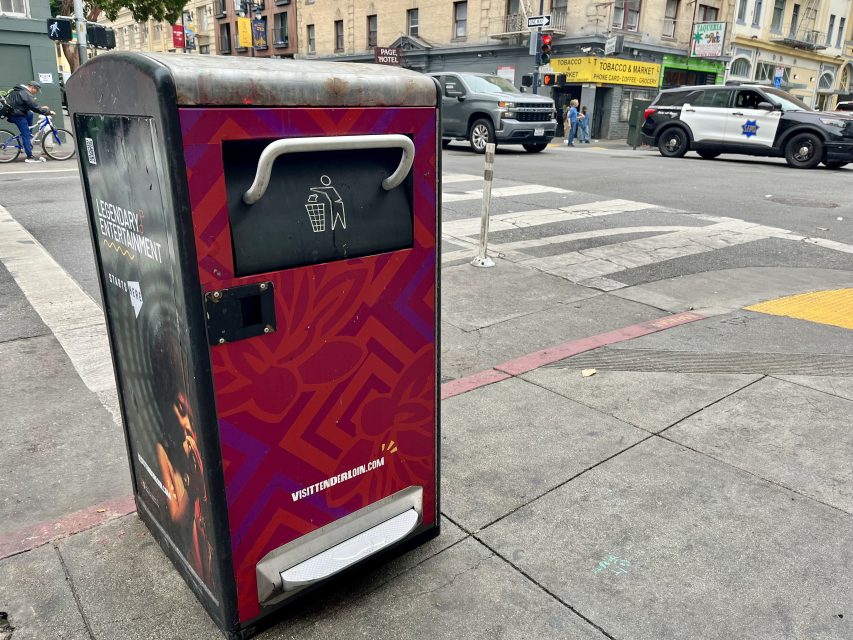
Tenderloin CBD’s executive director Kate Robinson hopes the city can help fund the Bigbelly cans until the Department of Public Works can bring in replacement trash bins.
The replacements may end up being the same old cans moved out in 2020, and just receiving those could take about four months, according to Public Works spokesperson Rachel Gordon.
“I don’t want there to even be a week where there are no trash cans,” said Robinson. “My biggest worry is that we don’t coordinate closely enough to make sure that there’s not a gap.”
The loss of funding, she added, means the nonprofit will have to pay more than $150,000 to get out of its contract with Bigbelly, which runs through September 2026.
Robinson and others say this outcome could have been foreseen.
“There wasn’t a long-term plan,” said Robinson, who took over the CBD in 2022. “I mean, does it make sense for OEWD to pay for CBDs to pay for trash cans? No!”
Former Tenderloin CBD head Simon Bertrang, who signed the initial contract with Bigbelly, said the city needed to step in.
“The city should have a responsibility to deliver adequate trash can service,” Bertrang said when asked what he thought of the CBD’s current predicament. “I think it’s the city’s responsibility.”
While the Bigbelly cans were purportedly superior at keeping trash inside the bins by preventing people from rummaging, Bertrang said it was unclear whether they even had an effect on reducing trash in the neighborhood, given the onset of the pandemic, the proliferation of sidewalk encampments, and the arrival of intensive street cleaning and community ambassadors.

The Castro Community Benefit District saw the writing on the wall early and, after a brief stint with just a handful of Bigbelly bins, reinstalled its city cans in 2020.
“Grants always go from year to year, so you never know from year to year about city funding. That’s just the way it is, right?” said Andrea Aiello, the executive director of the Castro Community Benefit District. “We just decided it wasn’t worth it.”
Bigbelly cans are costly, reportedly retailing for thousands of dollars apiece.
Leasing the cans isn’t much better: In addition to the $150,000 annual grant that the Tenderloin CBD spent on the bins, the organization also had to supplement with its own reserves (including property owner assessments) to keep the program running.
Last year, it spent an extra $93,000 to compensate for delayed grant funds and maintenance, and now faces more fees to terminate its contract.
When the bins became a target for damage and vandalism, additional costs to the CBD for repairs or replacements followed.
“We have a whole graveyard of them,” said Kate Robinson. “Ones that have been blown up, set on fire — you know, completely damaged beyond repair.”
Robinson said that the CBD has stopped replacing damaged Bigbelly bins, which will be gone soon anyway. Gordon said the city-designed bins will be cheaper, and may hit the streets in coming months.
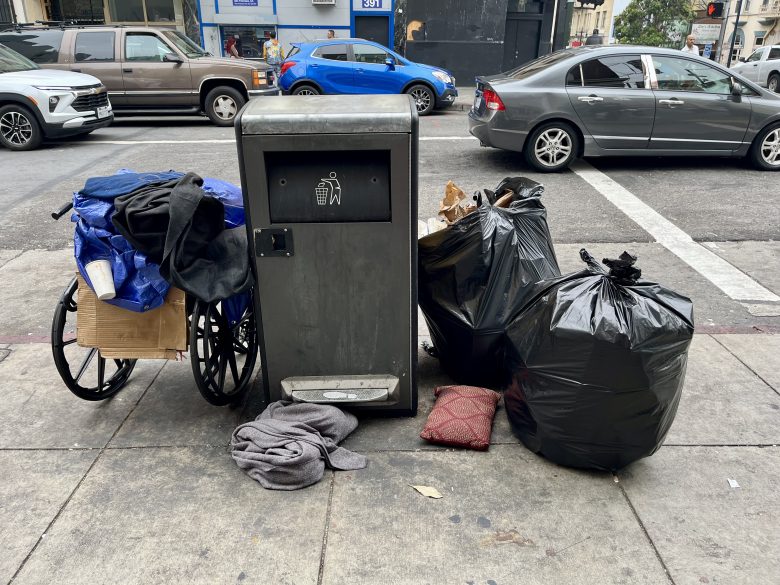
On Wednesday, people walked past a Bigbelly bin at the northeast corner of Jones and Ellis streets. Most of them didn’t even try to use it, which was just as well. The handle was missing and the foot pedal was broken.
“That thing don’t work,” said one pedestrian, not unkindly.
Recology garbage collectors knew the bin was broken, but no one had come to take it away. And the trash keeps coming. Around the bin sat a stack of garbage bags, scattered trash, and an old wheelchair.
Function must prevail over form…and even the most elegant and expensive trash can is no good if the city doesn’t keep it emptied.
Go back to the green blue and black format the rest of us use for the city streets. LA had robotic trash can pickups years ago. What happened to a consistent program?
And while we are at it, why don’t we have a bottle and can buyback system yet?
If San Francisco can’t handle trash pickups with the help of a CBD it should not attempt population growth or upzoning.
Best comment and so obvious!
Replace them with these – cheaper than the lease and easy to empty:
https://trash-cans.com/collections/trash-can-enclosures-for-standard-city-trash-recycle-bins
Great find Hector, imagine what the bulk discount for a thousand of these would be. Compared to the farce of a “selection” process, where you were only allowed to vote on their absurdly expensive models ( with no comments allowed).
Is D5 Supervisor Bilal Mahmood working to find a solution?
The “Nonprofits” are a scam.
I like the regular cans in the Soma which have aer on the sides of them, like comic book covers and suchlike. They look inexpensive and easy to empty.
Those bins are designed to keep the hardest working people in the city-The recyclers, from going threw the trash, to get the bottles and cans. If the powers, that be at City Hall, spent the amount of time trying to prevent stuff, rather than coming up with a solution, the city would function better.
“the CBD, a nonprofit run by local community members dedicated to improving the neighborhood”
Tenderlion CBD Board of Directors:
Rhiannon Bailard
Property Owner Seat
UC Law, San Francisco
Nafy Flatley
At-Large Seat
Teranga
Brennan Foley, Treasurer
Property Owner Seat
Hilton Hotel
Paula Hendricks
Resident Seat
Naomi Maisel, President
Business Owner Seat
La Cocina on Hyde
Isabel Manchester, Vice President
Property Owner Seat
Phoenix Hotel
Geoffrey McFarland
Business Owner Seat
St. Anthony Foundation
Diana Pang, Secretary
Property Owner Seat
Chinatown Community Development Center (CCDC)
Mark Puchalski
Property Owner Seat
Tenderloin Neighborhood Development Corporation (TNDC)
Patricia Tu
Business Owner Seat
Quoc Long Jewelry
Kristen Villalobos
Property Owner Seat
San Francisco Community Land Trust
– = – = –
Is this Board of Directors representative of Tenderloin residents? How much off of the top does TCBD take from each big belly for overhead?
Given shaky nonprofit budgets, unreliable public grants and contracts, it is residents who bear the burden when this Rube Goldberg outsourcing machine breaks down.
Just another example of how progressives can’t run a city.
Put the drug addicts to work to pay for their shelter , treatment , food or jail
The penalty for public intoxication will illegal poisons needs to be increased .
A shot of narcan will ruin their high quickly , help them work and give them a broom and a bucket .
Simplest is best,
The plain square concrete shell base open at top from 4 sides and a heavy plastic can inside that can be removed and emptied.
Only moving part is cheap lock on door with plastic innards and if it breaks you can still use the unit and keep the door closed by wedging a piece of folded cardboard in a crease.
In fact, it’s better with the lock broken cause the City won’t give volunteers a key to them and you have to force your orange bags through the top slots a little at a time squeezing contents that often contain crap and broken glass.
go Niners !!
h.
But then bad actors would put house hold items in the bins.