



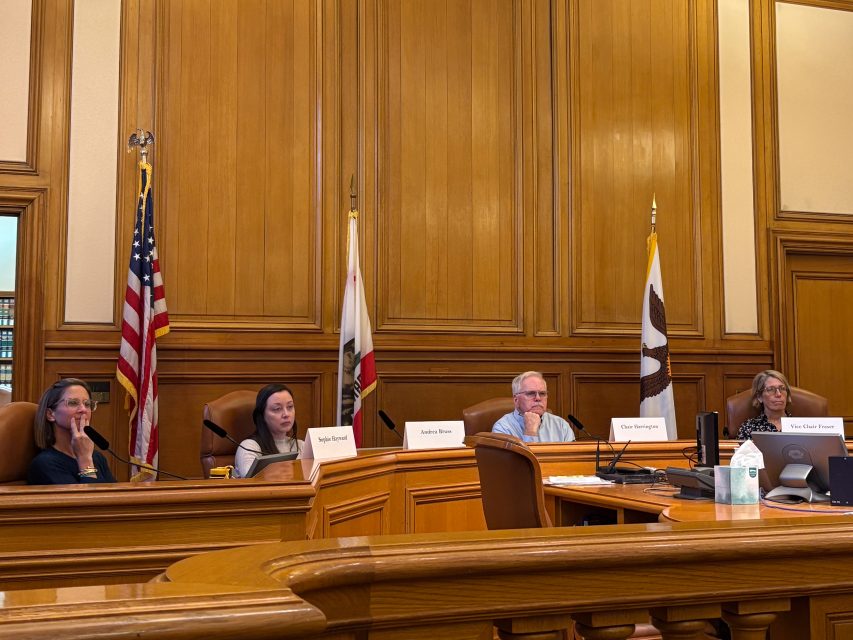
On Wednesday afternoon, San Francisco’s Commission Streamlining Task Force, the five-person body in charge of trimming the city’s 149 commissions to a more manageable number, met to discuss culling nine groups.
The first round was easy-peasy. Hard feelings were few; the first 31 to be eliminated were “inactive” bodies. Two-thirds of them did not even meet once in the past year. Now, as the task force starts to weigh in on the remaining 118 advisory groups, councils, commissions and other bodies, pushback has arrived.
Alongside the Treasury Oversight Committee and Treasure Island/Yerba Buena Island Citizen Advisory Board, for instance, the Sheriff’s Department Oversight Board was on Wednesday’s chopping block, eliciting a bevy of soul-searching questions: Does the sheriff’s department truly need its own oversight board? Can the board’s work, perhaps, be folded into that of the Department of Police Accountability?
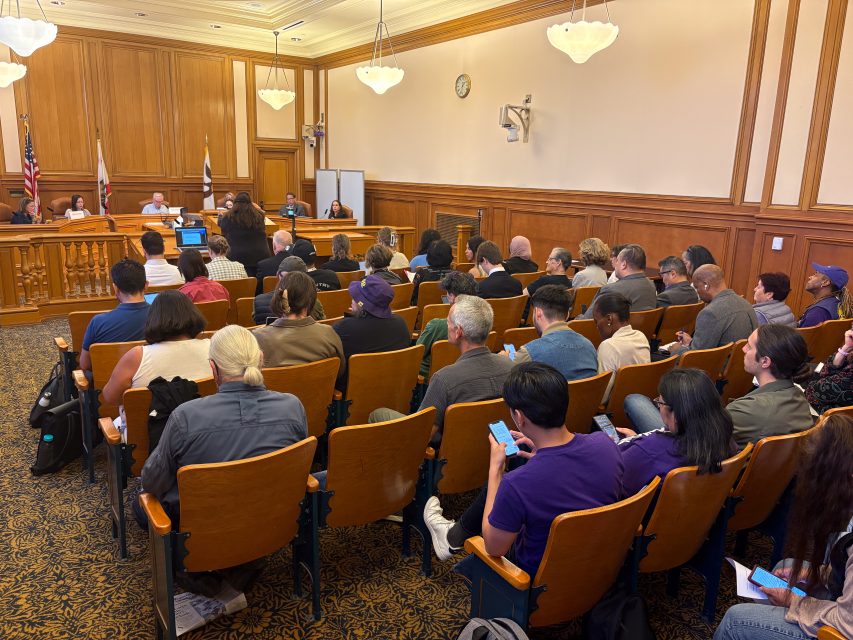
Absolutely not, said Kim Tavaglione, executive director of the San Francisco Labor Council and one of 40 or so people crammed into the small room on the fourth floor of City Hall.
“You have to look at the moment we are in,” Tavaglione added. “We have a sheriff who just endorsed a MAGA person for governor,” she said. “If you don’t think that deserves oversight, no more said.”
The Sheriff’s Oversight Board has struggled with attendance: In 2023, Mission Local documented two concurrent meetings in which just a single person came out to hear the seven-person body deliberate. In the third meeting, attendance doubled to two people.
District 10 Supervisor Shamann Walton, one of the original backers of Proposition D, the ballot measure that created the Sheriff’s Department Oversight Board in 2020, also objected. Removing the board will “strip away a critical safeguard for accountability,” wrote Walton in a statement issued the day before the meeting.
In addition, he told Mission Local, because the Sheriff’s Department Oversight Board was created through a ballot measure, it was beyond the powers of the Streamlining Task Force to eliminate it. “You can’t change charter commissions without some voter initiative or some approval by the voters,” Walton said.
The City Attorney’s Office concurred with Walton. Jen Kwart, its spokesperson, told Mission Local that the task force can recommend a charter amendment to the Board of Supervisors to eliminate the board, but cannot eliminate it unilaterally. The supervisors would need to put this on the ballot for voters to decide if the oversight board goes or stays.
Ed Harrington, a former city controller and PUC general manager and the head of the Streamlining Task Force, said the same. “It will go back to the voters if something is going to change,” he said during the meeting. That said, voters do seem to want fewer commissions: Nine months ago, they voted in favor of creating this culling task force.
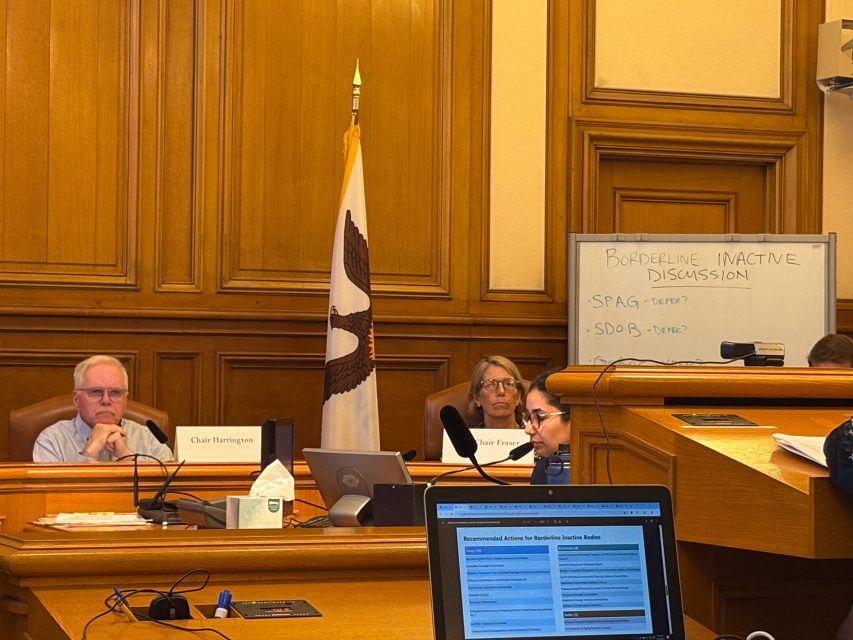
The commissions on Wednesday’s agenda were considered “borderline inactive,” meaning that they didn’t meet frequently enough or have enough sitting members, and couldn’t therefore be merged with other groups. One of them was the Sweatfree Procurement Advisory Group.
The group, created in 2005 alongside the city’s Sweatfree Contracting Ordinance, mandates that the city buy garments, such as city uniforms, only from manufacturers without sweatshop conditions.
Last month, Supervisor Rafael Mandelman tried to pass legislation to streamline contracting that would have eliminated the sweatshop advisory group, but he couldn’t get enough votes from the Board of Supervisors to make it happen.
Now its fate was in front of Harrington’s task force. But he and the other members voted to defer discussing it until Nov. 5, when his group meets to go over commissions related to general administration and finance.
The Juvenile Probation Commission, meanwhile, received a recommendation to stay. Margaret Brodkin, the commission’s president, though relieved that her commission was kept, objected to how the evaluation was handled.
“I feel like this is going in the wrong direction,” Brodkin said of the streamlining process. “It seems like your default position is like, ‘prove it.’ Prove that you can do something valuable.”
Harrington said he welcomed that kind of feedback. In his opinion, the task force’s meetings are a great way to get input from the public. The task force does not have the capacity or staffing to attend every commission meeting for members to see for themselves how each group is working, he said.
“If somebody’s meeting, and they’re trying to do good work, I have no reason to second-guess,” Harrington said.
Harrington used the example of two groups in the South of Market: the SoMa Community Stabilization Fund Community Advisory Committee and the South of Market Community Planning Advisory Committee. Originally, Harrington said, the task force was going to recommend eliminating both of them.
But public comment swayed them — people said they had a positive impact on the surrounding community — and a decision has been deferred to Oct. 1. Harrington said both bodies will likely be kept.
After Wednesday, there are still 113 commissions left to evaluate. The task force has until Feb. 1, 2026 to submit its recommendations for which commissions to cut or merge.
“It’s a garden that was overgrown,” Harrington said, of the long process that is currently underway. “You pull the weeds, but you don’t go and start trying to just prune all the plants because you feel like it today. And so, we are trying to pull the weeds, the things that have died.”
What? Why stop there?
And while I may not agree with the Sheriff’s position, that doesn’t trigger the “need” for an oversight committee.
C’mon San Francisco. We can do better.
Hard to judge, but “It seems like your default position is like ‘prove it.’ Prove that you can do something valuable,” should be exactly what the commission is looking at. At the risk of sounding like the Bobs from Office Space, you kind of need to be able to justify your existence. Some of these commissions sound good on paper, but if you’re not meeting, no one goes to your meetings when you do meet, and you can’t tout any tangible accomplishments, then maybe you should be on the chopping block.
Can you identify the 31 that were eliminated?
We passed the sheriff’s department oversight board during the madness of the Year of Greatest American Hero George Floyd. We made a lot of mistakes of excess during that year. A course correction is a good idea.
George Floyd should not have been murdered, but his murder didn’t make street crime OK.