


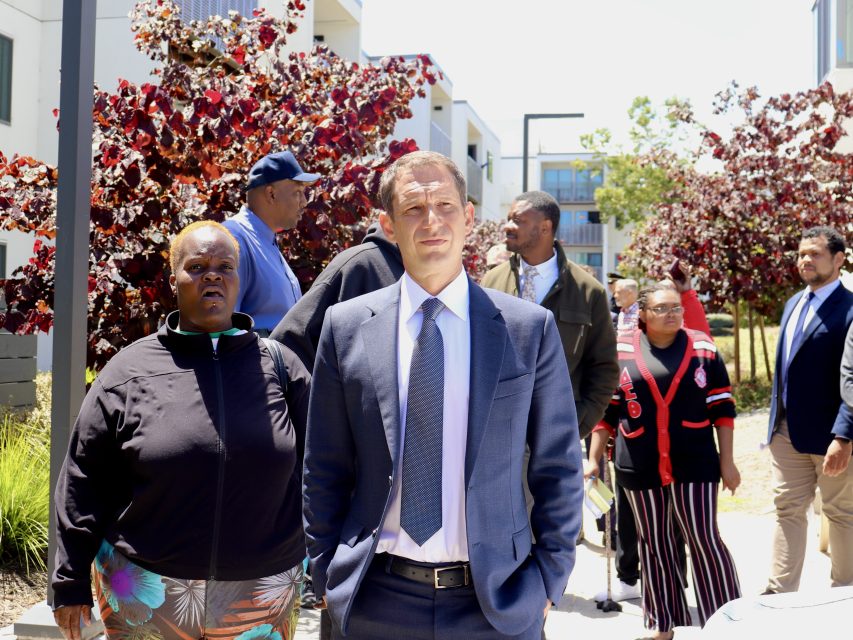
At the top of “The Hill,” Bayview’s steep enclave of largely low-income, subsidized apartments overlooking the western half of San Francisco, residents driving by or sitting on stoops on an uncharacteristically warm Tuesday afternoon got a bit of a surprise: There was Mayor Daniel Lurie, clambering up the steep slope, followed by a band of his security, staff, organizers and residents, going unit to unit.
Lurie knocked on the door of each resident who’d agreed to a visit, along with a security guard, two mayoral staffers and reporters. Clad in his characteristic tailored suit, Lurie entered each unit for about five minutes, nodding as tenants described black mold, asbestos, stoves that spontaneously combust and water leaks that have eroded the ceiling.
He shook residents’ hands, assured them he would make some calls and jokingly scoffed at a young tenant’s Los Angeles Dodgers hat. “We gotta talk about this,” said Lurie, taking on a more serious, mayoral tone. “What’s going on with the hat?”
But it’s not clear how much Lurie can do. Though his presence puts property developers and management in the hot seat, his advisor repeated the word “private” throughout the visit: City Hall’s power over these privately-owned complexes is limited, his staff told tenants.
After the visits Tuesday, Lurie and his staff did contact property management, and it worked: The pressure of receiving a call directly from the mayor’s office led property managers to visit some apartments that same afternoon. The managers are “making progress” on clearing out black mold and other issues, said mayoral staff.
Still, it wasn’t an entirely convivial trip. The Hill is a complex of some 600 units of garden-style apartments, smack in the middle of Bayview. It houses tenants receiving federal subsidies through project based vouchers, most of whom are Black and deep in poverty.
Three years ago, Mission Local documented “leaks, roaches, and rats” and an unresponsive property manager.
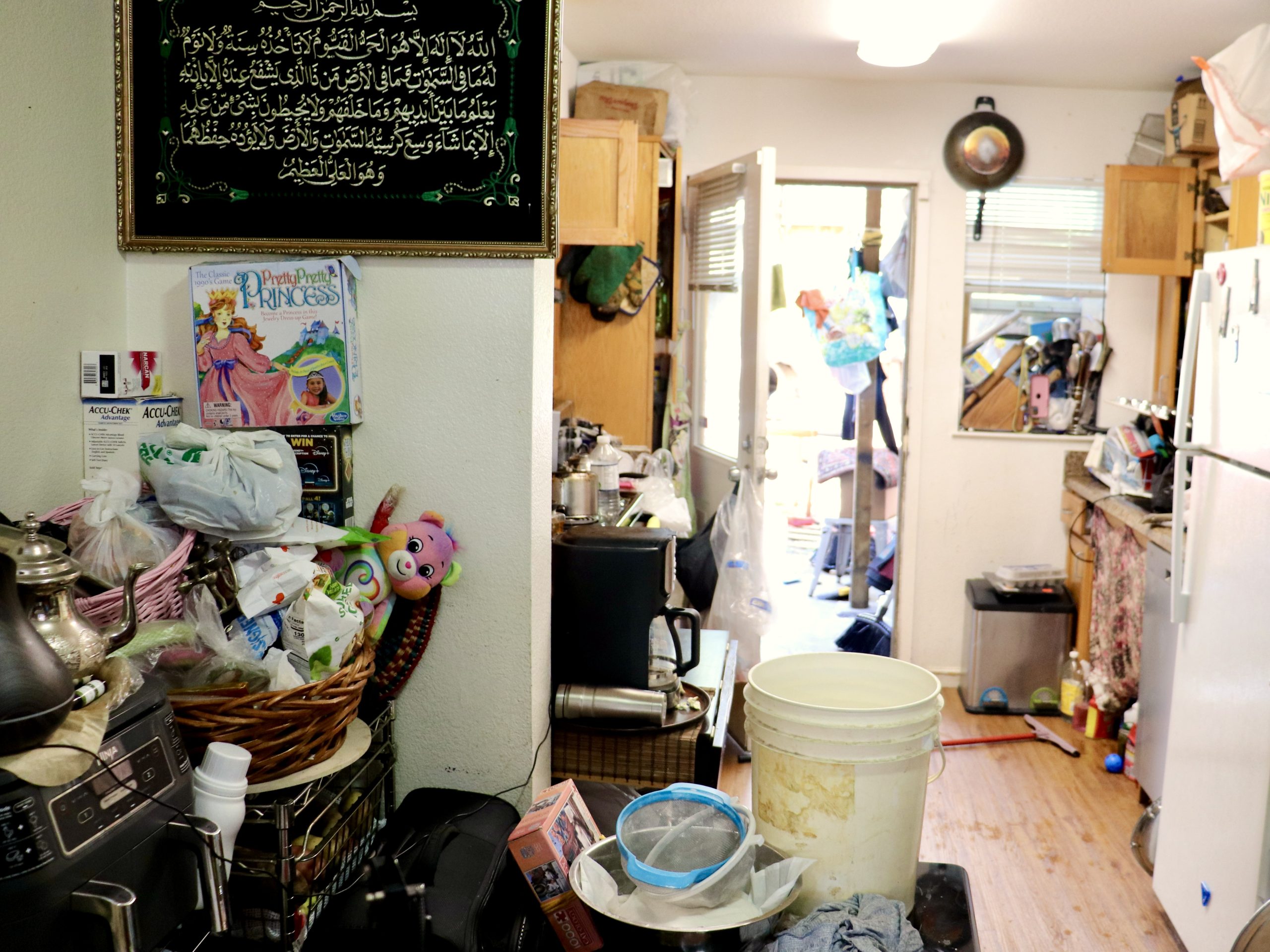
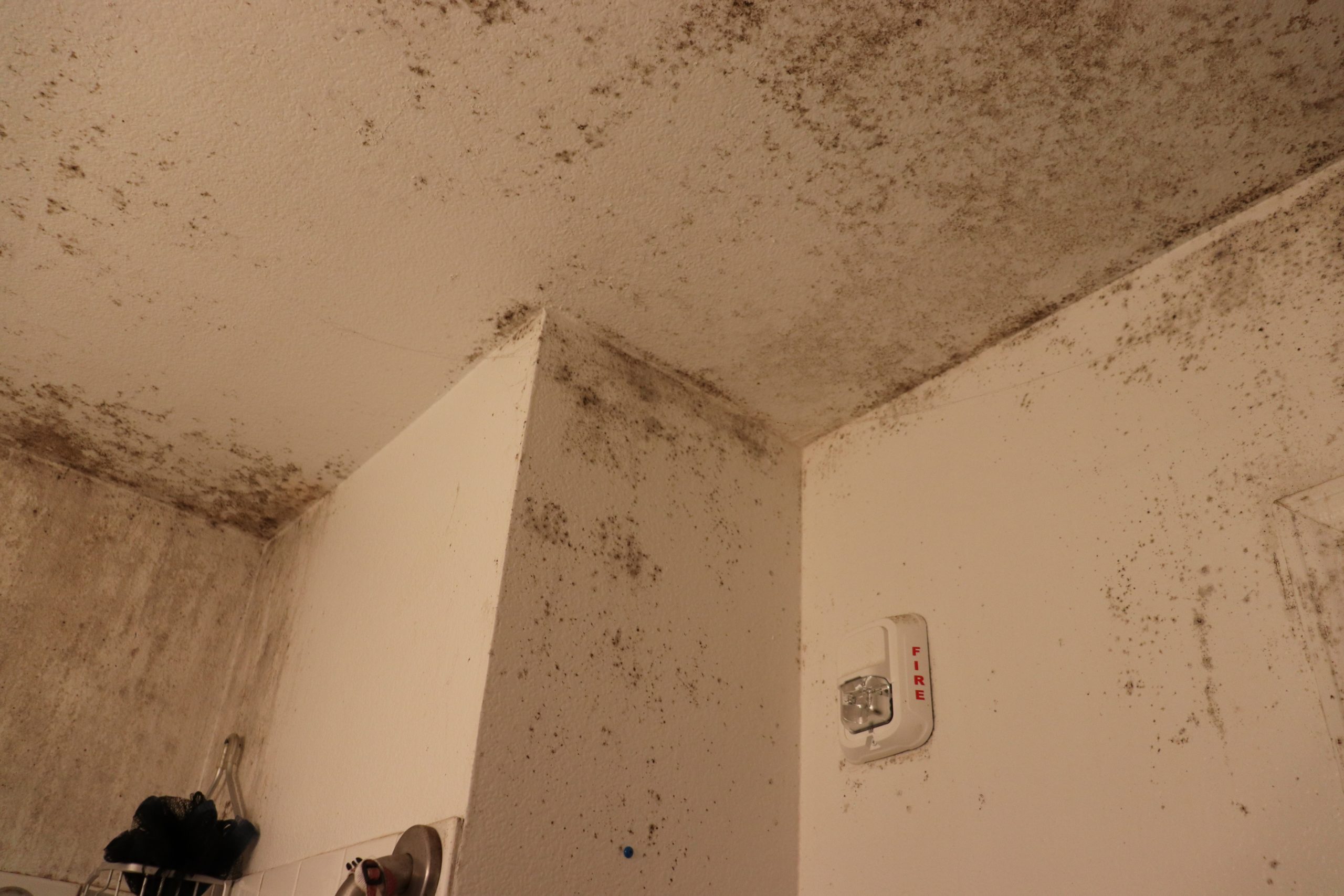
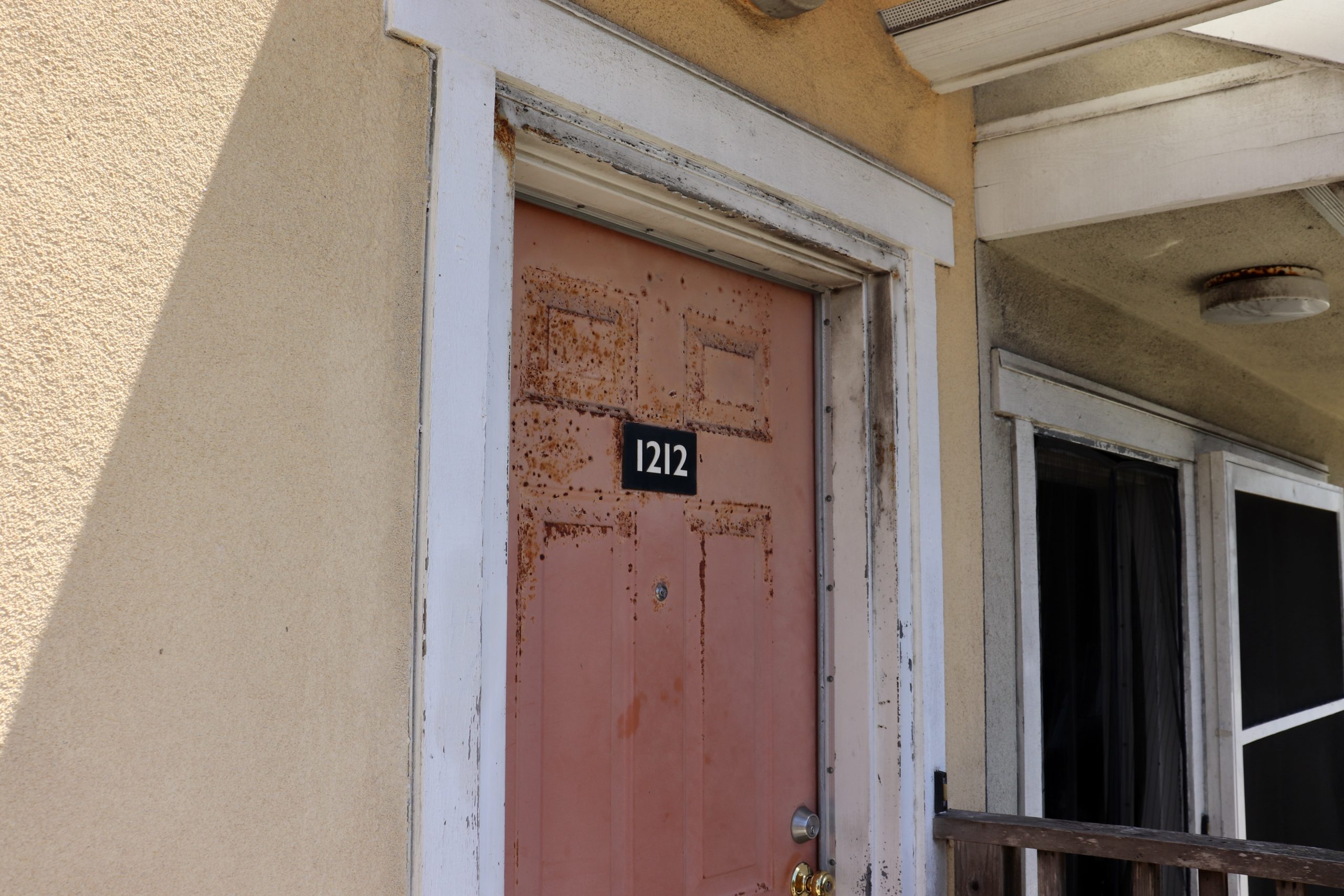
Tenants say little has changed. As resident after resident crowded around the mayor, one Bayview local asked if Lurie, an heir to the Levi Strauss fortune, understood the disenfranchisement of Black people. “I do,” Lurie responded, saying nothing more.
During the nearly 90-minute trip on Tuesday afternoon, Lurie stood in several black-mold-covered bathrooms, crowded with tenants into a lone working elevator, and inspected vents spewing smoke and ash.
After visiting three apartments on the Hill, he hopped back into his Rivian and drove a mile south to Alice Griffith, a former public housing complex near Candlestick Park.
It was his second time this month making a similar visit, after tenants living in low-income housing complexes across the city rallied at City Hall and marched into the mayor’s office, demanding he come by their apartments and see how they live.
He followed through: In the past month, Lurie has walked through six low-income housing complexes in the Western Addition and Bayview in an effort to show put-upon tenants that City Hall is listening.
Most subsidized housing complexes are privately owned
Most of the apartments the mayor visited this month are privately owned. Even Alice Griffith in Bayview, which used to be owned and operated by the San Francisco Housing Authority, is now owned by McCormack Baron Salazar, a private firm based in St. Louis, Missouri, following its redevelopment in 2017 through the HOPE-SF program.
The program aims to revitalize dilapidated public housing projects into modernized, mixed-income developments by tapping private investors and transferring ownership into private hands.
The Mayor’s Office of Housing and Community Development requires the owners to submit Annual Monitoring Reports, and must approve the hiring of a new property manager, but it cannot hire or fire property management itself. Only the owner of the building can do that.
In conversations during the tour, Lurie and Ernest Jones, who serves as the mayor’s office’s community ambassador, frequently deliberated what was in the scope of their power.
Standing in a low-income apartment with no heat, Lurie asked Jones what could be done. Jones told Lurie the building was “private.”
Earlier in the month, during Lurie’s visit to subsidized apartments in the Western Addition, the mayor told Mission Local the city “is not able to do much” to wield its power at apartments that are privately owned.
Anita Blackwell, a resident at Shoreview Apartments in Bayview, ushered Lurie and his crew into her home on Tuesday. It was ready for the army of visitors; Blackwell had cleaned her apartment in anticipation of her guests, lit scented candles, and R&B music softly hummed on her TV.
But Blackwell quickly pointed Lurie to her main point of concern: A heater vent above her living room spotted with ash. Lurie quietly nodded, squinting his eyes as he inspected the heater.
Blackwell told him she hasn’t had heat in two months: She’s afraid to turn her unit on. Every time she does, smoke blows in, her fire alarm goes off and her home is covered in a blanket of soot.
Blackwell is one of thousands of federally subsidized low-income tenants in apartments where the city has little oversight.
Residents at the Shoreview Apartments and other complexes like Thomas Paine and Frederick Douglass Haynes Gardens in Fillmore and La Salle Apartments in Bayview get federal subsidies, but the apartments are privately owned and managed.
Still, tenants want City Hall’s help.
Blackwell’s property manager, Related California, promised someone would come on July 3, she said. No one did, she claims.
Jones, turning to Lurie, told him Blackwell’s building was “private.” It is an issue for the Department of Public Health or the Department of Building Inspection if there is a code violation.
Lurie nodded, and assured Blackwell they would make some calls. The mayor’s office said that property management will conduct a “full duct and chimney cleaning” next week.
With little to no oversight, what can the city do?
As the group made their way out of Shoreview and on to La Salle Apartments, Jones told Dennis Williams Jr., executive director of a local contracting nonprofit, the Fillmore Community Development Corporation and a resident at Plaza East Apartments in the Western Addition, that there was little the mayor’s office could do in apartments like Shoreview, La Salle and Thomas Paine.
As Williams and Jones trudged down the hill and back up a narrow flight of wooden stairs again, Williams asked that Jones do something about the stairs. Lurie had taken off his suit jacket in the late August heat.
“Sheesh,” exclaimed Williams. “Is this wheelchair accessible?”
“It’s private,” Jones replied. To change anything, he said, “you would have to convince [the owner] to sell.”
“Oh, no,” Williams chuckled. “They aren’t going to do that.”
When asked what the city can do if tenants complain of maintenance and mismanagement, Anne Stanley, a representative from the Mayor’s Office of Housing and Community Development, said the office connects tenants back to their property managers, the “correct contacts” for any issues.
If there is a code violation, tenants can report it to the Department of Building Inspection.
And, though Lurie’s calls to property management helped, you can’t always rely on the mayor coming around. Tenants have described ongoing issues such as broken-down elevators, garage doors stuck open to the public, problems with security, plumbing issues with sewage and tap water that comes out brown. For these, tenants say, multiple attempts to contact property management have not made a difference.
Damaged ceilings, sheetrock over windows, and mold-infested apartments
Tenants’ issues are extreme.
A unit at the La Salle Apartments in Bayview was deemed “uninhabitable” by the Department of Building Inspection when they last visited, says Dequinda Johnson, who lives in the unit.
Johnson, who lives there with her three young children, one of whom has asthma, said Tuesday she will move in with family at the end of the month.
It has been months of living with black mold that she says has affected her and her children’s health. The mayor’s office said the black mold had already “been cleaned and removed.”
Two other units at La Salle are missing windows: When two tenants moved back into their apartments after renovations, sheetrock, painted purple, was hung up over the window openings. One tenant, who is mentally disabled, says it has been like that for weeks — they have had to keep the front door open for ventilation.
Another mother at Alice Griffith fastened a plastic sheet over her kitchen when a leak upstairs caused the ceiling to cave in. She says the leak had been an issue for two years.
Other leaks at Alice Griffith have caused the ceiling to cave in as well, according to tenants, and video from April showed a piece of plaster falling on a senior resident’s head.
For these units, the mayor’s office said new windows will be “prioritized.”

Mayor Daniel Lurie crowds with staff, organizers, and residents, into the one working elevator in a building at Alice Griffith, a former public housing complex in Bayview. Photo by Marina Newman. 
Sheetrock painted purple covers the window of a resident at La Salle Apartments in Bayview. Photo by Marina Newman. 
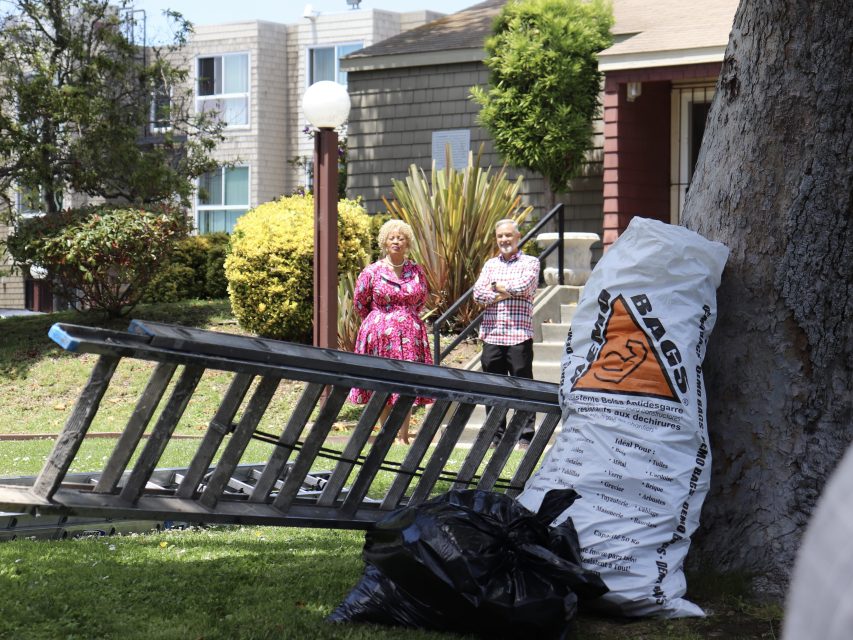
Mayor Lurie, residents, and staff walk down “The Hill” on August 19, 2025. Photo by Marina Newman. 
A plastic tarp covers where a ceiling has caved in over a tenant’s kitchen at Alice Griffith on August 19, 2025. Photo by Marina Newman.
There are places where the city can, theoretically, be more active. The San Francisco Housing Authority is still a part of the ownership structure at two properties currently considered public housing, Plaza East Apartments and North Beach Place.
There, Lurie told Mission Local, “We’re able to do more.”
In August, Plaza East’s prior property manager was replaced and, since then, the Housing Authority has told Mission Local it will assume direct oversight over its performance — a change from before.
But at the 40 or so properties that have been or will be privatized, property management is the purview of the owner, a private developer sometimes headquartered out of state.
The number of public housing complexes turned private will only grow.
After Mission Local reported on squatting and deadly fires at Potrero Terrace and Annex, a former public housing complex currently undergoing reconstruction, property manager Eugene Burger was replaced by Bell Properties.
But after the property is reconstructed, the city will no longer have that power.
“People take it as if we’re always nagging,” said a tenant at Alice Griffith, who wished to remain anonymous. “But we’re screaming for help.”
If there are conditions violating city code, then the proper enforcement agencies should be stepping in – just as they would at any private, badly run housing development. The mayor’s office should be connecting tenants to those departments, not property managers who did nothing in the first place. Why can’t the city attorney also be involved?
Nothing the city can do to enforce livable conditions in private buildings, huh? I could have sworn that there are these things called “laws” they can pass and then enforce even when they don’t own the actual property. For instance: If DBI declares a unit uninhabitable, are there laws that require the property owner to fix it or face penalties? Does the tenant have rights to relocation funding? Can the City Attorney pursue charges against bad actors? Can Lurie rally his “lots of rich friends” to fund this work if the cost is the issue? Or use his connections to lean on the owners of the properties – who are often dependent on future city contracts for their business? Can the Board of Supervisors pass laws to create tenants rights if there are gaps?
But yeah, so sad to see people with all the power of SF’s large and powerful government so helpless 🙁
My thoughts exactly. The city can enforce e housing codes easily on private entities.
California’s legal standard for habitability
California Civil Code § 1941.1 defines the minimum standards for a rental unit to be considered habitable. A unit is “untenantable” if it substantially lacks:
Effective waterproofing, weather protection, and unbroken windows and doors.
Working plumbing, including hot and cold water and a sewage disposal system.
A functional heating system and safe, working electrical equipment.
Upkept floors, stairways, and railings.
Clean premises and common areas, free of pests and debris.
An adequate number of receptacles for trash.
Tax implications of not maintaining habitability
If a landlord fails to maintain a property to a habitable standard, there can be significant legal and tax repercussions in California.
Tenant remedies: A tenant can legally use “repair and deduct” to pay for repairs and subtract the cost from their rent, or in severe cases, withhold rent or terminate the lease.
No income from property: If a tenant withholds rent due to a habitability issue, the landlord’s rental income may be reduced or eliminated. While expenses can still be deducted, a lack of income can affect the overall tax picture.
Legal action: If a landlord is sued by a tenant over habitability violations, any resulting court-ordered damages or legal fees could affect the property’s financials and tax reporting.
The City Attorney can very well bring charges against a landlord for failing to provide habitable housing. Federal subsidies can be withheld until the housing is brought up to code. The Building Dept can issue demands for repairs and fine landlords for uninhabitable units. Private landlords must comply with housing law. I have been a landlord for decades. I still earned income but provided safe and healthy housing, up to code and reasonable rents. It’s not hard to be an ethical landlord.
There is no subsidy given if a unit is deemed uninhabitable prompting the property management company to fix it.
Lost on the Mayor are the lessons learned from when the kind of “public-private partnerships” at SFHA, the likes of which Lurie does tapdancing backflips on Market Street to celebrate, go south.
The line between booster and huckster is blurring.
Didn’t Breed do this exact thing, just like Ed Lee, shortly after taking office?
And yet his new budget guts funding that aids so many in this community. Another fraudster in office.
Daniel Lurie doesn’t care about Poor People. Duh.
Where is the city attorney? Seems like these must be code violations, it’s very difficult to understand how there is no recourse here. Unless they just don’t wanna… How long is it going to take for the people to get sick of the “it’s private” excuse and demand these places be owned and managed by an accountable public entity. The status quo obviously isn’t working — or is it?
LOL1 The city controlled public housing in years past and it was so horribly run either the State or the Feds sized control from them ! That would be like letting the fox run the hen house !
Mayor Lurie is being played for a sucker,
He’s buying these ‘deep state’ talking points and buzzwords.
Your reporter noticed how often the word ‘private’ was repeated by City staff.
That’s a buzz word DBI and DPW toss out there to shift blame for addressing violations from themselves to some outside entity or other City department.
The cops favorite blame shift is the phrase ‘short-staffed’.
Of course, it is the fault of SFPD that they are short handed.
They have remained such for all 40 years I’ve been watching them.
So that they can have all the overtime they want.
Mayor Lurie has both turned a blind idea to and even rewarded such behavior.
Tell me the idea to double-promote SFPOA head, Lt. Tracy McCrady to Commander didn’t come from Room 200.
And, explain why I’m the only one in the City who thinks that the $580,000 we paid last year to the Patrolman who now runs the Cop Union … was excessive to put it mildly.
Hopefully, he’ll realize that the cop brass needs their asses kicked not kissed.
And that the only person who can do that is an elected Chief with greatly enhanced Charter power to hire and fire and Suspend w/out pay for failure to walk Foot Patrols or Staff Police Kobans.
As for these DBI rounds he’s making ?
He should be starting a new folder on each complaint and set his ‘Top Ten’ on the corner of his desk to refer back to weekly for progress reports.
Also, ask him how he got AJ Partners to remove the remains of scaffolding from around the Armory last year.
That could be a Pattern to follow repeatedly.
go Niners !!
h.
Hi Marina,
Good article. Lots of useful info, in fact it lays out a blueprint for the Mayor to fix the problems.
A Question – you mention: “Blackwell’s property manager, Related California, promised someone would come on July 3, she said. No one did, she claims.”
Is that the same Related company doing Treasure Island and multi-billion dollar developments in NYC and around the US?
Since blame is being passed around so much about repairs and no one seems to be making moves. The tenants of all these projects should get together and start a law suit. I’m sure action will start to take place then. And start trying to get some repairs done privately in the meantime, to help levitate some major repair problems in their units. And have recites, to show where they have had to come out of pocket with money to help themselves to just be able to live half way decent in their units. Bottom line, the tenants are going to have to help themselves until legal situation happen. Where there’s a will , there is a way.
So for all you delusional leftists. ANYTHING the government controls is always substandard, as well as corrupt. So ‘socialism’ in the USA would cause everyone to have a substandard and corrupt existence…
You can do a lot. Wasn’t Tipping Point funded with federal funds?
Inorder to rehab the terrible apartment unit. The tenants will have to move out.