

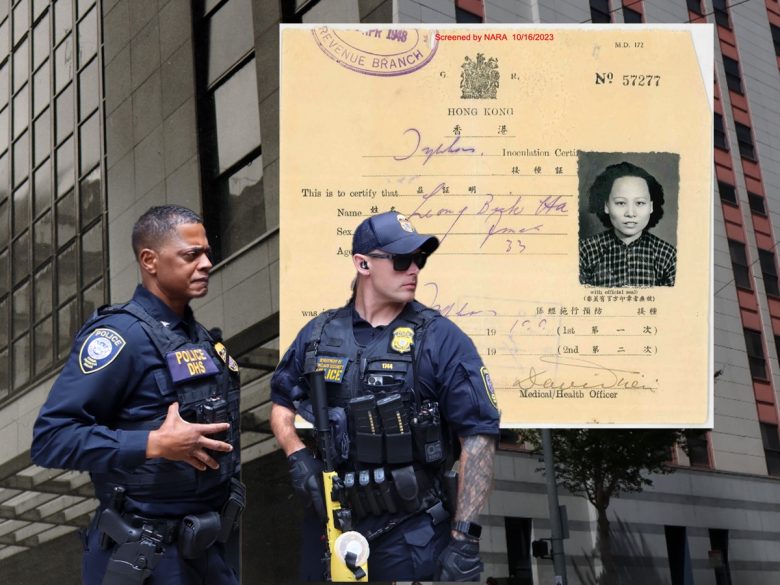
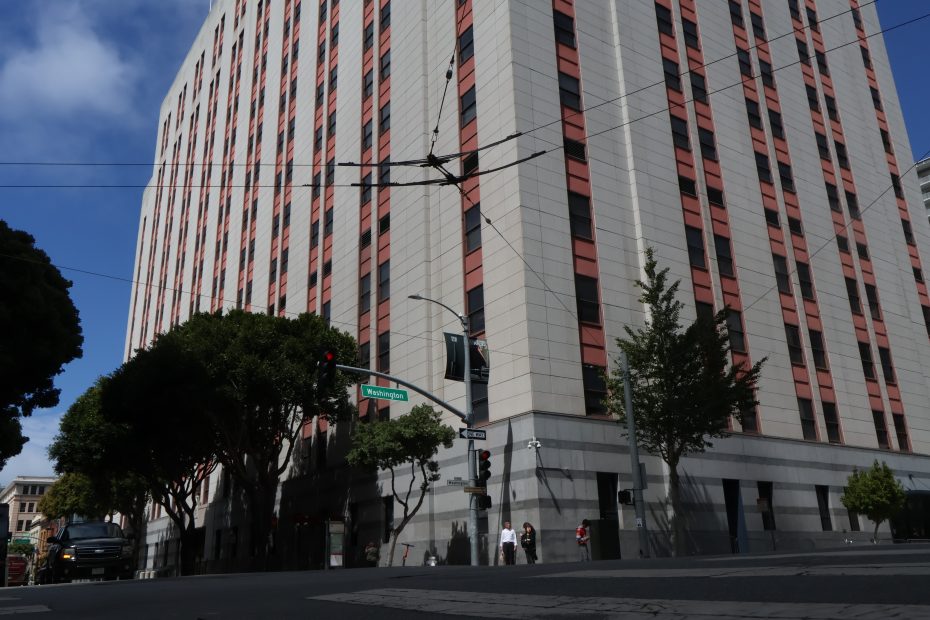
Over the past couple of months, mass immigrant arrests, asylum-seekers detained for longer and longer stays, and protests turned violent have shone a spotlight on the Immigration and Customs Enforcement office in San Francisco, located inside the Appraiser’s Building at 630 Sansome St.
It’s not the first time, however, that efforts to detain immigrants within the building have invited scrutiny. Ever since it was built, 630 Sansome has been linked with American immigration policy — and its tragic consequences.
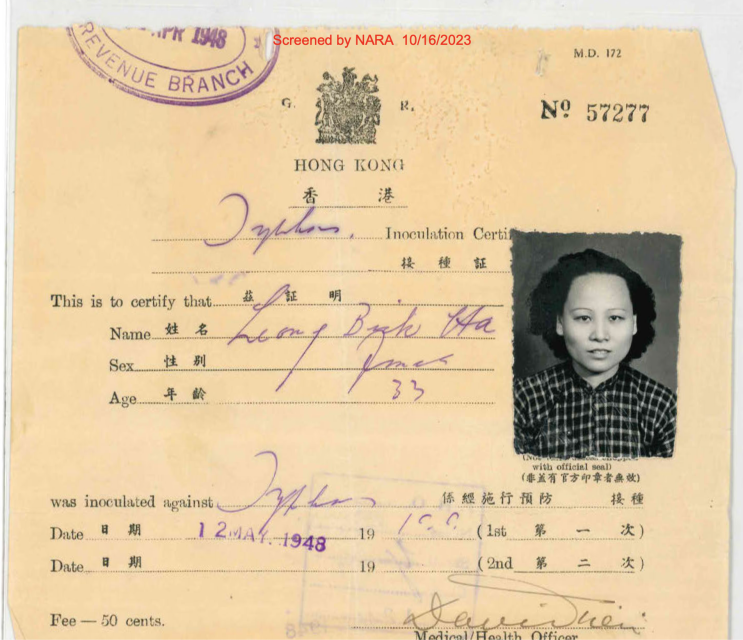
The night of September 21, 1948, 33-year-old Leong Bick Ha hanged herself on the 13th floor of the building, which at that time was the city’s headquarters for the now-defunct Immigration and Naturalization Services, which predated ICE.
Leong — her surname — was one of nearly 4,000 Chinese women who were detained inside the building between 1946 and 1948 after arriving in the United States to reconnect with their American GI husbands.
After being held for three months in jail-like conditions, unable to communicate with her husband U.S. Army Sergeant Ng Bak Teung and her 15-year-old son, Leong was subjected to a long interview process as officials tried to determine the legitimacy of her marriage.
She was so anxious before her official interview that immigration officials prescribed her sedatives. Afterwards, she was told that she had failed the interview and would soon be deported.
That night, several floors up from where ICE detains immigrants in holding cells today, Leong hanged herself in a shower stall.
630 Sansome St.’s relationship with immigration enforcement began around the end of World War II, when an electrical fire destroyed a 30-year-old immigration detention center on Angel Island. Shortly after, INS moved its headquarters and detention center to 630 Sansome St., an unassuming federal building in the Financial District completed in 1944.
The building has always housed some federal agencies unrelated to INS and ICE. But from the start, it had a relationship with immigration enforcement and detention. INS occupied six of the building’s 16 floors, and devoted two floors to the detention of men, women, and children. In 1947 the San Francisco Chronicle described the detention space as “a prison-like atmosphere — barred windows, locked doors, guards everywhere.”
Though Leong Bick Ha is arguably the best-known detainee at the INS headquarters, thousands of immigrants passed through in its first decade. European communists were tried and deported from the building in 1950. A Russian family was inexplicably held in detention for over 14 months in 1951. And a 21-month-old baby girl and her mother were held in the building for three months even after being ordered removed to Canada.
And yet, many San Franciscans were unaware of the hordes of immigrants detained in the modest building every day, according to historian Brianna Nofil, author of “The Migrant’s Jail: An American History of Mass Incarceration.” Nofil argues that 630 Sansome marks the beginning of the practice of detaining individuals in office spaces to avoid scrutiny.
Despite the scale, she says, “If you just hold people in an office building, there’s a pretty good chance that most observers will have no idea it’s happening.”
There were occasions when 630 Sansome lost its anonymity. A couple of months before Leong’s death, 41-year-old Huang Lai crawled onto a ledge of the building’s 14th floor. Lai, who had been in detention for nine months while awaiting an interview, sat on the ledge for hours until police successfully brought her back inside. Five thousand onlookers gathered to watch on the street below.
According to Nofil, this incident was the first time that many San Franciscans learned 630 Sansome St. was a detention center.
In July 1948, a columnist writing in the San Francisco Examiner under the pen name of “Freddie Francisco” implored “officer workers who spend their days in the financial district,” to look closer at the “shining white skyscraper that is the Customs Building on Sansome Street.”
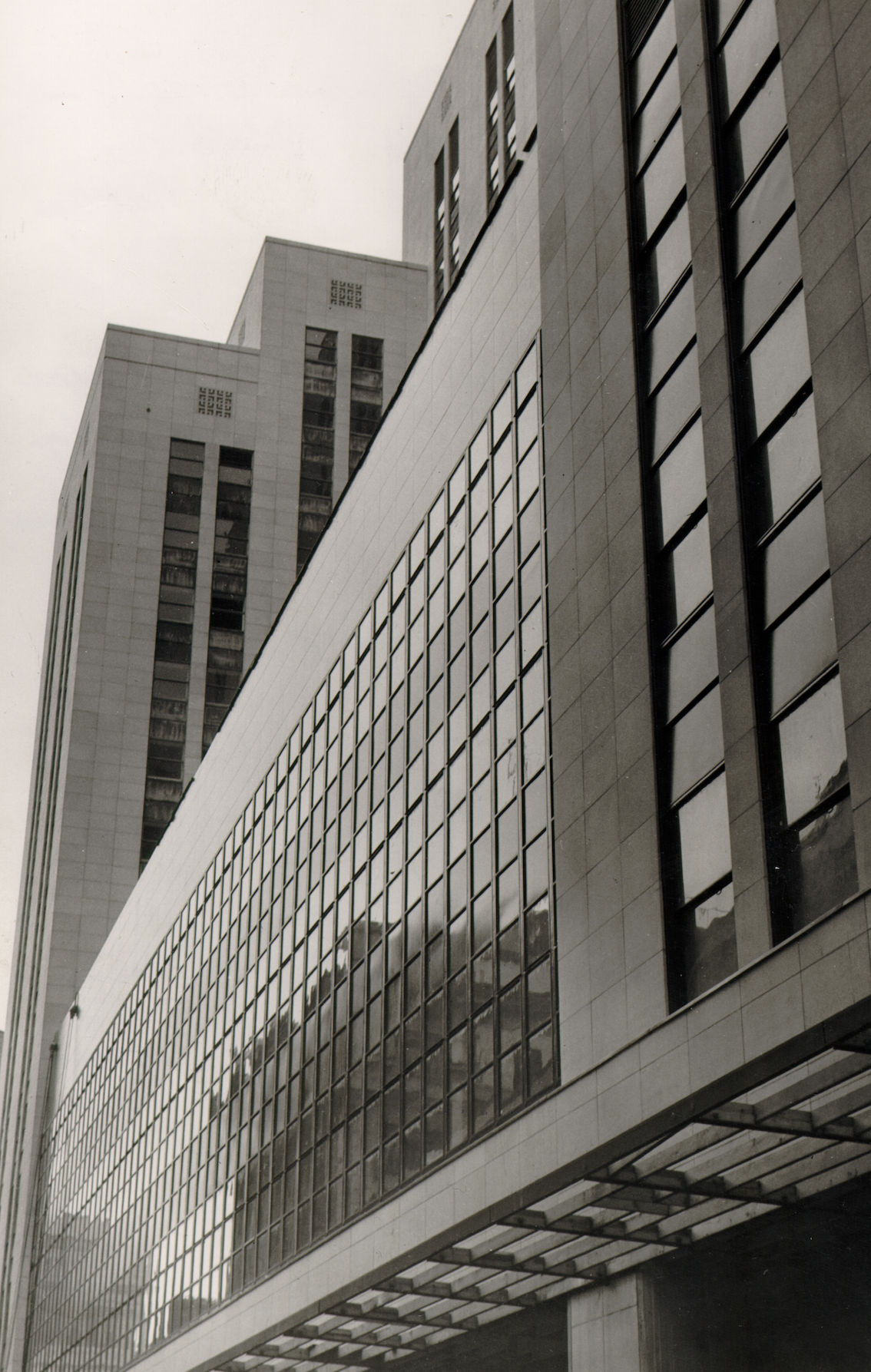
INS was likely doing its best to provide adequate conditions, Francisco wrote. But, “the fact remains that the top of an office building, in the center of a big city, is not the place in which to house hundreds upon hundreds of men, women and children for periods ranging from six months to a year, and more.”
During a 1952 hearing in front of the President’s Commission on Immigration and Naturalization about the financial cost of detaining immigrants for longer periods of time, the lawyer Welburn Mayock called the building a “skyscraper concentration camp.”
He represented American President Lines Ltd., a large American shipping company, and he complained to the commission about the high cost of detaining immigrants there.
Mayock wrote that the detention space “increases the risk of hospitalization” to those inside, and that on average one baby a month was born to women detained at the facility.
Shortly after, President Dwight Eisenhower promised to change immigration detention standards, passing the Refugee Relief Act of 1953 and opening new immigration pathways to 214,000 people. “This action demonstrates again America’s traditional concern for the homeless, the persecuted and the less fortunate of other lands,” reads his statement upon signing the act.
The detention center closed the next year on October 31, 1954. The holding areas were turned into office space or immigration courts — staying that way for a long time. All the remaining detainees were reportedly distributed between county jails and hotels, or released on parole.
While Eisenhower’s administration saw a shift towards alternative detention policies like monitored parole in big cities, immigration restrictions were only tightening at the southern border. The 1954 act Operation Wetback — which some advocates see as a predecessor for Trump’s current mass deportation plan — reportedly deported over one million Mexican day laborers, and wielded racialized immigration policy primarily against Latino people.
“It’s a story of shifting geography,” Nofil said of the 1954 closure, “not a history of eliminating migrant incarceration.”
Nowadays, 630 Sansome St. is again being used to discreetly hold immigrants. But it is no longer anonymous: It has become a place of protest by anti-ICE demonstrators, and for lawyers it is often the easiest place to access clients while trying to get them released through habeas corpus petitions.
Nofil said there was no particular precedent for what to do with immigrants when they first started coming into Sansome. The fledgling system that INS developed in the 1940s still informs modern detention, she said. “Everyone is just flying by the seat of their pants. No one has a plan.”
Back to its roots
Until the 2000s, 630 Sansome St. was mostly known as the headquarters for the regional U.S. Forest Service and the auction site of seized and unclaimed items gathered by the U.S. Customs Service, including confiscated liquor.
But even when INS dissolved in 2003, immigrants continued to shuffle through the court still there, said Jennifer Friedman, deputy director of the immigration unit at the San Francisco Public Defender’s Office. Established under the Department of Homeland Security, ICE adopted the court already housed on the building’s fourth floor, using it to try detained immigrants facing deportation.
Elsewhere in the building, United States Customs and Immigration Services, also under the DHS, processes immigrants for green cards and naturalizations.
Between 2008 and 2014, the number of people attending immigration court every day at the building hovered around 25, according to a data analysis conducted by Vera, a national organization composed of advocates and researchers. Immigrants would be brought to 630 Sansome St. for days when they had court, bused in from jails and prisons that housed people detained by ICE.
The number of people peaked in 2008, when ICE arrested 63 immigrants in a city-wide raid, and then again on July 13, 2011, when 88 people passed through the building.
San Francisco’s courts for detained immigrants at 630 Sansome St. closed in 2021 after all California jails and prisons ended their contracts with ICE, facing public pushback. The closest long-term ICE detention center was then in Bakersfield, said Friedman, and the court moved south to accommodate that change. Friedman added that this change also isolated detained immigrants from San Francisco’s pro-bono lawyers.
What remained at 630 Sansome St., however, was a courtroom where immigrants not in detention appeared for hearings — mostly related to asylum cases. Up until recently, they did not worry about being arrested at these hearings.
630 Sansome St. saw a decline in detainees in the late 2010s. Since the vast majority of the immigrants passing through the building were free to return home after their hearings, it was impractical to process immigrants there since it is so far from any detention court or long-term detention facility.
Patrick O’Brien and Joseph Park, two of the judges who preside over the courtrooms of 630 Sansome St. today, began hearing more general immigration and asylum cases when the detained court closed in 2021. Until 2025, an average of two immigrants were kept at Sansome per day.
But 630 Sansome St. is getting busier. Most immigrants arrested around the Bay Area are now being processed at the ICE office at 630 Sansome St. And many of those who show up for hearings are being arrested inside the building, as ICE agents wait outside the courtroom.
Some lawyers question the legality of these arrests, and have had success filing habeas petitions to release them.
Recent data indicates that people are being held in these spaces for longer and longer periods of time. Data analysis by Mission Local, using the Deportation Data Project’s most recent release, shows that at least 172 people were held at 630 Sansome St. from June 26 to July 29. Eleven of those people were held for over 24 hours. Two were held for over 72 hours.
Detainees who have stayed overnight said that the cells are cold, and they sometimes have to sleep on the floor with just a Mylar blanket, a sheet that looks like aluminum. Video smuggled out of holding cells in New York City’s equivalent to 630 Sansome St. — 27 Federal Plaza — shows cramped conditions in brightly lit rooms.
Only lawyers and family members of the detained have a legal right to get access to the sixth floor, where immigrants are detained. Media members are technically allowed to enter, but Mission Local reporters have been repeatedly denied access.
For visitors, the sixth floor is mostly made up of one long windowless hallway. Visitors are put into a small fluorescent-lit room, where they can speak with detained people across a plastic divider, through wall-mounted phones.
Francisco Ugarte, the first attorney to be hired to the immigration unit at the San Francisco Public Defender’s Office, said that arrests inside the courthouse are new. “What’s happening now, with masked agents at courthouses, this is unprecedented, authoritarian, and indicative of a government that’s failing its people,” he wrote to Mission Local.
630 Sansome becomes ground zero for San Francisco protests
Over the years, 630 Sansome has been a magnet for civil resistance.
The first major instance of protests began after Leong Bick Ha’s death, when 104 women detainees, the majority of them Chinese war brides, reportedly began a hunger strike, said Leona Lau, the founder of the 1945 Chinese War Brides Project.
While INS tried to downplay the protest, Lau said that Leong’s death became a lightning rod for the frustration and anger of the Chinese community. People protested outside the building, and the Chinese-language media lambasted what they saw as racist immigration and detention policies.
Lau said that this frustration and anger remain today, especially as some immigration policies target Chinese people.
“How many more years do we have to fight the fight to have this country recognize us?” Lau asked.
In later years, protestors at 630 Sansome St. were arrested for a 1976 sit-in against the expansion of detention centers, for a 1986 protest against President Ronald Reagen’s support of Nicaraguan anti-communist “Contra” rebels, and for a 1990 demonstration for the rights of immigrants with HIV/AIDS.
In 2007 and 2008, students protested there against immigration raids. In 2010, the building became the site of protests supporting sanctuary city policies and, in 2013, dozens of protesters gathered around a bus believed to be carrying undocumented immigrants to deportation, blocking the bus’s movement for several hours.
But recent protests have focused on what’s going on inside the building’s hallways — the arrest of immigrants as they leave regularly scheduled asylum hearings. Protesters have succeeded in closing the immigration court at 630 Sansome St. on a couple occasions, and they’ve done the same at 100 Montgomery St., San Francisco’s main immigration courthouse, around 10 blocks away.
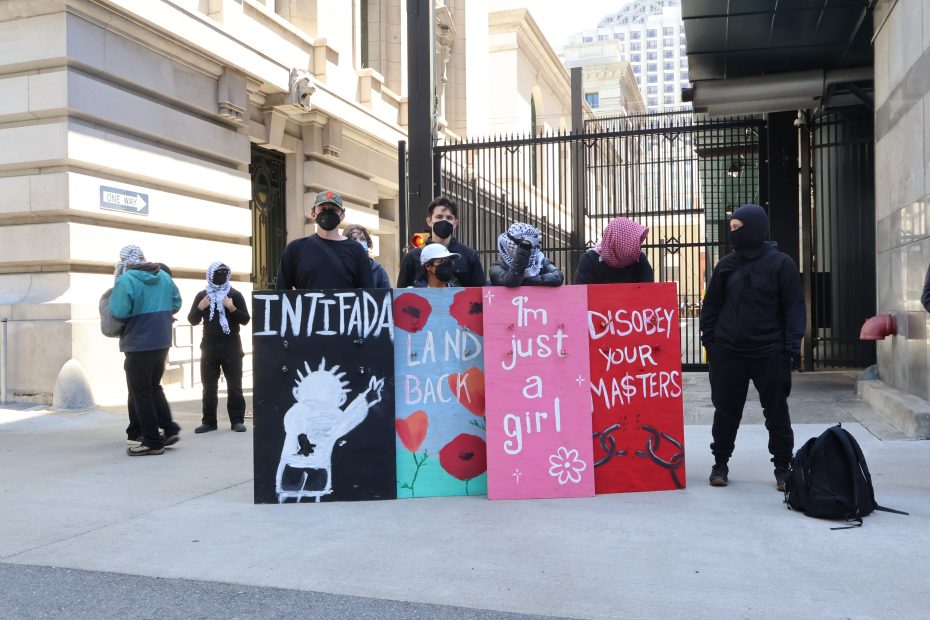
Protesters gathered outside 630 Sansome St. on July 29, 2025. Photo by Frankie Solinsky Duryea 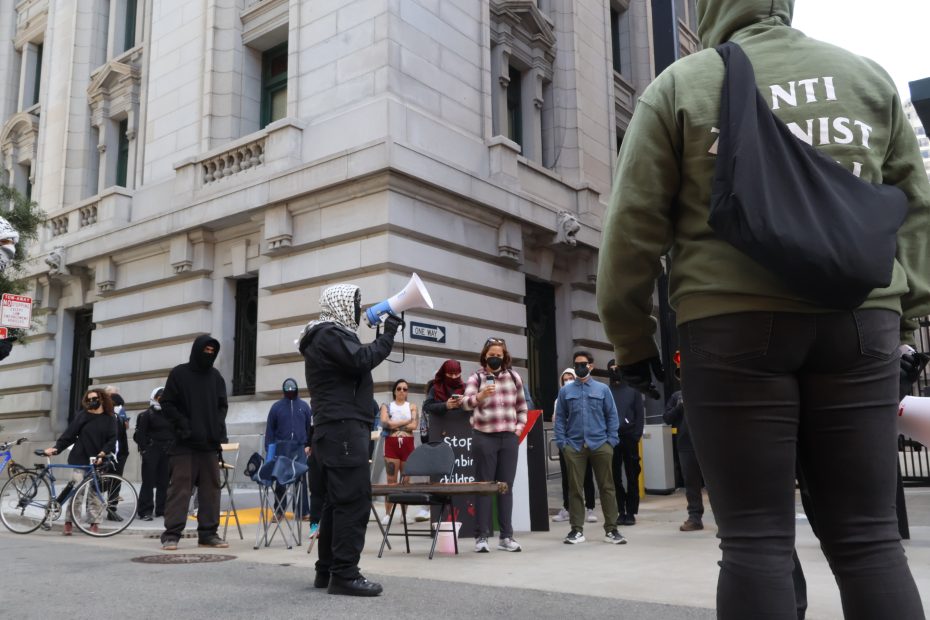
Protesters gathered outside 630 Sansome St. on July 29, 2025. Photo by Frankie Solinsky Duryea 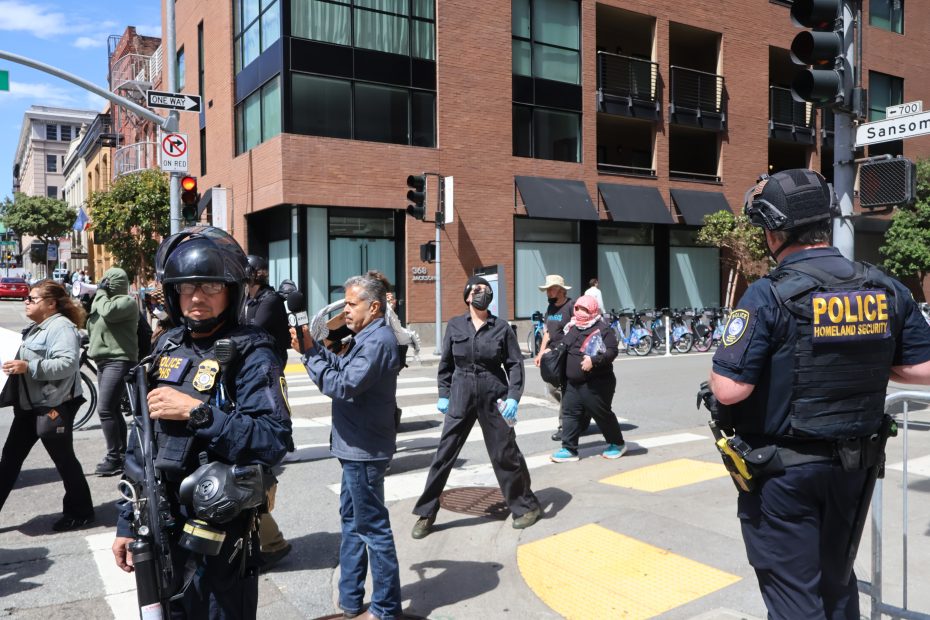
Protesters and federal officers outside 630 Sansome St. on July 29, 2025. Photo by Frankie Solinsky Duryea 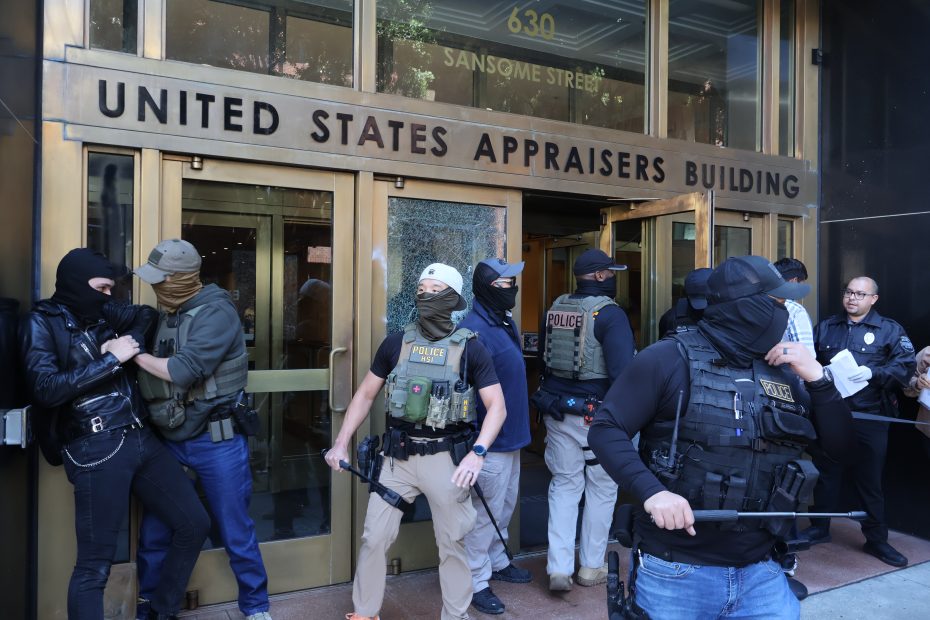
Protesters and ICE officers outside 630 Sansome St. on July 8, 2025. Photo by Frankie Solinsky Duryea
The demonstrations have had mixed results. When protesters tried to stop ICE officers from taking a detainee from 100 Montgomery St., the ICE van drove through the crowd. And, in the most recent attempt to stop ICE vehicles leaving 630 Sansome St., two protesters were tackled and detained.
Protesters continue to regularly show up at 100 Montgomery St. There, they hope that they can keep ICE officers out of the building. But at 630 Sansome St., protestors have said, there’s no ideal strategy. ICE officers can arrest immigrants and then process them two floors above, all out of sight.
At least 50 people have been arrested while attending routine immigration court arrests this year, Mission Local reporters have observed. But legal experts say that number is much higher, and courthouse arrests are occurring nearly daily.
As an unknown number of people are detained there every day, without an opportunity for observers to see courthouse arrests, immigration detention is again invisible, much as it was 80 years ago.
“Few, if any, detention spaces have endured since the 1940s,” said the historian Brianna Nofil. But, from INS to ICE, immigration enforcement has held a lease in San Francisco’s downtown for over 80 years. Nofil said she doesn’t know of any other detention space in the country that’s lasted that long.
Margaret Kadifa contributed reporting.
Correction: A previous version of this article stated that 176 people were held at 630 Sansome St. from June 26 to July 29. Several of those were duplicate entries in ICE’s data. The more accurate number of detained people during that time frame is 172.

This office has also processed thousands of green cards and naturalizations for San Francisco residents. I was one of them, and was well treated.
It is a law enforcement agency, and it does both good and bad. It might be worth telling both sides of the narrative,
And also very good reporting on the matter.Thank you.
I’m glad to see ICE continuing to carry out the deportations of illegal immigrants that Americans voted for last year, because I support democracy and the rule of law.
630 Sansome street building should be renamed the Schutzstaffel building. ..we are getting there at a fast pace..wake up America.
Great article. Thanks.