

The San Francisco Board of Supervisors unanimously voted Tuesday for a resolution that asks the San Francisco police and sheriff’s to come up with a plan for what officers and deputies should do when they receive calls for service related to suspected Immigration and Customs Enforcement arrests.
The resolution comes as ICE officers have been regularly arresting people who show up for routine court hearings as part of their political asylum cases at the San Francisco Immigration Court at 100 Montgomery St.
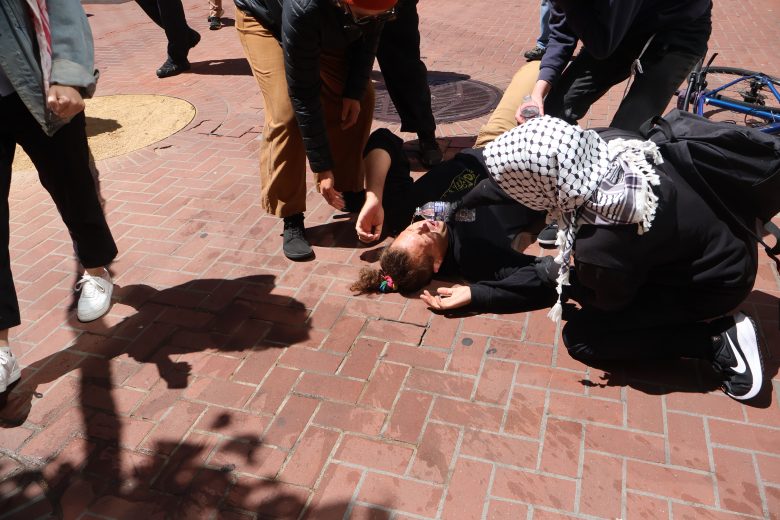
Protesters have staged weekly demonstrations outside of court as a response; at least a few dozen were gathered outside of the court by mid-morning Tuesday.
San Francisco’s 1989 sanctuary ordinance prohibits local law enforcement from assisting ICE, including when it comes to investigations or raids. Police can only respond when it “appears reasonably necessary to prevent serious injury to persons, whether or not a criminal offense is involved.”
But what, exactly, that means in practice, during a time of increased ICE enforcement in San Francisco, is not always clear. ICE officers are often dressed in plainclothes, driving unmarked vehicles, and wearing masks, raising the concern that they could also be easily impersonated.
On July 8, tension between the ICE officers and protesters turned violent, as ICE officers drove an SUV through protesters, in plain view of police officers. An ICE officer later pointed a rifle at demonstrators and a Mission Local reporter.
Days later, San Francisco Deputy Chief Derrick Lew suggested at a town hall meeting in the Castro that police may need to intervene to protect ICE officers and protesters. Police could not “just sit by and watch our fellow law enforcement agent or officer get hurt,” Lew added.
A public plan is necessary to maintain trust between law enforcement and San Franciscans, District 11 Supervisor Chyanne Chen said when she introduced the resolution. Chen pointed to protocols recently developed by the Los Angeles Police Department as a possible template.
The resolution is non-binding. Because the Board of Supervisors does not have direct control over law enforcement, the most the board can do is ask. The San Francisco sheriffs and police departments have both said they “routinely update” their “protocols and training to ensure we are prepared to respond effectively to any public safety challenge.”
Chen introduced the resolution on July 15. At 36.5 percent, Chen’s district has the highest proportion of voters who are foreign-born in San Francisco, according to Political Data, a campaign data firm.
The following supervisors cosponsored the resolution when it was introduced: District 1 Connie Chan, District 5 Bilal Mahmood, District 7 Myrna Melgar, District 9 Jackie Fielder and District 10 Shamann Walton.
Since then, Board President Rafael Mandelman and District 3 Supervisor Danny Sauter have also signed on as co-sponsors. Supervisor Sauter represents the Financial District, which is where San Francisco’s immigration court is located.
The mayor’s office declined to comment, citing the practice of previous administrations not to comment on such resolutions.
That’s a lot of co-sponsors! And a unanimous vote. Is co-sponsoring just a free thumbs-up on a resolution? The official way to add it to their CV? Why not just vote for it? Do co-sponsors take on any additional work or responsibility?
If it was unanamous, why is Joel Engardio not listed as a sponsor or suporter?
Police can only respond when it “appears reasonably necessary to prevent serious injury to persons, whether or not a criminal offense is involved.” Love to see someone read that publicly with a straight face. That said, there are states with dense concentrations of undocumented immigrants that form a critical agricultural work force where there are no “ICE raids” and immigrants are not walking around wondering if they’ll be grabbed. The reason, of course is that sheriffs and state police are cooperating with ICE so that ICE need only to show up to jails and prisons to apprehend their targets, not guess who is who at the Home Depot. Gonna guess immigrants are more victimized by the criminal cohort than the general population complaining about what ICE is doing…
There’s no guarantee that the SFPD can create a viable plan for responding to ICE arrests. And this puts too much of a burden for them because the Trump regime may not like their plan and threaten to arrest them for obstruction.
Thanks for reporting
The sanctuary law “Only allows police response to prevent serious injury…”
IC E should be given access to all drug related criminals who are in police custody regardless of statis
Why some are so against any help from anyone to help stop the horrific crimes and harm on the streets is absurd .
Until SF gets serious and gets the drug addicts and dealers off the streets , this city will continue to rot .
Taxpayers help all but it is beyond time their concerns get addressed .
I ‘m exhausted from the handoutsgoing to nonprofits and addicts who game the system while I have to go into the street with my walker and walk over shit and encounter the drug waste products who are entitled and who care less about others except doing my drugs.
Really sick and wrong .
The bleeding heart progressives think addicts should be allowed to get high one more time and we need to pay for them?
After one intervention , then no more ambulance or free lunch.
They need to get their act together and go find a job like the rest of us .