


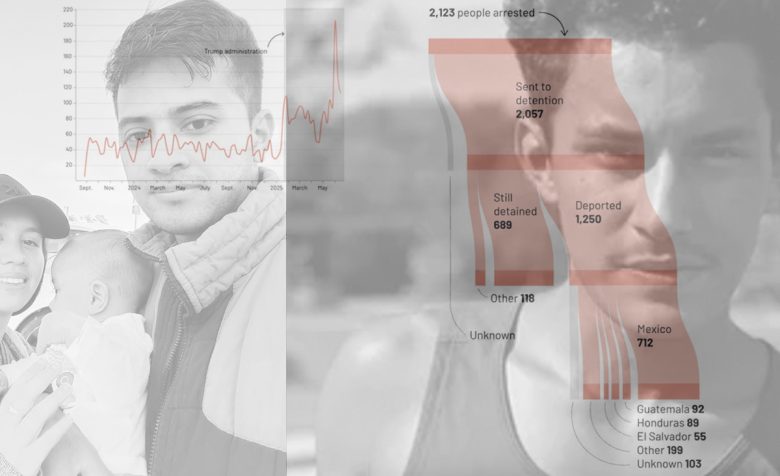

In early July, Edin Eduardo Castañeda Reyes stopped to get breakfast on his way to work in Redwood City when he noticed two unmarked cars following him into the parking lot.
“Right when I got out of my car and took two steps, they were on top of me, telling me not to move,” the 24-year-old Reyes said in Spanish in a telephone interview from Guatemala.
One of the three uniformed Immigration and Customs Enforcement officers asked for his driver’s license and then quickly cuffed him. They took his car keys and phone, Reyes said, and left his backpack in his car.
By 7 a.m. on that July 14 morning, Reyes, who had been living in the United States since 2016, was on his way to an ICE processing center.
Years earlier, Reyes had missed a court date for immigration proceedings in 2018. He knew that a removal order had been signed against him. But, while ICE officers had taken neighbors in the past, he had never been targeted.
Besides, he was married to an American citizen, Angela, and they had two children, ages 2 and 4.
Angela learned of her husband’s arrest through a video on NextDoor. It showed Reyes standing in the parking lot, surrounded by ICE agents.

Mission Local has documented dozens of ICE arrests that have taken place in San Francisco since May 27, 2025. Data, however, indicates there are far more detentions in what is known as the “San Francisco Area of Responsibility,” which covers Northern California, Hawaii, Guam, and Saipan in the Northern Mariana Islands.
At least 87 percent of those arrests were in the state of California.
By cross-referencing three datasets released this month — on ICE arrests, detentions and deportations — Mission Local was able to follow the journeys of those arrested between Jan. 20 and June 26 in this “Area of Responsibility.”
No names are attached to the datasets, but each person has a unique identification number. Using that number, we can plot each journey from arrest to deportation or release.
The data from Jan. 20 to June 26 was made available through records requests and subsequent litigation from the Deportation Data project, a group of researchers headed by David Hausman at the University of California, Berkeley.
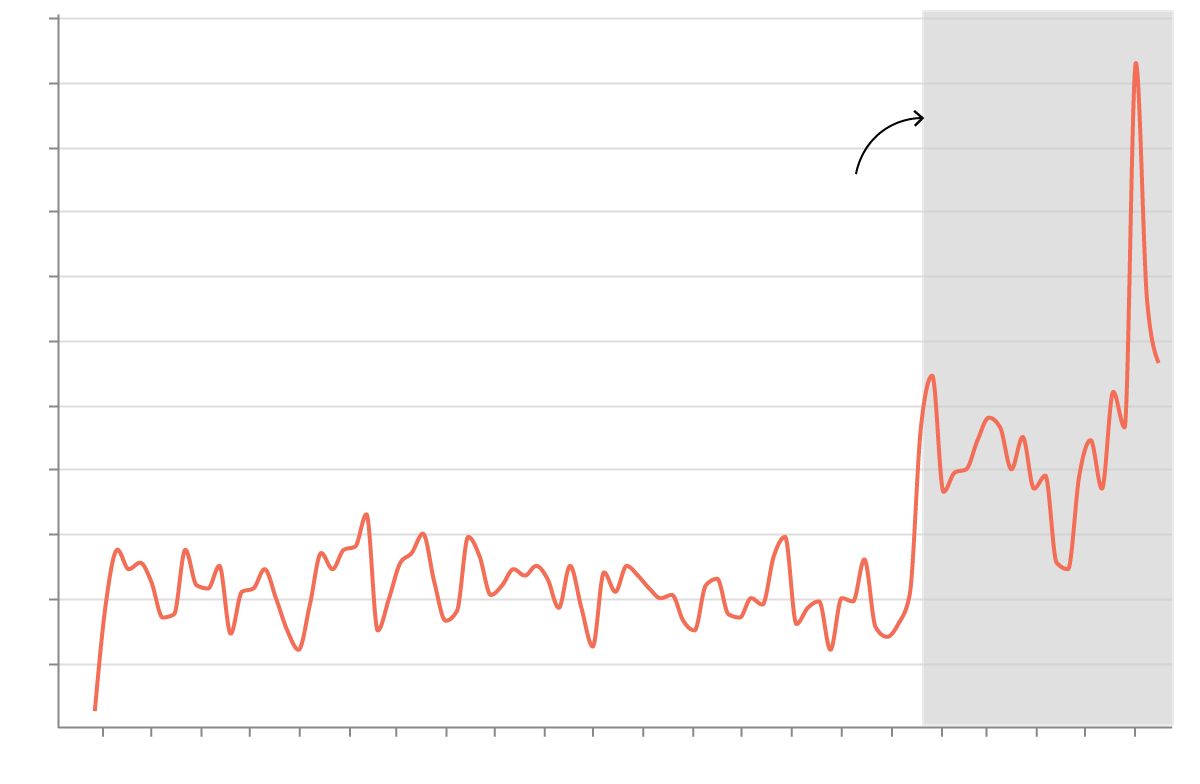
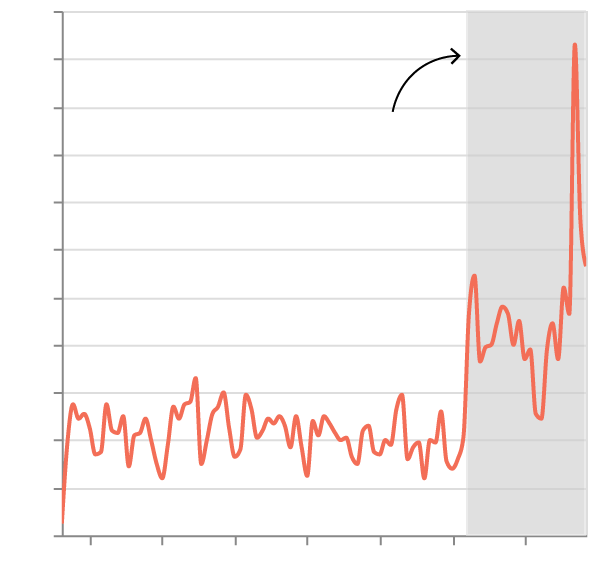
The data shows that arrests in the San Francisco “Area of Responsibility” have doubled compared to last year. They increased even more in late May, when senior officials from the White House ordered ICE to reach a quota of 3,000 arrests per day.
ICE arrests shot up in the S.F. area in 2025
220
200
180
Trump administration
160
140
120
100
80
60
40
20
Sept.
Nov.
2024
March
May
July
Sept.
Nov.
2025
March
May
220
200
180
Trump administration
160
140
120
100
80
60
40
20
Oct.
2024
April
July
Oct.
2025
April
This includes administrative arrests — arrests for civil violations of immigration law — within the San Francisco Area of Responsibility by week. That jurisdiction includes Northern California, Hawaii, Guam and Saipan. Data from the Deportation Data Project. Chart by Kelly Waldron.
ICE’s annual budget was recently increased from $8 billion to $28 billion, and attorneys are worried that this change in funds will lead to even more arrests, wrote Jennifer Friedman, interim manager of the Immigration Unit at the San Francisco Public Defender’s Office.
“It’s definitely heading in that direction,” Friedman wrote.
Most arrests in the city of San Francisco have taken place at immigration court or at ICE check-ins, at 630 Sansome St. and 100 Montgomery St., two locations within the city where asylum seekers appear for regularly scheduled hearings. Arrests elsewhere are made in parking lots, homes and jails.
For 23-year-old Anibal Mauricio Martinez Molinas, the arrest happened at his apartment when three uniformed ICE agents appeared at his door in San Jose.
Martinez left El Salvador with a group of other immigrants, when he was 9. He was detained by border control while walking through the Sonoran desert.
Martinez managed to delay removal for the next 14 years while finishing school and working at tire shops. Along the way, he became as comfortable speaking in English as he was in Spanish, and started going by Michael rather than Miguel, he said in a phone interview from El Salvador.

His American life ended on the night of June 17, 2025. Officers showed Martinez papers confirming his detention at the border more than a decade ago, and the removal orders that followed. Martinez was too shocked to even read them. “It’s over,” he remembers thinking.
After letting the ICE agents enter his South Bay apartment, Martinez gathered some clothes, an empty backpack, two pairs of shoes, a medical device for a sleep disorder, his passport, and $4,500 in savings; $200 or so in cash, and the rest on his debit card.
“The whole time that I was over there” — in the United States — “I was just fighting for a life worth living,” said Martinez. “I was kind of starting to make good progress towards that. And then this happened.”
The agents handcuffed him, put him in a van and drove him to the closest processing center.
Reyes and Martinez are two of the 2,123 immigrants who have been arrested in the San Francisco “Area of Responsibility” since Jan. 20. Many, like Reyes and Martinez, have no criminal record beyond traffic fines, and had lived in the United States for years. Their arrests seemed to come out of nowhere.
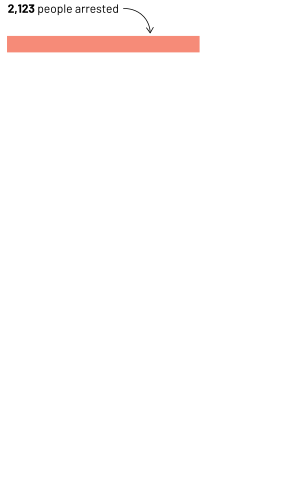
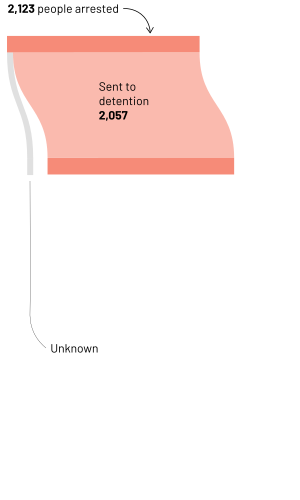
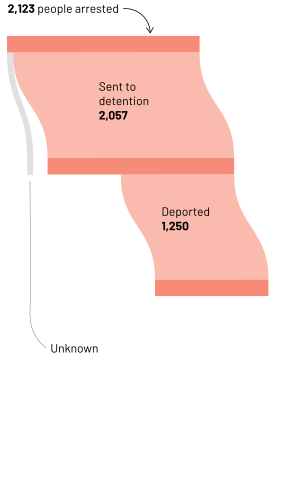
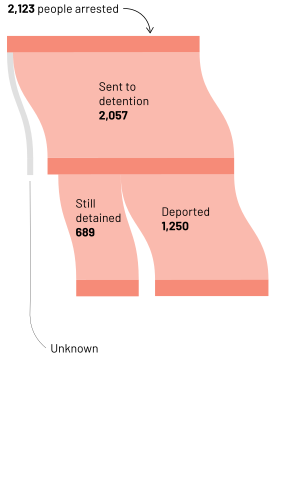
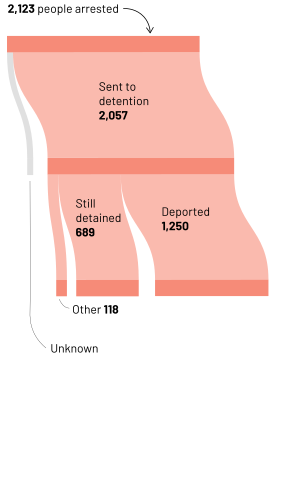
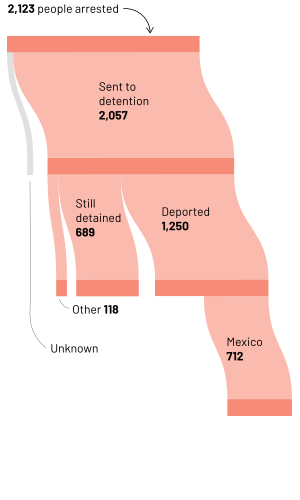
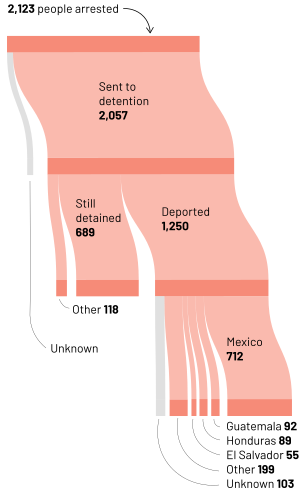
ICE arrests between January 20, 2025 and June 26 in the San Francisco Area of Responsibility.
The vast majority of those people were sent to ICE detention centers across the state and country.
It is unclear whether the 66 remaining people were released, or are missing in detention records.
The rest were deported.
As of the end of June, 689 people remained in detention — and had been there for an average of 45 days.
One-hundred and eighteen people were released for various reasons. One detainee escaped, others left detention for “voluntary return” and others for reasons that are unclear.
Of those who were deported, most were deported to Mexico.
The rest were sent to 33 other countries. Records indicating the departure country are missing for 103 others.
TK TK TK
Most detainees are quickly shuffled through
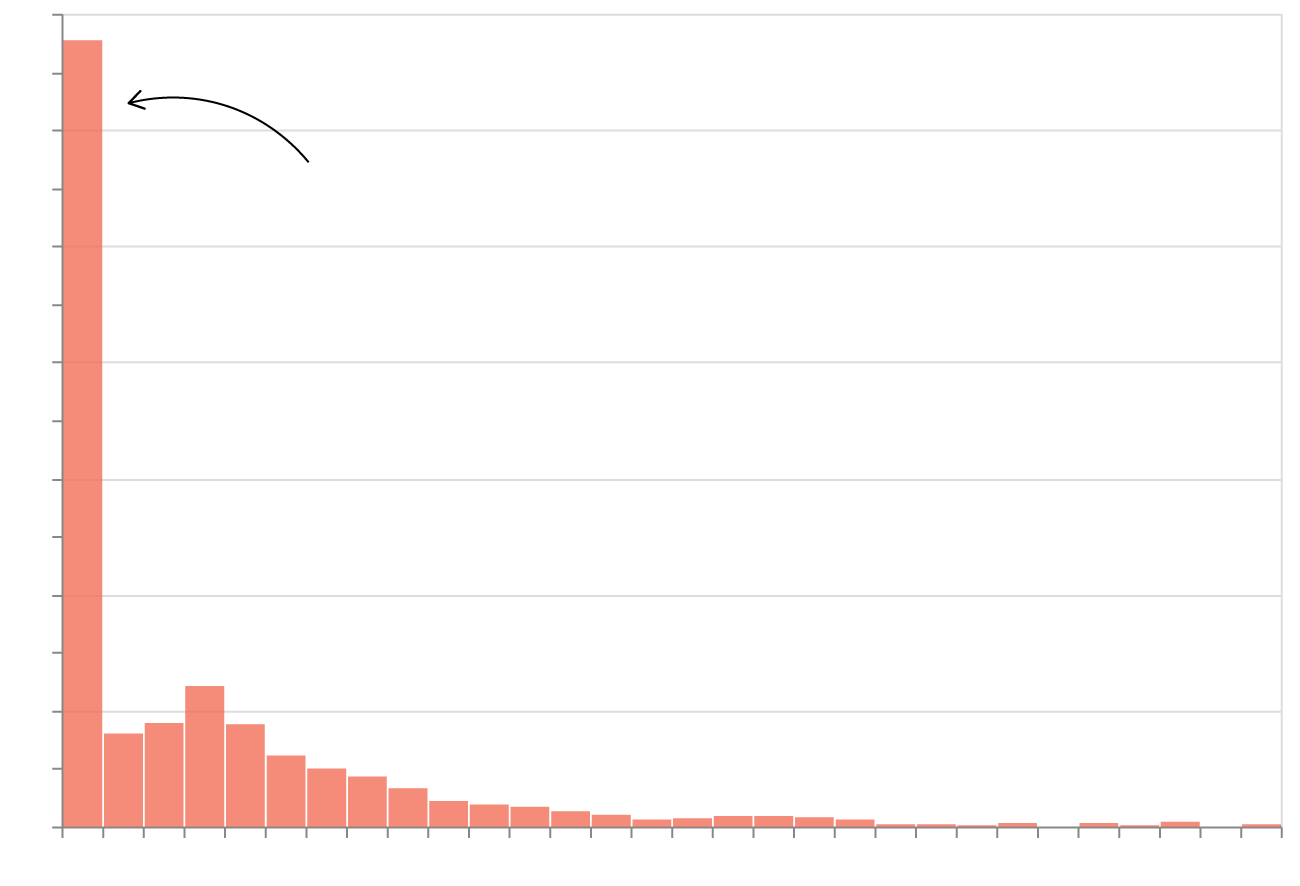
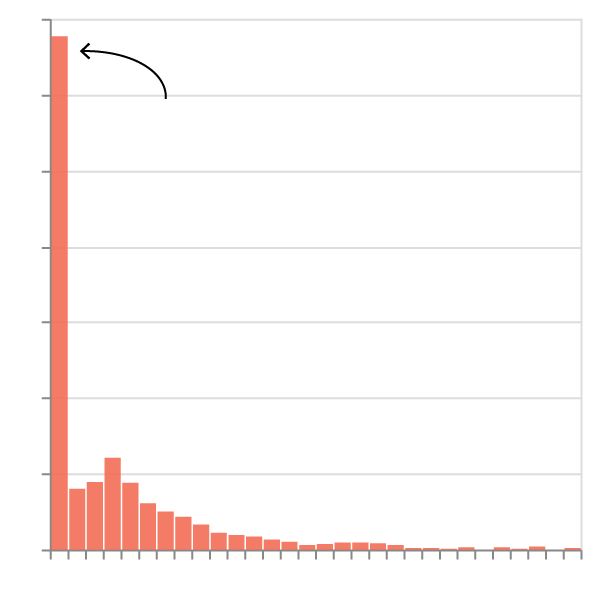
Mission Local identified 2,057 of the 2,123 people arrested in the San Francisco “Area of Responsibility” in ICE detention records. As of the end of June, 689 of them remained in a detention facility.
Of the 1,368 individuals in our data who were released from detention or deported, about half of them had been held in ICE custody for fewer than six days. Some 270 were in detention for more than 30 days.
Most detainees are moved through the system quickly
700
650
600
677 detainees stayed in ICE
custody for less than five days
550
500
450
400
350
300
250
200
150
100
50
10
20
30
40
50
60
70
80
90
100
110
120
130
140
150
700
600
677 detainees stayed in ICE
custody for less than five days
500
400
300
200
100
20
40
60
80
100
120
140
Only includes detainees who were arrested in the San Francisco Area of Responsibility between January 20, 2025 and June 26, 2025 and released from ICE custody within that period. Data from the Deportation Data Project. Chart by Kelly Waldron.
Michael Martinez was one of the many immigrants who moved through removal proceedings in less than a day.
While Martinez said that he couldn’t remember which processing center he was in, the drive from San Jose took less than an hour, meaning it was most likely 630 Sansome St. in downtown San Francisco. There, he was fingerprinted and allowed to make a phone call.
Since Jan. 20, at least 433 people have been detained at 630 Sansome St. in the SFR Holdroom on the fourth floor of the same building that holds ICE offices and immigration courts. For most detainees, the hold room is the first stop following their arrest.
ICE agents put Martinez into a holding room with about five other men from Mexico and Colombia, he said. He was given a suitcase for his belongings, but was careful to put his debit card and cash into a pocket of his backpack.
Less than a month later, Edin Reyes passed through the same processing center at 630 Sansome St.
By the time Reyes got there around 8 a.m. on July 14, his hands hurt from how tightly his handcuffs had been put on, he said. Five hours later, agents again put him in a van and drove him to the Fresno Holding Center, a hotspot for short-term detentions that 602 people in our dataset passed through from Jan. 20 to June 26, 2025.
In Fresno, he said, agents pressured him into signing a paper authorizing his immediate deportation.
“Look, we’re going to deport you no matter what,” Reyes remembered being told. “You sign or you don’t sign. I have to deport you. So it’s better that you sign your removal now. It’ll be quicker.”
Reyes had no access to a lawyer, he said, and no one offered him a phone call. He signed the papers, and then fell asleep on the floor of the Fresno holding cell.
On average, the detainees in our analysis were transferred three times, typically from short-term “holding” or “staging” facilities to a larger detention center.
Those arrested in the S.F. area have landed in detention centers across the country
Data from the Deportation Data Project. This map includes “book ins” for detention stays among those who were arrested in the San Francisco Area of Responsibility since Jan. 20, 2025. Most detainees were booked in at multiple locations. The map only includes facilities that received three “book ins” or more.
Out of those arrested in the San Francisco “area of responsibility” this year who are no longer in ICE custody, the average time spent in detention was 16 days.
According to Jeff Migliozzi of the advocacy organization Freedom for Immigrants, the Trump administration’s expansion of expedited removal has allowed for much faster deportation proceedings, skirting prior guardrails for deportation. “They’re eliminating a crucial stage of due process,” said Migliozzi.
While Martinez’s stay in ICE detention was short, Reyes passed through several processing centers. The morning after he was detained, Reyes was flown from Fresno to the Florence Processing Center in Arizona, where some 151 immigrants arrested in the San Francisco area have ended up.
It was in Arizona that he was first given the opportunity to call his wife. As soon as she heard his voice, Angela said she knew “there was just nothing to do.”
The next day, Reyes was handcuffed and flown out of Florence, Arizona, with other detainees. ICE agents refused to tell him or anyone else where they were going, he said. The plane stopped for a layover — in a state that Reyes still can’t identify — before flying on to the Alexandria Processing Center in Louisiana.
Jeff Migliozzi from Freedom for Immigrants said that this sort of transfer process is increasingly common. Already, many immigration detention centers are at their limits, so “wherever they have beds, they’re sending people,” he said.
“It’s logical that the neighboring states are where they’re transferring people,” Migliozzi continued. “But with ICE, transfers aren’t always logical.”
The day Reyes landed in Louisiana, a friend spotted his car in the parking lot where he had been arrested by ICE. Angela found someone to make her a new car key, then went to pick it up.
San Diego and Louisiana most common points for deportations
At least 1,250 people who were arrested in the San Francisco “Area of Responsibility” this year have been deported, the vast majority to Latin America. Most left the country by bus at the San Ysidro border crossing in San Diego, followed by Alexandria International Airport in Louisiana.
Some 25 percent of all U.S. deportation flights have left this year from the Alexandria Processing Center, with about 10 percent of those arrested locally spending time there.
Reyes was detained in Louisiana for two days. Then, on the morning of July 18, four days after being arrested, agents loaded him and around 100 other detainees onto a flight bound for Guatemala, the second most common destination for all deportees.
About 15 minutes before landing, Reyes said, the federal agents onboard began taking off everyone’s handcuffs. Reyes said that he thought agents did it so that Guatemalan officials would see that “they come nice, without knowing our hands are tied coming into our country.”
Reyes is now staying with his sister and father outside Guatemala City, the capital of Guatemala. He calls his wife and children as often as he can. And, while he will begin looking for legal pathways to return using his wife’s citizenship, he doubts he can return to the United States anytime soon.
Angela, who works two jobs in Daly City, will visit in the fall. But the immigration process for spouses of American citizens can take years if the spouse first entered the United States without documents.
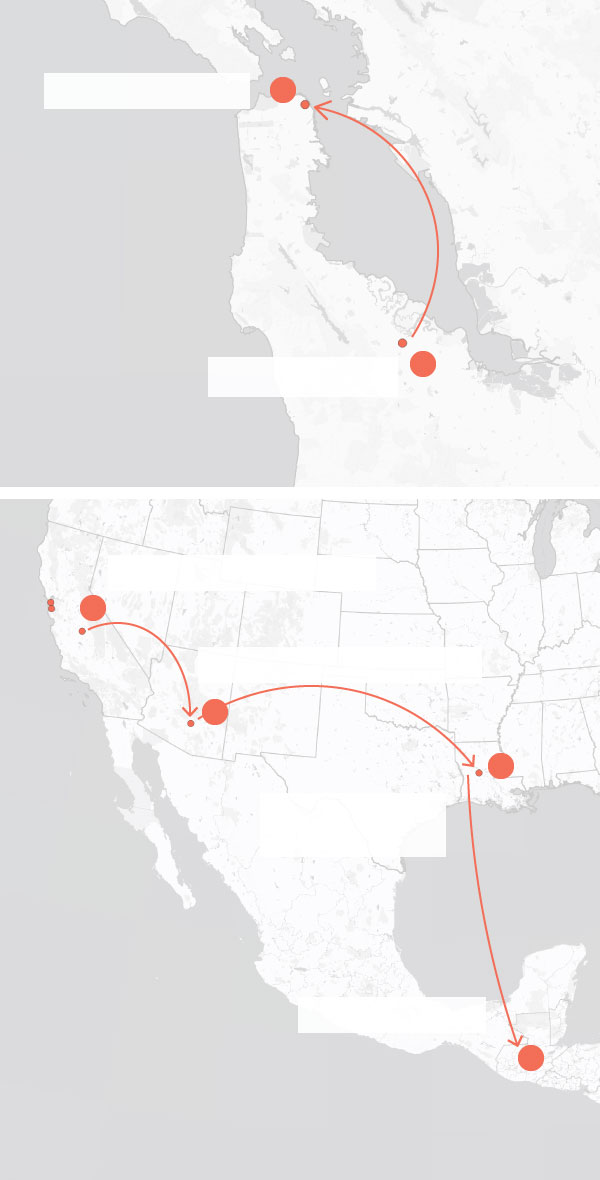
A timeline of Edin Reyes’ journey from arrest to deportation
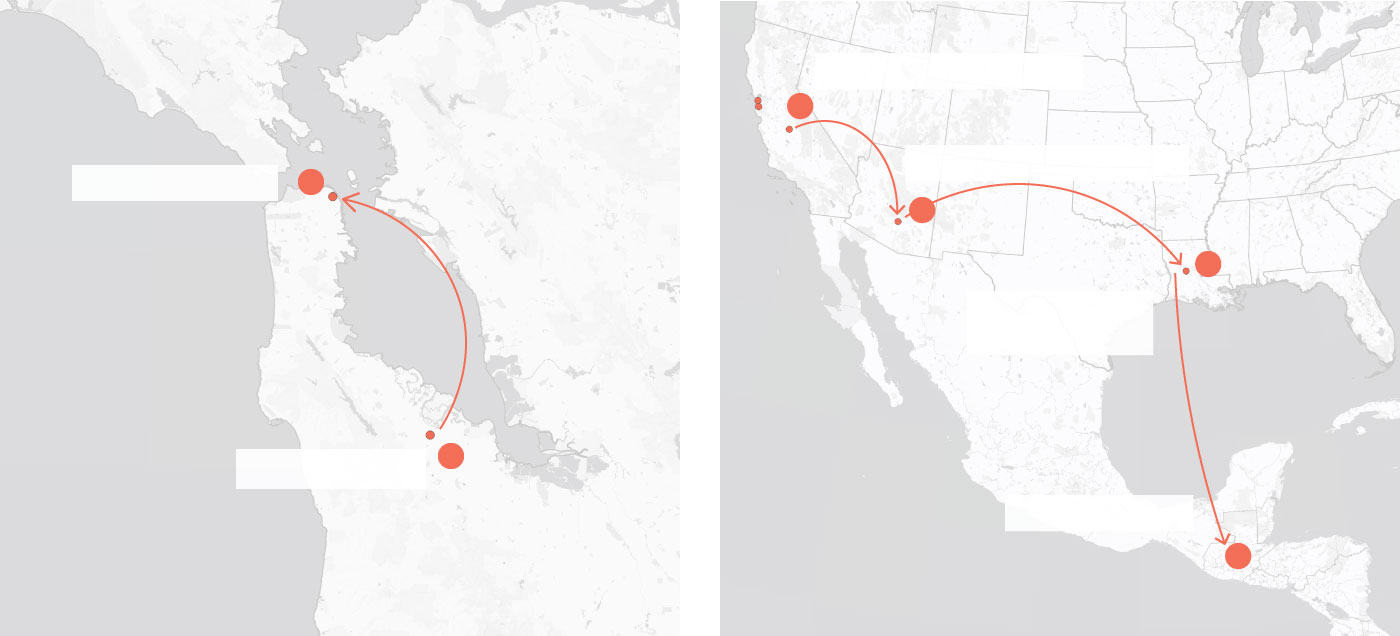
July 14: Driven to Fresno
CA
3
July 15: Flown to Florence
2
July 14: Processed
4
AZ
San
Francisco
5
LA
July 16: Flown to
Alexandria
Redwood City
1
July 14: Arrested
July 18: Deported
6
Guatemala
2
July 14: Processed
San
Francisco
Redwood City
1
July 14: Arrested
July 14: Driven to Fresno
CA
3
July 15: Flown to Florence
4
AZ
5
LA
July 16: Flown to
Alexandria
July 18: Deported
6
Guatemala
Source: Reporting by Frankie Solinsky Duryea. Maps by Kelly Waldron.
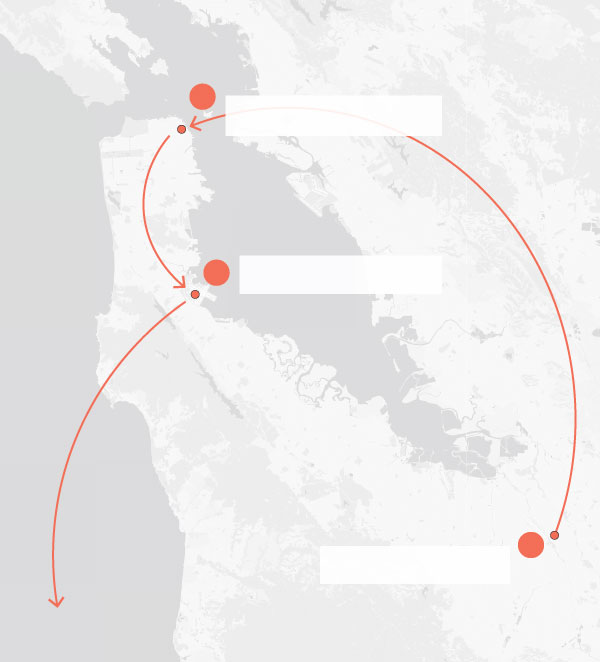
For his part, Martinez spent much less time detained. After a few hours in the holding cell, he and five other men were handcuffed again, loaded onto another van, and taken to San Francisco International Airport, only a 30-minute drive away. There, the men were split up and loaded onto separate flights.
Martinez’s flight to El Salvador took off at 2 a.m. on June 18, less than 12 hours after he was arrested.
“If this plane ends up crashing,” Martinez remembers thinking, “that wouldn’t even sound that bad.”
The flight landed in San Salvador, the capital of El Salvador. Martinez’s family house, which he hadn’t seen for 14 years, was a four-hour drive away in Nueva Esparta, a small rural town in the northeast of the country.
A timeline of Miguel Martinez Molinas’ journey from arrest to deportation

2
June 18: Processed
San
Francisco
3
June 19: Deported
San Jose
1
June 18: Arrested
2
June 18: Processed
San
Francisco
3
June 19: Deported
San Jose
1
June 18: Arrested
Source: Reporting by Frankie Solinsky Duryea. Map by Kelly Waldron.
Martinez paid $60 of his cash reserve to take a taxi to his cousin’s house, an hour and a half from the airport. He spent the night there, and then hitched a ride to his old home in Nueva Esparta, what he calls “a mud house in the hills,” that he left because of poverty and hunger.
Martinez said that when he left El Salvador, it was one of the most dangerous countries in the world. He’s now less afraid than he previously was, because of Salvadoran president Nayib Bukele’s crackdown on crime. Even still, he said, he held his backpack closely during the journey home, keeping his $4,500 in savings near.
As soon as he could, he said, he stashed his money in a Salvadoran bank. He withdraws a little cash every week, trying not to keep too much on him at any time.
The conditions in El Salvador are much worse than what he’s used to. “Where I shower, the other day there were a bunch of frogs in there,” he said. Things that he took for granted — AC, safety from bugs and disease, clean roads — are gone.
He bought a used Hyundai for $1,850, to get around the rural area where he lives. After that, rent, and food, he’s left with about $2,000 in savings in late July. He estimates that it’ll last him seven months at best, and he’s trying to find work in the meantime.
The minimum wage in Nueva Esparta is $10 a day. If Martinez wants to be smuggled back into the United States again, the trip would cost $12,000.
“There’s no way I could do that,” he said. His only hope, he believes, is to start his own tire shop. He doesn’t have enough money to do that, so friends back in the United States have set up a GoFundMe. As of July 30, they’ve raised only $180.
Martinez said that he was sad to know that he won’t see his friends and family in the United States again.
“Well, actually I’ll probably see some of them again,” Martinez said, correcting himself. “The ones that are undocumented, they’ll probably end up getting deported, too.”
Methodology
The data used for this analysis was downloaded from the Deportation Data Project, which publishes datasets on ICE arrests, encounters, detainers, detentions and removals. The latest release was published on July 15, 2025 and includes data from September 2023 to the end of June 2025.
The arrests included in the data cover all “administrative arrests,” which are arrests for civil violations of U.S. immigration laws. Those are conducted by ICE Enforcement and Removal Operations, the department responsible for civil immigration arrests within the United States. It does not include arrests made along borders by Customs and Border Protection officers. More on those definitions here.
There are some duplicates in the arrests dataset and it is not always clear whether those represent multiple arrests or duplicate entries. In our analysis, we assumed that any records that logged an arrest for the same person on the same day were duplicates.
The unique identifiers in the release are the same across datasets. For this analysis, we cross referenced unique identifiers obtained in the arrests data with those in the detentions and removals files. To calculate the total removals, we referenced columns in the detentions dataset as it is more complete. To calculate the number of people still in detention, we calculated the number of unique identifiers that did not have data in the “stay release reason” column. To understand points of departure, we used the removals data.
For any questions, please reach out to kelly@missionlocal.com.
Annika Hom contributed reporting to this article.
“Years earlier, Reyes had missed a court date for immigration proceedings in 2018. He knew that a removal order had been signed against him.”
I stopped reading at this point.
Illegal is illegal.
Yes, in that sense immigration offenses are no different from other types of crime. If you miss a court date in a criminal case then the judge will issue a bench warrant. That does not mean that sheriffs will necessarily go out and try and find you, although they may.
But what it does mean is that if you have any subsequent interaction with LE officers, from a routine traffic stop to a civil court appearance, then you can be detained with no possibility of bail. If that warrant is out of the county or the state, you may be bussed to that jurisdiction.
I have sat in courtrooms at 850 Bryant where half the defendants called are not present, and a no-bail warrant is issued. What are those guys thinking?
the comments here are disgusting. Is this a MAGA hangout?
It’s distressing that following the law is now considered not only disgusting, but a MAGA trait.
You might consider the longterm consequences, political and otherwise, of this association. Do you really want to be the party of criminals? This might actually be popular in a Mission St. café, but I don’t think it’s going to work nationally.
I want to be a Democrat AND have laws enforced. I know it’s an unpopular position in the Mission. But I don’t think it’s as unpopular as you think, even in the rest of the city.
“It’s distressing that following the law is now considered not only disgusting, but a MAGA trait.”
You got that exactly backwards. MAGA = Trump = violating habeas corpus deliberately and skipping legal asylum claims from uninvestigated individuals. That’s illegal under our Constitution, but the MAGA majority in Congress slight though it may be and the 6/3 Conservative SCOTUS have so far declined to enforce preserving and defending the Constitution.
So MAGA = trashing the Constitution ALONG WITH the rights of individuals merely thus ACCUSED of being undocumented or warranting deportation, under our legal system, and by extension damaging the validity of our legal system throughout.
You seem to think that enforcing only the laws you like, as you personally interpret them, is a version of “law and order” – but you are greatly mistaken on all counts, legally.
It’s called the “silent MAJORITY” vote
There are enough instances of rampant illegality of these roundups, from denial of constitutionally-guaranteed due process to kidnapping of US citizens that your arguments are contradictory and false.
Thanks for reporting
Everyone is welcome here as long as they come legally .
Criminals be gone
Even if born here and are committing crimes , local state and federal agencies should be working hard to remove this element
Sf police have lost control of the drug scene . Why not get federal agents here to go after the dealers and drug addicts ?
They would be saving lives as well.
In SF the number one problem is the out of control drug scene that is killing people .
Drug dealers and addicts should be placed in locked places away from the city. There is no reason they need to be locked up here .
The real bad guy here is groups like La Raza (MANY more but this the most prominent), some of the unions and even some of the churches who give these people false hope in “resisting”. They encouraged them to stay, they encourage them to hide under the delusion that things might work out for them. It’s important understand that these groups lose their funding without this population. These people are clinging the power and could careless about the welfare of these people. The unions want their dues and the churches want their tithes. What I would like to see is somebody bring a class action lawsuit against politicians who use these people as political pawns like Alejandro Mayorkas, President Biden and Democrats who sponsored sanctuary city laws. For it was truly a hateful act.
I know a guy who took the 1k payout to self deport, then snuck back over the fence in TJ within days. He managed to get back up to his cannabis grow in calaveras to water the plants.
The system is a joke. Both the dems and open borders at one end of the exteme spectrum, and the racist MAGAs at the other. Literally nothing will be solved because both sides are at such extremes.
Even when Dumpty talked about allowing farm and hotel worker visas which was a decent olive branch, his jackbooted thug Stephen miller and Ice Barbie were there to cry foul.
What I said before, there is no way to keep people out permanently, there are too many reasons for people to need to be here.
Get over it all, reform the laws, and legalize law-abiding long-term residents.
Don’t come here illegally and then cry about the consequences. There are 10s of thousands of hardworking, LEGAL immigrants in San Francisco that have to deal with the crime, drugs, and higher rent prices because of the ILLEGALS that are not paying taxes and causes a strain on the city infrastructure.
A lot of my close friends growing up were the children of both legal and illegal immigrants. We had Nicaraguans from the Sandinista conflict with legal asylum, mixed with illegals from Salvador and Mexico. Several homies got deported back in the day, but they committed crimes so can’t defend them. Otherwise it’s comical that ICE is only detaining non violent offenders at the court house get allow the open air drug markets in the TL. Bunch of cowards.
S/o to all my first gen SF natives 80s and 90s baby’s from Plaza Del Sol to Hoff to the VGs!
Please please please . If you came here illegally . Do not have children . It’s not right to them. We shouldn’t have kids left behind because their parents got deported . Reyes should be charged with child abuse . These poor children . Innocent beautiful children . Horrible parents
Who cares?! Don’t give a damn about their “stories”. Everyone knew this was coming down. They had their chance to leave on their own terms, on Uncle Sam’s dime and a $1000 for their trouble. They chose violent tantrums instead – you live by the ‘sword’, you die by the ‘sword’.
You are a fool who doesn’t read but wants to spread ‘opine’ regardless.
Bottle your hate, sell it on Truth Social instead.
Really appreciate the reporting here. Great to have the personal story along with the data. Scary time indeed, without due process really nothing stopping ICE from grabbing whoever they want. The 5 day turnaround to being out of the country is terrifying.
Really sad to see families broken apart
For me, this back and forth about justifying these deportations misses the larger point: we need updated, sensible immigration laws. The US needs vetted guest workers and the workers need the money. The reason our laws are stagnant is that any politician who tries to update them is immediately labeled as advocating for open borders. We need to stop demonizing people who are just trying to make enough money to feed their families.
WOW what a toxic, cruel set of comments! A government takes parents away from their children, abandoning a single mother with two jobs and the DAD is who you call cruel??? Not the government that set up rules preventing a path to citizenship and in many cases is violating the law by not allowing due process with these deportations??? The words I would use to describe what I think of this level of cruelty are not appropriate for this forum, but it’s been a while since I’ve encountered commenters this hateful. Disgusting.
I’m curious to know what happens to people who are detained for longer periods of time – those 689 in the dataset. Why are they held for longer periods of time, how are they being treated, what access do they have to their families, etc.? Thank you!
Please turn off the comments. It’s a cesspool.
If you want to maintain the illusion that everyone agrees with you, simply don’t read comments on any story, anywhere.
I’d rather they geo-fence comments to _actual_ SF locals rather than the riff-raff that is the greater internet with their pretty red children’s hats.
I think Mission Local has been doing excellent work documenting the horrific deportations in our area. (And I am happy to see Annika Hom’s name– her past reporting was stellar).
Here is another local story being reported today at the World Socialist Web Site:
ICE seizes and holds Korean-American scientist and legal US resident incommunicado
https://www.wsws.org/en/articles/2025/07/30/owmb-j30.html
Tae Heung “Will” Kim—a 40-year-old Korean American scientist and longtime US legal permanent resident—was detained by immigration authorities at San Francisco International Airport on July 21.
Kim’s attorney is Eric Lee is a socialist who has been involved in other high profile immigration cases. He is a hero!
One aspect that is often ignored — though ICE may spend huge amounts of money deporting people, we already know it is not that difficult to enter this country — thousands of miles of borders. Those with family here, and others, have every incentive to return, but will have no reason next time to report their whereabouts, and a big incentive to live under the radar. ICE can’t easily find what they don’t know about, and they will make no headway overall with immigration, but it is bad for the country not to have an orderly system, and a mistake to force people even more underground. It’s a false promise, but people are naive if they think it will make anything better on that level. People will always have good reason to want to be here, and the administration is ridiculous if they think they can change that, and only extremely repressive policies would alter that. At the same time, many, including economists, believe immigrants are a positive boon to the country, not a detriment.