


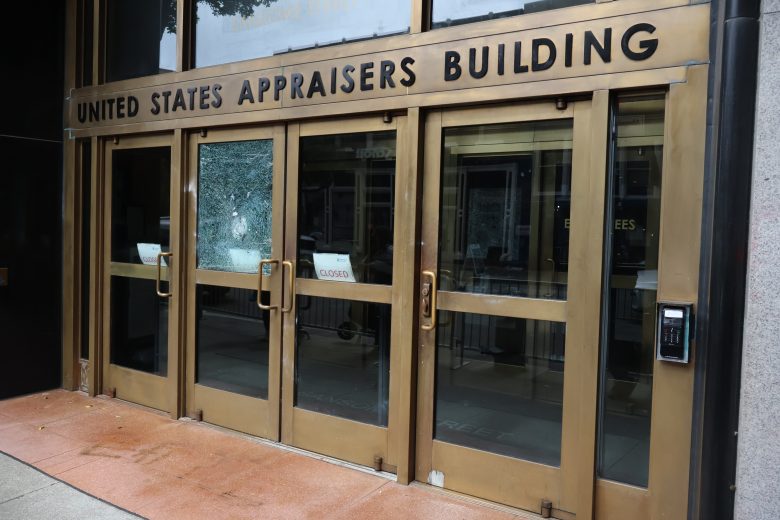

Three asylum-seekers leaving routine court hearings at San Francisco immigration court Thursday morning were arrested by Immigration and Customs Enforcement officers, including one man who a judge had just said might be mentally impaired.
They’re the latest in a series of ICE actions, where more than 30 immigrants have been arrested by federal agents while leaving San Francisco immigration court at 100 Montgomery St., or at 630 Sansome St., which also has an ICE field office.
This morning’s arrests were at 630 Sansome St.
After the Department of Homeland Security attorney on Thursday moved to dismiss the case of the man, a strategy which federal attorneys have recently been using to make asylum-seekers easier to remove, immigration judge Patrick O’Brien raised doubts over his mental ability, saying, “it’s obvious to me that there are competency issues.”
The man — who was only fluent in Mam, a Mayan language primarily spoken in Guatemala — had been muttering to himself throughout the morning, O’Brien said.
Later in court, the man was unable to tell O’Brien his address.
O’Brien even asked the man at one point if he was on medication.
There appear to be competency issues beyond just a language barrier, O’Brien said. (After a few hours of requesting one, the court had been able to find a remote Mam interpreter to help with the man’s hearing.)
O’Brien then proceeded to ask the Department of Homeland Security attorney for a continuance of the case, rather than a dismissal, due to the man’s possible mental incompetence. The man needed time to find a lawyer and other support, O’Brien said.
“He’s clearly not understanding the questions,” O’Brien said. “Is this someone the department really wants to move to dismiss a motion to appear on?”
The DHS attorney agreed and allowed for a continuance of the case, which essentially means the man will come back for another hearing in a few months. The DHS attorney said she could “renew” the motion to dismiss another time.
But as the man left the hearing room, Mission Local observed about five ICE officers stopping the man and then leading him out a side door.
The man’s arrest was the third over the course of three hours Thursday morning.
Earlier that morning, the DHS moved to dismiss two other cases, both of women who appeared in court alone.
In both cases, the DHS attorney said what has become a standard script in recent months: “Circumstances have changed” since the women were first told to appear in court.
When DHS moves to dismiss cases, it does so with the goal of placing asylum seekers in a process called expedited removal, which can fast-track them out of the country without appearing before a judge again.
Judges in San Francisco rarely immediately grant those motions. On Thursday, O’Brien told the women he would give them time to respond to the motion. He would not rule on it that day.
However, as would happen to the potentially impaired man later that morning, and has happened routinely in recent weeks, both women were arrested directly following their hearings anyway.
In court, O’Brien appeared to try to prepare the women for a possible arrest.
“I am pretty sure you won’t be coming back to my court,” he said. He also urged them to get a lawyer as soon as possible.
Both women were at first confused. “How am I supposed to respond to this motion if I don’t understand it?” one asked, in Spanish, through an interpreter. They quickly became terrified. Both started crying as they asked O’Brien questions at the front of the courtroom.
The same woman said that she wanted a chance to explain to the judge why she came to the United States, and why she was afraid to return to her home country.
“We’re not going to do that today,” O’Brien said.
The moment the women walked out of the courtroom into a hallway, Mission Local observed ICE officers arresting them. The officers ordered them to turn around and face the wall, then handcuffed them.
Over the course of the morning, Mission Local asked two ICE officers for their badge numbers. They refused to provide them.
After arrest, asylum seekers are typically taken two floors up from the immigration courtroom to a temporary detention and processing center on the sixth floor of 630 Sansome St.
After a couple of hours, they are generally then placed into long-term detention at one of the for-profit private prison detention centers elsewhere in California, or the country.
At most public hearings, attorneys for the Bar Association of San Francisco are present under the “Attorney of the Day Program.” They provide legal support to asylum-seekers and transmit information to the Rapid Response Network, allowing for attorneys to be dispatched to support the immigrants placed into detention.
They also warn those asylum seekers who have cases that DHS moved to dismiss that they might be detained.
But Thursday morning, no attorneys were present. As a result, none of the arrests can be independently confirmed. According to Milli Atkinson, who runs the program, immigration support services “are working backwards from limited info we have.”
Soon after the women’s arrest, the courtroom returned to business as normal. Classical music played over a speakerphone while the judge sat on hold for a remote interpreter.
Moments later, he heard the case of a family of four: Two parents, a toddler and a baby. The four of them had been scammed by a lawyer so were still unrepresented, they said. They had driven from their new home in Oregon for the hearing. O’Brien was apologetic for both.
“I appreciate you folks making it on time, with two young children as well,” he said, then filed paperwork to move their case to a court nearer their new home.
As of noon, ICE officers were still hovering in the hallway outside the immigration court. Public court hearings had ended for the day.
People who are targeted for severe mistreatment – not discrimination, not bullying – by the government or people the government allows to persecute those people, CAN qualify for asylum. The Inter-American Commission on Human Rights has tried to get the Guatemalan government to stop sexual and physical abuse of people with mental illness. By “abuse” I mean indefinite institutionalization, lack of informed consent, inadequate medical care, systematic physical and sexual violence, and impunity for abusers. People who could live normally with medication – working, paying taxes, etc. – instead get locked up and abused, sometimes in solitary confinement, for life.
Under US law, this guy has the right to present the facts of his case. He’ll need a lawyer and mental health treatment, but I bet he has a decent case.
https://oneill.law.georgetown.edu/press/inter-american-court-to-hear-case-on-human-rights-violations-at-guatemalas-federico-mora-hospital-to-inter-american-court/#:~:text=The%20case%20began%20in%202012,with%20disabilities%20across%20the%20region.
Wow, I had tears running down my face from the unmitigated cruelty displayed by our government reading this article. And then I read the comments of two compassionless racists that made me outraged. I could spend another 10 minutes in this comment arguing about immigration law and policy. But I won’t. Instead I’ll finish with a quote:
First they came for the Communists
And I did not speak out
Because I was not a Communist
Then they came for the Socialists
And I did not speak out
Because I was not a Socialist
Then they came for the trade unionists
And I did not speak out
Because I was not a trade unionist
Then they came for the Jews
And I did not speak out
Because I was not a Jew
Then they came for me
And there was no one left
To speak out for me
Again, where the hell is the mayor? He’s supposed to represent our sanctuary city.
I am not sure that being mentally ill gives you immunity from the purely factual issue of whether or not you are in the US legally.
If he is in fact mentally ill, then we definitely don’t want him in the USA…He’ll likely be a drain on our society.