

On Tuesday morning, one asylum seeker in San Francisco made a drastic choice.
He was so afraid of being detained by the immigration agents who have been routinely waiting to arrest immigrants after their court hearings that he withdrew his application for asylum.
By the time he appeared at immigration court at 100 Montgomery St. to tell the judge overseeing his case about his decision, the man already had a plane ticket to leave the United States. His nationality was unclear.
“My friends got detained, and my family needs me,” the man told Judge Arwen Swink in Spanish through an interpreter. He said he just wanted time to sell his belongings and his car before leaving.
He had originally sought asylum, he told Swink, because someone threatened to kill him. But that was now a secondary fear of ending up in the custody of Immigration and Customs Enforcement. “This is not the situation that I had dreamed of,” the man said.
Immigration advocates have in recent months feared that the Trump administration’s mass detentions and deportations are discouraging people with asylum claims from continuing with the process.
Since the end of May, ICE agents have regularly arrested people after routine court hearings or check-ins at San Francisco’s immigration court or its ICE field office, at 630 Sansome St.
In court today, that fear was clear. The man who decided to withdraw his application for asylum asked Swink if he needed multiple copies of his signed order to keep ICE agents from arresting him. In the back row of the courtroom, family members of a different asylum seeker had tears streaming down their faces.
At one point, Swink asked the Department of Homeland Security attorney present whether ICE agents were waiting in the hallway. It was only when the attorney said no that some attendees in court got up and left the courtroom, when the judge called for a break midway through the morning’s hearings.
“We are seeing widespread fear of being detained by community members with no criminal history who have upcoming court hearings,” said Milli Atkinson, an immigration specialist with the Bar Association of San Francisco.
Atkinson runs the Attorney of the Day program, which coordinates attorneys to attend court hearings to give free legal advice to asylum-seekers.
“We have seen more and more individuals with strong claims for asylum choosing to abandon their applications rather than risk being held in detention for months or years while their cases are processed through the court system,” she said.
Swink did the due diligence of checking whether the asylum-seeker who asked to leave the country Tuesday was being pressured to stop the process. It is legal under international law for those who have a credible fear of persecution in their home countries to seek asylum elsewhere, including in the United States.
“I just want to confirm you’re under no duress or undue pressure to withdraw your application for asylum,” Judge Swink said to him.
“No,” he responded, through the interpreter. The man had not been deported from the United States before, and had never been arrested or convicted of a crime in the United States or any other country, he said. His fear, he said, was singular: “I don’t want to be detained by ICE.”
Swink then granted his request for voluntary departure.
“Thank you for the opportunity to be in this country,” the man said.
“Very gracious, sir, thank you,” the judge said in response.
Over the course of three and a half hours Tuesday morning, two other people told the judge they were also afraid of arrest and detention.
One asylum-seeker had a final hearing date set for 2029, but said he was afraid to be deported in the interim. Swink could only coax the Department of Homeland Security attorney, Lauren Black, to say that “at this moment” there was no indication he would be targeted.
The mother of an adult son, who had his first asylum hearing in court that morning, said through an interpreter she was similarly “very concerned and scared” as she sat by his side in court. The DHS attorney had a similar response: “At this time, my information indicates that there are not concerns.”
Swink was apologetic throughout. In response to the asylum-seeker’s fears that he would be arrested before his 2029 hearing, Swink said: “I wish I was a higher-up decision-maker and could affect those decisions.”
Fear of arrest after court hearings has prompted some asylum-seekers to appear virtually instead. One person did so Tuesday morning. She gave two reasons for the remote appearance: Caring for a young relative, and fear of coming to court.
Black, the Homeland Security attorney, initially pushed to require the asylum-seeker to appear in person at future hearings. But Swink pushed back, citing the “temperature in court” and “the terror” that the court sees in respondents.
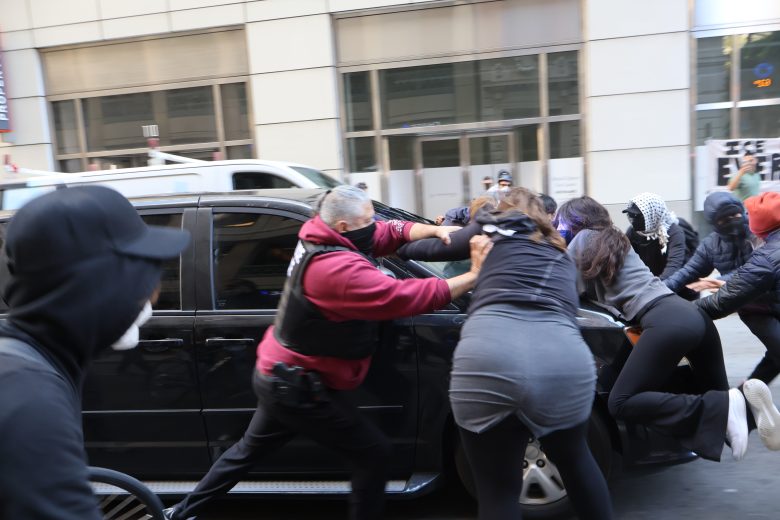
On July 8, following hearings that morning, conflict heated up between ICE agents and protesters outside of the courthouse, resulting in one protester injured and an ICE agent brandishing his rifle at protesters and a Mission Local journalist.
Swink appeared to refer to that in court: “There was a violent encounter,” Swink said, that left court staff “shaking and in tears.”
Black ultimately acceded, but said the remote hearing was granted because of the asylum-seeker’s caregiving responsibilities, not the fear of coming to court.
Mission Local did not see ICE agents at court at 100 Montgomery St. on Tuesday morning, and Atkinson, who tracks arrests at San Francisco’s courts, said she did not get reports of arrests either.
The most recent arrests that Mission Local has confirmed at a court in San Francisco were Thursday, outside a courtroom at the ICE field office, at 630 Sansome St.
In a separate case Tuesday, another asylum-seeker missed his court appearance after asking to attend remotely. Swink did not order him removed from the country, though Swink was entitled to do so. Instead, Swink gave the asylum-seeker another chance to attend, and granted him permission to appear remotely.
1936 Germany. Wake up America. It was not taught in schools so go to the libraries and check out what was going on in 1936 while the libraries still have books or are still open. I also think we should give back the Statue of Liberty to France since it is no longer relevant. “Give me your poor, your tired” has been replaced with “Give me your money or your cryptocurrency”.
No other nation tolerates blatant violations of it’s immigration laws. It’s insane that people expect the US to simply allow violations without ramifications.
Play stupid games, win stupid prizes.