

You can see all our coverage of 16th and Mission streets here.
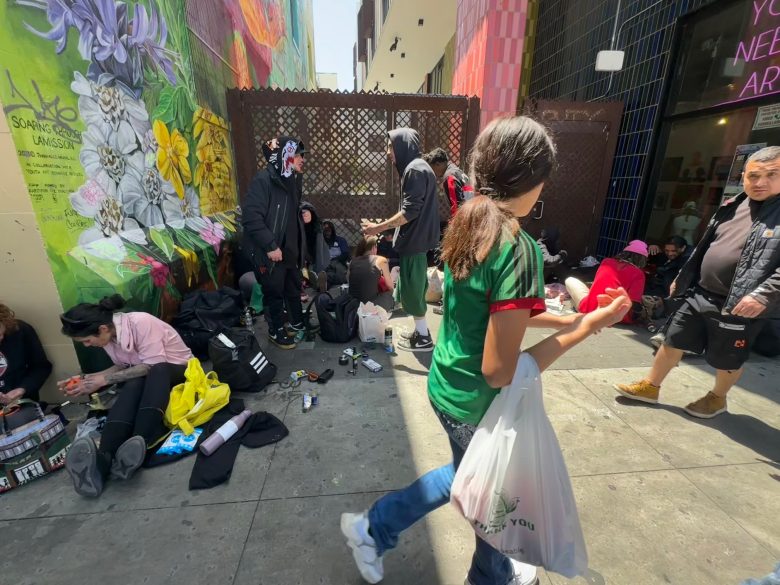
In the photograph, the young girl wears a soccer jersey, her face partially obscured because she is turning to look at the Sunday afternoon scene on Mission Street: What she sees are some 14 men and women hanging out, slumped over or openly using drugs.
The characters she is looking at are parked in front of La Fenix, a four-year-old housing development with 157 units filled with families and children. It is not a scene unique to one building. On weekends and often during the week, men and women, bent over glass pipes or foil, sit on the Mission Street sidewalk between 16th and 15th streets, often nearly as far as 14th Street.
Such scenes have persisted for most of the 100 days that began with Mayor Daniel Lurie announcing in early March that he sees what we see.
“I’m seeing what our children have to see on their way to and from school every single day,” he said in a video filmed at the corner of 16th and Mission streets. “That’s unacceptable.”
And it is. It’s infuriating. It no doubt infuriates the mayor, who appears to regularly visit his operation at 16th and Mission.
And here is the bottom line: It can be different. After Mission Local wrote about a weekend of vending and drug use in early June, Santiago Lerma, the head of the Mission Street Team that is overseeing on-the-ground operations, said the city would be changing strategy.
The following Saturday, the city did just that. Three patrol officers and many more workers from the Department of Public Works arrived on Mission Street and, by mid-afternoon, they had cleared the sidewalk of the dozens of vendors and drug users that had turned up earlier that morning. They did so gently; no confrontations ensued.
For one beautiful day, pedestrians ruled the sidewalk, and Mission Street looked like any other busy commercial corridor near a major transit hub. For one day.
We are now at Day 100 of Mayor Lurie’s efforts that began with great fanfare and the arrival of the white RV-sized Mobile Command Unit Two on the southwest plaza. Since then, Mission Local has been photographing and visiting the plazas and nearby side streets daily.
It has been, perhaps, a fool’s errand, but as an editor, I could think of no other way to actually hold city officials accountable to their promise of cleaning up the plazas and nearby side streets. We needed to see what residents see.
I wrote the daily posts at the start, and again I’ve been out there for the last couple of weeks, simply because I wanted to get my own feel for what change may have transpired. It helps that I live nearby, and 16th Street is my natural Muni and BART stop.
I am by nature an optimist, but the level of open drug use and unpermitted vending of likely stolen goods that continues day after day after day can sap the sunny out of anyone.
Some 34 children under 5, and another 312 under 18 live in the immediate area, according to the 2023 Community Survey. Many other children come to the early education center on Mission Street and Marshall Elementary School at 15th and Capp streets.
What children see on a daily basis is not pleasant. Misery is not confined to the side streets. It is on display on one of the city’s busiest commercial corridors. Even during the week when unpermitted vending is down, I see at least two to three pipes out. On the weekend, the count on one side of Mission Street has been as high as 16.
The mayor would say, “That’s unacceptable.”
Who lives here
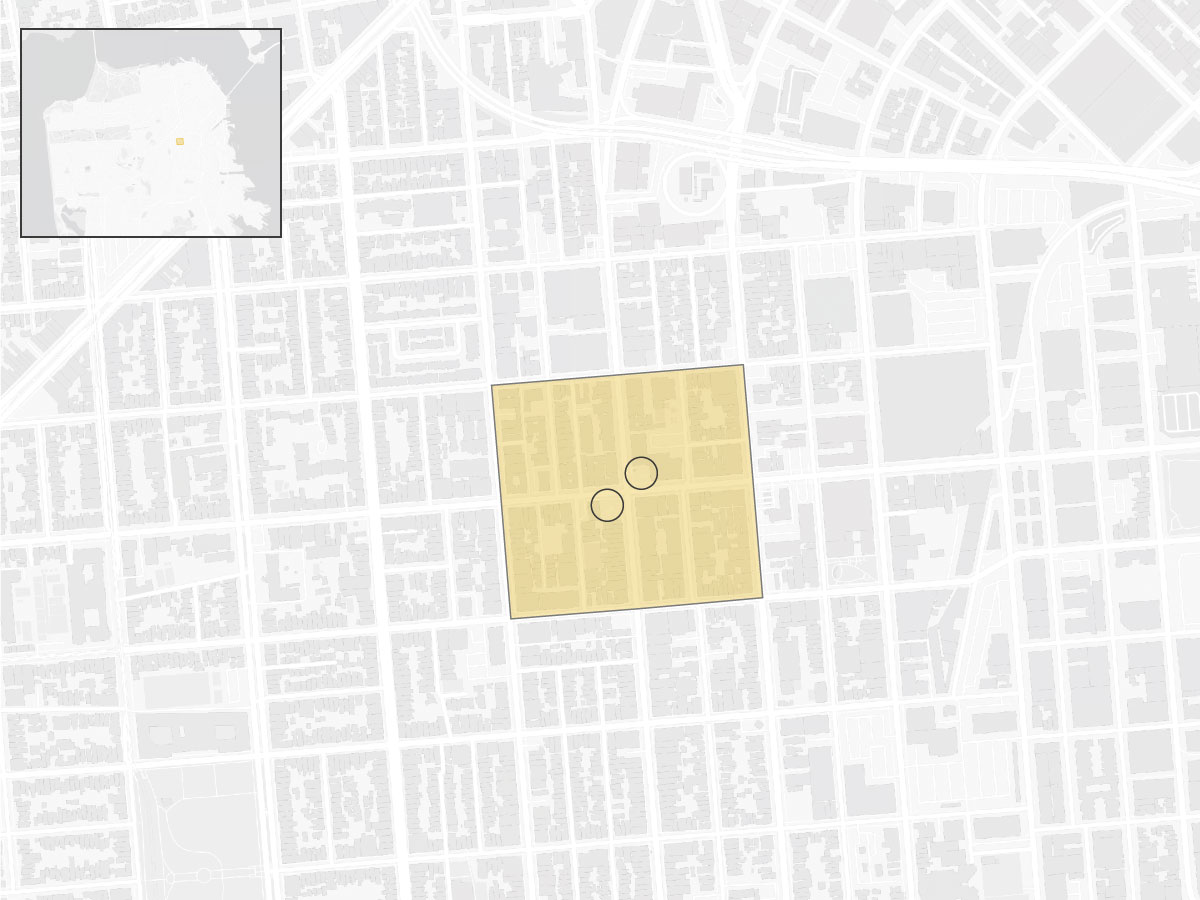
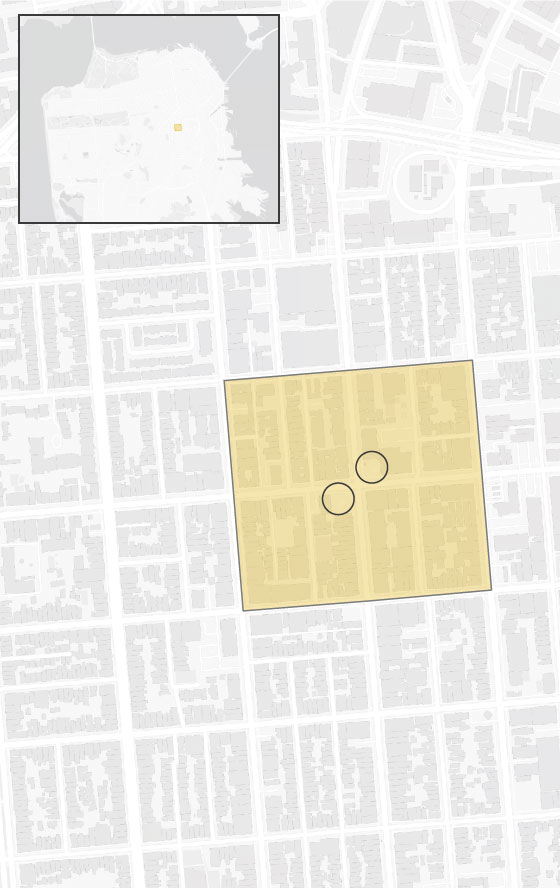
Officially, it is Census Block 201.2, a neat box bordered by Valencia and South Van Ness, and 15th and 17th streets. Overall, the square census block of 3,627 residents is less educated, but has as many residents holding doctorates as the rest of the city. It trends older and poorer, with more renters than owners, and fewer cars than the rest of the city.
Voting turnout in November, 66.4 percent, was well below the citywide turnout of 79 percent. Only 17.9 percent voted for Lurie; almost as many, 15.7 percent, voted for Donald Trump.
Mission St
16th St
BART
plazas
18th St
Mission St
16th St
BART
plazas
18th St
Note: Census tract 201.02 includes areas surrounding the 16th Street BART plazas.
Graphics by Junyao Yang and Xueer Lu. Source: U.S. Census Bureau (2023). American Community Survey 5-year estimates.
How we got here
The intersection of 16th and Mission has always been difficult, and a place where drugs could be found. But the unpermitted weekend vending that grew worse over the last year increasingly includes open drug use, said multiple neighbors.
Paul O’Driscoll, who owns a building at the corner of Mission and 15th streets and has had his office across the street for the last 22 years, knows the history well.
Up until the pandemic, weekend vendors paid a small fee to use the open-air lot on Mission between 14th and 15th streets. With the pandemic, they began to spill out onto the sidewalk, but the vending stayed reasonable, he said.
Then in December 2021, Mayor London Breed declared war on the drug dealing in the Tenderloin and O’Driscoll began to see a different type at the Mission Street market: pods of drug users. They’ve increased in number since the start of the new year and renewed police operations in the Tenderloin and South of Market neighborhoods, he said.
O’Driscoll knows of multiple drug overdoses on Shotwell and Capp streets in the last six weeks. We do, too. A photographer working for Mission Local on Saturday witnessed an overdose at the 16th Street Plaza and a Mission Local reporter watched another overdose unfold Monday on 15th Street. On Wednesday, Day 99, someone died on Wiese Street, slumped against the curb.
Residents ask about a plan
The Mission District police captain, the former police chief, and the mayor have acknowledged the impact of earlier crackdowns in the Tenderloin and SoMa.
The problem for residents is that they see no clear strategy to remedy what the city created.
That lack of clarity leaves residents bewildered. Yes, they see street teams out occasionally, patrol officers occasionally and Public Works out, but once officials leave, and sometimes even while they are nearby, the groups of drug users or unpermitted vendors simply return.
“What are we trying to do here?” asks O’Driscoll. He watches pairs of patrol officers and DPW workers on foot walk right by someone openly using drugs. “I love the Mission, and I have never seen this,” he said. “I don’t understand it. I don’t know what we’re supposed to do.”
He cannot rent out his ground-floor commercial space. To add insult to injury, a city worker recently showed up to take photos of the empty space, and he will possibly be charged a commercial vacancy tax. “How am I supposed to lease this property?” he asks.
City officials have declined to discuss their plan. They point to the Mission Street Team and its collaboration with multiple agencies and police. Who is overseeing the Mission Street Team and the police?
Ask the police, one city official says. The overseer is supposed to be at the Department of Emergency Management, but interviews there cannot be scheduled until after the budget season, says Denny Machuca-Grebe in communications.
Constituents who email the mayor’s office of community affairs receive replies that bear no relation to what the resident is seeing on the ground. In a response to a query this month from one neighbor, Jess from the Office of Community Affairs — there is no last name on the signature, but we have inquired — wrote:
“As noted by the Supervisor’s Office, there is currently a moratorium on unpermitted vending along Mission Street. Enforcement of vending regulations is handled exclusively by San Francisco Public Works. The SFPD works in coordination with Public Works staff and responds to active criminal activity, including drug dealing and drug use.”
What the constituent sees on a daily basis is unpermitted vending and uninterrupted drug use.
To Jess, however, all of this is being taken care of. They write:
“Also, there is already a strategy to address the issues you have described in a targeted zone on the blocks around 16th and Mission with a strong focus on the alleys off of 16th between Valencia and South Van Ness (Weise, Julian, Caledonia and Capp). … All involved agencies remain committed to continuing these efforts on a daily basis to improve public health and safety in the area.”
Granted, we are not in the area for whole days at a time. However, it is infrequent, but always noted, when we see any member of these teams. More importantly, Jess seems to think the issue is under control. That is not what constituents see. That is not what we see.
Nonetheless, it is clear what works to keep open drug use and rampant unpermitted vending at bay. The recent Saturday when sidewalks were clear took three officers. They were on foot, and they were accompanied by a greater number of workers from the Department of Public Works than usual. The latter helped approach the vendors, while others picked up the debris left behind. It worked.
Nearby neighbors whom Mission Local reporter Abigail Vân Neely polled early in the mayor’s efforts agreed that their streets of Caledonia, Wiese and Julian have gotten marginally quieter, but conditions still change hour by hour. Our daily visits show that Caledonia Street made the biggest transformation in mid-April when Mission Housing, which runs the Maria Alicia Apartments, which back onto Caledonia, hired a security guard.
Julian Avenue and Wiese Street have also made some progress. In early June, the Gubbio Project began a patrol of three outreach workers who loop the block bordered by Julian, 15th Street, Caledonia and 16th Street. We have seen them out.
Julian Avenue “started out as a massive mob of drug users, a 24-hour party of fentanyl users,” said one resident. “They were loud and annoying and disturbing. That is now largely gone.”
But if police were to stop driving through the alleys regularly, he predicted, the “mob” that has moved to Mission Street would return.
“I look over Weise Street and they aren’t there right now,” another resident said. “But I see pictures of Mission Street and know they’ve all moved one block over.”
Neighbors understand this is not a solution. “I don’t want them to be here,” one Julian Avenue resident said of the users. “But if all we’re doing is pushing them one block over, it’s punitive and ugly.”
John Andrade, another Julian Avenue resident, suggested officers step out of their cars and get to know people. This, he said, could build the rapport needed to get people into treatment.
Some strategies by the city or property owners have worked to keep crowds at bay:
- The mobile command unit, and generally an unmanned police car, sit on the southwest plaza. It’s easy to make fun of them just sitting there, but it is effective at the plaza. The photos we took leading up to the unit’s arrival illustrated the vending and chaos. That’s gone. It’s a living room for many of the residents of nearby SROs, and it is a clean place for them to sit out and visit.
- Simply parking a police car on the northeast plaza can sometimes be effective. If a police car or officers are there, vendors and drug users often leave. But this is rare, and vending and drug use remain a daily occurrence on and near the northeast plaza.
- Private security guards. In mid-April, Mission Housing posted a private security guard on Caledonia Street. Nowadays, the street is most often clear. Talking to the security guards suggests that it does not take much to keep it that way; just their presence does the job. Ditto for the security guards at the 60 Mission Cabins for formerly homeless residents. It is run by Five Keys in the lot between Mission and Capp streets and 16th and 15th streets.
- Public Works clean-ups. The frequent visits from the Department of Public Works have made a difference on Julian Avenue as well as on Wiese, Capp and Caledonia streets. O’Driscoll, who sees the market debris overflow on 15th Street every Monday, says they need to do the side streets as well on Mondays. The on-the-ground Public Works staff does meticulous work, but again, the amount of debris that quickly accumulates suggests they are not there often enough or passing by in trucks frequently enough.
- Outreach. This is very difficult to judge. Numbers are non-existent. The street teams are out, and it is slow, methodical work to get someone into care. The Gubbio Project is also doing this and reports getting 28 people a month into city-funded substance abuse programs. Outreach and getting homeless residents shelter or permanent housing is the goal, but it is a long game.
It is not fun on Mission Street
The people on the street using drugs or vending stolen goods do not appear to be having a good time. It is not a party on Mission Street, but desperation and misery.
“None of them are in good shape,” says David, who has lived at the Altamont, a single room occupancy hotel at 16th and Wiese streets, for nine years.
Many need help. It’s unclear how many are ready for help. Perhaps more outreach workers getting to know the people on the street would find answers.
In the meantime, residents appear to have little choice but to wait and see how effective the city can be. While Misson Local will no longer do daily posts as a matter of course, we will check in regularly and we will continue to write about the efforts made by the city, residents and business owners.
Thank you to all of the readers, neighbors, city workers and officers who have spoken with us, sent tips, photographs and encouragement. We can’t do our work without your help.
Abigail Vân Neely and Vincent Woo contributed reporting.
Thank you for all of your reporting on this. The situation that families and children are forced to deal with on a daily basis just to get to work and school is, to say the least, incredibly unfair and unsafe. I have been in the neighborhood for almost 30 years and I have never seen 16th & Mission like this. While it sounds like daily updates won’t be happening, please keep up your amazing work of documenting the realities that our working class residents deal with on a daily basis just trying to get by and live their lives.
“I have been in the neighborhood for almost 30 years and I have never seen 16th & Mission like this. ”
^^^ This.
Mayors ordered SFPD to disrupt the scene in the TL that was guaranteed to disperse addicts elsewhere. They were corralled into the North Mission.
Meanwhile, PODER excepted, Supervisor Fielder and the nonprofiteers are playing the guilt trip wurlitzer, woke scolding residents the Marshall Elementary community about their privilege and the compassion that we need to show for the most vulnerable.
Those who demand justice for addicts predicated on injustice for residents, voters and elementary school students play a very risky political game in these recally times.
I don’t understand why felder isn’t focusing on the poor kids who have to navigate this craziness every day. We have to ensure these kids don’t spiral down like the poor souls they see
Thank you, and you’re welcome, and yes, we definitely plan to continue doing updates. If you see things happening that we should know about, please don’t hesitate to send an email to lydia.chavez@missionlocal.com. The input from residents has been really helpful. Best, Lydia
Since the new mayor made this a priority during his campaign, it’s important to hold the administration accountable for this. Thank you for the reporting.
The new supervisor is completely absent from this story though. As the representative for D9, shouldn’t Sup. Fielder be working on this everyday? Is she visiting these sites too? What is her take on the current strategy and suggestions for better approaches? Is she receiving this feedback directly, or just reading it here like the rest of us? This must be #1 on her list for constituent services.
Progressive Supervisor Fielder has no strategy, except provide more and more money and a lot of compassion/prayer to drug addicts and criminals.
Great writeup. As annoying the spreads of obviously stolen goods on the sidewalks has become, in my eyes, priority needs to be given to pushing back on the miserable drug situation. No more “addressing”, things need to get fixed. With a glance over to parts of the T’loin, where’s it’s been like this for eons, you’d think there’s no denying that we’re way past the point of us listening to the same old narrative of how we’re supposed to be waiting for addicts to get ready for detox.
Where are the drugs coming from, get rid of them & the users along with it.
Prosecute every vendor until they are all gone.
RESIDENTS ARE GOD DAMN SICK OF THESE CONDITIONS.
And forget Jackie Fielder, what a useless, inept supervisor who cares more about keeping the status quo.
Yeah we all know how that war on drugs works. Drivers the problem every time and isn’t a complete waste of time and resources just like the wars of security in the middle east we’re barrelling into again \s
But seriously, how can people ever believe it makes more sense to invest in pain and suffering instead of food, shelter, and human dignity?
Every city has their own 16th and Mission. They all strive to “fix” it, and really almost none have had success, but I really believe that 99% of the fixes are simply political showmanship and the press takes some pictures the same day and then walks away. I seriously appreciate this ongoing review of the process (which is what got me to donate to MissionLocal). I think it’s critical for people to see that “more cops” doesn’t just fix the problem, but may move it around a bit, and that it’s really not a good long-term solution at all. However, perhaps making it more difficult to buy drugs, more difficult to sell shoplifted goods, more difficult to find a place to DO drugs, perhaps that works? Who the heck knows? But I think this series of articles will teach us more than statistics.
There aren’t “more cops”.
Evidently it’s not possible to even have two “on foot somewhere”.
According to today’s ML interview with Mission Capt. Liza Johansen:
“If I have two officers on foot somewhere, and then a call comes out of a violent crime in another part of the district, they need to run or walk to their car to get out there.”
Yo, Capt., that “somewhere” is Mission Street between 16th and 14th.
And, not surprisingly, we must take into deep consideration the tender feelings of a significant segment of our citizenry “who might not want to see more cops out there”.
Lurie might as well hoist the Mission Accomplished (I guess that’s a double entendre) banner and call it a day cause it ain’t gonna get better with the Capt. actually taking into consideration that cops may need to keep a low profile so as not to upset folks.
Just for the record the correct answer regarding “community policing” is …
San Francisco Patrol Special Police.
But that’s not possible because the Police Union is firmly against the idea.
the old Walgreens side was brutal yesterday afternoon, looked like UN Plaza six months ago.
Let’s not lose sight of reality: all this chaos is perpetuated by maybe a few hundred degenerate people who would be themselves healthier and less of a nuisance in a locked facilities.
Thanks for reporting
The city really has lost control to the drug dealers and addicts.
It is a beyond a crisis .
I would call it “ mass murders on the lose”
The drug dealers are freely and openly selling lethal poisons to impaired persons .
This is so sad , scary and inhumane ,
Why are persons not out in large numbers ptotesting and demanding this be addressed .
This is impacting and ruining and harming all.
Come on SF show that you are concerned and care.
This city and its residents have a learned helplessness going on
Weird how people just walk by addicts openly using drugs ,and bodies on the sidewalk.
People are busy propping up the vile theocratic regime in Gaza…..
Thank you Mission Local staff for 100 days of consistent journalism. I was recently reminded how important it is just to document what is happening on the streets each day and it made me think of your reporting. I’m proud to support you every month and I’m grateful for your independent, data driven journalism.
What? 18 children? There are hundreds living right around where we live near the BART station. The Marshall elementary school is across the street from us. There are many more than 18 here. Most people don’t report their demographics, especially these days with cruel indiscriminate roundups. Don’t know where you get your stats? You need to dive deeper. Come out and announce when you’ll be here , and long term residents and school parents can tell you the reality.
Things improve on one block by the police RV.
Parents their children nor anyone should have to continue this urban decay. It looks like a third world country. The Mission is a great district and enough is enough!
I mean we have tried. We tried services. We tried needlessly exchanges. We tried housing. We tried shelters. We tried laws and orders. At this point the only course of action left is to involuntarily detain and ship the druggies to Tule Lake Internment Camp and leave them there to figure it out. Anyone assisting them in any capacity, including providing food water or blankets will be arrested and imprisoned for a mandatory minimum 5 years. We are LONG past the point of caring about others privileges when it infringes on our rights to a safe clean living city. If these antisocial degenerates want to be a mess and mooch, they can do it at a concentration camp set up for their arrival.
You’re kidding, right?
We haven’t tried shit. Billionaires remodel their houses for the 50th time so their kids 4000 sqft game room can be 10ft to the left while we consider smashing people into congregate housing and 200sqft “junior ADU” coffins “trying everything”. It’s embarrassing. We are the richest country to have ever existed and we can’t even end food insecurity.
If attempts to solve these problems just move them to a different location, maybe there’s a way to move them into Fresno?
“It’s infuriating. It no doubt infuriates the mayor, who appears to regularly visit his operation at 16th and Mission.”
Does he? I’ve been reading your dailies and non of them have mentioned a visit from the mayor for like the last two months. When was the last time he was actually there? It appears to me he has fully moved on.
On June 15, someone mentioned that he had seen the mayor earlier in the week. So, he has been there fairly recently. On other occasions, people we interview randomly mention having seen the mayor. Best, Lydia
Is anyone gonna tell Lurie that there’s more to governing that just being a relentless optimistic booster?
We have an SFPD that refuses to enforce the California Vehicle Code towards Vision Zero and which likes to get paid lobbing relatively harmless fentanyl addicts back and forth between the Mission and Tenderloin.
Was in Union Square yesterday, and the ground floor retail vacancies remain positively Breedian, Lurie’s relentless sunny optimistic boosterism notwithstanding. It is going to get really ugly with Lurie once boosterism is revealed to be ineffective.
Meanwhile, Marshall Elementary, with students who are more likely to be migrants, kids of color and homeless, is held as a magnet for the city’s undesirables.
Tell us again all how intersectionality and centering the lived experience of the most vulnerable does not apply to our local elementary because addicts have it worse.
Thank you for your continued coverage of conditions at 16th and Mission. As someone who lives near the Tenderloin, I’ve watched these issues unfold not just over the past 100 days, but over the past five years — largely ignored by city leaders and the broader public.
For years after the pandemic, the Tenderloin became a containment zone for open-air drug use, stolen goods markets, sidewalk blockages, and deteriorating public safety. Children couldn’t safely go to parks, sidewalks were impassable, and longtime residents and small businesses, including members of the Vietnamese community, were pushed out. City leaders and many progressives dismissed the growing crisis as simply part of the neighborhood’s “gritty” identity, defending harm reduction policies without addressing the consequences for those of us who live here.
Now that these same problems are spilling into the Mission, a more affluent and politically active area, the city seems to be paying attention. Suddenly, what was once “acceptable” in the Tenderloin is being called what it always was: unacceptable.
The article rightly points out that the problem is not being solved, it’s being displaced. Without real accountability, enforcement, or a long-term plan, the chaos simply shifts from alley to alley, neighborhood to neighborhood. It shouldn’t take the discomfort of wealthier residents to provoke action. We needed this level of urgency and compassion years ago, when vulnerable communities were being hollowed out.
I empathize with Mission residents now facing what we in the Tenderloin have endured for years. Maybe now that the problem is visible to more powerful eyes, the city will find the political will to take lawful, balanced, and sustained action. We need real outreach, real services, and real enforcement, not just temporary cleanups and vague reassurances.
Residents of the North Mission are “wealthy” in your prejudiced fantasies. North Mission residents are organizable even with the nonprofits trying to keep a lid on things while the TL is locked down tight by the nonprofits and residents less inclined to organize.
Wealth has nothing to do with it.
16th and Mission area has been concentration zone for 30 years plus. The SROs are the common denominator with the TL.
The best thing about this project is that it has exposed an extremely far-left journalistic organization to the reality of what happens when you don’t use police, and instead try to address the situation with either social services or neglect.
The only way to fix this is to arrest drug dealers and users and illegal vendors and take them to jail, but no one wants to do it. It’ll never change until you actually arrest people and get them off the street.
It’s true that the TL has been just the worst for decades now. I remember my parents trying their hardest to get us out of that violent druggie hell when I was a kid. Fast forward a couple decades and it feels like all of that just caught up with me at 16th and Mission. So who should keep moving around the city, me or the city’s drug crime problem?
Get over it woman! This is San Francisco, not Beverly Hills.
What does the Mission hate more – aggressive policing or out of control drug users? I guess we’ll find out.
Typically, problems occur, and when the complaints come in, the police get aggressive, pushed by the politicians, until then the complaints become about overzealous police. Rinse, lather, repeat.
I’m not so sure the current strategy actually works. Shuffling people along is maybe a quick fix, but it doesn’t address the real social issues underlying the problem. Criminalizing and essentially terrorizing those on the sidewalk doesn’t speak to me as a remedy. They will either come back or relocate. Because of the TL and SOMA policies the mission saw an increase of the activity. I remember there used to be more harm reduction and support groups as well as activities drug users could participate in as well as get a little money for their own. If we don’t ty to show and teach the people how to be productive and at least responsible for their trash or feel like they are a part of a larger community, they won’t respect or care about what they do or where they do it. A better strategy needs to be created that helps everyone not just the financially fluent.