


Mayor Daniel Lurie will unveil San Francisco’s budget proposal for the next two fiscal years by June 1.
This year, that stands to be an arduous task: Lurie must work to close a two-year $781.5 million projected deficit (which is due, in part, to lower tax revenue, and increasing costs associated with salaries and benefits), and at the same time, the city must prepare for potential federal funding cuts that pay for essential city services like healthcare, housing and food stamps.
But the mayor has little wiggle room.
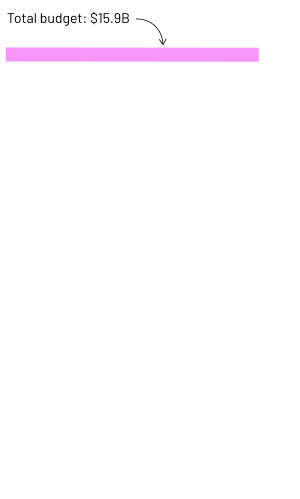
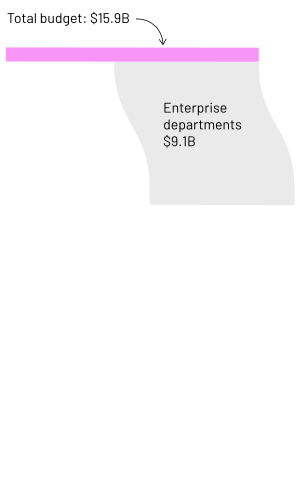
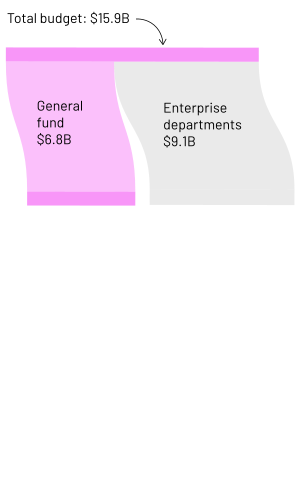
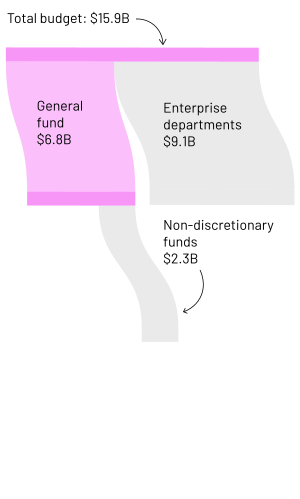
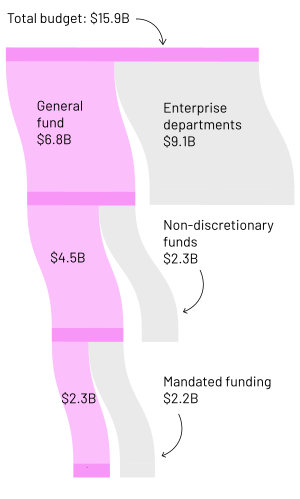
San Francisco's overall budget for 2024-2025 is $15.9 billion.
Out of that $15.9 billion, $9.1 billion is income from “enterprise
departments,” which include the SFMTA, the PUC, the airport and the port.
Those departments generate their own revenue and generally keep that revenue (some also contribute to the general fund).
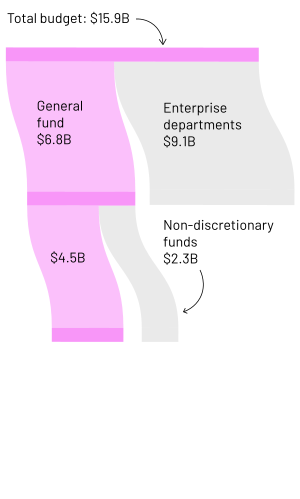
The remaining $6.8 billion goes into the "general fund," essentially a vast pool of money that pays for most day-to-day city operations. That includes all other city departments, and administrative costs.
$2.3 billion of the general fund is earmarked for specific programs such as Medicaid, and CalFresh.
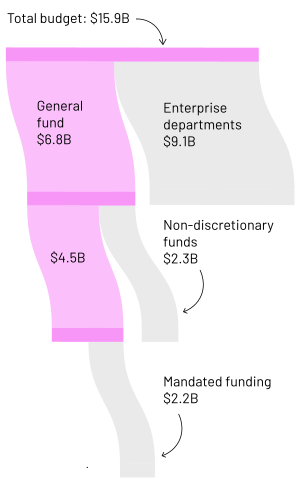
That leaves $4.5 billion in the general fund.
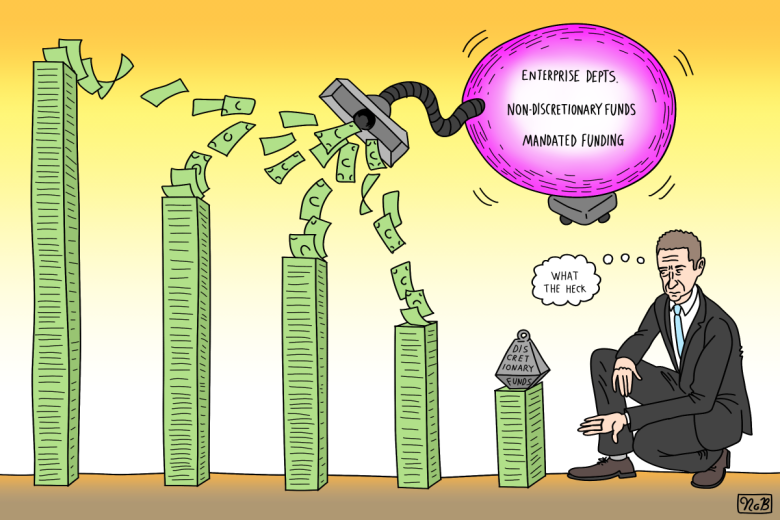
But out of that $4.5 billion, another $2.2 billion is baked into the budget, largely because of voter mandates such as one that sets aside gross receipts tax revenue to fund homelessness services, or another that allocates discretionary fund revenue to fund the public libraries.
That leaves the mayor with $2.3 billion in discretionary funds, or about 15 percent of the overall budget.
On Friday, Mayor Lurie unveiled his budget proposal, an indication of how he will allocate those discretionary funds.
The proposal includes sparing cuts for departments related to his key priorities: public safety, clean streets. That includes the Police Department and the District Attorney’s Office and the Public Defender’s Office. Meanwhile, some 100 city workers will be laid off, and $100 million in nonprofit spending will be cut.
Methodology
Chart by Kelly Waldron. Data provided by the Controller’s Office. The chart includes data based on the Annual Appropriation Ordinance (the city’s budget) for the 2024-2025 fiscal year. To see how that compares to previous years, check out our previous budget coverage.
This post was updated with new information regarding the mayor’s 2025-2027 budget proposal.
Mr. Mayor,
I can save you 23 million with two simple moves and one will kill two birds with one stone but don’t put it thataway in the Budget cause it’s violent.
1. Cancel the Trash Can contract for just over 15 million dollars.
I work with the City’s cans and gutters several hours daily and the old ones are fine and I mean, the older and simpler the better with preference being the concrete caves with the plastic liner.
2. Fold the SF Rec and Park Ranger unit of 56 officers (9 women) into SFPD.
I also have worked with lots of the rangers and they’re ready for some kind of Lateral Transfer that will keep them right where they are and you can say:
Lurie finds 56 new cops hiding in Plain Sight !!
go Niners !!
h.
Of course police budgets will remain untouched. You can always count on American politicians to glaze up the military and the police. Teachers: “fuck em”. Literally every other walk of life: “get a real job”.
But police? Here, have another overtime shift, on us.
Love this breakdown, very helpful with seeing the different types of ‘money’ within the budget. Could you give more clarification on what an Enterprise Department is? Right now, the implication is that they don’t receive their money from city taxes but instead fees or other revenue sources like advertising, but it’s unclear if that’s just a portion of a department’s budget or their entire budget. You cite SFMTA as an example but within their own budget presentation they claim to get roughly a 1/3rd of their budget from the general fund. I think your intention was to illustrate that a significant amount of the city’s budget is raised by department’s themselves rather than through direct taxes, but I think it would be helpful to clarify that SFMTA, Airport, etc. are still getting money from the general fund, because right now it comes across that the mayor can’t touch their budgets. The chart is focused on the types of money in the budget, but I think it would be very useful to see how those types of money are spread across different departments