


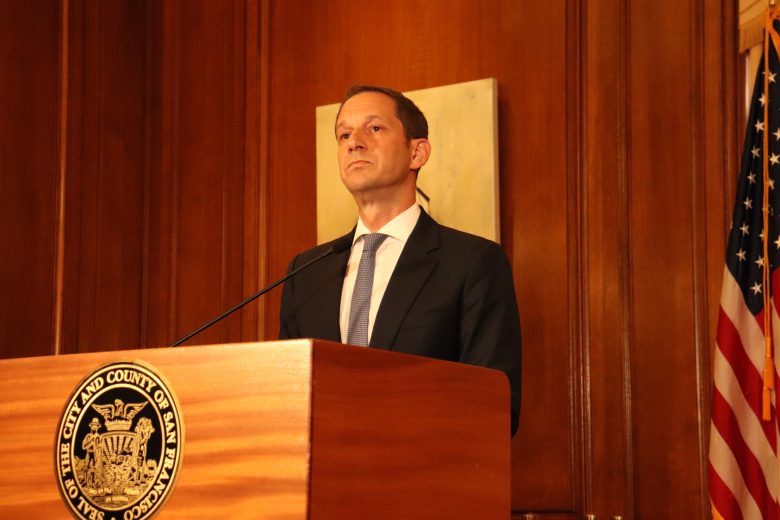

Mayor Daniel Lurie unveiled his long-awaited San Francisco budget proposal on Friday.
The two-year proposed budget preserves (and in some cases, increases) funding for departments core to Lurie’s priorities of public safety and clean streets, while eliminating costs in an attempt to target the city’s eye-watering $782 million two-year deficit. (Both this figure and an older deficit figure of $817.5 million were used in documents accompanying Lurie’s announcement today)
The proposal allocates $15.9 billion for the upcoming 2025-2026 fiscal year (the same amount as the 2024-2025 budget), and $16.3 billion for the following year.
While Lurie said that “the era of soaring budgets is over,” his $15.9 billion budget is actually $400 million higher than the fiscal 2025-2026 version submitted by Mayor London Breed in May 2024.
Funding will be maintained for the following departments:
- Police
- Sheriff
- Fire
- District Attorney
- Public Defender
- Emergency Management
In addition, Juvenile Probation and Adult Probation departments will be spared cuts, funding for street cleaning will be maintained and services providing legal support for LGBTQ+ and immigrant communities will also be preserved.
Meanwhile, Lurie is taking the scalpel to other departments citywide:
- 1,400 positions will be eliminated, of which about 1,300 are vacant due to a January hiring freeze and this city’s longstanding inability to onboard people expediently. Approximately 100 people will be laid off. Seventeen departments will be affected; Mission Local has heard of heavy cuts on the Office of Economic and Workforce Development and Department of Emergency Management. There are, incidentally, approximately 3,000 vacant general fund positions in San Francisco, down from nearly 5,000 in 2023. The mayor’s office confirmed that it is losing vacant positions, like other departments — but its budget has grown. The Mayor’s Office of Housing and Community Development, housed in the mayor’s office, however, will face cuts.
- Nonprofit contracting will be cut by $200 million over two years. It is not yet clear which nonprofits or focus areas will be affected; the city outsources many services to nonprofits including homelessness services, legal aid services, and arts and cultural programming.
- Lurie added that his office is “taking major steps towards ending the use of one-time funds for ongoing expenses,” a move out of Budgeting 101. The mayor’s office confirmed the use of at least $40 million in one-time reserves being used in the present budget, but listed other expenditures without disclosing a dollar cost. It did not answer questions about if projects have been altered or abandoned. The use of one-time funds for ongoing expenditures has long been a source of contention: Ben Rosenfield, the former city controller and, later, an advisor to Lurie, in a 2023 revenue letter lamented the city’s reliance on one-time funds to cover operating costs.
- The budget sets aside $400 million in anticipation of federal cuts. This week, the feds informed San Francisco that, in addition to stiffing the city some $267 million in FEMA funds, it will attempt to claw back some $141 million already provided to San Francisco.
Lurie is hoping to reallocate funds amassed via Prop. C of 2018, a gross receipts tax that funds homeless and housing services. Past Boards of Supervisors rebuffed Mayor London Breed’s efforts to do this, but did consent in 2024 to allow reallocation of some $14 million in interest. With a new and more pliant Board, however, Lurie could obtain the necessary eight votes to reallocate far greater sums.
In his remarks this morning, Mayor Lurie recognized that addressing the city’s growing deficit does not go without making difficult decisions.
“We must face the historic $817.5 million budget deficit that we inherited head-on,” Lurie said. “A budget crisis of this magnitude means we cannot avoid painful decisions, but we are acting with great intention to double down on core services that enhance quality of life for all San Franciscans, make our neighborhoods vibrant, and drive our economic vitality.”
This article will continue to be updated as more details are obtained.
Thanks for the article, and your critical eye, and even though you say “its not yet clear…”, it doesn’t answer important questions like for example, what will be cut from from these departments, like MOHCD? How will theProp C funds be siphoned from housing and be applied? What can we do about these cuts? Where does labor stand on all this?
Today I received this from Bay Resistance:
“The People’s Budget Coalition is a grassroots movement comprised of over 100 local organizations demanding an SF budget that funds care, housing, language access, food, healing, and more in this year’s budget.
Meeting this Sunday, Budget 101: What’s Really Going On
Sunday, June 1, 2025
5:30–7:00 PM”
Zoom – Register here
Also, there will be a rally in support of the People’s Budget on the steps of City Hall Wednesday, June 4, at noon. Demands include opposing $90 million of additional police overtime, pressuring Airbnb to drop its lawsuit against paying its taxes, demanding a city wealth tax, and supporting public arts funding.
Police and Sheriff budget should not be increased until policies are put in place to restrict overtime. Traffic control & local beat officers do not deserve to be making $200,000+ annually
DOGEer, he must be a republican. Just wait until it take you have a day to get a parking permit and the park and rec garbage cans don’t get emptied because there is no one to do it.
Rey, what do you propose cutting if it were up to you? Or are you just acting like Jackie Fielder and complaining without providing solutions?
Speak up yourself or stfu with the dumb rhetoricals.
Welcome to SF under the New Oligarchy…
These comments are pretty bleak. Not usually this level of Fox News inspired talking points. Would love to see a budget that actually hired people in the right places. Instead just spend more money pretending to treat the symptoms and none of the underlying issues. I do like the recommendation of a wealth tax. Meanwhile all the billionaires are pretending to be our benevolent gods by throwing us crumbs in the form of tax deductible donations which amount to pennies compared to what the rest of us pay in taxes. Not to mention that they take up an inordinate amount of city services through high needs requests to their buddies at City Hall. Highest number of billionaires per capita in this city and we still can’t solve child hunger or provide quality public education.
Thanks for reporting
Will be interesting to see if those who get paid at nonprofits truely care once the funds dry up?
Also if anything changes ?
So far , never see even one nonprofit on the streets helping where we live .
Would like to see how much has gone to each and every nonprofit . Where every penny went?
Usually the majority goes to salaries .
The nonprofit industry really has shattered its own image .
If they truely care then they should volunteer during budget crisis .
After working elsewhere , will see how altruistic people are ?
We all take paycuts and work more hours when times are tough .
Thanks for reporting .
If the city doesnt have the money coming in they cannot be giving it out .
Something never discussed is why the city is still promoting restoring the neighborhoods where crimes remain out of control.
The unhoused caravans and drug dens are still on Lower Polk / Larkin.
The Tenderloin still is out of control.
Where are the jobs in this city ?
No one can or wants to open a business if they are getting robbed and vandalized all day .
People avoid areas where the illegal activity continues .
If no jobs then the city should help send these persons to other cities/towns where housing is possible and they can find a job.
That would be cheaper then the costs to house them here with no chance for work.
Due to police shortages , the city should hire private security companies with advanced training to help get this city under control.
What should be cut?
1. Building and planning staff, with simplified permitting, and less regulation. Cut 2/30f the department
2. City commissions
3. Parking enforcement, and overmetering
4. Homeless services.
5. Stop using city money to pay for $1m/unit “low income” housing.
The elimination of
1,400 SF City employee positions,
which will likely include
1,300 already vacant positions,
will be cheerfully welcomed by the overwhelming majority of 850,000
San Franciscans who are not
SF City-County public employees.
Since the Jimmy Carter administration, SF private sector employees,
often who work at very similar positions as SF public sector employees,
have endured countless compensation reductions,
both wages and benefits,
while SF public sector employees very often received annual increases in compensation.
And because of corrupt SF HR policies,
SF private sector employees were systematically stopped from becoming SF public sector employees.
Thousands of SF private sector employees,
say,
KARMA,
It’s a beautiful thing.