



District 6 Supervisor Matt Dorsey’s “recovery first” ordinance advanced to the full 11-member Board of Supervisors today after a 3-0 vote at the Public Safety and Neighborhood Services Committee.
But the ordinance, which is an aspirational policy outlining the city’s approach to drug-addiction recovery with no real teeth, was amended to cross out its original goal, which prioritized an “abstinence-first” approach. The goal is now “long-term remission.”
That came after harm-reduction advocates criticized Dorsey’s original legislation, saying his definition of recovery was too narrow.
The San Francisco Marin Medical Society, an association representing 3,000 physicians, medical students, residents and fellows in San Francisco and Marin counties, recommended the change. Adam Francis, the association’s senior advocacy and policy director, said the changes ensure that “there isn’t a fight between harm reduction and abstinence.”
San Francisco is in the midst of a years-long debate between both camps regarding how to address drug overdoses.
Harm reduction generally stresses making it safer for people to use drugs, and aims to protect them from overdoses and infection through programs such as safe-consumption sites and needle exchanges. Advocates say the approach meets people where they’re at, and that recovery often involves relapses.
Those pushing “abstinence-first,” which prioritizes the cessation of substance use as its primary goal, often argue that their approach would remove the risk of a slippery slope leading to relapses. They say harm reduction has made San Francisco permissive of open drug use.
Most medical professionals say both approaches are needed.
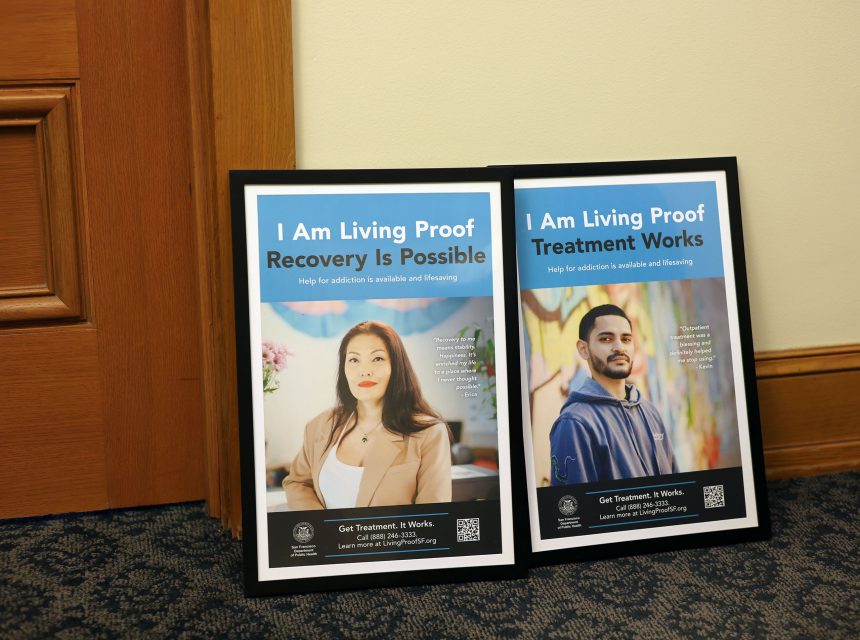
Dorsey’s ordinance sets the “north star” for city contractors and future drug legislation, as well as the tone for how the city is going to approach recovery. But it is symbolic and has no immediate effect.
The amended ordinance now counts any program determined by the participant to support their efforts to be in remission as supporting “recovery.” Those include outpatient and residential substance-use treatment programs, medication-assisted-treatment programs administered by licensed healthcare providers, or programs that pay people to reduce or stop using drugs.
Dorsey said that a lot of San Franciscans have grown infuriated with the harm-reduction approach. “We are losing the hearts and minds of San Franciscans,” Dorsey said. But medical doctors have said that harm reduction is an important tool, and that the city moving in an abstinence-only direction could be deadly.
After 14 months of drug overdose deaths falling from a historic high of 88 in August 2023, fatal overdoses are on the rise again: There were 65 accidental overdose deaths in San Francisco in March 2025, according to the Office of the Chief Medical Examiner, the fourth consecutive monthly increase.
The average number of overdose deaths in 2024 was 53, according to the medical examiner’s data.
Mayor Daniel Lurie has recently taken steps to roll back some harm reduction policies, like stopping city-funded nonprofits from handing out smoking supplies unless those nonprofits offer recipients counseling services or connect them to services. Advocates caution that this may lead to fentanyl users switching from smoking to injection, which could result in more overdoses and infections.
Dorsey, a recovering alcoholic and meth addict, is firmly in the abstinence-first camp, and has spoken often about needing tough love during his own addiction recovery. Still, he said the San Francisco Marin Medical Society “shared my conviction that recovery need not be an either/or proposition with respect to harm reduction.”
“To the contrary,” Dorsey added. “We must include all approaches to accommodate a multitude of pathways taken by those of us who face problems with addiction.”
The Thursday hearing was attended by some 71 people giving public comment, including at least a dozen who had either recovered from drug use or were on their way to recovery.
One called Dorsey’s ordinance “common-sense legislation” that would stop encouraging illicit drug use. He said he had squandered 23 years in state prison for crimes committed due to his addiction, and attributed the blame to harm reduction, calling the approach “permissive policies that enabled me to continue to use for years.”
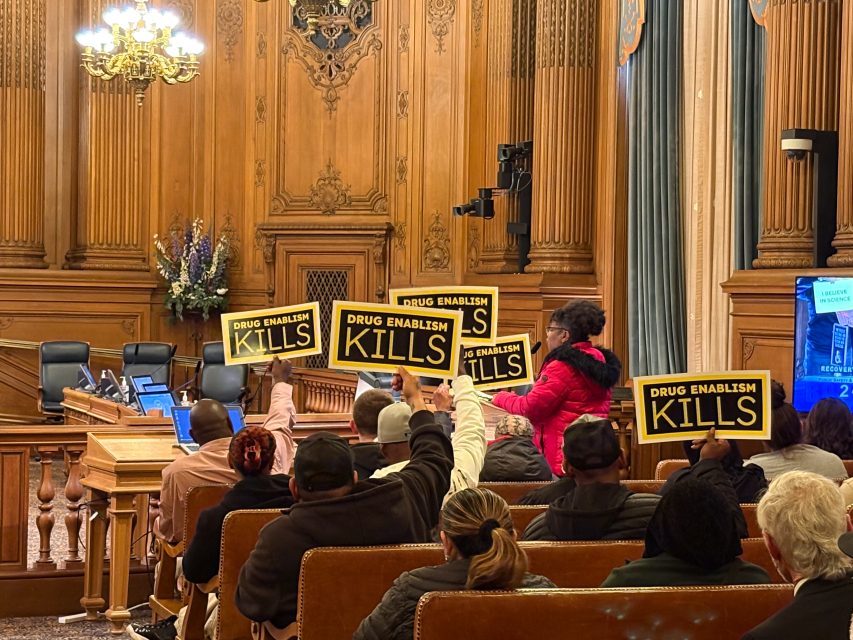
“I’m grateful that the page is finally turning in the city, and we’re going to start having accountability and recovery first,” he said. Many cheered and waved signs that read “Drug enablism kills” in support.
Harm-reduction advocates, for their part, said they appreciated Dorsey’s amendments.
“The pathway to recovery can start in any number of places,” said Laura Thomas, senior director of HIV & Harm Reduction Policy at the San Francisco AIDS Foundation.
“We want overdose prevention and intervention to be included in your ordinance,” added Laura Guzman, the executive director of the National Harm Reduction Coalition. “We want to make sure that those are also considered as you move your ordinance to the full board.”
The full support of the committee, which Dorsey chairs, came without surprise. The two other members of the committee, Supervisors Danny Sauter and Bilal Mahmood, were already co-sponsors of Dorsey’s ordinance.
The ordinance will also likely pass with little friction at the full board: It needs six votes and already has seven co-sponsors. It will be heard on May 6, according to Dorsey’s staff.
Thanks for reporting.
I wish they had consulted addiction healthcare and facility experts .
If addiction was easy to fix then it would not be such a tragic scene
The public has input but they are not really qualified .
Rather ,
Betty Ford and Hazelton are the best places to go . The city should have requested their help and input .
I dont think anyone would want the public or politicians to be making medical decisions and treatment for other health issues .
Look at the abortion mess politicians and some of the lay public have caused .
I do know they do not allow any drugs or alcohol. If so , the patient is out .
Abstinence must be followed . Relapse may occur but treated .
There is no cure .
Unfortunately , even motivated addicts who are treated often dont make it .
Opiate addicts dont live long .
Again, a really nice guy Mayor’s follows the Path of Proven Failure,
There are only two paths to follow in addressing Addiction.
Revenge and Reform.
Reform has been proven to work.
Revenge has been proven to make addicts worse and harder criminals.
And, UBI is a cheaper Crime Stopper than increased Policing.
I’m confident the Mayor will figure this out and follow the other paths listed by other posters such as considering the opinions of the Stanford Medical Community as better qualified to design Addiction Reform Strategies superior to those of the SFPOA.
go Niners !!
h.
I was hoping now that the State of California has begun producing its own generic naloxone, if the opiate antagonist could be made available in broadcast spray form, so that we could spray clouds of Government Narcan as we walk down our sidewalks and see where the cards fall.
I’m glad the resolution got amended to be less ideologically purist about abstinence only. Something that is also missing here is addressing the root causes that push people into addiction to street drugs. For many, they lose their homes first, and then take drugs to deal with the extreme stress and anxiety that comes with being homeless and not having a safe place to sleep.
San Francisco must get serious about building/acquiring affordable housing for all. Someone is going to bring up zoning laws, and sure, upzoning can be part of the solution but we also need PUBLIC INVESTMENT in housing. Look at how many years we were waiting for funding to come through for 1515 South Van Ness to finally break ground, and the teacher housing at 18th and Mission still isn’t funded.
We also need to stop engaging in the game of cruel musical chairs where homeless people are swept from place to place without any real solutions – whether that looks like your typical homeless sweeps where tents, medications and ID documents are unceremoniously trashed, or the performative police crackdowns like Lurie is doing at the 16th Street plaza today. I understand that many neighbors welcome these strategies because in the short term, it can seem to get trouble off their particular block. But it’s time we caught on that without real solutions, such relief will always be short-lived. In the meantime, we’re retraumatizing folks and making the temptation to turn to drugs to cope that much stronger.
“they lose their homes first” – Well, Lurie decided to cut the legal defense aid that helps keep those being illegally harassed and evicted by slumlords, so… anyone want an expensive subsidized art installation nobody voted on instead? Sold, to the Billionaire in the dark corner…