

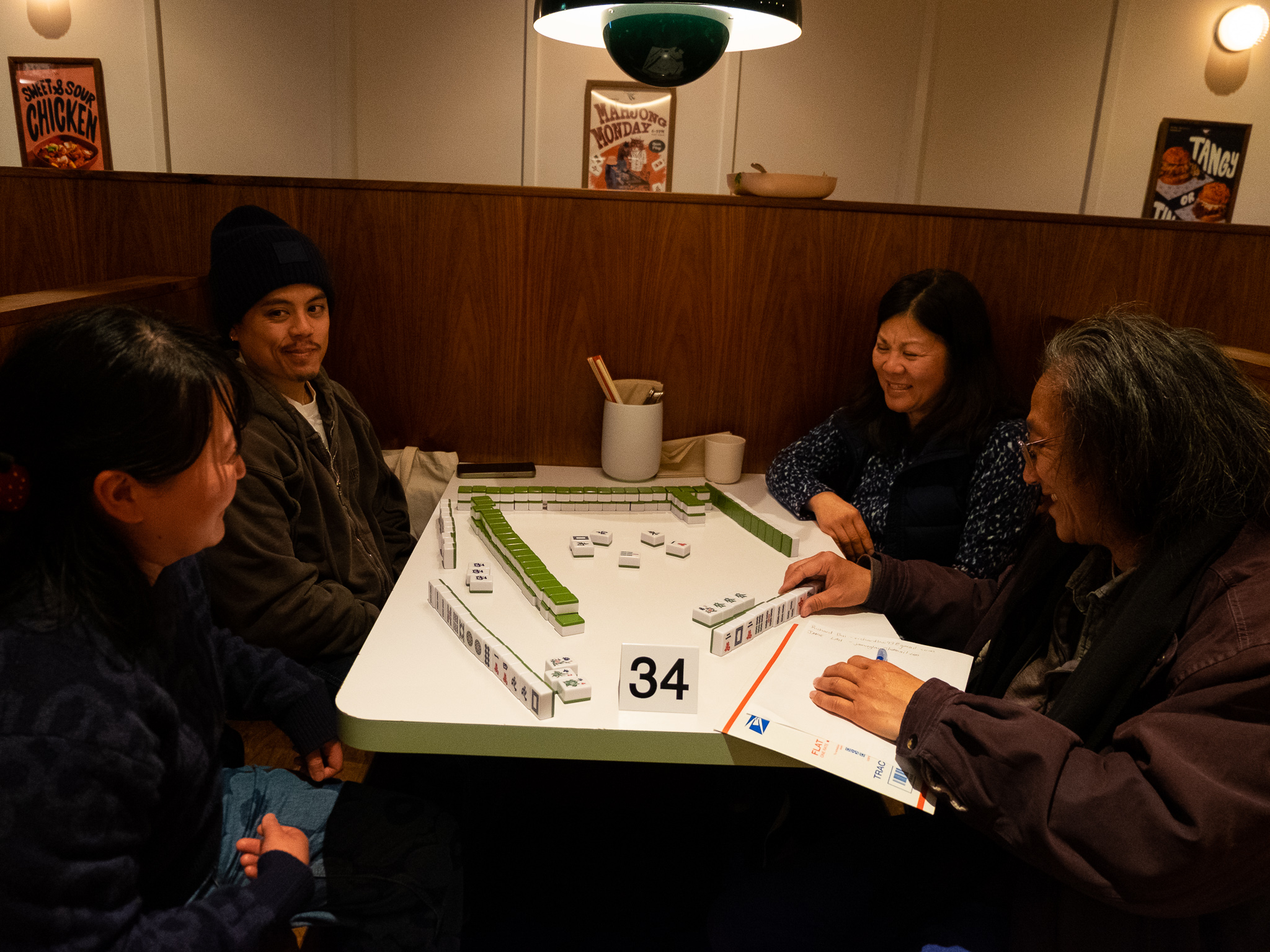

Walking around any residential neighborhood on the weekends, I would always hear the sound of mahjong tiles coming from somewhere.
On school days, my grandma would drop me off at my elementary school in our small Chinese city in Sichuan Province, and join other grandparents on childcare duty at a tea house on the same street. She would play mahjong for the entire afternoon before picking me up.
I was 11 then, and I’d always ask if she’d won that day. When she did (which put her in a good mood), I’d ask for a few yuan (less than 50 cents) to buy chewy gluten snacks coated in chili oil and Sichuan peppercorn from my favorite food stand nearby.
Andrew Keeler has never been to that small Chinese city. He grew up in a Jewish household in San Diego where, in 1968, the five-year-old Keeler experienced mahjong for the first time in his mother’s living room. She would host games there for the next 30 years. Fast-forwarding to modern-day San Francisco, when his wife took up the game, Keeler was once again surrounded by women playing mahjong, and his wife became his mahjong instructor.
Nowadays, he can be found on Monday nights at Mamahuhu, a modern Chinese American restaurant in Noe Valley. True, I did not find the stale smell of cigarettes that usually filled the mahjong parlors in my hometown, nor the tacit exchange of cash at the end of a game, but there was the familiar clack of mahjong tiles and the chattering and laughter of the players.
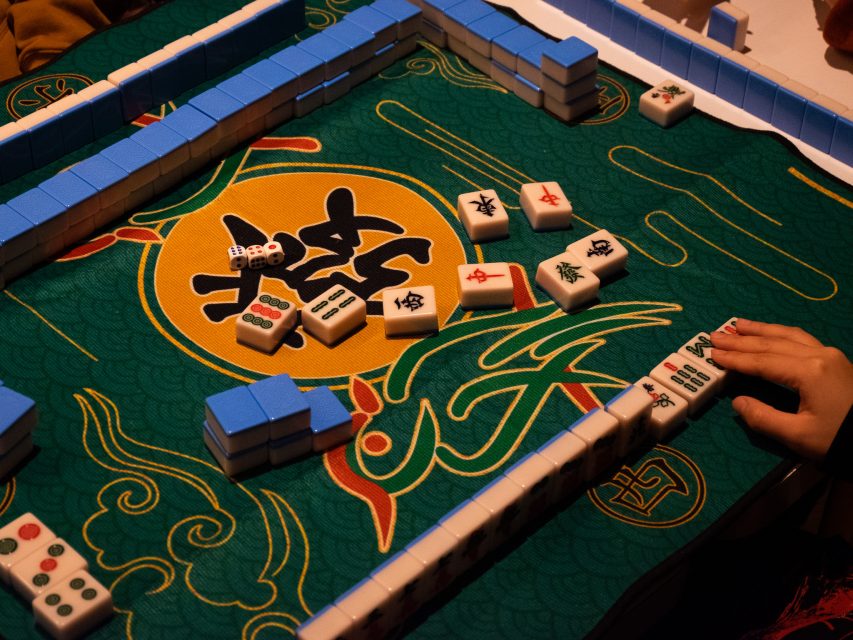
Some 25 people, about half Asian and half non-Asian, gathered around square dining tables, shuffling mahjong tiles in yellow, magenta or glittering gold. A handful ordered bowls of Mamahuhu’s mapo tofu, paired with lotus root salad and jasmine rice, but others just came to play.
“Monday is known as the mahjong day,” Keeler said, wearing a red warmup jacket and half-straw, half-wool bucket hat. Everyone knows Keeler; he shows up almost every week to teach clueless first-timers.
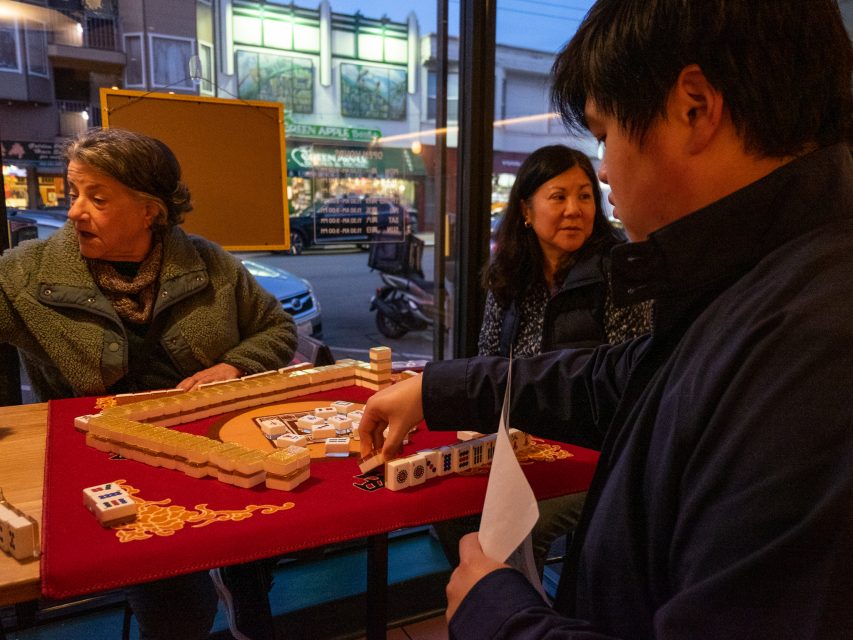
At a table of four women in their 60s, all “recruited” by Keeler — their kids all go to school together — the learning began. While each held a tip sheet distributed by Keeler, they played in Hong Kong style. To set up, each player stacked 18 mahjong tiles on top of another 18, making up four walls. Everyone rolled the dice. Each player started with 13 tiles. As players discarded tiles and picked up tiles from others, the player who got four sets of threes and a pair won.
The mahjong set had numbers written on tiles’ top left corners, in addition to the Chinese characters. The numbers allow beginners to understand the sequence of tiles even without reading Chinese. But if anyone wanted to learn further, Keeler came prepared: From time to time, he pulled out a sheet with pronunciations of the tiles in Cantonese and Mandarin, and asked this reporter if he did it right (he did).
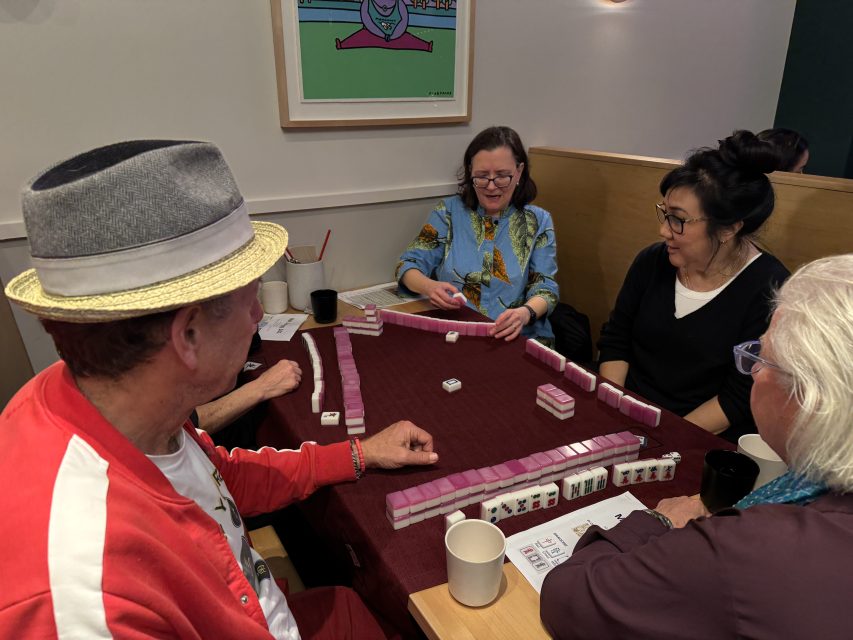
The learning game for beginners was filled with questions and exclamations of excitement or regret.
“Wait!” one player blurted out after missing an opportunity to pick up a tile. “Oh! Ah! … Shoot! Okay.”
Some 15 minutes later, Sue, who was only playing for the second or third round, got her first win. Around the table, her new friends took a photo of her. “Always take a picture of the first win,” one said.
Mamahuhu (“馬馬虎虎” meaning “not so bad” in Chinese), the restaurant serving sweet-and-sour chicken and pineapple bun chicken sandwiches, started hosting Mahjong Mondays in late 2022, two years after it opened its first location on Clement Street. Nowadays, the program gets the mahjong-curious together on Mondays at its three locations in the Richmond, Noe Valley and Mill Valley.
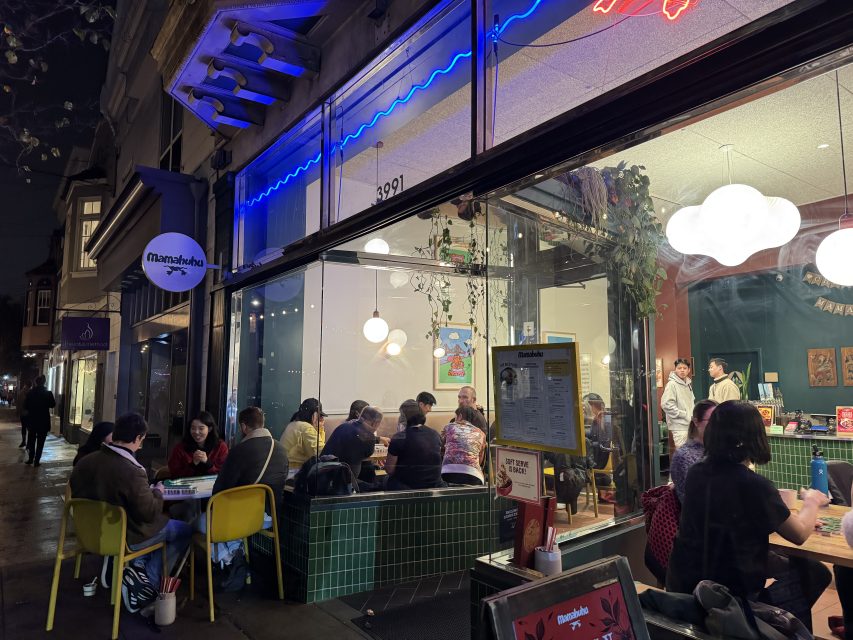
The program enjoys the most success at its Noe Valley branch, according to Ben Moore, co-founder of Mamahuhu. He credits Keeler, who volunteers his time to teach and organize. Keeler gave out mahjong chocolate made by putting homemade mahjong stickers on Hershey’s Miniatures. When Mamahuhu organizes ticketed mahjong events, Keeler gets compensation or a free meal, but most of the time, it’s a labor of love. And competition.
Today, Keeler goes to professional mahjong tournaments around the country; he just came back from one in Palm Springs a month ago, playing American-style mahjong as one of the only eight men in a competition of 180 people, he said. Keeler, who started teaching mahjong about 10 years ago, organizes events at Mamahuhu, the Ferry Building and, this April, at the Saint Joseph’s Art Society, a former church on 10th and Howard streets.
Those who grew up around family members playing mahjong find a place of nostalgia, while people who never played learn a new game that takes as much luck as strategy to win.
“People like to eat and drink and chit-chat and play a game,” said Moore. For him, bringing people together to play mahjong, whether they grew up playing it with family or never touched it before, shows the essence of Mamahuhu’s Chinese American cuisine, “where different cultures come together to create something new,” Moore said.
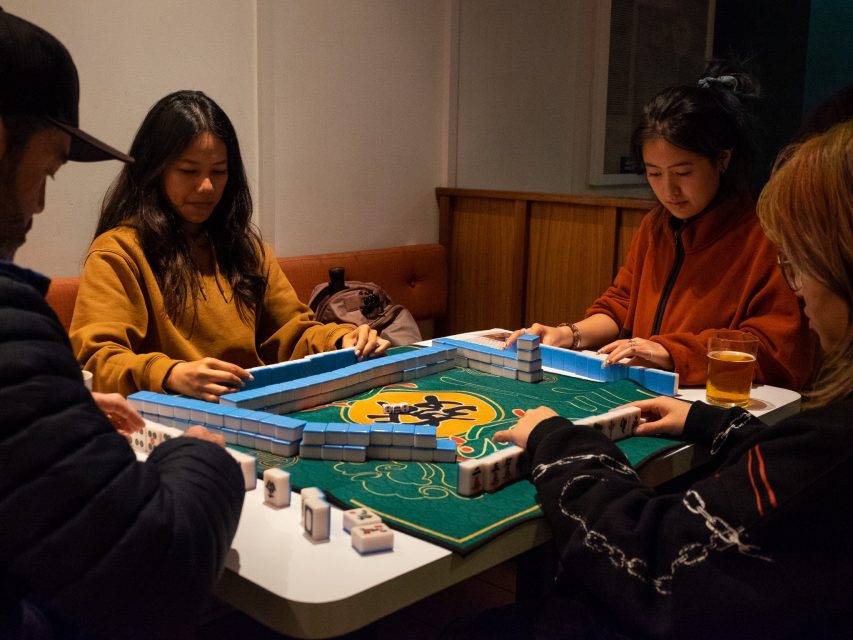
On the other side of the city, at Mamahuhu’s Clement Street location, Ken Wong rediscovered mahjong after going to Keeler’s meetup group at the Ferry Building in January.
From there, Wong, who learned to play from his Hong Kong family as a teenager, encountered the Mahjong Monday events at Mamahuhu. Already, Wong has become an instructor at the Clement Street restaurant. On a recent Monday, he floated among four tables, explaining rules, helping beginners recognize the characters on the tiles, and hinting to a confused newcomer what to do. When one table was short a player, he sat down and played.
“The excitement, the noise, the building of the big hands,” he said. “The whole game is about winning big, right? But when you try that, sometimes you lose big.”
Wong loves the “good old feeling” of the tiles. Instead of looking at the tiles, “You can use your thumb. You feel it. That way, people say, you’re pretty advanced.”
Has he gotten it wrong? “All the time,” he said. “I’m constantly guessing, because I’m not at that point yet. I’m trying to practice.”