
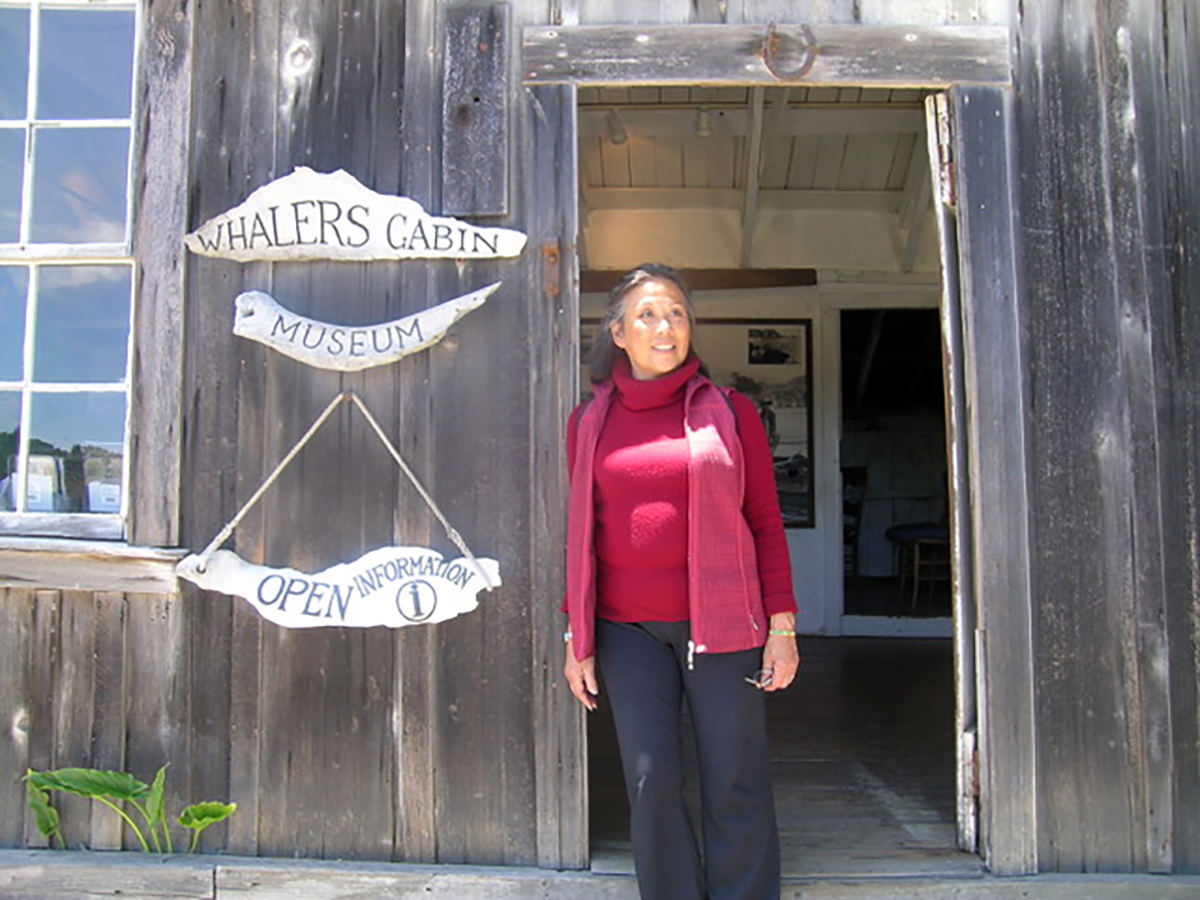

Nancy Wang, a local playwright and director, met her Aunt Mary around 2009 at a family reunion. That was when she began to hear tales of her family’s first days along the Monterey coast, some 170 years ago.
Eventually, Wang turned the stories into a theater performance piece for Eth-Noh-Tec, a nonprofit storytelling company she founded in 1981 with her husband, Robert Kikuchi-Yngojo. Most recently, she melded the accounts into the historical novel “Red Altar,” which beautifully weaves together her family’s history with the early development of Monterey’s fishing industry.
Wang will be reading from the novel and discussing it on Thursday Feb. 27 at 7 p.m at Medicine for Nightmares, 3036 24th St.
In the novel, we meet Wang’s great-great grandmother, So Me, in 1849, months before she marries Quock Bo, a 17-year-old Chinese fisherman. Bo’s torn between marriage and leaving Canton, China, to find his fortune in Gum Saan, the Gold Mountain of California’s Gold Rush. It was unusual for brides to join their husbands on such a journey, but Bo notices, early on, a fierceness in his fiancee, and thinks, “This could be an interesting marriage.”
In Wang’s hands, it also proves to be excellent material for a novel. She takes the reader across the ocean on a junk with six teenagers, barrels of rice, an assortment of animals, and the Red Altar, a simple shrine to Tin Hau, the Goddess of the Sea. Not even the goddess can protect the voyagers from a storm off the California coast, and the boat crashes into the rocks at Carmel Bay.
After being nursed back to health by members of the Rumsen-Esselen nations, the young couple soon decide that they will make their fortune fishing along the Carmel Coast and beyond.
It isn’t easy. Wang portrays an early and idyllic collaboration with the Rumsen-Esselen Nations and success in supplying fish to markets in California and China. But by the late 1860s, the Chinese residents encounter the racism that will define their experience for decades.
This, after all, is the country of the Dred Scott decision, which held in 1857 that a Black man couldn’t be a U.S. citizen. Verbal abuse, lynchings and arson in their villages all become part of the Chinese immigrant’s life. The vicious racism is written into law in 1882, when Congress passes the Chinese Exclusion Act, prohibiting Chinese immigration for a decade.
Wang offers a nicely paced account of how the Chinese residents, who soon have American-born families, endure and thrive through the growing hostilities. As her listeners, we become invested in their lives. Next time you visit, you’ll see the Monterey Bay area in an entirely different way.
You can purchase the novel here. Another reading will take place on March 27 at Fabulosa Books at 489 Castro St.