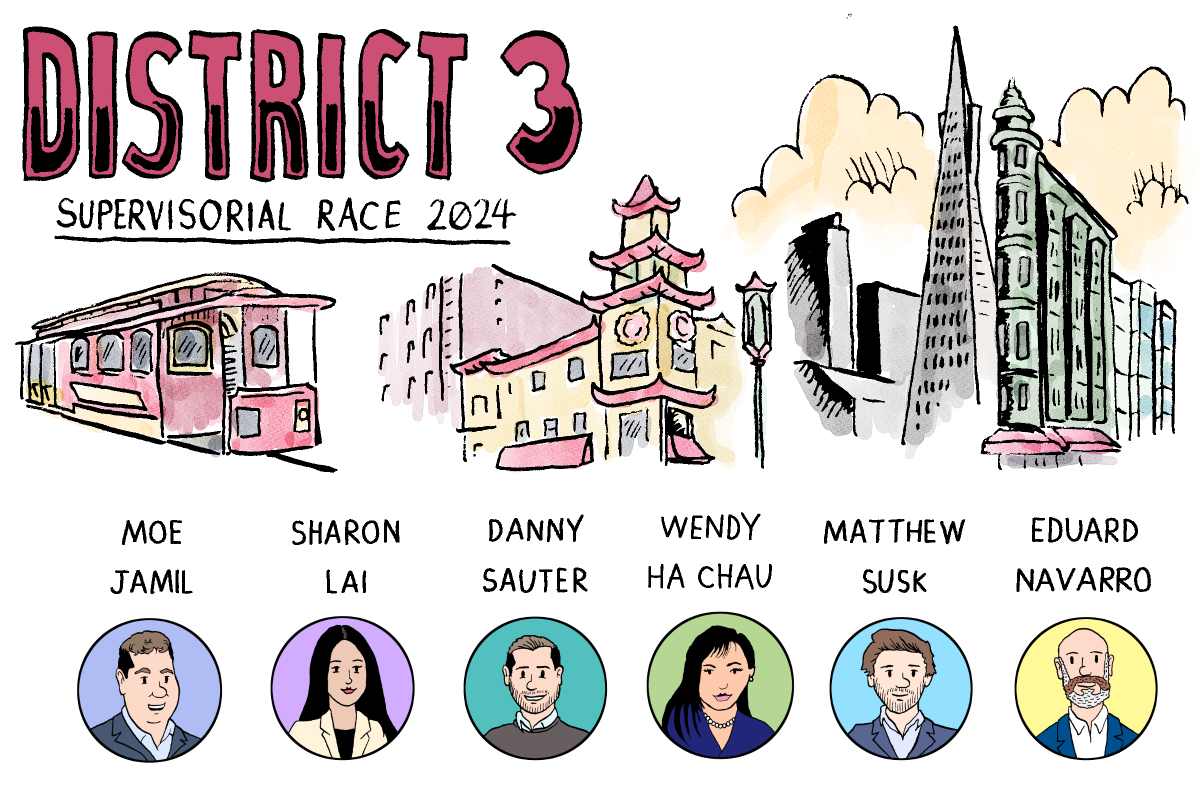
We’re wrapping up our weekly “Meet the Candidates” Q&A with the District 3 candidates. Just days before voters go to their polling places and drop off ballots, or as they’re filling out their vote-by-mail ones, we wanted to give a look back at how the supervisorial candidates running to replace termed-out Supervisor Aaron Peskin differed on the issues.
We’ve made a table to show their biggest differences on mayoral picks, the March propositions, housing issues, the Central Subway, encampment sweeps and more. We’ve taken out the ballot measures where all candidates agreed.
In answering most of our other weekly questions, the differences were more nuanced.
To understand their stances better, we categorized the questions and summarized their answers.
Click on each of the topics below to see the main takeaways.
Housing
By 2031, San Francisco is required to plan for some 82,000 homes, of which 46,000 are affordable.
Candidates showed varying degrees of enthusiasm for building new housing in District 3.
Sauter is dedicated to building more housing, especially for families and seniors.

Susk and Navarro want to build more housing, without overwhelming residential neighborhoods with skyscrapers.
Both Sauter and Susk mentioned converting offices to residential units.
Lai and Jamil mentioned that growth needs to be thoughtfully managed, with Lai emphasizing affordable housing and Jamil incorporating community input and preserving existing housing.

*We asked the question on housing before Chau joined the series.
Homeless shelter
Lai and Sauter support the concept of sober living facilities. Sauter suggested enforcing drug-free common-area guidelines. Lai believes that the city should have provided relocation options to legacy tenants at the Granada Hotel homeless housing, whose lives were turned upside down when the city bought the property for homeless re-housing in 2020.

Jamil, Lai and Sauter mentioned enforcing community-developed good neighbor policies to ensure clean and safe streets around shelters. They mentioned that the city has disproportionately concentrated shelters and supportive housing in Lower Nob Hill.

Susk believes the city is incapable of operating sober living facilities effectively. He proposes holding city departments and nonprofits accountable with quantifiable success metrics and investment in top performers.

*We asked the question on the Granada Hotel homeless housing before Chau joined the series.
Businesses: Formula retail, small business and Union Square
Candidates expressed varying attitudes towards the formula-retail restrictions in District 3.
Sauter said, “these outdated rules don’t work.” He mentioned reforming the “broken planning code” and limiting abuse of discretionary review.
Chau, Navarro, and Susk support thoughtfully loosening retail restrictions.
Jamil and Lai oppose the idea of loosening retail restrictions.
In response to a question on their plans to revive Union Square, Lai, Sauter and Susk mentioned creating safe and clean streets. Susk suggested offering free parking in Union Square garages. Jamil supported conversion of buildings to mixed-use spaces.
*We asked the question on Union Square before Chau and Navarro joined the series.
Biking
When asked about the San Francisco Municipal Transportation Agency’s new Biking and Rolling Plan, Sauter said he wants to create a more walkable district, and wants to see safe bicycle infrastructure.
Five candidates believe SFMTA should conduct better outreach.

Lai and Navarro said the city needs a holistic approach to mobility planning.
Chau said that no new bike lane should be built in Chinatown.
*We asked the question on the Biking and Rolling Plan before Chau joined the series.
Lower Nob Hill
Five candidates support building a new park in Lower Nob Hill. Susk wanted to integrate community policing within the park to enhance safety. Navarro wants the future space planted fully with native species.

Chau, who’s a resident in Lower Nob Hill, opposed the idea, citing that the area already enjoys plenty of parks in the adjacent Tenderloin, and the neighborhood should be focused on building small businesses.

When talking about more general suggestions to better integrate Lower Nob Hill into District 3, Lai wanted to empower neighborhood self-determination. Sauter is committed to regular foot beat patrols in the neighborhood and mentioned expanding street cleaning services.
Jamil suggested creating a Lower Nob Hill Community Benefit District and mentioned that he won’t support any additional shelter or supportive housing in Lower Nob Hill.
AI safety bill
Four candidates didn’t support Sen. Scott Wiener’s AI safety bill, which would have required developers of advanced AI models to adopt safety measures, and was vetoed by Gov. Gavin Newsom in September.
Susk was concerned that the bill could stifle innovation.
Jamil mentioned that AI requires federal and international regulation rather than a state-by-state patchwork approach.
Navarro said it’s too early to regulate AI when harms are hypothetical and the industry is still nascent.

Sauter supported the bill because it would place reasonable safeguards alongside the new technology.
SFUSD
Navarro is firmly against closing schools in San Francisco.
Chau believes SFUSD’s Resource Alignment Initiative, the school closure process, should have been held off until six months after the election. It has since been indefinitely postponed.
Police redistricting
Five candidates support the current conversation of police redistricting to keep District 3 neighborhoods under one police station to best direct resources.
Navarro suggested creating subdistricts that match specific neighborhoods.
Chau believes redistricting is a horrible idea that mismanages resources and will not address any issue on crime.
You can also read their full answers in our archive of all District 3 "Meet the Candidates" answers.
Illustrations for the series by Neil Ballard.