


Last week, on the 2,232nd day of her tenure as mayor, London Breed put out an executive order trumpeting the need for comprehensive charter reform to re-do the way San Francisco government works.
This is such a pressing and vital endeavor that Breed’s plan calls for us to place this matter before voters on the November 2026 ballot, a mere 799 days from today.
It was Berkeley free-speech activist Mario Savio who said that, when a certain level of odiousness is achieved, it “makes you so sick at heart, that you can’t take part. You can’t even passively take part.”
San Francisco is a city that is, in many ways, sick at heart. But we can’t even passively claim that the mayor’s broad and vague executive order is a serious move to address that. Rather, it’s just the latest attempt to present voters with her deeply counterintuitive reelection message: I cannot fix the problems.
Breed’s gambit is a novel one for a political re-election bid, but not for other venues in which people attempt to elude culpability. Defense attorneys could tell you about the vaunted SODDI and BEE strategies: These acronyms stand for “Some Other Dude Did It” and “Blame Everyone Else.”
With Mayor Breed, some other dude always did it. It’s always blame everyone else. But this pressing call for charter reform — a mere six years after she took office and with the goal of getting something in front of voters in two years and change — does advance these stratagems to brave new realms. Rather than blaming flesh-and-blood supervisors, her own appointees or the voters, this is a condemnation of the entire system.
And this, again, is a curious message from a six-year incumbent fighting to stay in power. Effective San Francisco mayors didn’t wheedle about charter reform or make their inability to do the job a campaign issue. Rather, charter reform tends to be discussed and initiated under ineffective mayors.
Is San Francisco poorly run? Yes: Same as it ever was. And, yes, part of that is a broken process issue. But you might also say it’s a talent and vision issue. And there’s no charter reform to fix that.
We’ve written this before, but it bears repeating: You cannot legislate a solution to a problem that is fundamentally a management problem. It requires good management.
The notion of an entrenched incumbent running on reform is not just laughable in the abstract, but also in the concrete. And, also, on celluloid. From the 2000 Coen Brothers film “O Brother, Where Art Thou?”:
“Well, he’s the reeee-form candidate, Daddy. People like that reeee-form. Hey! Maybe we should get us some?
“I’ll reform you, you soft-headed sumbitch! How you gonna run reform when we’re the damn incumbent? Is that the best idea you boys can come up with? Reeee-form? Weeping Jesus on the cross!”
And yet, 24 years later in San Francisco, this is an actual serious political strategy for a viable candidate. Twenty-four years later, the ascendant wing of the San Francisco Democratic Party, which calls itself “Democrats for Change,” is emphatically endorsing the six-year incumbent.
Weeping Jesus on the cross.
Breed was, alas, a shade late to the reeee-form party: There are already two items on the November 2024 ballot calling to remake the charter. One is a sweeping TogetherSF proposal to halve the number of city commissions, significantly enhance mayoral power and essentially curtail civilian oversight of the police, which also serves as a fundraising vehicle for mayoral candidate Mark Farrell. Another is a more moderate counter to the TogetherSF measure, backed by mayoral candidate Aaron Peskin and former city controller Ed Harrington.
Over the weekend, Breed abruptly yanked her support of the TogetherSF measure citing, in part, the vast torrents of money it has amassed in serving as a stalking horse for Farrell’s candidacy. Well, okay then: That’s been apparent for months and months and, regardless, has little to do with its substance.
Breed’s executive order really is broad and vague, while also managing to be short; there’s not much of note in here, other than exhortations for people to get to work, and a timeline for them to do it in. Waiting six-plus years to put out a two-page document renders this foray into reeee-form — sorry, reform — awfully late as a practical matter. And waiting until other charter reform efforts are on the ballot and amassing millions of dollars for her competitor renders it awfully late as a political one.
Aides for prior mayors, meanwhile, tell me they’d have never, ever suggested a move like Breed’s. That’s because I’ll reform you, you soft-headed sumbitch! How you gonna run reform when we’re the damn incumbent? is the response they’d anticipate getting. Or perhaps something a bit more polite (but maybe not).
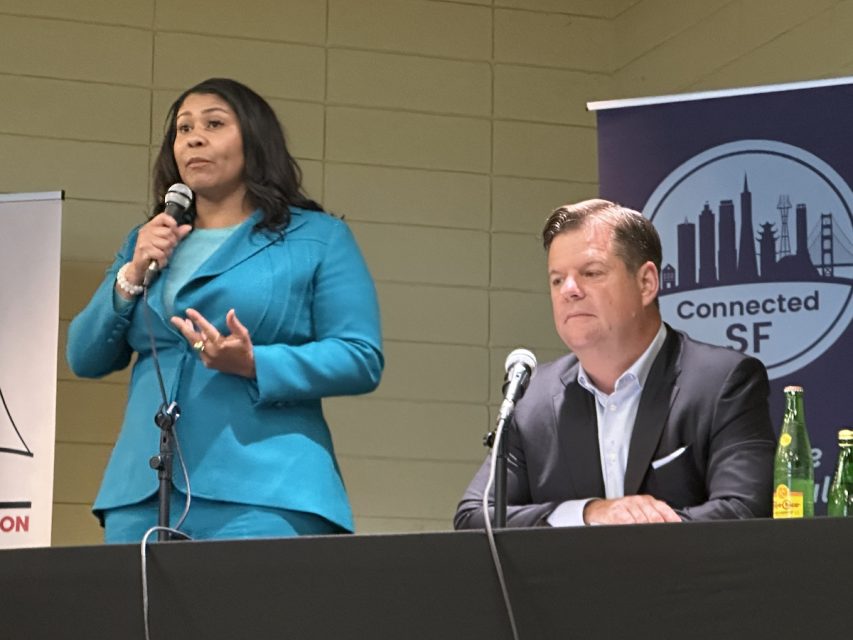
Meanwhile, in other reeee-form news, the good-government think tank SPUR recently released its own road map to curtailing San Francisco’s dysfunction and scleroticism.
Make no mistake, the city’s status quo is not optimal. There’s some good stuff in here: Would-be reformers have been trying to consolidate redundant city bodies for generations, and San Francisco’s low bar to placing material on the ballot hampers actual governing.
These would be good legislative fixes but, remember: You cannot legislate a solution to a problem that is fundamentally a management problem. And everyone is still fixated on matters such as mayoral hiring and firing of department heads or sprawling and ineffective commissions. Of course those are problems. But they are not remotely the major problems limiting the effective functioning of San Francisco government.
To be frank, San Francisco presently has a bigger issue with qualified department heads not wanting to come work for us than an inability to properly onboard them or send them packing. As for commissions, your humble narrator spoke to a handful of erstwhile staffers who had worked for a succession of mayors going back to the 1990s.
On literally hundreds and hundreds of occasions, these former aides sat with mayors in City Hall Room 200 as those chief executives outlined what they wanted to do.
If you’re wondering how many times someone interjected and said “Hey, we need to talk to the commission about this,” the answer is: Zero.
The inherent hilarity of a six-year incumbent pushing for government reform is blunted by the fact that ostensibly serious people claim that San Francisco’s mayor — who is clothed in immense power — is not powerful enough to be effective.
The mayor of San Francisco, a combined city-county, has far more centralized and universal control than virtually any of her colleagues. The city-county runs the water system here, and the transit system. And, for that matter, the airport and the hospital. San Francisco’s mayor can, for better or for worse, effect far more change than elsewhere in the Bay Area, where city and county governments overlap and elected bodies control utilities districts or transit agencies.
The mayor’s control of San Francisco’s vast budget dwarfs that of other city or county executives, let alone the San Francisco Board of Supervisors. In fiscal 2023-24, for example, she had a direct hand in some $2.4 billion in discretionary spending, nearly 60 times the amount re-allocated by the 11-member Board of Supervisors during the “add-back” process.
While “add-backs” dominate whatever media coverage there is of the city’s vast budget, it warrants mentioning that they represent about two-tenths of one percent of our yearly spending.
Yes, San Francisco’s lethargic bureaucracy invites cronyism and influence-peddling. But merely streamlining government isn’t enough. The city likely only had the best of intentions when it moved to expedite the creation of homeless housing and navigation centers via no-bid contracting. And yet, the practical result of this was to put since-imprisoned Public Works boss Mohammed Nuru in a position to hand out contracts as he saw fit.
San Francisco remains a place that could generally use more oversight, not less. And streamlining without addressing endemic ineptitude and corruption issues will only streamline ineptitude and corruption.
Again, the problem with city government is a broken process issue. But it also remains a talent and vision issue. With enough talent and vision, you can overcome a broken process. But without it, even the best process will founder.
The proposals presently on the table only deal with process, because you can’t legislate away a management problem. Barring unforeseen lunacy, the city isn’t getting fixed anytime soon — because these are the fixes.
She already deregulated property developers and the police department. The next thing to deregulate was the Mayor’s office; hence, the charter reform.
those of us who opposed her ‘zonor’s original candidacy foresaw way she was blaming everyone else for the city’s problems.
she has no ability to take personal responsibility for her actions unless it serves her political ambitions. much like her appointed DA, she prostitutes political capital in the interest of an elite constituency not those who really need help recovering from a 2 year lockdown.
one only has to look at the VC takeover and safeway closure in the fillmore to see how only the powerful political brokers have taken the people’s government hostage.
SF Government needs to be engineered to not be completely dysfunctional when a weak mayor like Breed gets elected or not completely overrun when a strong mayor like Brown gets elected.
Division of power with more independent eyes on the problem increases the chance that one commissioner can pull the alarm lever on corruption, checking both a weak mayor’s hands off and strong mayor mano duro approaches.
For instance, Breed’s appointment of Max Carter-Oberstone to the Police Commission was viewed by her as an bug because the commissioner had a mind of his own and spoke and acted on it when in reality it was a feature.
‘
In a healthy democracy, this could have opened the door to reform of the SFPD that’s changed its motto from “Oro en Paz, Fierro en Guerra” to “We are understaffed, The Police Commission is bad, Superior Court judges are bad and it is all the Supervisors’ fault and My Dog Ate My Homework.”
But in response to a modicum of oversight, the ReeeformersSF lost their shit and decided to clamp down further on a diversity of eyes on the problem.
There are happy middles here where mayors, supervisors and residents can all play our parts in ensuring that government functions, irrespective of the leadership characteristics of any or all electeds.
She “found time” during COVID to break the rules and party with Tony Toni Tone.
She “found time” during the budget/police/crime crisis to VETO and speak out against a simple statement against Israeli genocide in Gaza, ongoing.
She WON’T find time to listen to SF residents if they’re not in her critical demos, real estate billionaires, asian techies, LGBT non-profit staff, bicycle influencers, or legacy “city family” corruption club members.
Breed needs to find a real job for the first time. Anyone who’s been in SF 6 years or more can see that as plain as her PR photo-op homeless sweeps failed the first several times she already tried this, and failed utterly.
FIRE CORRUPT AND INCOMPETENT BREED AND EVERY LAST FRIEND OF THAT WALKING PILE OF LIES.
“ …yes, part of that is a broken process issue. But you might also say it’s a talent and vision issue. And there’s no charter reform to fix that.
We’ve written this before, but it bears repeating: You cannot legislate a solution to a problem that is fundamentally a management problem. It requires good management.”
Spot on, Joe. Spot on.
> San Francisco remains a place that could generally use more oversight, not less. And streamlining without addressing endemic ineptitude and corruption issues will only streamline ineptitude and corruption.
Even more sloppy logic than usual. None of Nuru’s corruption convictions had to do with streamlined homeless shelters. They were in regards to a market rate property development deal and Recology rates. However, you use Nuru as evidence that removing the sorts of discretion and contracting which invite corruption will “streamline” it. Huh? Do you also think if bad oil is causing your engine to seize, changing your oil will streamline the seizing?
Had there been a commission overseeing DPW and it contracting instead of DPW being a mayoral fiefdom like the MOEWD and MOHCD, other nests of political corruption, then any contracts Nuru was letting would have been scrutinized in public session and it would have only taken one commissioner, one public commenter to blow the whistle on favoritism corruption.
Jake —
Clicking on the link to the federal release would’ve shown you how the DOJ noted that Nuru used his emergency contracting powers to hand a contract to Walter Wong.
More germane: You’re defending less oversight and carte blanche contracting for Nuru?
I’m afraid I can’t follow your motor oil analogy as it seems to be the logical equivalent of drinking motor oil.
JE
His assistance to Wong was in the context of the competitive bidding process and DPW permit approvals. As reported by the Justice Department:
> Nuru helped Wong secure City contracts by structuring the City’s Request for Proposals (RFPs) to ensure Wong’s company secured the contract, by providing Wong with confidential information on competitors’ bids, and by helping Wong expedite permit approvals.
This had nothing to do with streamlining. And yet you cite this to say:
> The city likely only had the best of intentions when it moved to expedite the creation of homeless housing and navigation centers via no-bid contracting. And yet the practical result of this was to put since-imprisoned Public Works boss Mohammed Nuru in a position to hand out contracts as he saw fit.
Why would Wong need Nuru’s help learning about competing bids if it was a no-bid process!? No matter, basic logical consistency isn’t relevant to our dear narrator.
And Joe you really have to remember I am 99th percentile among your readership. So if you want to insult my intelligence, feel free, but it means something really dire for the rest of the people on here.
Jake —
It turns out I attached a link from 2022 instead of the one from 2021 that specified this. Here’s the operative sentence from the 2021 link:
https://www.justice.gov/usao-ndca/pr/former-san-francisco-public-works-director-admits-string-briberies-and-corruption
“In one example outlined in the plea agreement, Nuru used DPW’s emergency contract process, which did not require a public bidding process, to direct construction work to Walter Wong Construction on a navigation center located at 1515 South Van Ness Street and on the Jelani House (a housing shelter), resulting in City payments to Wong’s company during fiscal years 2017-2018 and 2019-2020.”
JE
“None of Nuru’s corruption convictions had to do with streamlined homeless shelters. ”
You do not pay close enough attention. Did you work for Breed, yes or no?