
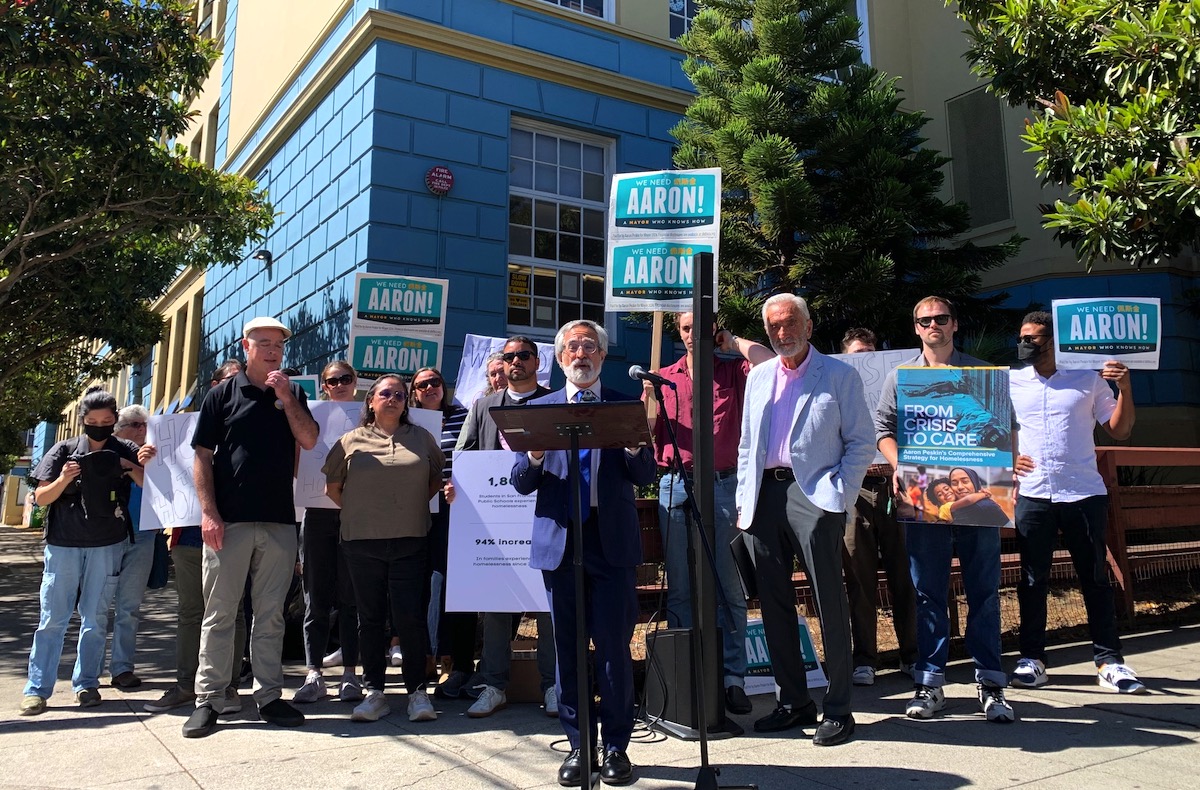

Supervisor Aaron Peskin gathered with supporters at Buena Vista Horace Mann K-8 school on Tuesday to announce his six-point Crisis to Care plan, saying that, if elected mayor, he would address homelessness with housing, conservatorships, and cash payments to avoid evictions.
The plan itself, which was printed on glossy pamphlets and handed out to attendees, is classic Peskin — impossible to distill down to a single soundbite. Each of the six points in “From Crisis to Care” bristles with sub-points, many of which are galaxies of policies unto themselves.
- “Within the first week, bring every department head together and force them to adopt a single set of metrics to evaluate proposals and report successes around homelessness.”
- “Sell currently un- or under-utilized city and SFUSD properties with the condition that they be used exclusively for new affordable housing.”
- “Create a fund of one-time emergency loans of up to $2,000 to tenants facing eviction.”
- “Expand humane conservatorship, including inpatient psychological treatment that is individually tailored to the most positive outcomes.”
Peskin said he would be hands-on in the plan’s implementation.
“I will be the person that convenes the department heads,” says Peskin, in the tone of someone ascending to the emotional high point of a speech. “I will be the person who calls for and reads the audits and implements the results, and I will be the person who implements the systemic management reforms. I am the person who, from the legislative branch, has seen the tangled web and knows how to untangle it.”
It is this enthusiasm for the boringness of civic governance and budgeting (which even people who disagree with Peskin cite as a defining characteristic) that has raised the hopes of many of those assembled here that homelessness could be managed more like a public health problem than a referendum on an official’s political career. Though in this case, it could be both.
Art Agnos, who was mayor of San Francisco from 1988 to 1992 and arguably lost his bid for re-election because of the city’s growing homeless crisis, was there to support Peskin.
“If you had told me 35 years ago that I would be speaking in 2024 about homelessness and trying to fix it, I would have dismissed it as ludicrous,” says Agnos, who also had a plan called Beyond Shelter, though not the $40 million he estimated that he needed then to implement it.
Since then, says Agnos, every mayor has come up with their own plan, depending on the politics of the time, a rotation he describes as “Cops, no cops. Cash, no cash. Bus tickets, no bus tickets. Tents, no tents. Sidewalks, no sidewalks.”
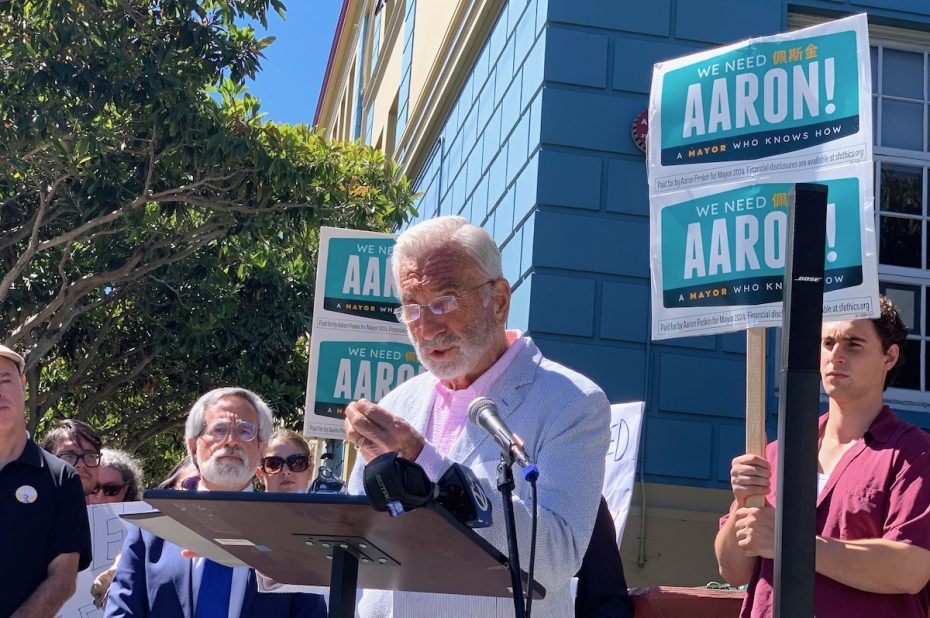
Agnos and others are making speeches in support of yet another plan, because they see a window of opportunity opening.
Despite the city’s looming budget crisis, there is dedicated money for homeless programs: Proposition C was passed by voters in 2018, and created the Our City Our Homes fund, which now has hundreds of millions of dollars at its disposal; at the time, Peskin supported the measure, while rival Mayor London Breed did not.
Proposition 1, which passed at the state level earlier this year after heavy campaigning from Gov. Gavin Newsom, requires every county in California to spend more of its tax revenue from the Mental Health Services Act on housing and treatment for people with drug and alcohol problems. It also requires money be set aside money for expanding residential facilities for people with mental health or substance abuse problems.
Some of the most practical sites for this kind of housing, says Agnos, are state mental hospitals that were defunded back when Ronald Reagan was governor of California. Local governments could literally work together and begin to un-Reagan decades of California mental health policy.
Some of these buildings are quite nice, Agnos adds. They look like college campuses.
One reporter asks how Peskin plans to collaborate with Newsom. Peskin replies cheerfully that Newsom was Peskin’s seatmate when they were on the Board of Supervisors. He does not bother to mention the part where the two also clashed often when Newsom was mayor, because why would you? “San Francisco has to get past its narcissistic notion that we can go it alone,” he says. “We need to lock arms with San Jose and Santa Clara County, with Oakland and Alameda County. I think that the Newsom administration would welcome that and encourage it.”
Peskin made his announcement in front of Buena Vista Horace Mann, at the corner of 23rd and Bartlett, because of the school community’s decision, beginning in 2018, to stay open after school hours as a shelter for homeless families with San Francisco Unified School District-enrolled children.
Initially, overnight use of the school by homeless families was so rare that critics called to have the program shut down. Today, says Anabel Ibáñez, a teacher, there’s a waitlist to sleep there. Room 100 at SFUSD headquarters, where parents go to enroll their kids, is doing double-duty as an informal housing services agency. Earlier this year, the city’s biennial point-in-time homelessness count showed a 94 percent increase in homeless families between the count in 2022 and 2024. Out of the estimated 8,000 individuals living without housing in San Francisco, 1,800 are SFUSD students.
“We work with families who’ve been sleeping in bus shelters, sleeping on Muni, sleeping in vehicles, and we’ve gone with them to the city access points,” says Matt Alexander, communications director for Faith in Action Bay Area and a school board member. “And you know what happens at those access points? They get a 90-minute-long interview where they get asked all kinds of personal questions. At the end of that interview, they say the shelters are full. They give them a handful of Muni tokens and send them on their way.”
With federal help, San Francisco has managed to nearly end homelessness among military veterans, says Peskin. The same should be true of students.
In her decades of seeing the city’s public health strategies play out in real time — first as a nurse at San Francisco General Hospital during the AIDS crisis, then as a pivotal figure in the city’s Covid-19 response — Diane Jones has also seen her fair share of plans come and go.
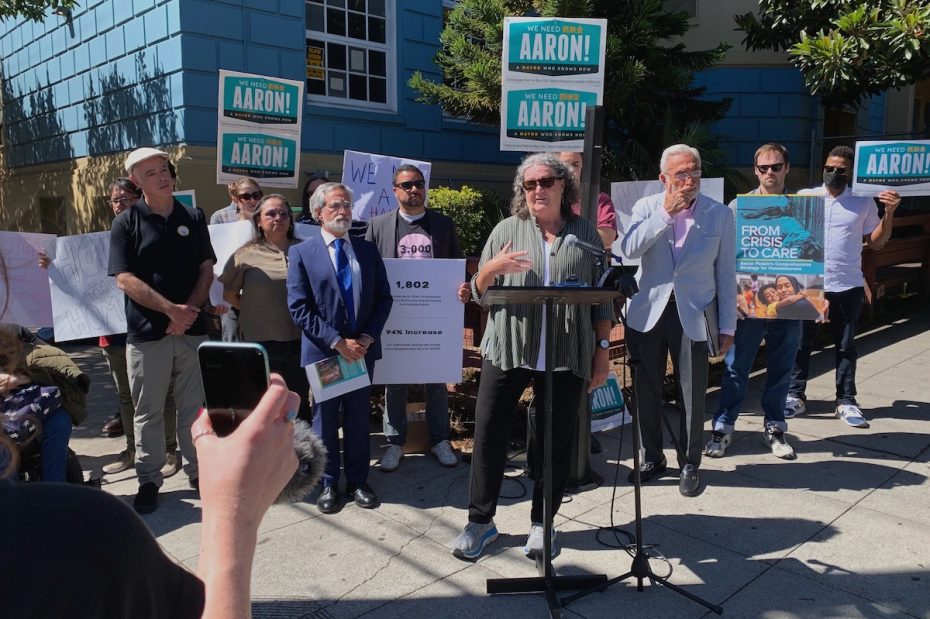
Our City, Our Home was a good plan, she says. Some have even credited it with making San Francisco’s homeless crisis less awful than it could have been. But its implementation remains challenged by the fact that the mayor was opposed to its very existence and continues to tussle with the plan’s oversight committee over how its funds are spent.
“We know that homelessness is a public health crisis,” says Jones. Despite the many tales of San Francisco’s failures, though, the city has a way with disease. “Our AIDS response became the global standard,” she adds. “Our community-led covid response became a national and international model. Why are we not able to do this for homelessness?”



Peskin has been an important member of the Board of Supes for years. He had a chance to do something about homelessness.
In all the years Peskin has gotten a City paycheck why hasn’t he done any of these “great” things to fix homelessness? He’s had years and the problem has just gotten worse.
What do you want, a magician? He’s introduced solid legislation over the years that helps keep renters in their homes. He has my respect and my vote.
What a false equivalency! The Mayor has those powers. A single supervisor, even one as knowledgeable and skilled as Peskin, is 1/11 as powerful as San Francisco’s strong mayor.
Peskin’s Wiki page is pretty interesting. After reading it it’s pretty easy to see that Peskin is a big part of the problem – he’s had lots to time and used his power in City government to get us where we are- in a mess. ” Peskin wrote and won approval for 205 ordinances during his first eight years on the San Francisco Board of Supervisors, making him the most prolific supervisor of his time.[13]”
True, but the Board of Supervisors can by a resolution urge the Mayor to consider policy objectives and can adopt legislation relating to homelessness and housing insecurity issues. I am impressed that someone is finally thinking about a regional collaborative approach to address these challenges.
“The Hilton San Francisco Union Square and the Parc 55 San Francisco are both also in receivership after the owner stopped payments on a $725 million in June of 2023”.
This is a quote from an article in the SF Examiner about the sorry state of real estate in the Financial District.
These two buildings with hotel rooms with baths and all the infrastructure they have to potentially add kitchens, would seem like an ideal way to create a 21st century version of a decent SRO which historically San Francisco had plenty of (think of the pre-Redevelopment Agency blocks where Moscone Center is now).
Adjoining rooms could be linked to create space for family-style housing units.
If the City doesn’t buy these properties, who will?
Are large tourist hotels even viable any more, never mind all the vacant office space?
Aaron Peskin is probably the smartest person in the race when it comes to understanding the gears that turn in SF. And his heart is in the right place.
Agnos nailed it. Homeless policy in SF swings from benign neglect to malign neglect and back again because of the politics, not bureaucratic competence or incompetence. However many points Peskin has in his plan, they won’t make a difference unless there is substantial political support to treat people humanely. That political support was absent when Agnos was mayor and absent now (virulently so).
ah yes, exacerbator of the housing crisis, tell us how to solve homelessness… how rich
Yes Lyn, large hotels are viable for tourists and continue to be booked throughout the world as the most prevalent booking in travel to major cities.
And yes he understands the gears as he’s created and benefitted from the corruption at city hall.
I believe genuine offers of shelter, both short term and long term, must be accepted by those camping outdoors. There can no longer be allowance for homeless persons to choose to remain outdoors. That is Mayor Breed’s policy in light of the Supreme Court’s ruling. There is no longer an option to stay for years on SF’s sidewalks, streets, and parks. It is simply common sense built from experience that shows we must force people into treatment and into shelter. It is harsh, but it is not hateful. I believe we will make significant progress reducing street dwelling due the laws becoming clearer and more consistently applied.
The problem with “homelessness” in San Francisco, is the progressives are far too promiscuous with their compassion and Peskin has been a big compassion harlot for decades.
It will take a wonky nerd like Aaron Peskin to make progress on San Francisco’s chronic issues with homeless people. Peskin understands the structure of SF’s government and our departments, and he knows how to get things done. Currently under Breed, the city departments charged with addressing homelessness, mental health, emergency response, and housing are not coordinating……heck, they aren’t even talking to one another because Her Royal Breedness has them all thinking they need to bow and scrape to her before any decisions or actions can be taken. That is how we got here. Never forget: Breed secretly required that her appointees sign undated letters of resignation so she could control them. Breed sought complete control of every decision. Now she must take the blame.
Free Press cornered in the Mission,
I’m hearing more of my intelligent friends whom I haven’t seen in awhile repeating Negative Talking Points born of Trump or Newsom or Breed or other Right Wingers.
They haven’t become bad people.
It’s just all they hear and here they are repeating it.
Voting against their own interests and on the side of Hate.
I blame it on the loss of Liberal American media outlets through acquisition like the Chronicle and Examiner or closing like SF Weekly and the Call and the creation of new Moderate Propaganda publications like SF Standard which altogether produce a flood of lies and confusion.
You’re pretty much looking at all that’s left here of an organized Honest Press Outlet anywhere around where me and my dog live.
Can enuff truth get out to get Aaron across the Finish Line ?
I sure hope so.
Go Niners !!
h.